

Commercial and Industrial (C&I) Loans: What They Are and How They Work
A business that needs cash to buy equipment, cover payroll during a slow stretch, or purchase the building it operates out of usually ends up talking to a bank about a commercial and industrial loan. This guide covers what is a C&I loan, the three ways banks structure them, what it takes to qualify, and current rate data, so a business shopping for one knows what to expect before it applies.
What Is a C&I Loan?
C&I loans, short for commercial and industrial loans, are business loans banks make for a business purpose: working capital, equipment, inventory, expansion, or owner-occupied real estate. C&I stands for commercial and industrial; the two words are treated as one combined term (C&I banking), covering everything from a small manufacturer's equipment loan to a large corporation's revolving credit facility. The simplest C&I meaning, and the answer to what is C&I in banking: money lent to a business, for a business reason, not a mortgage on the borrower's home or a personal auto loan.
How C&I Loans Work
A business applies, a bank underwrites the request against its financials and the intended use of funds, and if approved, extends credit under agreed terms: an interest rate, a repayment schedule, and, in most cases, collateral. A bank evaluating a C&I loan digs into business financial statements, cash flow trends, and existing debt, not just a credit score, so two businesses with identical revenue can land very different terms depending on how volatile that revenue looks and what collateral backs the loan.
Pricing typically floats off a benchmark rate, commonly the bank's prime rate or a SOFR-based index, plus a spread set by risk. A stronger borrower with solid collateral gets a tighter spread; a newer or thinly capitalized business pays more for the same loan amount. For a closer look at current benchmarks and what moves that spread, see C&I Loan Interest Rates.
By the numbers
C&I LENDING IN 2026
$2.90T
Total C&I loans outstanding
at all US commercial banks, July 2026
0.0%
Net share of banks tightening
C&I standards, large/mid firms, Q3 2026
6.7%-7.1%
Median urban-bank rate on new
small-business term loans, Q1 2026
6.75%
Bank Prime Loan Rate, the common
pricing base for C&I loans, Sept 2026
Source: Federal Reserve Bank of St. Louis (FRED), Federal Reserve Bank of Kansas City Small Business Lending Survey
The Three Structural Types of C&I Loans
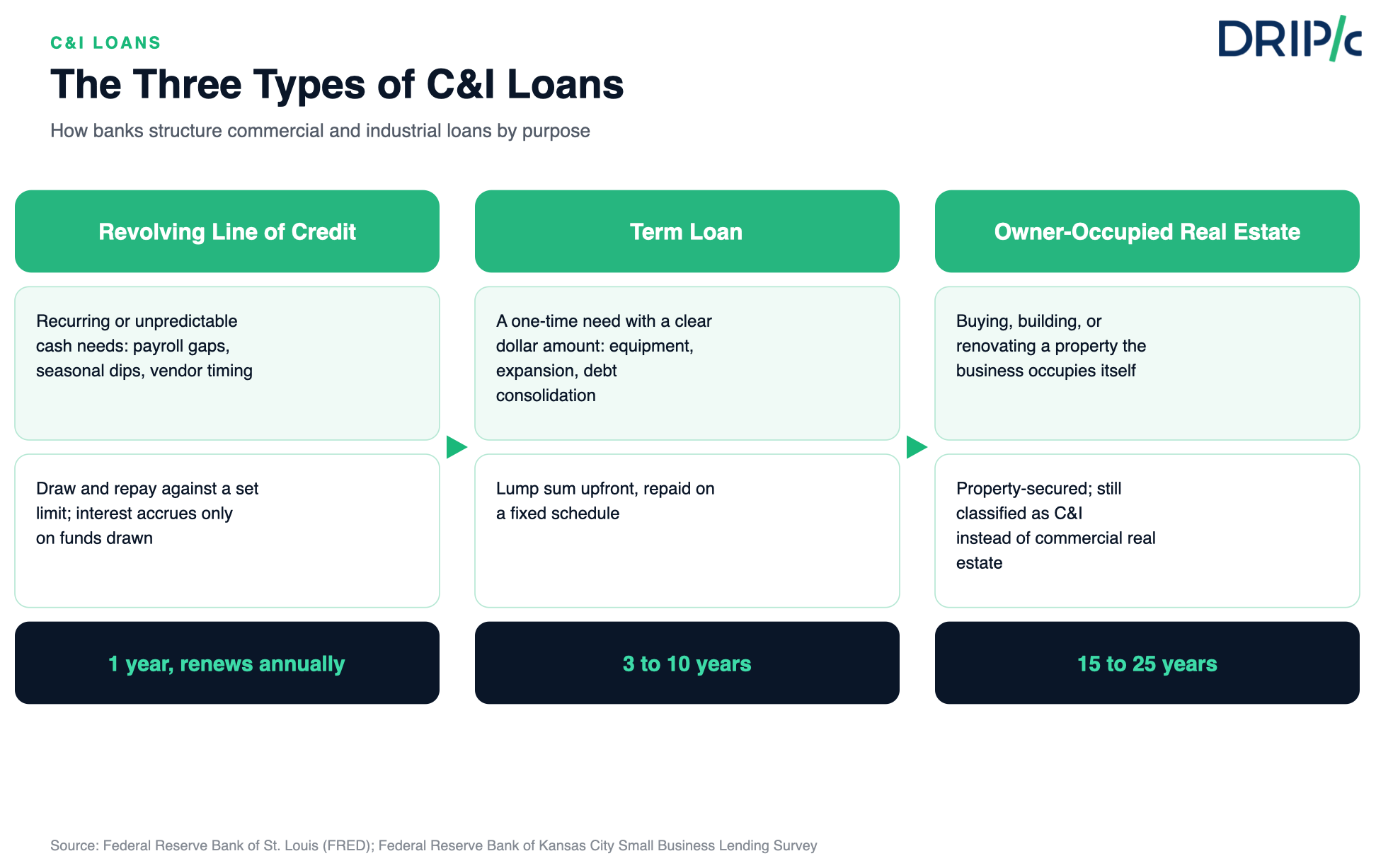
C&I loans are not one uniform product. Banks generally structure them into three broad forms, and which one a business ends up with depends on what the money is for and how long it will take to repay.
Revolving Line of Credit
A revolving line of credit lets a business draw funds up to a set limit, repay what it draws, and draw again, similar to a credit card but sized for business use. Interest accrues only on the balance drawn. This structure fits recurring or unpredictable cash needs: payroll gaps, seasonal dips, or the timing gap between paying vendors and collecting from customers. Terms typically run one year and renew annually.
Term Loan
A term loan delivers a lump sum upfront, repaid on a fixed schedule (usually monthly) over a set period, commonly three to ten years. This structure suits a one-time need with a clear dollar amount: buying a piece of equipment, funding a specific expansion project, or consolidating existing debt into one predictable payment. Because the loan amount and repayment schedule are fixed from day one, term loans are easier to budget around than a revolving facility, but they offer no flexibility to draw more later without a new application.
Owner-Occupied Real Estate
When a business buys, builds, or renovates a property it will occupy itself (a warehouse, an office, a manufacturing facility), the loan still falls under the C&I classification instead of commercial real estate, provided the business itself occupies most of the space. These loans usually carry longer amortization schedules, often 15 to 25 years, and the property itself typically serves as collateral. A bank underwriting this type looks closely at whether the business's operating cash flow can support the payment, not just the property's appraised value.

Qualification and Collateral: What Banks Actually Look At
Qualifying for a C&I loan comes down to a handful of factors every bank examines, even though the exact weighting differs from lender to lender.
Time in business. Banks want at least two to three years of financial statements showing consistent, verifiable revenue. A newer business faces a steeper climb.
Cash flow. Banks care less about top-line sales than how much cash the business generates after expenses and debt service, comparing that against existing and proposed payments.
Collateral. Equipment, inventory, receivables, and real estate all serve as collateral depending on the loan type. It does not guarantee approval, but it materially affects pricing: a well-secured loan generally prices lower.
Personal financial strength of the owners. For most small and midsize businesses, banks also review the owners' personal credit and finances, since many C&I loans to closely held businesses carry some form of owner guarantee.
Industry risk. A bank also weighs how exposed the borrower's industry is to disruption: commodity swings, tariff exposure, or a supply chain concentrated in one region.
Common Uses of C&I Loans
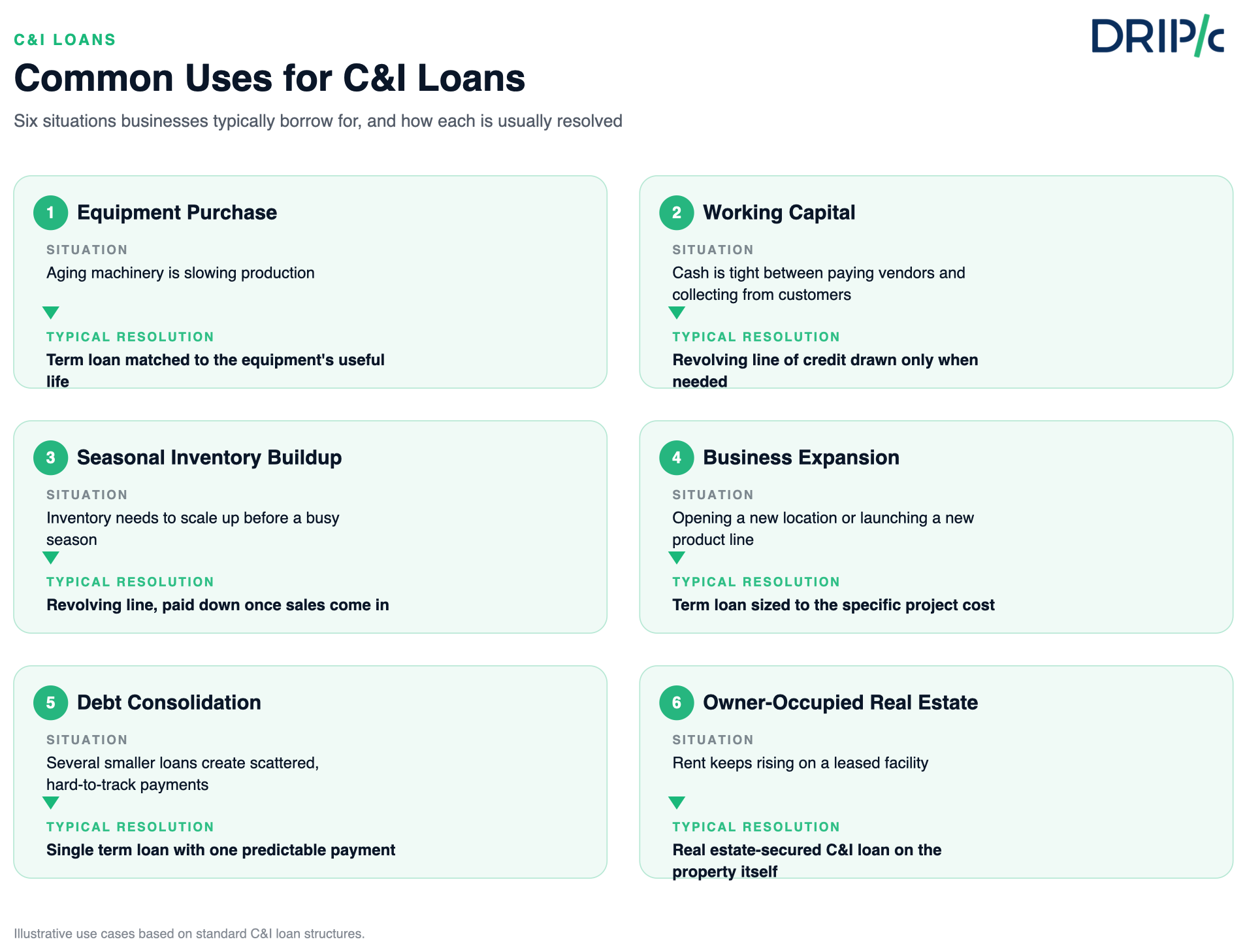
Businesses turn to C&I lending for a wide range of purposes, and the right structure usually follows from the purpose itself, as the cheat sheet below shows.
Why C&I Underwriting Has Tightened in 2026
Underwriting on C&I loans has stayed cautious through 2026. Trade-related disruptions, including new tariffs and longer shipping routes, have made the cash flow of businesses with meaningful trade exposure harder for a bank to read from the outside, which is part of why standards on trade-exposed borrowers have stayed tighter even as the broader lending trend has eased.
C&I Loans vs Other Business Financing
C&I loans sit alongside a few other categories worth knowing before shopping across lenders. A commercial real estate loan is made against a property the business does not occupy itself; an SBA-guaranteed loan is a government guarantee layered on top of what is still a C&I loan underneath, which loosens qualification requirements. Equipment finance and asset-based lending are narrower, tied to a single collateral type, while a C&I loan is typically underwritten against the business as a whole.
Where Drip Capital Fits
C&I loans work well for businesses that fit the profile banks underwrite for: several years of financial history, steady cash flow, and collateral a bank can lend against. A business whose finances move with a shipping schedule instead of a calendar quarter does not always clear that bar as cleanly.
Drip Capital works with businesses in that gap, particularly importers and exporters whose cash timing follows vendor payment terms and customer collection cycles. Vendor Financing pays a vendor directly on a transaction basis, is collateral-free, and is available to businesses with a minimum of two years in operation and $2 million or more in annual revenue. Drip Capital's Line of Credit offers a revolving facility sized to the business, with draws funded within 24 hours of a credit decision that typically takes about 48 hours.
For a business buying the building it operates out of, a bank's owner-occupied real estate structure is likely still the better fit. For a business whose working capital gap tracks its trade cycle, Drip Capital's underwriting is often a faster path to the same outcome a C&I loan is designed to solve.
Frequently Asked Questions
What Does C&I Stand For?
C&I stands for commercial and industrial. It is the classification banks and regulators use for business loans made for a commercial or industrial purpose, as distinct from consumer loans or loans secured mainly by residential real estate.
What Is C&I in Banking?
In banking, C&I refers to the broad category of loans made to businesses for business purposes, covering everything from working capital lines to equipment and real estate loans. It is a regulatory reporting classification, and the exact structure of a given C&I loan varies by purpose.
What Are C&I Loans?
C&I loans are commercial and industrial loans: credit extended to a business, secured or unsecured, for purposes like working capital, equipment, expansion, or owner-occupied real estate. Banks structure them as revolving lines of credit, term loans, or real estate loans depending on the use of funds.
How Long Does It Take to Get a C&I Loan?
A well-documented request from an established business can move from application to funding in a few weeks. Real estate-secured loans typically take longer for appraisal and title work.
Do C&I Loans Always Require Collateral?
Not always, but most do. Unsecured lines of credit exist for well-qualified borrowers, but most C&I loans, especially term loans and real estate loans, are secured by equipment, receivables, inventory, or property.