

Amazon Seller Financing helps businesses pay for inventory and operating expenses while they sell through Amazon. You can explore offers available through Amazon Lending or apply independently to a financing provider. The useful starting point is the amount you need, what it will pay for, and when your business can repay it.
For sellers using Fulfillment by Amazon, those questions include production, freight, fulfillment costs, and the timing of payouts. This guide explains how to assess Amazon FBA Financing around one inventory purchase and compare offers using your own numbers.
Photo by Luke Heibert on Unsplash.
How Amazon Lending Works
Amazon Lending connects eligible sellers with third-party financing providers. Its current US program page lists Term Loans, Merchant Cash Advances, and Lines of Credit. The options available to an individual business depend on eligibility and the provider's offer.
Start by checking for invitations in Seller Central. Review the proposed terms, then decide whether to authorize sharing your Amazon selling data. Amazon's process redirects applicants to the financing provider to complete the application. An invitation gives you an opportunity to apply; approval remains a separate decision.
Record the provider's legal name, product type, net proceeds, payment schedule, and permitted uses. Avoid assuming that two offers displayed through the same marketplace carry the same obligations.
Start With the Cash Your Order Needs
Build the Purchase Budget
List the vendor deposit, production balance, freight, duties, preparation, and delivery costs. Add the cash needed to keep the rest of the business running while this stock sells. Our Inventory Finance guide explains the broader procurement-to-payment cycle.
Separate committed costs from estimates. A vendor quote may leave out inspection, relabeling, or an additional transport leg. Ask who pays each charge and when it becomes due before deciding how much to borrow.
Estimate Net Proceeds per Unit
Use Amazon's Revenue Calculator to estimate relevant selling and fulfillment costs. Then add your own product cost, advertising allowance, expected returns, and financing cost. Review the assumptions for the specific item and fulfillment method.
A product with healthy sales can leave little cash for repayment. Test the contribution remaining after those expenses and compare it with your fixed operating costs.
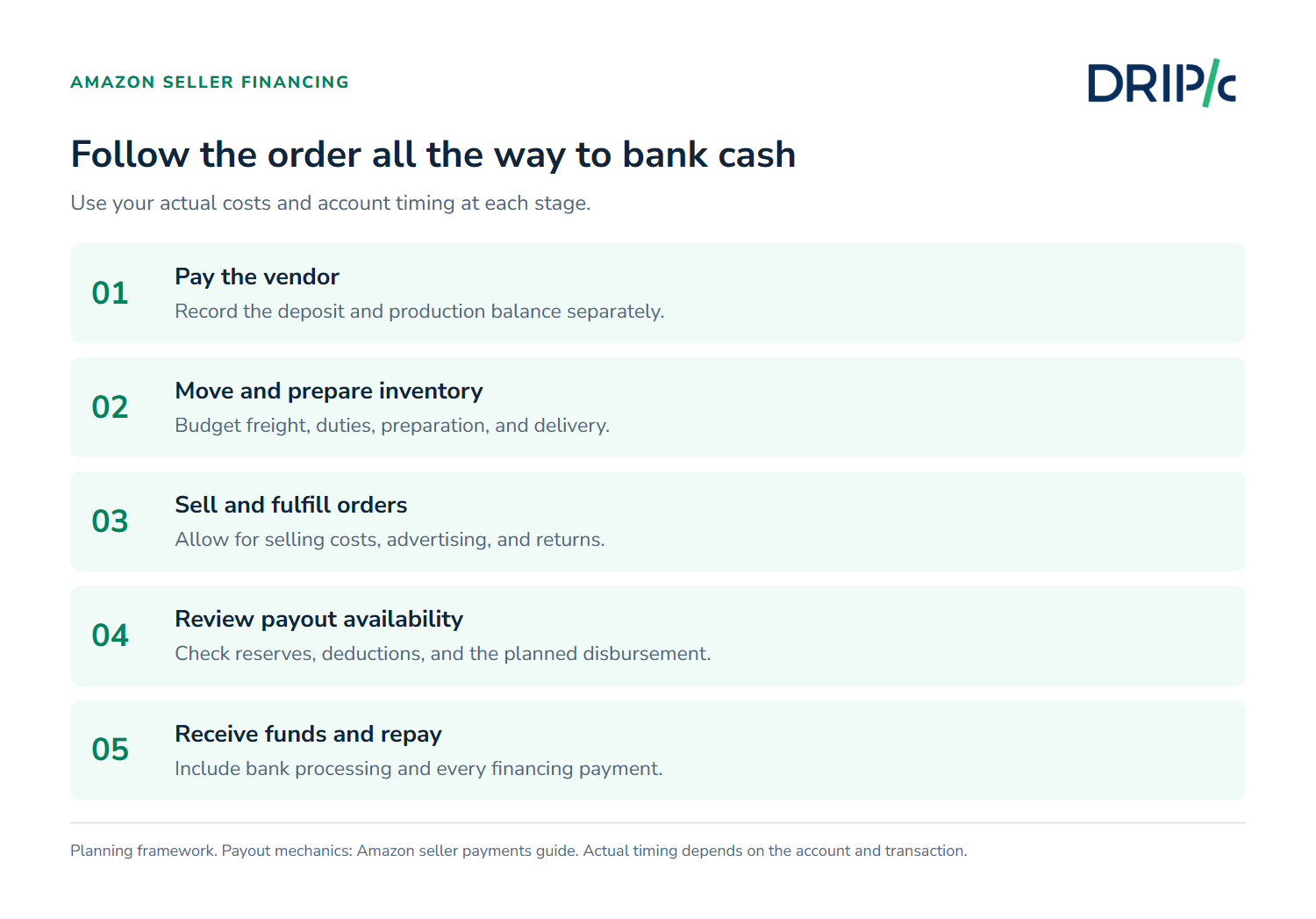
By the Numbers
Actual cash availability depends on the order and account. Build your forecast from your own Payments Dashboard and account conditions.
Match Financing to the Expense
A Defined Inventory Purchase
For a particular production run, compare the amount available with the payment milestones in the vendor's quote. Establish whether funding reaches your business or goes directly to the vendor. Confirm that the facility supports the intended purchase, country, and currency.
If you need background on financing structures, our ecommerce Inventory Financing article covers that broader subject. Here, keep the decision tied to the order you are actually placing.
Recurring Operating Expenses
A revolving facility can be useful for repeated expenses when drawings and repayments fit the business's cash flow. Compare how available credit is restored, whether each draw has its own schedule, and what happens when several draws overlap.
Our business financing options guide provides a wider comparison. For your shortlist, request an actual payment schedule for the amount you expect to use.

Sales-Based Payments
For an offer tied to sales, establish the percentage collected, the sales measure used, and any reconciliation or minimum-payment provisions. Read the agreement's treatment of slower sales and account interruptions. A fixed capital fee still represents a financing cost even when an offer has no stated interest rate.
Our Merchant Cash Advance guide explains the questions to ask about this structure. Use those questions to compare the cash left for your next inventory order after collections.
Compare Offers Against a Weekly Forecast
Calculate the Peak Shortfall
Consider a hypothetical seller with $30,000 available for a new product order after setting aside its operating reserve. Before the expected payout, the order requires a $20,000 deposit, a $40,000 production balance, and $10,000 in freight and preparation costs.
The planned outlay is $70,000, leaving a $40,000 funding gap. This calculation uses hypothetical figures. Place each payment in the week it falls due, then add financing charges and repayments. The largest cumulative shortfall determines the amount that needs coverage.
Do the calculation across your full business. Existing inventory, advertising bills, and another loan payment may compete for the same cash. Counting one expected payout against several commitments makes the forecast look safer than it is.
Test a Slower Sales Period
Move expected receipts back and reduce the number of units sold. Keep contractual payments on their original dates unless the agreement expressly changes them. Include the next reorder if you intend to maintain stock availability.
For example, repeat the forecast with sales receipts 25% below your plan. That percentage is a planning assumption, not an Amazon benchmark. Record the additional cash required and identify how you would cover it before accepting the offer.
Review Total Cost and Restrictions
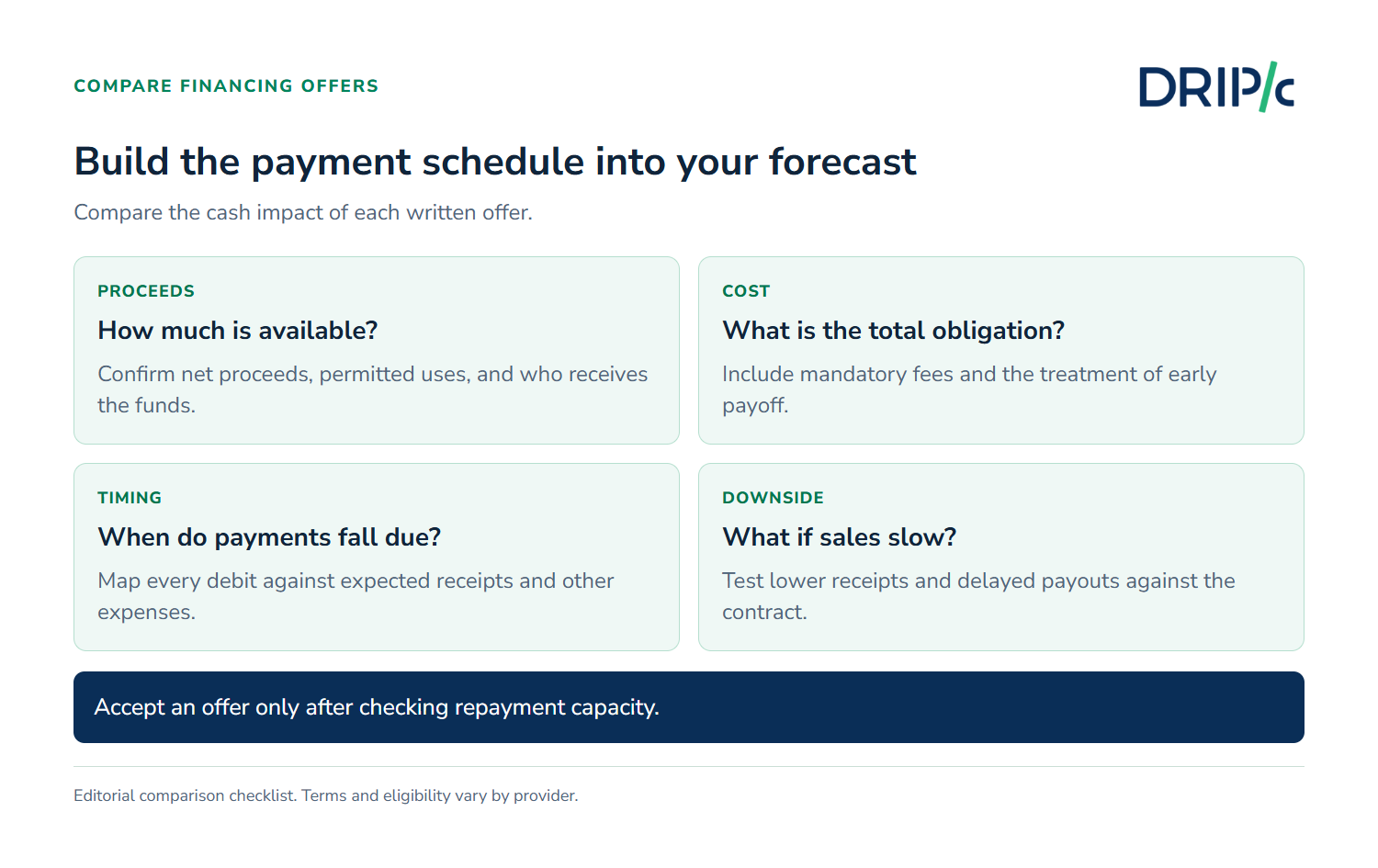
Ask for the net amount received, total scheduled payments, all mandatory charges, early-payoff treatment, and payment frequency. Convert the schedule into weekly cash outflows for your forecast, even when the contract collects monthly.
Also check collateral requirements, account-debit permissions, default provisions, and restrictions on additional borrowing. If two offers use different pricing measures, request a comparable explanation of cost. A fee percentage and an annual interest rate measure different things.
Prepare an Application That Matches Your Records
Good Funding for Amazon Sellers starts with reliable information about the business. Gather recent business bank statements, sales and settlement reports, inventory records, vendor quotes, existing financing schedules, and current financial statements. Ask the provider which periods and formats it needs.
Reconcile sales reports with bank deposits and explain material differences. Provide a clear account of the amount requested and how the purchase generates cash for repayment. Providers set their own documentation and eligibility requirements; a strong sales month alone does not establish approval.
Before taking on Amazon Seller Financing, assign someone to update the forecast, check payout changes, and track upcoming repayments. Review the purchase again if the vendor changes its delivery schedule or the expected margin falls.
Where Drip Capital Fits
If your business supplies Amazon directly, Drip Capital's Receivables Financing can help you access cash tied up in unpaid invoices issued to Amazon. Use the funds for your next inventory order, vendor payments, or operating expenses while Amazon pays on its agreed terms.
Amazon meets the buyer-size requirement for Receivables Financing, which serves businesses supplying buyers with more than $1 billion in annual revenue. Your business must still meet the applicable eligibility criteria, including US registration and at least $1 million in annual revenue, and undergo underwriting. Financing remains subject to approval and invoice eligibility. This applies to direct sales where Amazon is the invoiced buyer.
Frequently Asked Questions
Does Amazon Lend Directly to Every Seller?
Amazon's current program connects eligible sellers with third-party financing providers. Check your invitations and the named provider's terms in Seller Central. An invitation does not guarantee approval.
Is Amazon FBA Financing a Specific Loan?
Amazon FBA Financing is a descriptive term for financing used by businesses selling through Fulfillment by Amazon. The underlying product could have a fixed repayment schedule or another structure. Check the actual agreement and permitted uses.
How Much Should an Amazon Seller Borrow?
Calculate the largest shortfall in a weekly forecast that includes purchase costs, operating expenses, and repayments. Test slower sales and delayed receipts. The resulting amount still needs to fit the provider's eligibility and your capacity to repay.
Can a New Seller Get Financing?
Requirements vary by provider and product. Ask about minimum operating history, revenue, and documentation before applying. Avoid committing to a vendor payment based on an unapproved offer.