
What Is Asset-Based Lending? A 2026 Guide for US Businesses
A business with a warehouse full of inventory and a stack of unpaid invoices can look cash-poor on paper, even when it owns real, sellable value. Asset-based lending exists for exactly that mismatch. It is one of the oldest forms of commercial finance in the United States, and one of the least understood, because the underwriting logic runs opposite to what most owners expect from a bank.
What Is Asset-Based Lending?
Asset-based lending, often shortened to ABL loan, is a financing structure sized to the value of a business's collateral. An ABL lender calculates a "borrowing base": a percentage of eligible collateral value, usually accounts receivable and inventory, sometimes equipment or real estate, and leans on that figure ahead of cash flow, tax returns, or credit history.
That borrowing base is not set once and left alone. Lenders recalculate it on a recurring schedule, often monthly, using updated receivable agings and inventory reports the borrower submits. As the business's receivables and inventory rise and fall, so does the amount it can draw. A term loan version exists too, sized off a fixed collateral appraisal at closing, but the revolving structure is more common for working-capital needs.
What is asset-based lending in practice comes down to one idea: the collateral does the talking, and the lender keeps checking that the collateral is still there.
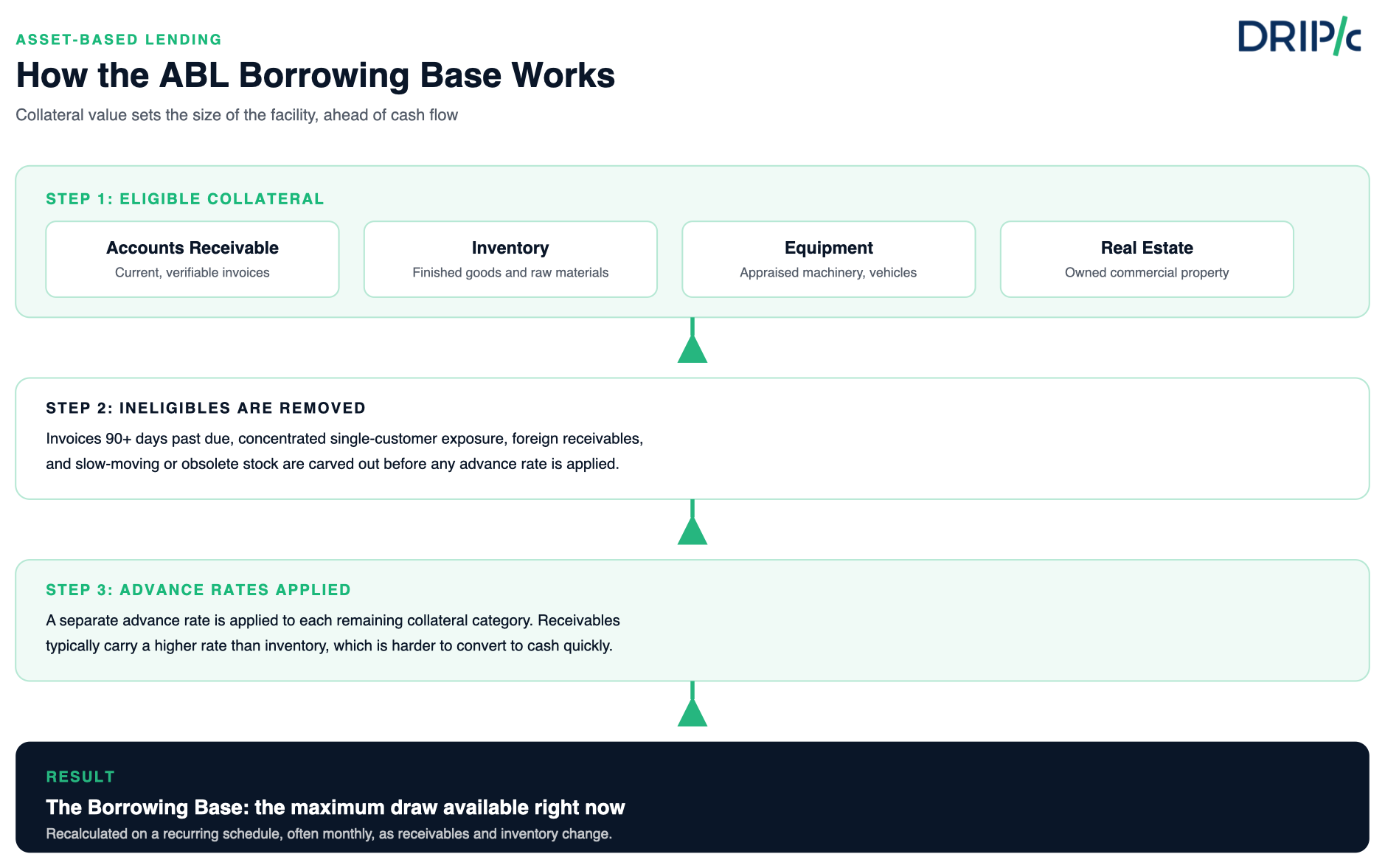
How the Borrowing Base Works
The mechanics are formulaic by design. A lender applies an advance rate to each collateral category: a higher rate against receivables that are current and owed by creditworthy customers, a lower rate against inventory, which is harder to convert to cash quickly and carries more valuation risk. Real estate and equipment can be included too, usually at conservative advance rates tied to an appraisal.
Certain receivables and inventory get excluded from the base entirely before any advance rate is applied. Invoices more than 90 days past due, concentrated exposure to a single customer, foreign receivables, and slow-moving or obsolete stock are common exclusions. Lenders call these carve-outs "ineligibles," and they shrink the base before the math even starts.
Ongoing monitoring is a core part of the deal. Expect a borrowing base certificate on a set schedule, periodic field exams where a lender's team physically verifies inventory and reviews receivable agings, and in some structures a lockbox that routes customer payments through an account the lender controls. None of this is punitive. It is simply how a lender that is underwriting collateral keeps its exposure current.
Who Asset-Based Lending Fits
This structure tends to suit businesses that are asset-rich relative to their reported cash flow: distributors carrying heavy inventory, manufacturers with long production cycles, importers financing large purchase orders, or fast-growing companies whose receivables are outpacing a bank's cash-flow model.
It also fits businesses coming out of a rough stretch. A company that took a loss two years ago, or is mid-turnaround, will often get declined by a lender underwriting primarily on trailing financials. If its receivables are current and its inventory is verifiable, that same company can still qualify for financing sized to what it actually owns. The collateral is real even when the income statement had a bad year.
Working-capital intensity is the common thread. A business whose growth is limited by how much inventory it can carry or how long it waits to get paid is a natural candidate, regardless of industry.
Asset-Based Lending vs Factoring
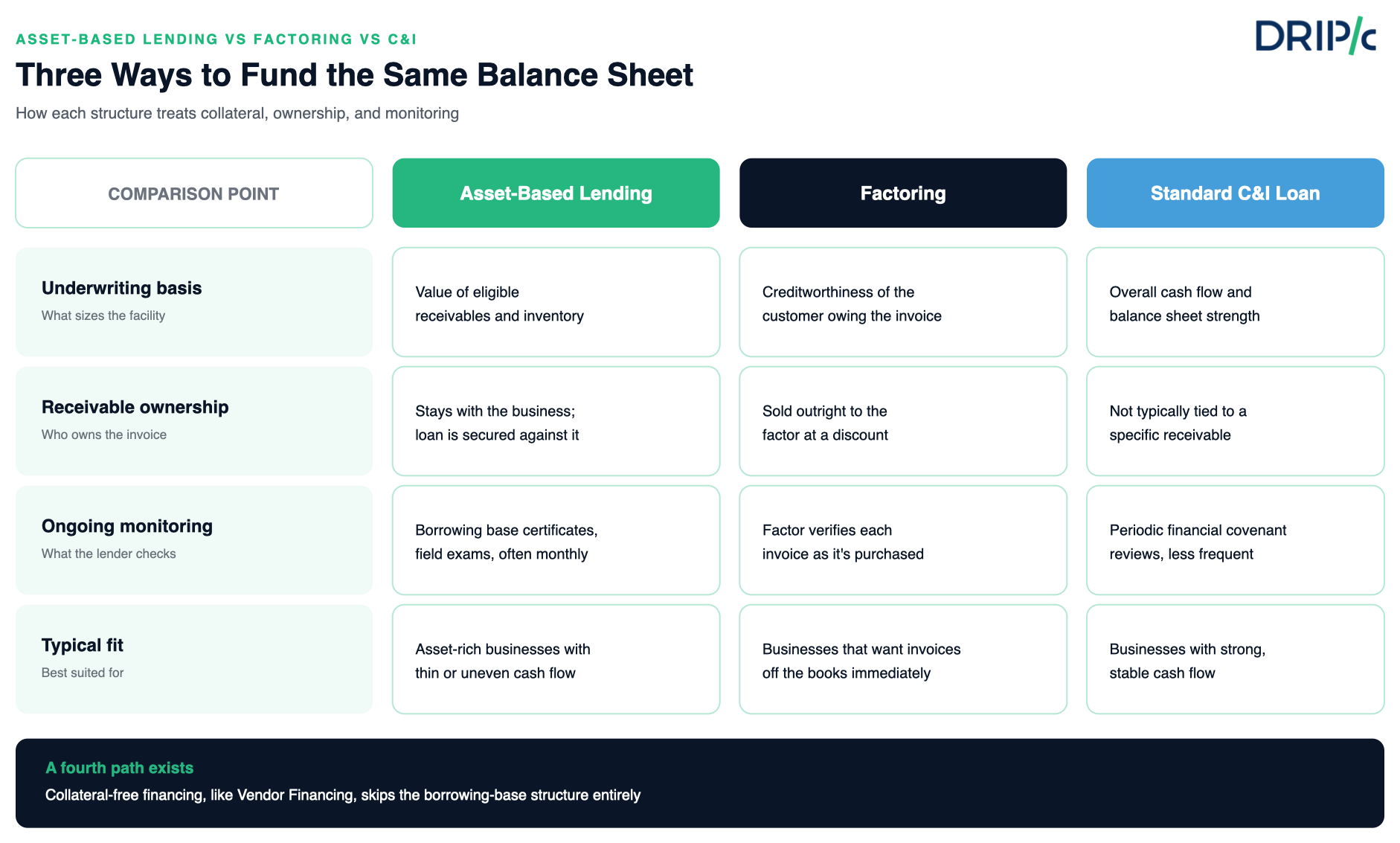
Asset based lending vs factoring is one of the most common points of confusion, and the distinction is worth stating plainly. In factoring, a business sells its receivables outright to a third party at a discount; the factor now owns those invoices and collects payment directly from the customer.
Asset-based lending works differently. The business retains ownership of its receivables and inventory and continues collecting payment itself. The lender extends a loan secured by that collateral; the business's balance sheet still carries the receivables as its own asset, with a loan sitting against them. Some ABL facilities do include a lockbox for payment control, which can feel similar to factoring on the surface, but legal ownership of the receivable stays with the business throughout.
Asset-Based Lending vs a Standard C&I Loan
A standard commercial and industrial loan underwrites primarily to the business's overall financial strength: cash flow, profitability trends, and balance sheet ratios, with collateral as secondary support if required at all. Asset-based lending flips that emphasis. Collateral value drives the facility size, and the ongoing monitoring described above (borrowing base certificates, field exams, sometimes a lockbox) replaces much of the covenant testing a cash-flow lender relies on.
Neither structure is better in the abstract. A business with strong, stable cash flow usually gets a better outcome from a standard loan. A business whose story is better told by its receivables and inventory is often better served by a facility that reads its balance sheet as it actually is.

What Asset-Based Lending Costs
Asset-based lending rates are not a single published number the way a credit card APR is. Pricing on an ABL facility depends on facility size, the collateral mix, how liquid that collateral is, and the monitoring intensity a lender requires, so two businesses in the same industry can see meaningfully different terms. What's consistent is the pricing shape: a base rate plus a spread, alongside monitoring costs such as field exam fees that a pure cash-flow loan would not carry.
That variation is worth naming honestly instead of papering over it with an invented average. A business evaluating an asset based loan should request quotes and compare the full cost picture, since the borrowing-base mechanics themselves (advance rates, ineligibles, exam frequency) shape total cost as much as the interest rate does.
By the numbers
Collateral and financing access in 2026
51%
of small businesses with debt secured it
using business assets as collateral
42%
of financing applicants got the full amount
sought; 22% received none of it
Source: Federal Reserve, 2026 Report on Employer Firms (2025 Small Business Credit Survey)
Where Drip Capital Fits
The collateral-monitoring structure at the center of asset-based lending isn't the only path to working capital, and it isn't always the right fit for a business that needs speed over a large, asset-heavy facility. Vendor Financing takes a different approach entirely: Drip Capital pays the vendor directly on the buyer's behalf, and the facility is collateral-free, with no borrowing base, no field exams, and no monthly certificate to file. It's built for businesses with a minimum of two years in business and $2M+ in annual revenue, with repayment due up to 90 days later.
For businesses that want a revolving facility without the ongoing collateral monitoring an ABL structure requires, Drip Capital's Line of Credit runs from $50,000 to $1 million, with a credit decision typically within 48 hours and draws funded within 24 hours. There's no prepayment penalty, no annual maintenance fee, and no blanket lien or UCC filing unless the account goes into default. Both products still weigh the strength of the underlying deal and vendor relationship more than a straight ABL lender would, without asking a business to hand over a lockbox or submit to a recurring field exam.
Frequently Asked Questions
What is asset-based lending?
Asset-based lending is a financing structure, usually a revolving facility, sized to a percentage of a business's eligible collateral value: typically accounts receivable and inventory, sometimes equipment or real estate. The lender recalculates that borrowing base on a recurring schedule and weights it well above cash flow.
Is asset-based lending the same as factoring?
No. In factoring, a business sells its receivables outright at a discount, and the factor collects payment directly. In asset-based lending, the business keeps ownership of its receivables and inventory and takes out a loan secured by them, collecting payment itself.
What qualifies as collateral for an ABL loan?
Accounts receivable and inventory are the most common collateral categories for an ABL loan, with equipment and real estate sometimes included. Lenders apply different advance rates to each category and exclude certain receivables and inventory (past-due invoices, concentrated customer exposure, obsolete stock) as ineligible before calculating the borrowing base.
How is the borrowing base calculated?
A lender applies an advance rate to each eligible collateral category after removing ineligibles, then totals the result to set the maximum the business can draw. Because receivables and inventory levels change, the base is recalculated periodically, often monthly, using updated reports the borrower submits.
Is asset-based lending expensive?
Asset-based lending rates vary by facility size, collateral mix, and monitoring requirements, so there's no single typical figure. Total cost includes the interest rate plus monitoring-related fees like field exams, so comparing full facility terms matters more than comparing headline rates.