
What Is a Commercial Invoice?
A commercial invoice is the foundational document of international trade. It is a legally binding record of a transaction between a seller and a buyer - one that travels with every commercial shipment crossing an international border and serves as the primary document customs authorities use to assess duties, taxes, and import eligibility.
In the United States, the commercial invoice is a mandatory requirement for import clearance under 19 CFR § 141.83, administered by US Customs and Border Protection (CBP). Without a complete and accurate commercial invoice, goods cannot clear customs - and incomplete or incorrect invoices are among the most common causes of shipment holds, additional duties, and financial penalties.
Despite how central this document is to cross-border trade, there is widespread confusion about what it actually needs to contain, how it differs from similar documents, and what CBP can and cannot do when it finds errors. This guide covers all of it.
Commercial Invoice vs Pro Forma Invoice vs Packing List
These three documents are frequently confused - sometimes used interchangeably by mistake. They are not the same thing and serve distinct purposes at different stages of a transaction.
A pro forma invoice is issued before a shipment. It is a quotation in invoice format: a preliminary document that outlines the goods, quantities, prices, and terms being offered. Buyers use it to apply for import licenses, open letters of credit, and arrange payment. It is not a legal record of a completed transaction and is not accepted by CBP in place of a commercial invoice (except in specific circumstances outlined in 19 CFR § 141.85).
A commercial invoice is issued at the time of shipment. It is the final, binding record of the transaction: confirming the goods actually shipped, the price actually paid, and the terms actually agreed upon. This is the document CBP requires for customs clearance.
A packing list is a physical inventory of the shipment's contents: how many packages, what is in each, net and gross weights, dimensions. It does not include pricing or transaction value. It accompanies the commercial invoice but does not replace it - CBP officers may use both documents together to verify that what was declared matches what was shipped.
Who Needs a Commercial Invoice?
Any business or individual importing commercial goods into the United States needs a commercial invoice. This applies regardless of company size, industry, or mode of transport (air, ocean, or land).
There are limited exemptions: 19 CFR § 141.83(d) lists specific categories of merchandise that do not require a commercial invoice, including goods imported for personal use (not for resale), merchandise returned to the US after being exported for repairs, and certain low-value informal entries. For all other commercial shipments, the commercial invoice is non-negotiable.
On the export side, a commercial invoice is equally essential. For US businesses engaged in cross-border trade, the buyer's country uses the document to assess import duties and verify compliance with their own customs regulations. Requirements vary by destination country, but the US commercial invoice format (meeting CBP standards) is accepted as-is by most countries, provided all required fields are present.
What Are the Mandatory Fields on a US Commercial Invoice?
The mandatory content requirements for a US commercial invoice are defined in 19 CFR § 141.86. The regulation specifies 11 categories of required information.
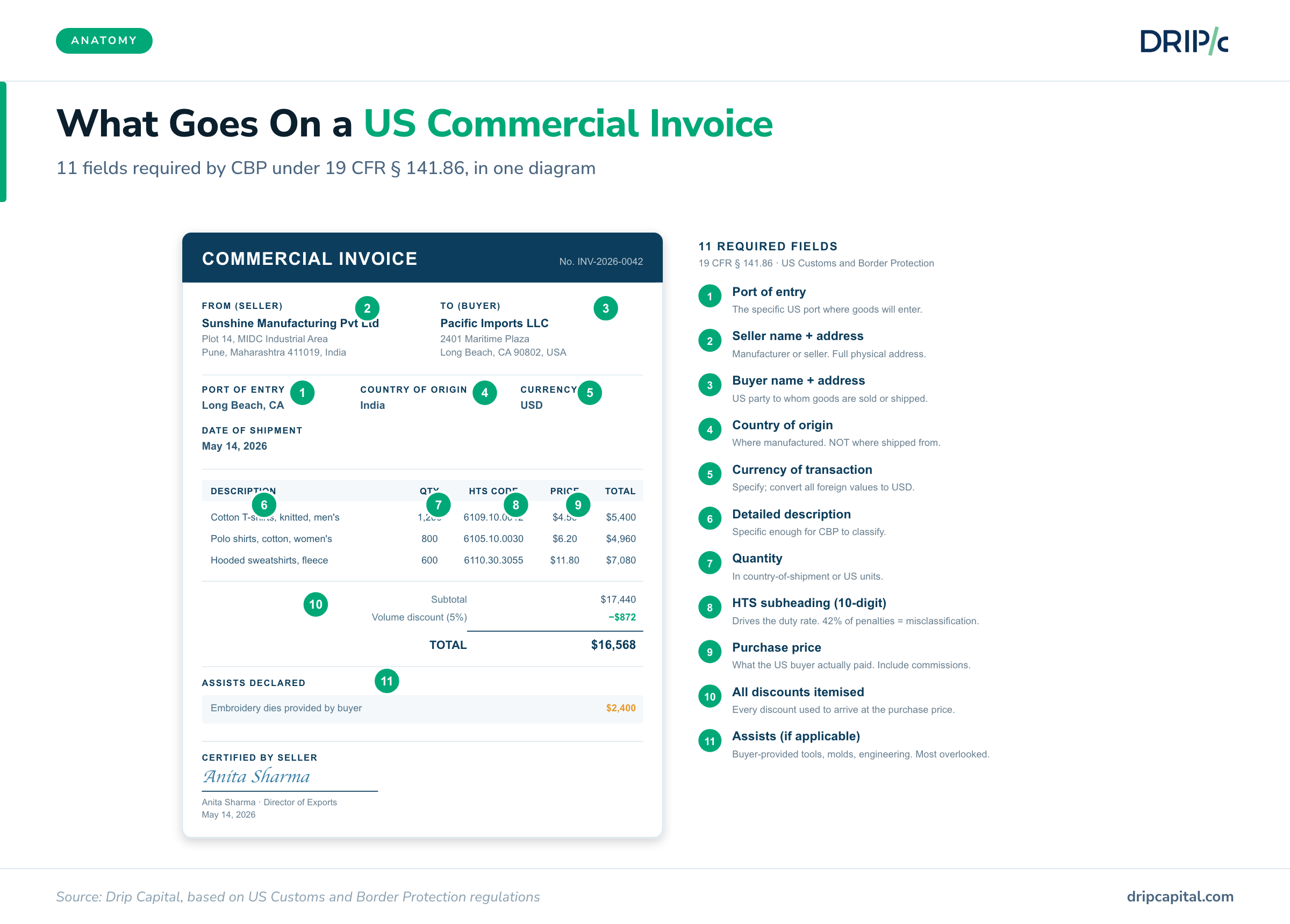
Below is a field-by-field breakdown with notes on what trips up importers most often.
| Field | Mandatory | Notes |
|---|---|---|
| Port of entry | Yes | The specific US port where goods will enter customs. |
| Seller name and address | Yes | The party responsible for invoicing, ordinarily the manufacturer or seller. |
| Buyer name and address | Yes | The party in the US to whom goods are sold or shipped. |
| Detailed merchandise description | Yes | Must include name, grade or quality, marks, numbers, and symbols under which the item is sold in the country of export. |
| Quantity | Yes | In weights and measures of the country of shipment or of the United States. |
| Purchase price | Yes | In the currency of the purchase. Must reflect what the US buyer actually paid, not the intended retail price. |
| Currency of transaction | Yes | Must be specified. All foreign currency values must be converted to US dollars. |
| Country of origin | Yes | Where the goods were manufactured or produced. NOT where they were shipped from. |
| All discounts | Yes | Every discount applied in arriving at the purchase price must be itemized. |
| HTS subheading | Yes (10-digit) | The Harmonized Tariff Schedule of the United States classification code for each line item. |
| Assists | Yes (if applicable) | Any goods or services provided free or at reduced cost by the buyer to help produce the merchandise (dies, molds, tools, engineering work) not included in the invoice price. |
A note on three fields that most frequently cause problems:
Purchase price and declared value: According to CBP, the value on a commercial invoice must be the price the US buyer paid for the goods, not the intended retail price. It must also include selling commissions, assists, royalties, production costs, and packing costs. Failure to include these constitutes undervaluation and can result in penalties.
HTS code: The Harmonized Tariff Schedule code determines the duty rate applied to your goods. Most SMBs either omit it entirely or use an incorrect classification. A wrong HTS code can result in the wrong duty rate being applied - sometimes higher than what is actually owed, sometimes lower (which triggers a supplemental duty bill after the fact). If you are unsure of the correct code, CBP will assist on request.
Assists: This is the most overlooked field on a commercial invoice. If your buyer provided materials, tooling, molds, or engineering work that helped produce the goods, and those costs are not included in the invoice price, they must be declared separately. Most SMB importers working with overseas manufacturers are unaware of this requirement.
Little-Known Facts About Commercial Invoices in the US
There is no government-mandated template. This surprises most importers. According to the Federal Register, CBP deliberately chose not to develop a specific form for the commercial invoice. Importers are allowed to use their own existing invoices to comply with the regulations, provided all required fields under 19 CFR § 141.86 are present. What is mandated is the content - not the format, layout, or appearance of the document.
If goods are sold while in transit, two invoices are required. Per 19 CFR § 141.86, if merchandise is sold while in transit from the port of exportation to the port of entry, both the original invoice and the resale invoice must be filed as part of the entry documentation. This catches importers who purchase goods from intermediaries or trading companies rather than manufacturers directly.
CBP can assess the value itself if none is declared. Per CBP guidance, if no value is provided on the commercial invoice, CBP will assess it independently. The assessed value is rarely in the importer's favor.
Misclassification is the single most common cause of CBP penalties. According to CBP enforcement data, misclassification of goods accounts for 42% of all CBP customs penalties - making an incorrect HTS code the most costly mistake an importer can make on a commercial invoice.
Some commodities require additional invoice information. 19 CFR § 141.89 contains a long list of product categories that require special information on the commercial invoice beyond the standard 11 fields - everything from ball bearings to textiles to certain food products. Importers should verify whether their commodity falls under this section before preparing their first shipment.
Common Mistakes That Cause Customs Delays
Most commercial invoice errors fall into a handful of recurring patterns. These are the ones CBP flags most frequently.
Vague merchandise descriptions. "Electronic parts," "clothing," or "hardware" are not adequate descriptions under 19 CFR § 141.86. The description must be specific enough for CBP to classify the goods and assess duties accurately. If your description could apply to a hundred different products, it is not specific enough.
Incorrect or missing HTS codes. Either the code is omitted entirely, or the wrong subheading is used. Both create problems - a missing code delays clearance, while an incorrect code can result in the wrong duty rate being applied or a compliance flag being raised. 42% of all CBP customs penalties stem from misclassification, making this the highest-risk field on any commercial invoice.
Undervaluing goods. Declaring a lower value than what was actually paid - whether intentionally or because assists and commissions were not included - constitutes a customs violation. Penalties range from additional duty assessments to seizure of goods, depending on the severity.
Country of origin errors. The country of origin is where goods were manufactured, not where they were shipped from. A product shipped from a Singapore warehouse but manufactured in Vietnam must declare Vietnam as the country of origin. Misdeclaration of origin (particularly for goods subject to anti-dumping duties or country-specific tariff rates) is treated seriously by CBP.
Currency not specified. If the invoice lists a price without specifying the currency, CBP cannot determine the correct US dollar value for duty assessment. All foreign currency amounts must also be converted to USD on the invoice.
Missing seller signature or declaration. While CBP does not require a wet signature in all cases, the invoice must be prepared and certified by the seller or their agent. Unsigned or uncertified invoices can be flagged for additional review.
Best Practices for Preparing a Commercial Invoice
Prepare it before the shipment moves. The commercial invoice should be completed and reviewed before goods leave the country of export, not assembled in a hurry at the port. Errors discovered after a shipment is in transit are harder and more expensive to correct.
Use a consistent invoice numbering system. CBP regulations require invoices to be numbered - and when an entry covers multiple invoices, they must be paginated consecutively. Establishing a systematic numbering format (date plus sequential number, for example) prevents confusion and makes recordkeeping cleaner.
Work with your supplier on accuracy. For US importers buying from overseas manufacturers, the commercial invoice is typically prepared by the seller. Make sure your supplier understands exactly what US CBP requires, particularly on the declared value, assists, and HTS code fields. A supplier unfamiliar with US requirements can create compliance problems for the importer.
Verify the HTS code before every new product. HTS codes are product-specific and can change. Before importing a new product category, verify the correct 10-digit HTS subheading using the USITC HTS search tool. Do not rely on codes used for similar products or codes provided informally by freight forwarders.
Keep copies of every commercial invoice for at least five years. CBP can audit import records up to five years after entry. Maintaining complete, accurate invoice records is both a legal requirement and protection against post-entry audits.
Consider working with a licensed customs broker for complex shipments. For high-value, high-volume, or commodity-specific shipments (particularly those falling under 19 CFR § 141.89 special requirements), a licensed customs broker can review the commercial invoice before submission and flag potential compliance issues before they become holds or penalties.
At Drip Capital, we work with small and mid-size businesses across the United States that are engaged in cross-border trade: importing goods, building supplier relationships, and navigating the documentation, compliance, and cash flow realities that come with it. If you are a small business involved in importing or exporting and want to learn more about how Drip Capital supports businesses like yours with working capital solutions and vendor financing built specifically for cross-border trade, visit us at dripcapital.com.
Frequently Asked Questions
What is a commercial invoice?
A commercial invoice is a legally binding document issued by a seller to a buyer that records the details of a commercial transaction involving the sale and shipment of goods across an international border. It is required by US Customs and Border Protection for import clearance and is used to assess duties, taxes, and import eligibility.
Is there an official US government commercial invoice form?
No. CBP deliberately chose not to create a standard government form for the commercial invoice. Importers may use their own invoice format, provided it contains all mandatory fields specified in 19 CFR § 141.86. What is mandated is the content - not the format or appearance of the document.
What is the difference between a commercial invoice and a customs invoice?
The terms are often used interchangeably. A customs invoice typically refers to a commercial invoice prepared specifically to meet the customs requirements of the importing country. In the US context, a CBP-compliant commercial invoice and a customs invoice are the same document.
What happens if my commercial invoice is incomplete or incorrect?
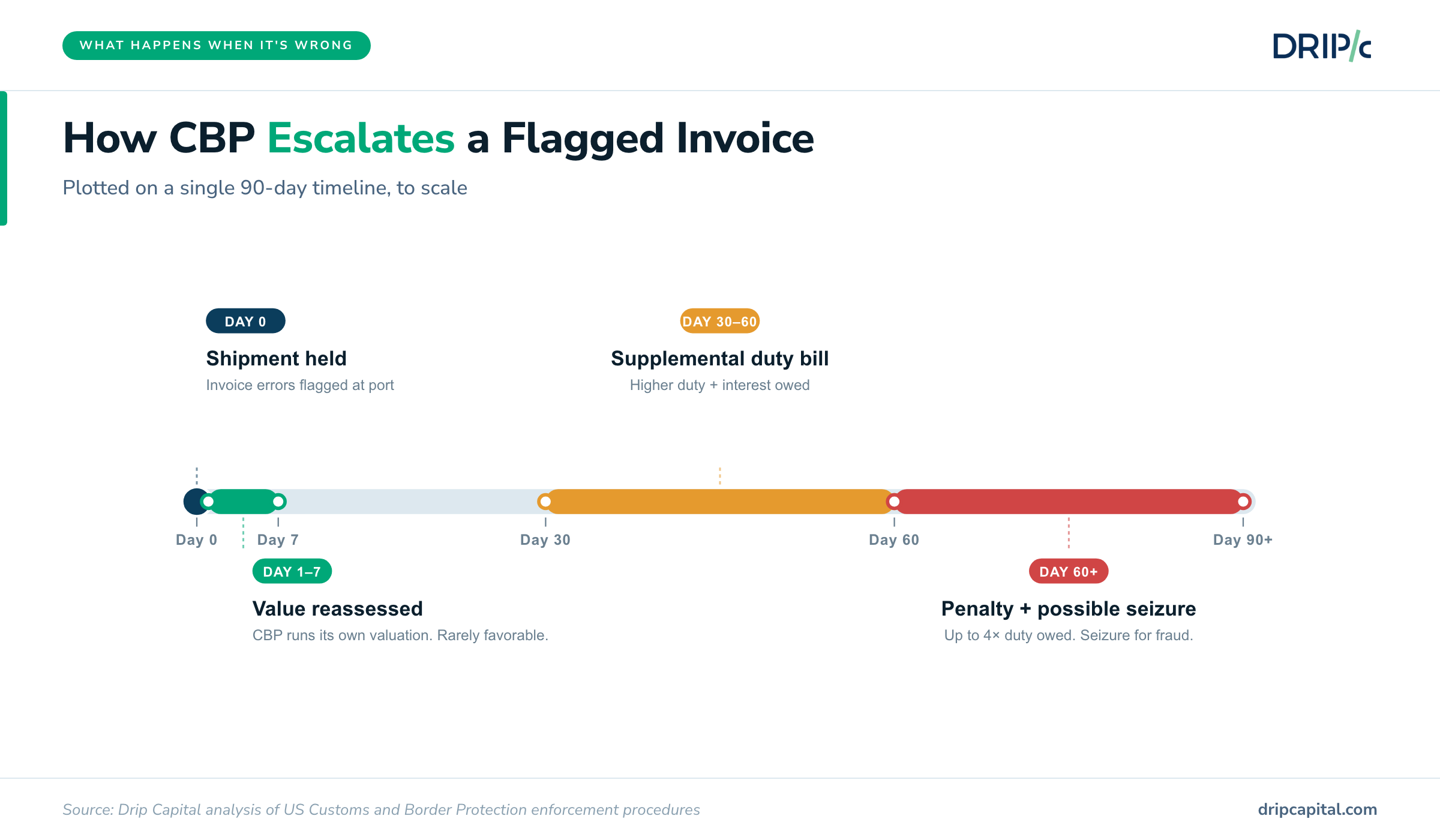
CBP may hold the shipment for additional examination, assess duties based on its own valuation (which is rarely in the importer's favor), issue a supplemental duty bill, or impose penalties. In cases of deliberate misrepresentation (particularly undervaluation or country of origin fraud), CBP can seize the goods entirely.
Does a commercial invoice need to be signed?
A commercial invoice must be prepared and certified by the seller or their authorized agent. While a wet signature is not always required, the document must be attributable to the seller. Electronic invoices are accepted by CBP provided they contain all information required under 19 CFR § 141.86.
What is an HTS code and why does it matter on a commercial invoice?
The Harmonized Tariff Schedule (HTS) code is a 10-digit classification number that identifies the type of goods being imported and determines the applicable duty rate. It is a mandatory field on a US commercial invoice. An incorrect or missing HTS code can delay clearance and result in the wrong duty rate being applied to your shipment. Misclassification accounts for 42% of all CBP customs penalties.
Can I use the same commercial invoice format for all countries?
A US CBP-compliant commercial invoice is accepted by most countries. However, some countries require additional fields, specific languages, or particular formatting. Before shipping to a new destination country, verify their specific commercial invoice requirements with the buyer or a licensed freight forwarder.
What is the difference between a commercial invoice and a pro forma invoice?
A pro forma invoice is a preliminary quotation issued before shipment - used for planning, payment arrangement, and import licensing purposes. A commercial invoice is the final legal record of the transaction, issued at the time of shipment, and is the document required by CBP for customs clearance.