Photo: Albert Stoynov / Unsplash.
Export financing gives US exporters cash to fill a foreign order before they ship, or turns foreign invoices into cash before the buyer pays. The seven main options are EXIM's working capital guarantee, export credit insurance, SBA export loans, letters of credit, export factoring, pre-shipment and purchase order financing, and forfaiting. The right mix depends on whether your cash is stuck before or after shipment.
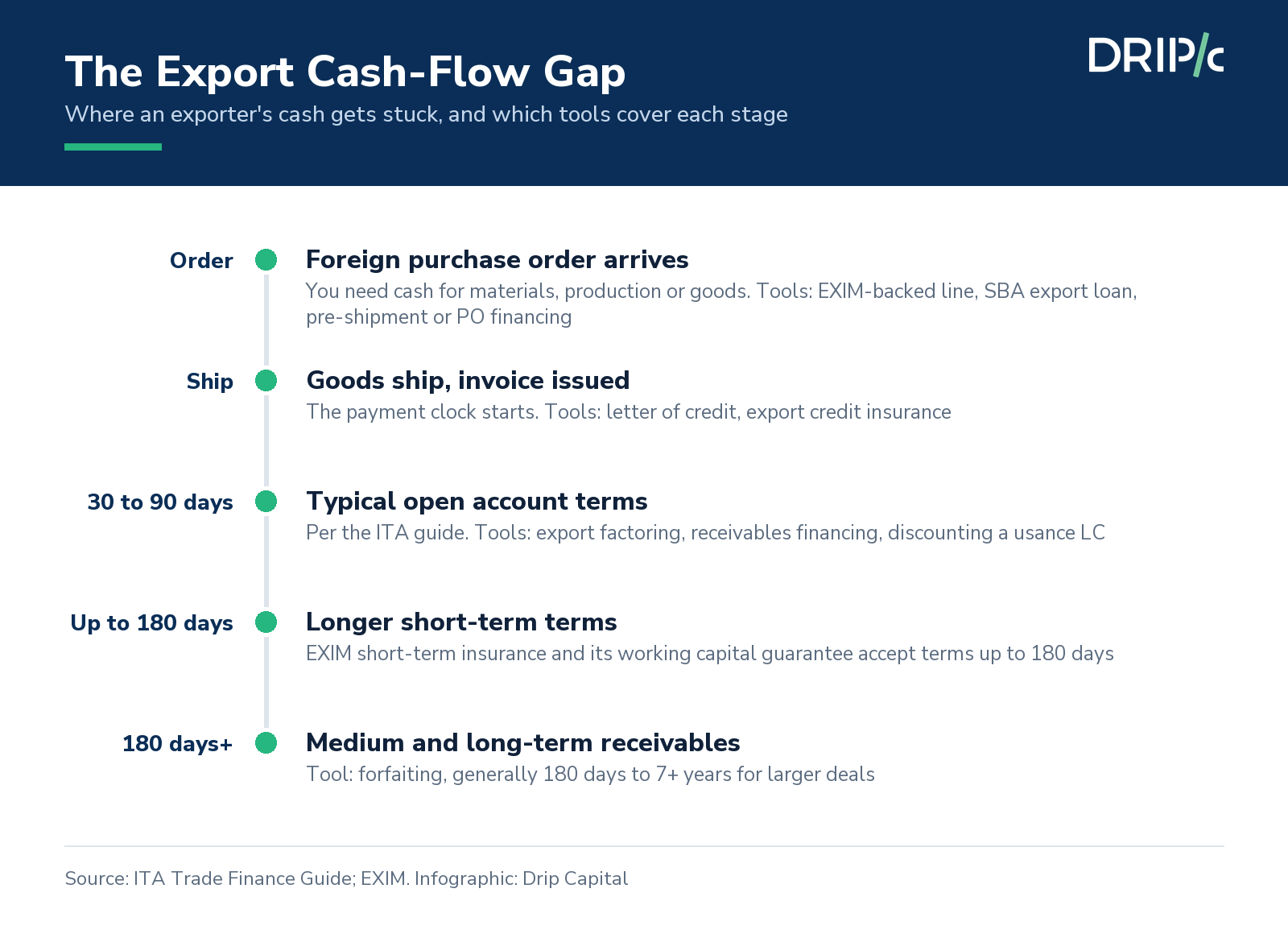
The gap is real. Under open account terms, payment is typically made in 30, 60 or 90 days, according to the International Trade Administration's Trade Finance Guide. Meanwhile you still pay vendors, staff and freight. This guide compares the main export financing options for 2026 with their costs, limits and best uses.
Export Financing: 7 Ways US Exporters Get Paid Faster
Export finance falls into two groups. Pre-shipment tools pay for materials, production or finished goods before the order leaves. Post-shipment tools turn a foreign receivable into cash, or protect it if the buyer doesn't pay. Many exporters combine one of each.
Most US exporters are small. Of 271,250 identified exporters in 2024, 97.1% were small and medium-sized companies, which Census defines as fewer than 500 employees plus firms with missing employment data, according to the Census exporter profile released in May 2026. They accounted for 32.1% of known export value, and 60.0% of all exporters shipped to only one country. If you are one of them, a 60- or 90-day payment term on a large order can tie up cash you need for the next one.
1. EXIM Working Capital Loan Guarantee
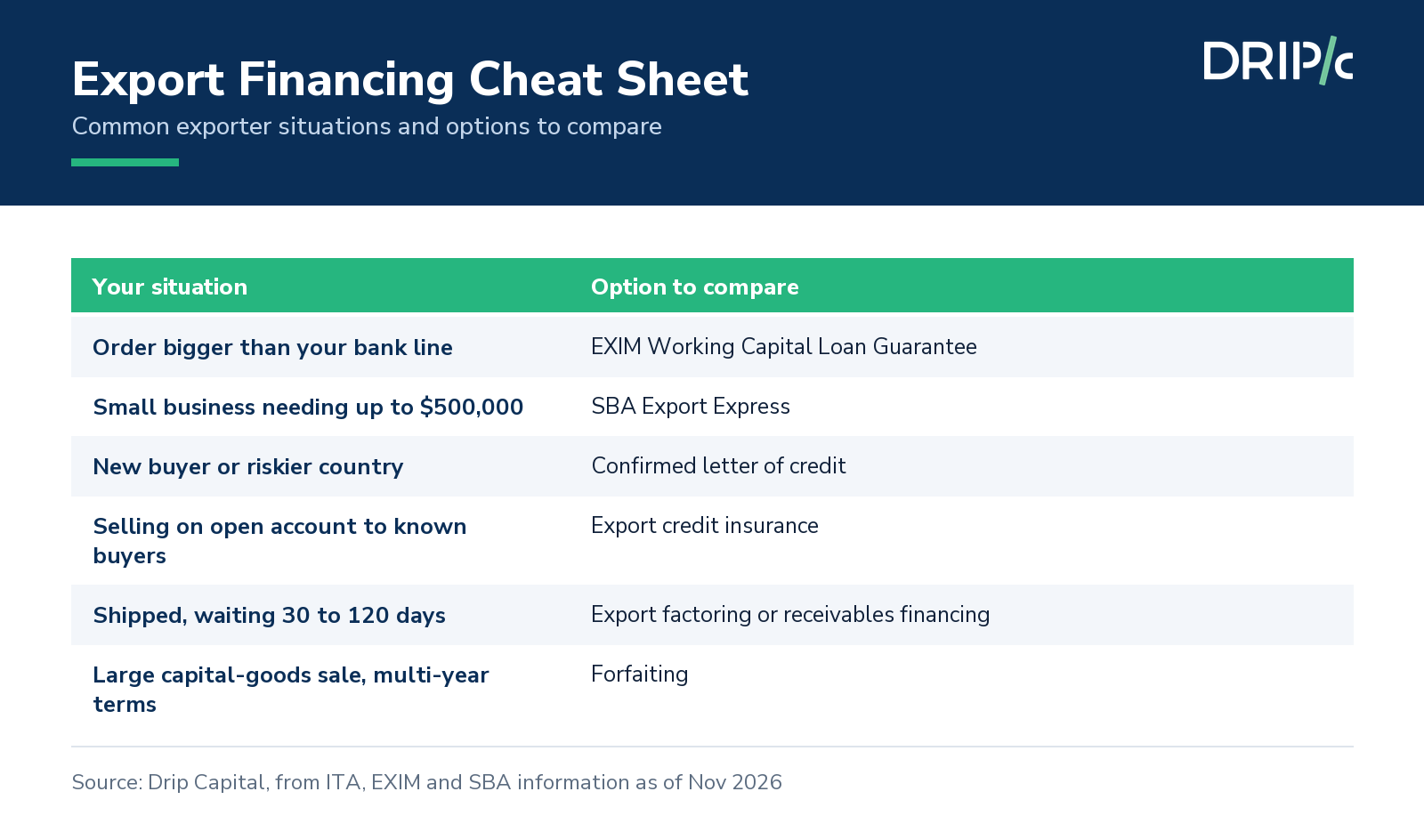
EXIM doesn't lend directly for working capital (see our EXIM Bank guide). Instead, it guarantees 90% of a loan your bank or finance company makes, so the lender can advance more against export-related inventory and foreign receivables than it normally would. EXIM's program allows advances of up to 75% on export inventory and up to 90% on eligible foreign receivables. EXIM's Export Finance Solutions Guide lists fees of 0.25% to 1.10% a year, on top of the lender's interest. EXIM's working capital page says the minimum US content requirement is just 10%. This is the classic source of export working capital for companies with a bank relationship.
Best for: exporters whose orders are bigger than their current credit line.
2. Export Credit Insurance
Export credit insurance protects against covered foreign-buyer nonpayment. EXIM offers coverage of up to 95% of sales invoices. Its Small Business Multi-Buyer policy comparison lists private-buyer premiums of $0.55 per $100 for terms of one to 60 days, $0.90 for 61 to 120 days, and $1.15 for 121 to 180 days. At the listed 90-day rate, a $100,000 invoice has a $900 premium. Other policies and buyers have different pricing.
Insurance provides protection against covered losses, subject to the policy’s terms and claims process. It does not itself advance the invoice value. A lender may separately agree to finance insured receivables.
3. SBA Export Loans
The SBA guarantees export loans made by participating lenders. Its export-program overview lists Export Express loans of up to $500,000, and Export Working Capital and International Trade loans of up to $5 million. You can apply for Export Working Capital before finalizing an export sale. Approval and funding timing depend on the lender and application. Our US export guide provides context on export markets.
Check current ownership eligibility before applying. GAO’s account of the March 2026 SBA changes describes the requirement that all direct and indirect owners be US citizens or US nationals with their principal residence in the US, its territories or possessions. Ask the lender to confirm the rules that apply to your ownership structure and application.
4. Letters of Credit
A Letter of Credit is a bank commitment to pay against documents that comply with its terms. Confirmation adds another bank’s payment commitment and can reduce exposure to the issuing bank and its country. Documentary conditions still matter. A deferred-payment Letter of Credit may be discounted to obtain cash sooner, if a bank agrees. Read our Letter of Credit guide.
Letters of credit protect you at the point of shipment. The next three options focus on getting cash for goods you have already shipped or are about to produce.
5. Export Factoring and Receivables Financing
Export factoring involves selling foreign receivables to a factor. Other Receivables Financing structures may lend against them. ITA’s Trade Finance Guide describes factoring as a package that can include funding, collection and credit protection. Check the advance, reserve, fees and which nonpayment risks the factor accepts. Even a non-recourse arrangement can leave you responsible for disputes or failures to perform.
Best for: exporters paid in 30 to 120 days who want cash now.
6. Pre-Shipment and Purchase Order Financing
Pre-shipment finance covers agreed materials, production or finished-goods costs before shipment. Purchase Order Financing is one approach. Ask which costs the provider funds and how repayment works if the buyer pays late. Our pre-shipment financing guide explains the stage in more detail.
7. Forfaiting
Forfaiting involves selling medium- or long-term foreign receivables at a discount on a non-recourse basis. ITA describes terms commonly running from 180 days to seven years or more, often supported by a bank guarantee. It can fit capital-goods sales with extended payment terms. The exporter receives the agreed discounted proceeds; financing the full receivable does not mean receiving its face value without deductions. Read more about Forfaiting.
How to Choose the Right Export Financing
Start with where your cash is stuck. If you need money before you ship, compare an EXIM-backed bank line, SBA export loans and pre-shipment finance. If you have shipped and are waiting to be paid, compare factoring, discounted letters of credit and, for large long-term deals, forfaiting. If your worry is nonpayment, insurance or a confirmed letter of credit comes first.
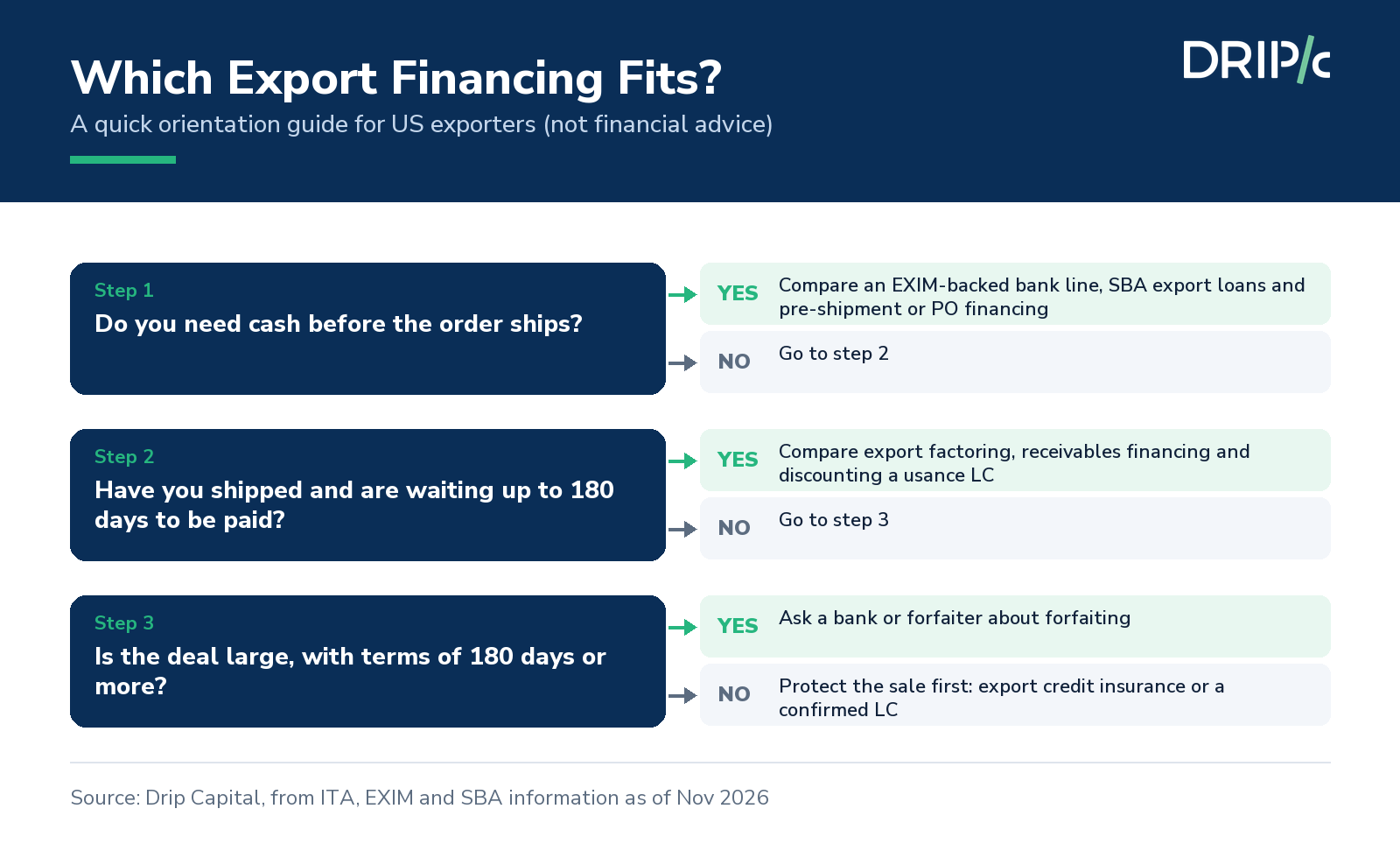
Many exporters stack tools: they insure a receivable, which can make lenders more willing to lend against it. Ask each lender the same questions: what it advances, what it charges per 30 days or per year, what collateral it needs and how fast it pays. Comparing export financing on total cost for your real payment terms avoids surprises.
Where to Find Export Finance Help and Data
Free government resources cover most of the ground. The ITA Trade Finance Guide explains payment methods and financing tools. SBA's trade tools page lists export loans and Export Finance Managers who give free counseling. EXIM publishes policy terms and premium charts on exim.gov. For market data, the Census Bureau's foreign trade statistics show where US exports go. Before you apply for export financing, gather your purchase order, buyer details, receivables aging, shipping documents and recent financial statements.
Your local Small Business Development Center or SBA Export Finance Manager can help you match a deal to the right program.
How Drip Capital Helps Exporters Pay Vendors
If you buy goods to fulfilll export orders, vendor payments can fall due before the buyer pays. Drip Capital’s Vendor Financing pays vendors directly, with repayment terms of up to 90 days, subject to approval and agreed terms. Confirm that the facility fits your purchases and repayment plan.
Vendor Financing pays your vendors' invoices directly; duties you owe US Customs are separate costs to plan for. To see if it fits your next order, explore Vendor Financing or apply online.
Frequently Asked Questions
What is export financing?
Export financing is funding and risk protection that helps exporters pay for production before shipment and get cash after shipment instead of waiting for the foreign buyer. Common tools include EXIM-backed working capital loans, SBA export loans, export credit insurance, letters of credit, export factoring, purchase order financing and forfaiting. Many exporters combine a pre-shipment and a post-shipment tool.
Does EXIM lend money directly to small exporters?
For working capital, generally no. EXIM's Working Capital Loan Guarantee backs 90% of a loan made by your own bank or finance company, which lets the lender advance up to 90% against eligible foreign receivables and 75% against export inventory. EXIM also insures foreign receivables against nonpayment for commercial and political reasons.
How much does export credit insurance cost?
EXIM’s listed Small Business Multi-Buyer private-buyer premiums vary with payment terms. For example, $0.90 per $100 on 61- to 120-day terms gives a $900 premium on a $100,000 invoice. Confirm the policy, buyer and current quote before relying on that example.
What is the maximum SBA export loan?
Export Express allows up to $500,000. Export Working Capital and International Trade loans allow up to $5 million. These are program ceilings; the lender must approve the borrower, use of funds and amount.
What is the difference between pre-shipment and post-shipment finance?
Pre-shipment finance pays for materials, labor or finished goods before the order ships, using a confirmed order or letter of credit as support. Post-shipment finance turns the invoice into cash after shipment, through factoring, discounting a letter of credit or forfaiting. Exporters often need both: one to produce the order and one to bridge the payment term.
Can I finance export invoices with 90-day or longer terms?
Some programs can support 90-day or longer receivables, subject to buyer, country and transaction limits. For longer capital-goods contracts, consider whether Forfaiting or another medium-term structure fits. Confirm the maximum term with the provider.
Is a letter of credit better than export credit insurance?
The choice depends on your buyer, risk and payment terms. A confirmed Letter of Credit adds bank payment commitments subject to compliant documents, while insurance covers defined losses under a policy. Compare both cost and conditions, including how quickly either arrangement can produce cash.