

An importer buys a shipment for $100,000 through a trading company. The factory charged that company $75,000. Which amount should customs duty be calculated on?
The First Sale Rule can allow the earlier transaction to support the customs value, provided the importer can substantiate the sale and meet the valuation requirements. The price difference creates a reason to investigate. The documents determine whether the claim holds up.
For businesses buying through intermediaries, the useful starting point is a single shipment whose orders, invoices, payments, and destination can be traced from the factory to the importer.
What the First Sale Rule does
The First Sale Rule concerns customs valuation in a chain with more than one sale before importation. A qualifying manufacturer-to-intermediary sale may provide the transaction value used to calculate duty. Required additions still apply.
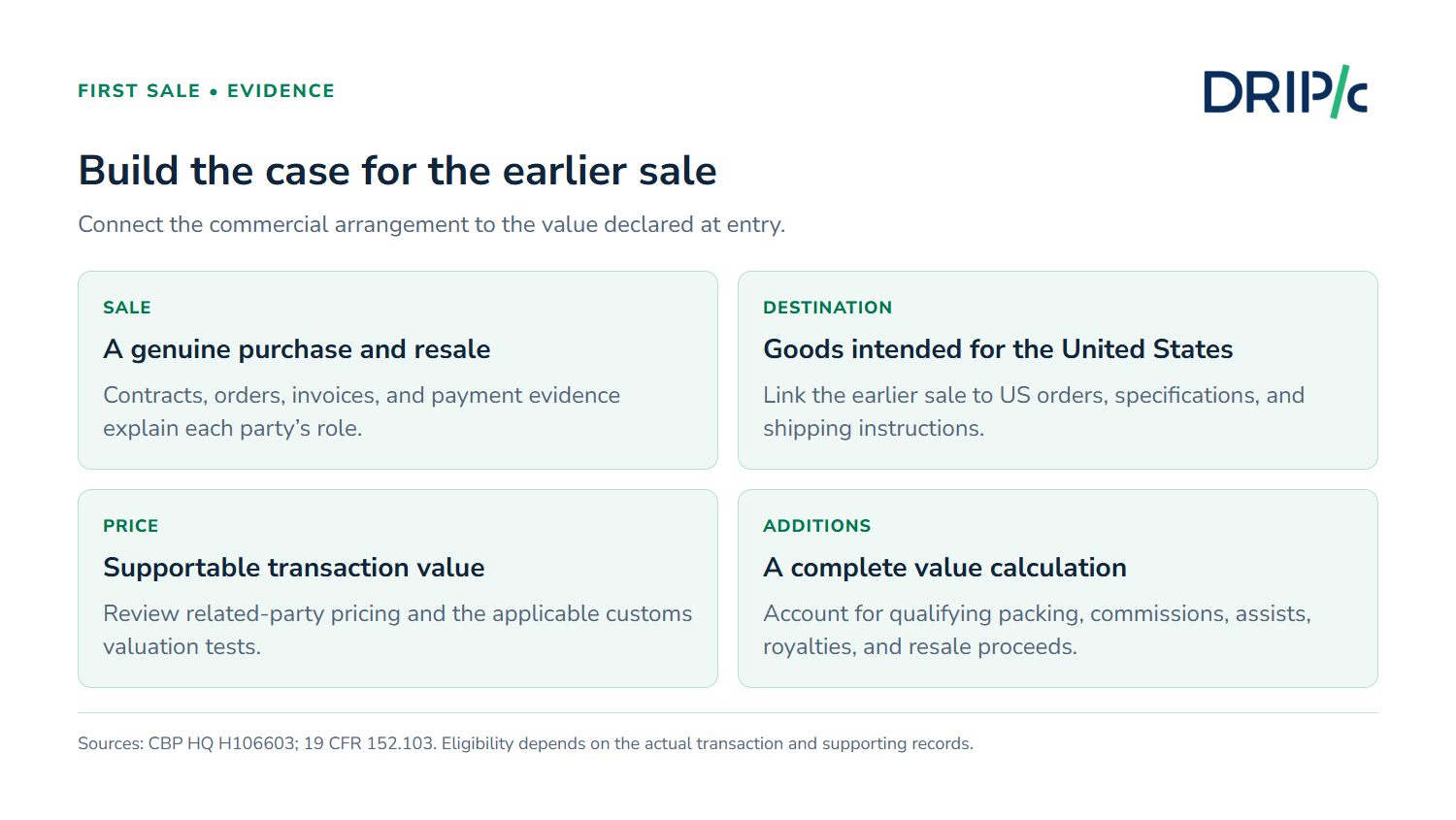
CBP generally presumes that the price paid by the importer is the appropriate basis. Its ruling H106603 explains the importer's burden to support an earlier sale, including a genuine sale, a US destination established at that time, and acceptable pricing.
The first sale principle affects the value declared. The applicable tariff classification and duty rules still need their own review. For the underlying calculation, see this guide to customs value.
By the numbers
Three questions to answer before using the earlier price
Was there a genuine sale?
Identify the manufacturer, intermediary, and importer, then establish what each party bought and sold. Contracts, purchase orders, payment records, and terms governing title and risk help show the commercial arrangement.
A manufacturer's invoice alone leaves questions unanswered. For example, an intermediary acting only as an agent may have a different role from a company purchasing and reselling goods. Have the broker or customs adviser examine the actual arrangement, including any side agreements.
Were the goods already destined for the United States?
The evidence must connect the earlier sale to US-bound merchandise. US customer orders, product specifications, labels, shipping instructions, and linked order numbers can help establish that connection.
Goods purchased for general inventory and assigned to a US customer later need particular scrutiny. A final bill of lading proves where the shipment traveled; the file should also establish the intended destination when the earlier sale occurred. Keep the shipping documents connected to the relevant purchase orders.
Can the price withstand customs review?
Related companies can potentially use first sale valuation, but the relationship requires analysis. The importer must demonstrate that the relationship did not influence the price, or satisfy an applicable test-value approach.
In H106603, CBP rejected the claimed earlier value because the importer had not established acceptable arm's-length pricing between related parties. A complete set of invoices does not resolve a pricing weakness. The related-party provisions explain the valuation tests.
Build a shipment file that joins every transaction
Start with the importer's order to the trading company and follow it back to the manufacturer's order. Match product descriptions, quantities, identifiers, and shipment references across both sets of records.
Collect documents from both sales
Request purchase orders, sales contracts, invoices, payment evidence, packing lists, and transport documents. Include credits, rebates, or adjustments that affect the agreed price. A commercial invoice is one part of this file; reconcile it with the money actually paid or payable.
Ask who can provide factory-level records before making First Sale Rule customs declarations. An intermediary's willingness to share supporting information can determine whether the program is workable.
Explain additions and discrepancies
Record whether the buyer provided molds, materials, design work, or other items that may qualify as assists. Review packing, commissions, royalties, and resale proceeds under the applicable valuation rules. Avoid adding an expense twice when it is already included in the price.

If quantities differ between an order and an invoice, document the reason. Partial shipments, rejected goods, and consolidated payments should be traceable without relying on someone's recollection. Assign responsibility for gathering missing records before the broker files the entry.
A First Sale Rule example with realistic limits
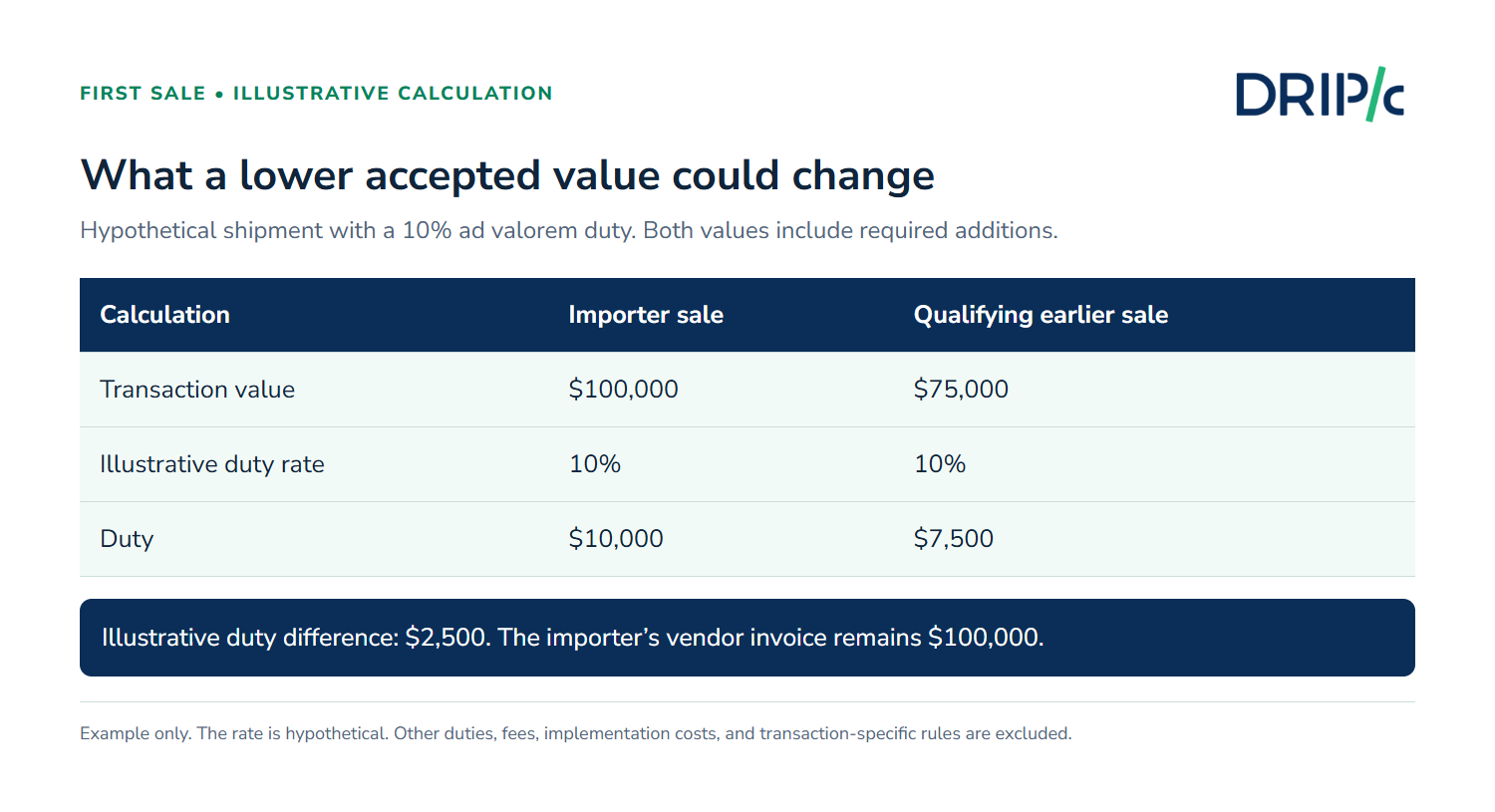
Consider this hypothetical First Sale Rule example. A trading company invoices an importer $100,000. Its manufacturer charged $75,000. Assume the earlier sale qualifies, both values already include all required additions, and the goods face an illustrative 10% ad valorem duty.
Duty on $100,000 would be $10,000. Duty on $75,000 would be $7,500. The difference is $2,500.
The illustrative 10% rate has no connection to a particular product. The calculation excludes other duties, fees, and implementation expenses. Actual results depend on the goods, applicable measures, and supportable customs value.
Translate the calculation into a purchasing decision
The importer still owes its vendor the agreed $100,000. A lower accepted customs value does not change that commercial invoice. Budget for document collection, specialist review, and ongoing controls before treating the gross duty difference as net savings.
Use the accepted value in a complete landed-cost calculation, alongside freight, insurance, duties, and other applicable charges. This makes the First Sale Rule for duty savings a measurable purchasing decision.
Test one trade lane before expanding
Choose a repeat product and vendor relationship with accessible records. Ask a licensed customs broker or customs counsel to evaluate the sale chain and identify unresolved issues. Where appropriate, discuss a prospective CBP ruling request based on the actual facts.
Create a repeatable review process for new manufacturers, changed contract terms, price adjustments, and related-party arrangements. An accepted approach for one transaction should not become a blanket assumption for every purchase.
Keep the records accessible to the importing business. The First Sale Rule works best operationally when purchasing, finance, and customs teams can retrieve the same shipment file and explain how the declared value was calculated.
How Drip Capital fits into the purchasing cycle
Customs valuation and vendor payment timing are separate decisions. While your customs adviser evaluates the earlier sale, Drip Capital's Vendor Financing can pay vendors directly, with repayment terms of up to 90 days.
This can help preserve cash for operating expenses while purchases move through production and shipping. Eligibility includes at least two years in business and $2 million in annual revenue, with financing subject to underwriting and approval. Drip Capital does not determine whether a customs valuation claim qualifies.
Frequently asked questions
Can every importer use the First Sale Rule?
The First Sale Rule requires a qualifying earlier sale and evidence supporting its use for customs valuation. Businesses purchasing directly from the manufacturer generally do not have the same intermediary markup to examine. Have the actual transaction chain reviewed before making a claim.
Does first sale valuation change the duty rate?
First sale valuation can change the accepted value to which a value-based duty applies. Classification, origin, and applicable tariff measures still determine the relevant duty treatment. Specific duties calculated per unit require separate consideration.
Can related companies qualify?
Related-party sales can be acceptable if they meet the applicable valuation requirements. The importer needs evidence supporting the pricing, as well as the sale and US destination. Common ownership alone does not settle the question.
Is a factory invoice enough?
A factory invoice is useful evidence, but CBP evaluates the entire transaction. Purchase orders, payments, shipping information, pricing support, and required additions must tell a consistent story. Begin with a complete shipment file before estimating repeat savings.