

Photo: Headway / Unsplash. Illustrative image.
A colleague is about to email a technical drawing to an overseas customer. Another is arranging a plant visit. A third is preparing a shipment. Each needs to recognize when an export-control question belongs with the compliance team.
ITAR training gives people that starting point. A useful program connects the rules to the decisions employees actually make, including decisions made before anything reaches a loading dock.
What ITAR training should explain first
The International Traffic in Arms Regulations govern defense articles and defense services under State Department jurisdiction. Start by establishing which products, services, and information your business handles fall within that scope. The government's US export-controls overview explains the division of responsibilities between agencies.
Classification comes before assumptions
A product used by a military customer does not become ITAR-controlled solely because of that customer. The relevant jurisdiction and classification analysis still matters. Your team needs a documented answer from the person responsible for classification, with a process for escalating uncertainty.
Keep the ECCN guide available for Commerce-controlled items. An ECCN belongs to a different classification system from the United States Munitions List.
An export can involve information
Under 22 CFR 120.50, releasing controlled technical data to a foreign person in the United States can constitute an export, subject to the regulation's exceptions. Physical shipment is one of several ways an export can occur.
22 CFR 120.33 defines technical data and exclusions. Training should help employees route drawings, instructions, and other potentially controlled material for review without treating every engineering conversation as controlled.
Who needs ITAR compliance training?
The Directorate of Defense Trade Controls' compliance-program guidance recommends training tailored to job responsibilities and organizational risks.
Give everyone a usable foundation
For general staff, explain what potentially controlled information looks like, where it may be stored, and whom to contact. Give a new hire a realistic example from your business, such as a request to forward a customer drawing.
The useful outcome is an employee who knows when to pause and ask.
Go deeper for people handling exports
Sales may need to recognize changes in customers and end use. Engineering may need instructions for sharing files. IT may need access-control procedures. Shipping needs the release checklist and a clear escalation contact. Managers need to understand who can authorize work and who can stop it.
This makes ITAR compliance training relevant across departments.
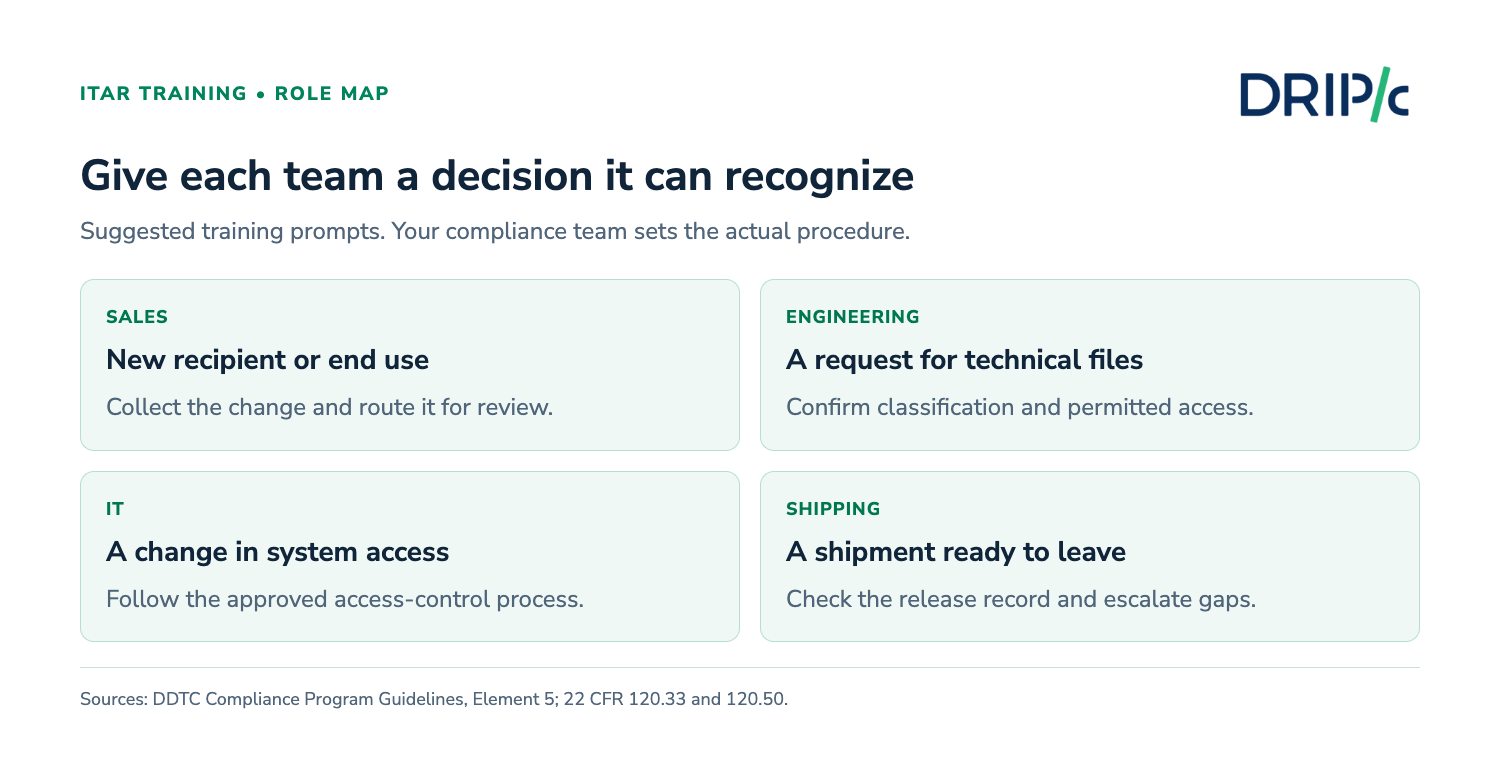
By the numbers
Annual minimum: DDTC's training guidance recommends recurring training at least annually. The recommendation guides program design; training-hour requirements depend on the applicable circumstances.
Four illustrative tiers: The same guidance presents general personnel, senior management, export-function staff, and the compliance team as a possible tiered structure. Smaller organizations can adapt the approach.
Build the session around actual decisions
Separate registration from authorization
22 CFR 122.1 expressly states that registration does not confer export rights or privileges. A company registration, a training certificate, and authorization for a particular activity answer different questions.
Use the export and import license guide for broader context, then identify the approval or exemption analysis required for the specific activity.
Practice an escalation
Give employees a scenario: a customer adds a new recipient to a technical email thread. Ask what information they would collect, whom they would contact, and where they would record the answer. Avoid using real controlled material in an unrestricted training exercise.

A useful exercise ends with a named owner and an observable next step. “Ask compliance” becomes more useful when the team knows the contact, the required details, and the expected response channel.
Connect training to shipment records
Use a sample commercial invoice and packing list to explain how product descriptions and shipment references connect. Those documents support execution; they do not establish export authorization on their own.
Keep the program useful between sessions
Record what people learned
Maintain attendance, the material version, role-specific modules, and assessment results. DDTC recommends keeping training records. A short scenario-based assessment can reveal whether someone understands the escalation process better than a completion tick alone.
Update after changes and near misses
Add a focused refresher when the business introduces a product, changes access arrangements, or finds a weakness in its process. DDTC recommends keeping training current and using incidents and audit findings to improve it.
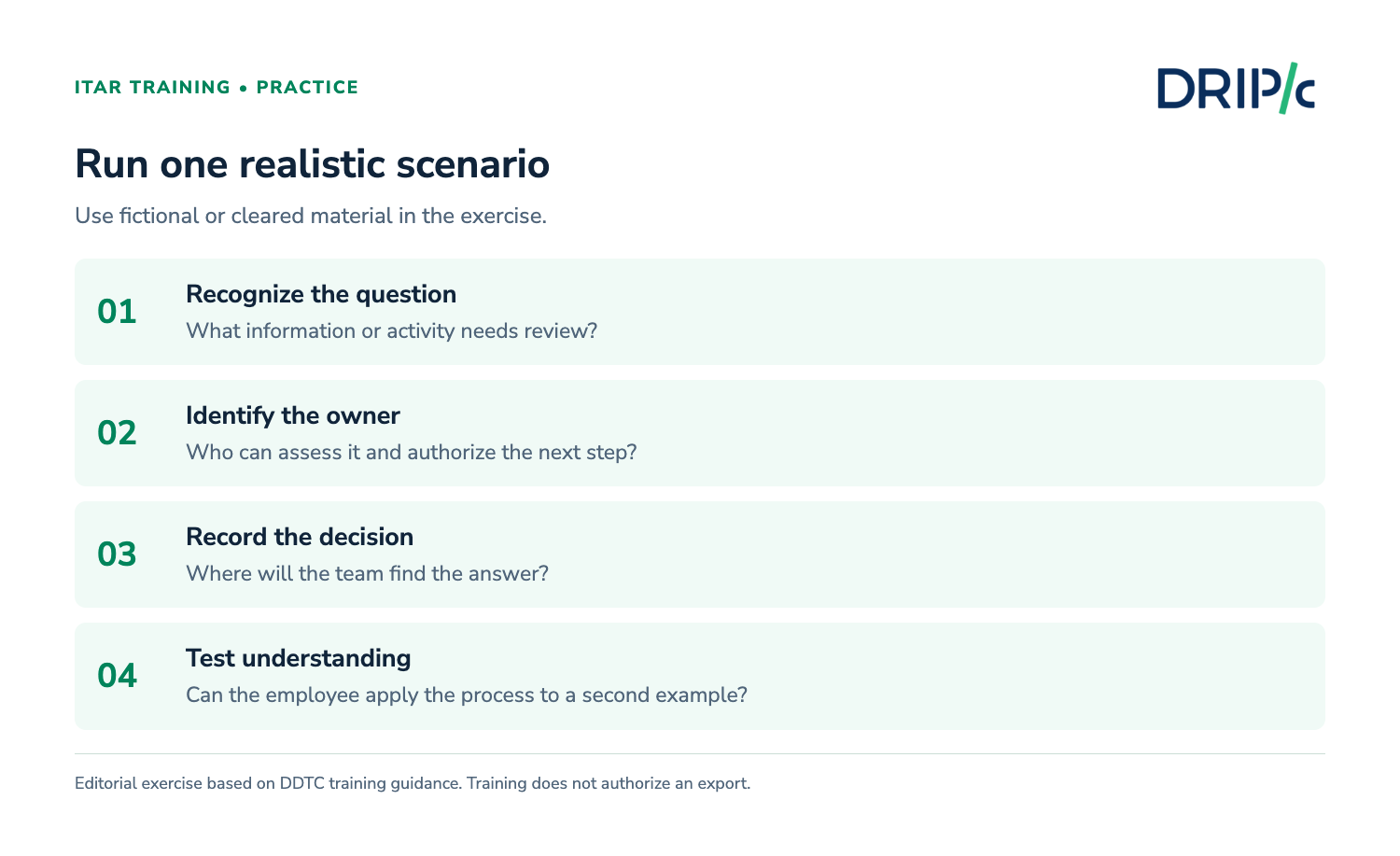
Choose one recent operational question for your next team discussion. Remove sensitive details, explain the correct route, and make the revised instruction easy to find. Keep training alongside the wider export logistics process.
Where Drip Capital fits into business planning
Compliance review can sit alongside production planning and vendor-payment decisions. For permitted commercial purchases, Drip Capital's Vendor Financing pays vendors directly, with repayment terms of up to 90 days, subject to underwriting and agreed terms.
Discuss the proposed transaction and applicable restrictions before seeking funding. Financing does not authorize a controlled export or replace your compliance process.
Frequently asked questions
Is ITAR training a government export license?
No. Training develops employee knowledge, while export authorization depends on the applicable rules and transaction. A course certificate does not authorize a shipment or technical-data release.
How often should ITAR training take place?
DDTC recommends recurring training at least annually and updates as risks or rules change. The program should also address new personnel and role-specific responsibilities.
Does every employee need the same course?
A common foundation can help everyone recognize concerns. Employees with export responsibilities need training suited to their particular activities and the company's risk profile.
Can domestic activity raise an ITAR question?
Yes. Certain releases of technical data to foreign persons in the United States can be exports under ITAR. The compliance team should review the information, participants, and applicable exceptions before release.