
Trade Finance for Miami-Based Re-Exporters: Paying Vendors Before Goods Reach Latin America
A re-exporter in Doral buys from a factory in Asia and sells to a distributor in Bogotá. The goods land at PortMiami, get consolidated, and ship south. On paper it is one transaction. In cash terms it is two, which is why trade finance for Miami re-exporters works differently from ordinary import lending.
You pay the overseas vendor before anything ships. Then you wait on a buyer in another country who pays on their own terms, in their own currency, under their own conditions. Most financing advice assumes one leg. Re-exporters are funding both, and Miami import export funding has to cover the whole round trip.
Why Miami Became the Hub for This Model
The reason so many of these businesses sit within a few miles of the airport is infrastructure, and it shapes what Doral trade finance has to do.
PortMiami's scale
PortMiami handled 1,115,058 TEUs in 2025. The port maintains separate trade statistics for Latin America and the Caribbean, Asia, and Europe, which tells you something about how the volume is structured: this is a place built for goods arriving from one region and leaving for another.
Doral's concentration of trade businesses
Warehouse and consolidation space around Doral exists because the model works there. A container arrives, gets broken down, gets reconsolidated for four different countries, and leaves. That density is why Doral trade finance is a distinct need rather than a variation on domestic lending.
The Double Cash Gap Behind Trade Finance for Miami Re-Exporters
The problem is structural, and it compounds.
Paying the vendor before goods arrive
Overseas vendors want payment, or a large deposit, before release. That cash leaves your business weeks before the container reaches Miami, and months before your Latin American buyer pays you. Nothing about the re-export model shortens that first leg.
Waiting on buyers in another country
A distributor in Peru or Colombia is not paying on delivery. Terms of 30 to 60 days are normal, sometimes longer, and enforcement across a border is harder than it is domestically. This is the gap LatAm distributor financing exists to cover: you have already paid for the goods, shipped them out of the country, and the receivable now sits with a buyer under a different legal system.
Currency and country risk stretch terms further
Buyers facing a devaluation or a slow month tend to pay late, and you have limited leverage. That risk is a reason many re-exporters carry longer effective terms than they agreed to, and a reason Miami import export funding gets sized against the slower leg rather than the faster one.
By the numbers
Trade finance for Miami re-exporters, by the numbers
1.12M
TEUs handled at
PortMiami in 2025
48%
of firms source inputs
from outside the US
4 in 10
firms report tariff costs
as a financial challenge
42%
of applicants received the
full amount they sought
Source: Miami-Dade PortMiami cargo statistics; Federal Reserve Banks, 2026 Report on Employer Firms
Why This Strains Working Capital More Than Straight Importing
Two features make trade finance for Miami re-exporters harder to arrange than financing for a domestic import business.
You are financing two legs, not one
An importer selling domestically has one gap: vendor payment to customer payment. A re-exporter has the same gap plus an export leg, with its own freight, documentation, and collection timeline. That makes it a working capital question before it is a sales question. Each order occupies your cash longer, so the same revenue supports fewer orders per year.
Cost pressure lands mid-cycle
Forty-eight percent of firms sourced at least some inputs from outside the United States, and a large majority of those firms saw those input prices rise year over year. More than four in ten firms reported tariff-related costs as a financial challenge. For a re-exporter, a cost increase arrives while cash is already committed to goods in transit, which is the worst possible timing.
How Re-Exporters Fund Both Legs
The tools differ depending on which leg is tight.
Vendor Financing for the import leg
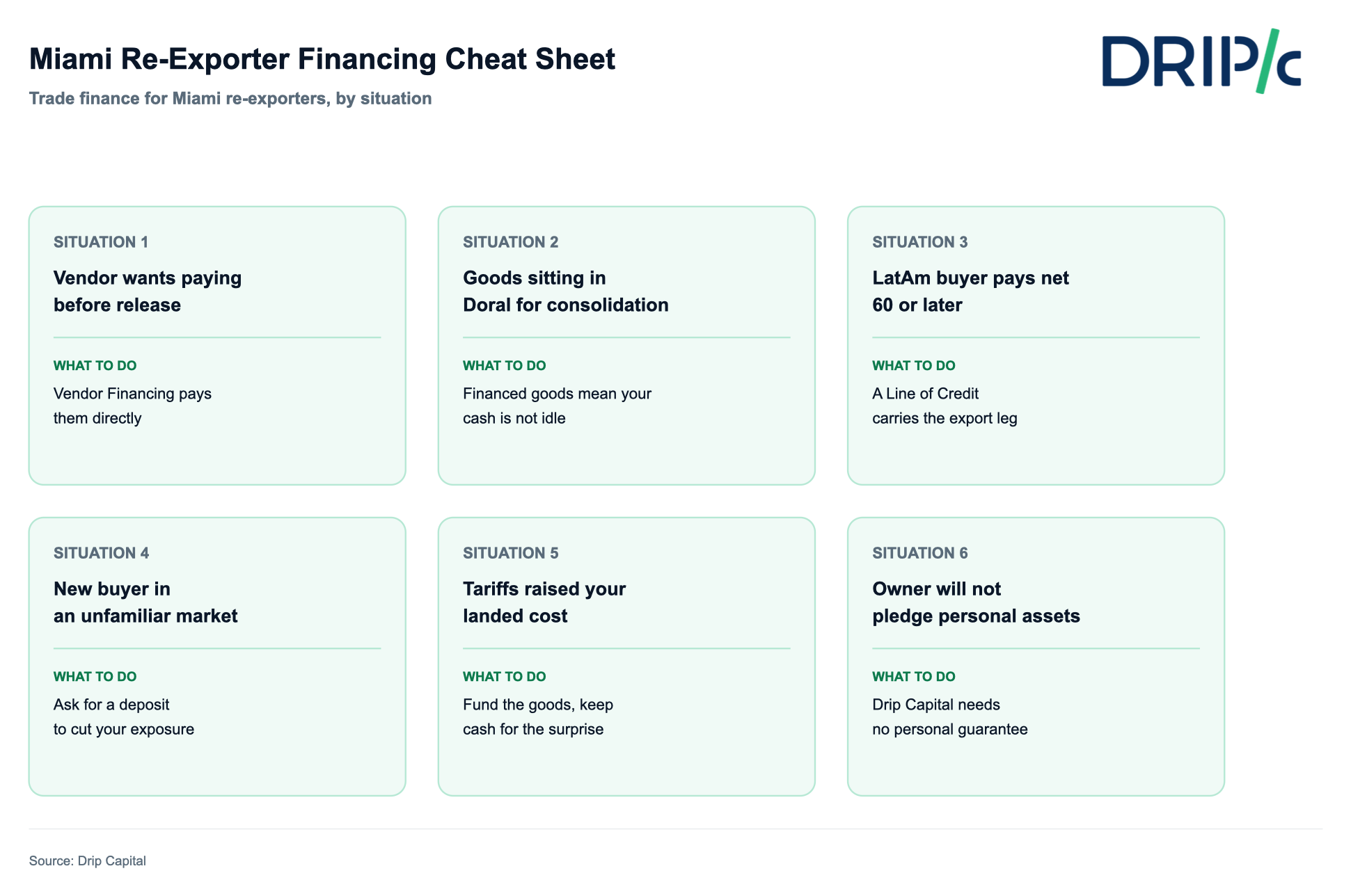
Vendor Financing pays your overseas vendor directly, so goods are released and moving while your cash stays in the business. Repayment falls within an agreed window, typically up to ninety days, which covers the period while goods arrive, get consolidated, and ship south. Pricing is a flat fee on the invoice, usually 1% to 2% per month, charged only on what you draw and only while it stays outstanding. For most Doral trade finance needs, this is the first leg solved.
A Line of Credit for the export leg
A Line of Credit suits the second leg, where the money is already spent and you are waiting on a foreign buyer. Because it revolves, you can draw to cover operations during the wait and repay when collections land. That makes it the practical form of LatAm distributor financing for a business selling into several countries at once, and it works differently from a bank loan, where the full amount arrives at once whether the gap is open or not.
Negotiating terms on both sides
Worth doing before financing anything. A vendor you have bought from for years may accept a smaller deposit, and our guide to extending vendor payment terms covers how to make that case. On the export side, a deposit from a new Latin American buyer reduces your exposure on the leg you control least.

What Re-Exporters Should Have Ready
Have the vendor's invoice or pro forma, your business formation documents, recent bank statements, and the purchase orders from your export buyers. Because this model crosses two borders, clean documentation on both sides speeds up any Miami import export funding application considerably. A financier assessing the deal wants to see the trade, and in a re-export deal the trade has two halves.
How Drip Capital Helps Miami Re-Exporters
Drip Capital pays your overseas vendor directly, so a release-before-payment demand does not compete with the cash you need for freight, consolidation, and the export leg. Repayment falls within an agreed window, typically up to ninety days, and the cost is a flat fee on the invoice rather than a number that moves after you sign. It is collateral-free, and no personal guarantee is required.
Vendor Financing through Drip Capital requires a minimum of two years in business. Approval leans on the strength of the order and your vendor relationship, which suits a re-exporter whose trade is real and repeatable even when the balance sheet is thin.
Frequently Asked Questions
What makes trade finance for Miami re-exporters different from financing an importer?
Trade finance for Miami re-exporters has to fund two legs: paying an overseas vendor before goods arrive, then waiting on a foreign buyer after goods ship out. An importer selling domestically only has the first gap, so the same order ties up a re-exporter's cash for longer.
Can I finance goods that are not staying in the United States?
Yes. Vendor Financing funds the payment to your vendor for the goods themselves. Where the goods go after they arrive does not change that mechanic, though clean export documentation helps the assessment.
How do I handle the risk of a Latin American buyer paying late?
Reduce exposure where you can, with deposits from newer buyers and clear written terms. LatAm distributor financing helps on the other side, keeping your operations funded while a receivable runs longer than planned.
Do I need to be based in Miami or Doral to qualify?
No. Location does not drive eligibility, so Doral trade finance and trade finance for Miami re-exporters are available to any US business that meets the criteria: a confirmed order, a reliable vendor, and a minimum of two years in business.