
Photo: Fine Photographics on Unsplash
In the Supreme Court tariff case, Learning Resources, Inc. v. Trump, the Court ruled 6-3 on February 20, 2026 that the International Emergency Economic Powers Act (IEEPA) does not authorize the President to impose tariffs (slip opinion). With the IEEPA tariffs struck down, the 2025 "fentanyl" tariffs on Canada, Mexico and China and the worldwide "reciprocal" tariffs ended, and importers can now request refunds from U.S. Customs and Border Protection (CBP). Tariffs under other laws, including Section 232 and Section 301, still apply.
Last updated: November 5, 2026.
What does the ruling mean for you? If you import goods into the US, the Supreme Court tariff ruling matters in three ways: some duties you paid may come back, the tariffs you pay today have changed, and parts of the refund fight are still in court.
The Supreme Court Tariff Case at a Glance
| Case | Learning Resources, Inc. v. Trump (No. 24-1287), decided with Trump v. V.O.S. Selections, Inc. (No. 25-250) |
|---|---|
| Question | Does IEEPA allow the President to impose tariffs? |
| Argued / decided | November 5, 2025 / February 20, 2026 |
| Vote | 6-3; majority opinion by Chief Justice John Roberts |
| Dissent | Justices Kavanaugh, Thomas and Alito |
| Holding (Court's syllabus) | "IEEPA does not authorize the President to impose tariffs." |
What the Court Ruled, in Plain English
The Constitution gives Congress the power to tax and to impose duties on imports. IEEPA, a 1977 emergency-powers law, lets the President "regulate" importation, but it never mentions tariffs. The majority held that regulating imports does not include taxing them. It noted that when Congress has given the President tariff power in other laws, such as Section 122 and Section 301, it has done so expressly.
"None of IEEPA's authorities includes the distinct and extraordinary power to raise revenue. And the fact that no President has ever found such power in IEEPA is strong evidence that it does not exist."
Chief Justice John G. Roberts, Jr., opinion of the Court, Learning Resources, Inc. v. Trump, February 20, 2026
Justice Kavanaugh, joined by Justices Thomas and Alito, dissented and warned about what would follow:
"The United States may be required to refund billions of dollars to importers who paid the IEEPA tariffs."
"As was acknowledged at oral argument, the refund process is likely to be a 'mess.'"
Justice Brett M. Kavanaugh, dissenting, Learning Resources, Inc. v. Trump, February 20, 2026
The Supreme Court tariff case did not decide how refunds should work. Those questions went back to the Court of International Trade (CIT), which is where most of the action has been since.
Are Tariffs Illegal Now? What Was Struck Down and What Still Applies
So are tariffs illegal after the ruling? Only those imposed under IEEPA. The same day, the President signed Executive Order 14389, ending IEEPA duties and stating that Section 232 and Section 301 duties are unaffected. CBP stopped collecting IEEPA duties on goods entered on or after February 24, 2026 (CSMS #67834313). A separate order kept the suspension of duty-free de minimis treatment.
| Tariff | Treatment under the cited notices | What it covers |
|---|---|---|
| IEEPA tariffs | Struck down; collection ended Feb 24, 2026 | Fentanyl tariffs on Canada, Mexico and China; reciprocal tariffs; other IEEPA duties |
| Section 232 | In force | Steel, aluminum, copper, autos and parts, trucks, lumber, semiconductors and more |
| Section 301 (China lists) | In force | 7.5% to 25% on most listed Chinese goods; higher on some products, such as electric vehicles (Federal Register) |
| Section 301 forced-labor tariffs | In force since Jul 24, 2026 | 10% for 17 economies including Canada and Mexico; 12.5% for most others including China (USTR; Federal Register) |
| Section 122 surcharge | Expired Jul 24, 2026 | 10% on most imports from Feb 24 to Jul 24, 2026 (CIT Slip Op. 26-47) |
| Section 338 (Canada) | In force since Aug 22, 2026 (CBP CSMS #69606660); product list changed in September and October 2026 | 50% on selected Canadian goods, first set by proclamations on alcohol, dairy and motor-vehicle products, including goods that qualify under USMCA (White House) |
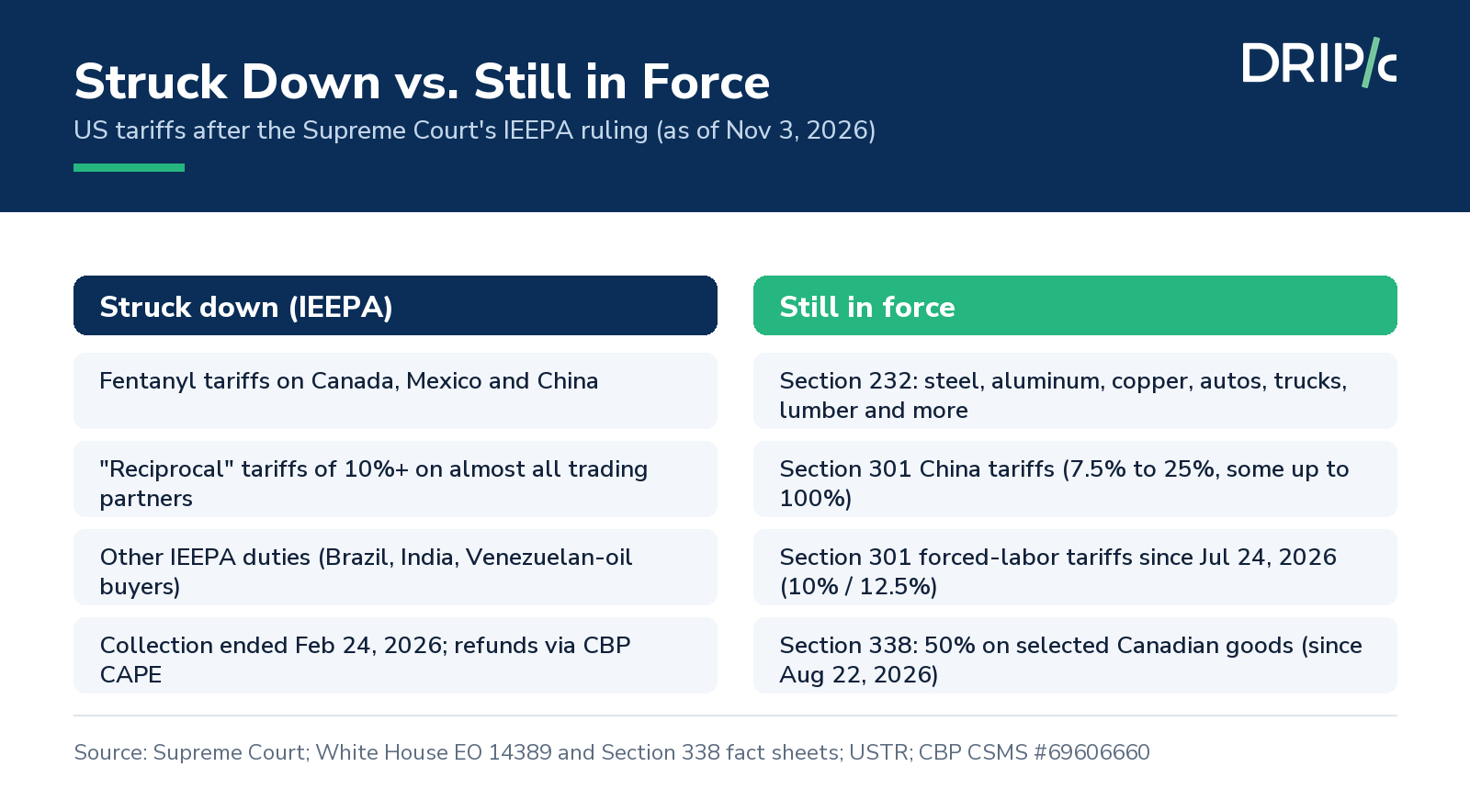
For current rates, see our Section 232 and Section 301 pages and the IEEPA tariffs overview.
What the Ruling Means for You, by Country of Origin
The effect of the Supreme Court tariff case depends on where your goods come from, because different laws now apply to different origins.
Goods from China. The IEEPA "fentanyl" tariff and the reciprocal tariff are gone. Chinese goods still pay the regular HTS duty, Section 301 duties of 7.5% to 25% on most listed products (higher on some), and, since July 24, 2026, a 12.5% Section 301 forced-labor duty on most products (Federal Register). For goods on the Section 301 lists, the total duty is still well above the regular HTS rate. Check your HTS code before you price new orders.
Goods from Canada and Mexico. The IEEPA fentanyl tariffs are gone (before the ruling, 35% on most non-USMCA Canadian goods under Executive Order 14325 and 25% on non-USMCA Mexican goods). Goods that qualify under USMCA still enter free of regular duty and are exempt from the new 10% Section 301 forced-labor duty (Federal Register); goods that do not qualify pay it. Section 232 tariffs still apply to steel, aluminum, copper, autos and other covered goods, and since August 22, 2026, selected Canadian goods face 50% Section 338 tariffs even when they qualify under USMCA. That product list has changed several times (White House, September 2026; White House, October 2026), so check the current proclamations for your goods.
Goods from other countries. The reciprocal tariffs are gone, and the temporary 10% Section 122 surcharge expired on July 24, 2026. Since July 24, 2026, the Section 301 forced-labor tariffs apply to 60 economies at 10% or 12.5%, with separate rules for partners such as the European Union, Taiwan, Japan, South Korea and Switzerland that take regular duties into account, according to USTR.
Supreme Court Tariff Case Timeline
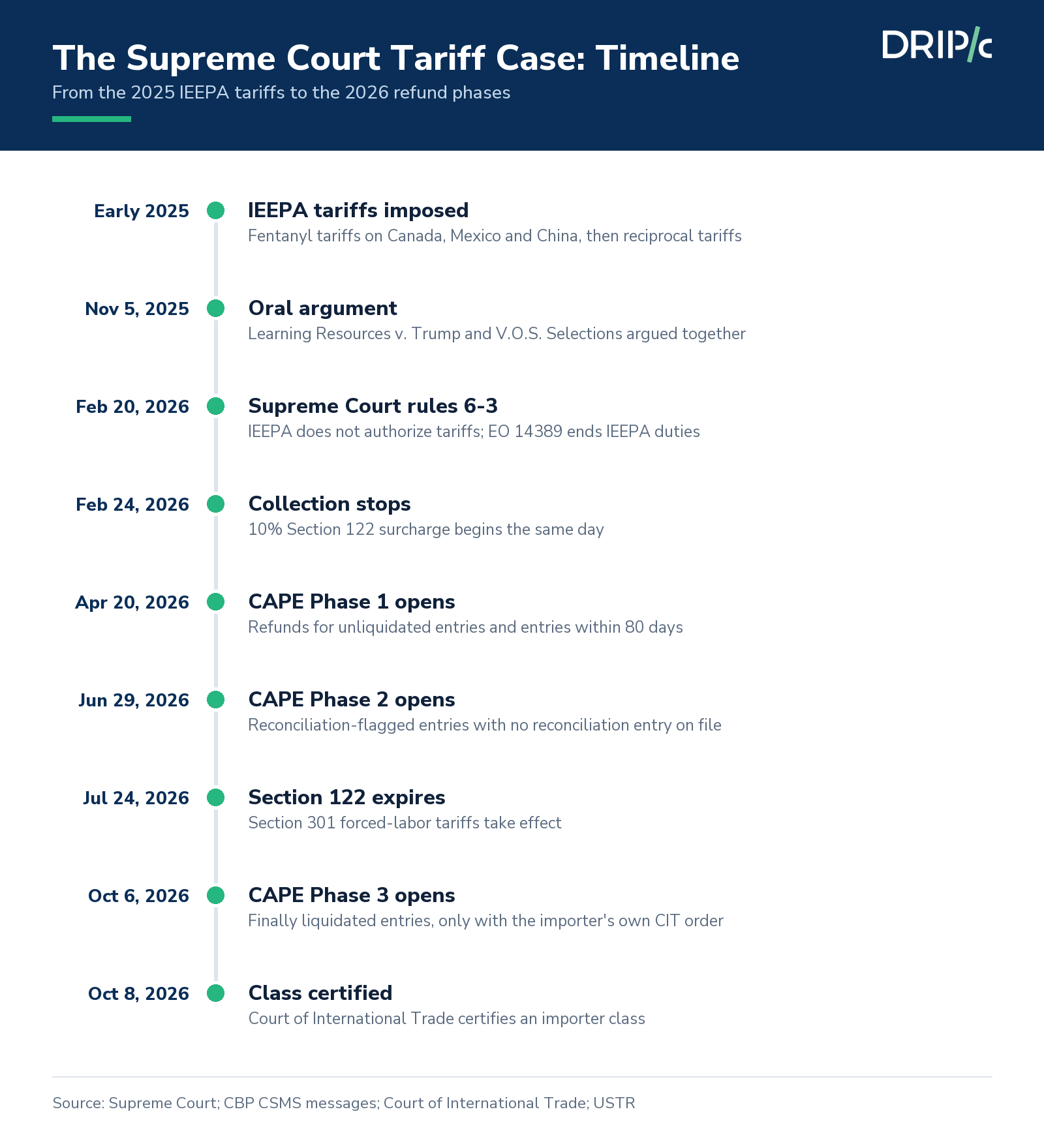
If you are asking when will the Supreme Court rule on tariffs, the answer is that it already has. The key dates:
How IEEPA Tariff Refunds Work
After the ruling, CBP built a refund process called CAPE inside the ACE Portal (CBP refunds page). Only the importer of record, or the licensed customs broker that filed the entries for it, can file a CAPE Declaration, which is a list of entry numbers. CBP says valid refunds are generally issued within 60 to 90 days of acceptance unless a compliance concern needs further review; entries that are extended, suspended or under review, and warehouse entries, are refunded only when they liquidate. Refunds go by ACH to the importer of record, or a party it designates on CBP Form 4811, not to end customers, and include interest under 19 U.S.C. § 1505. For the full steps, read our guide to claiming your tariff refund through CAPE.
| CAPE phase | Opened | Which entries qualify |
|---|---|---|
| Phase 1 | Apr 20, 2026 (CSMS #68340863) | Unliquidated entries, and entries liquidated within the preceding 80 days, subject to other CAPE eligibility requirements, so CBP can reliquidate them inside its 90-day voluntary window (19 U.S.C. § 1501) |
| Phase 2 | Jun 29, 2026 (CSMS #69035485) | Entries flagged for reconciliation where the reconciliation entry is not yet on file |
| Phase 3 | Oct 6, 2026 (CIT Slip Op. 26-123) | Finally liquidated entries (liquidated more than 90 days), only for importers whose own CIT case has a reliquidation order |
Check your entry list carefully before you file: CBP says an accepted CAPE Declaration cannot be amended. Also expect the cash you receive to differ from the IEEPA duties you paid. CBP nets over- and underpayments across each entry when it liquidates or reliquidates, and it can divert a refund to offset legally fixed, undisputed debts you owe the United States (CBP).
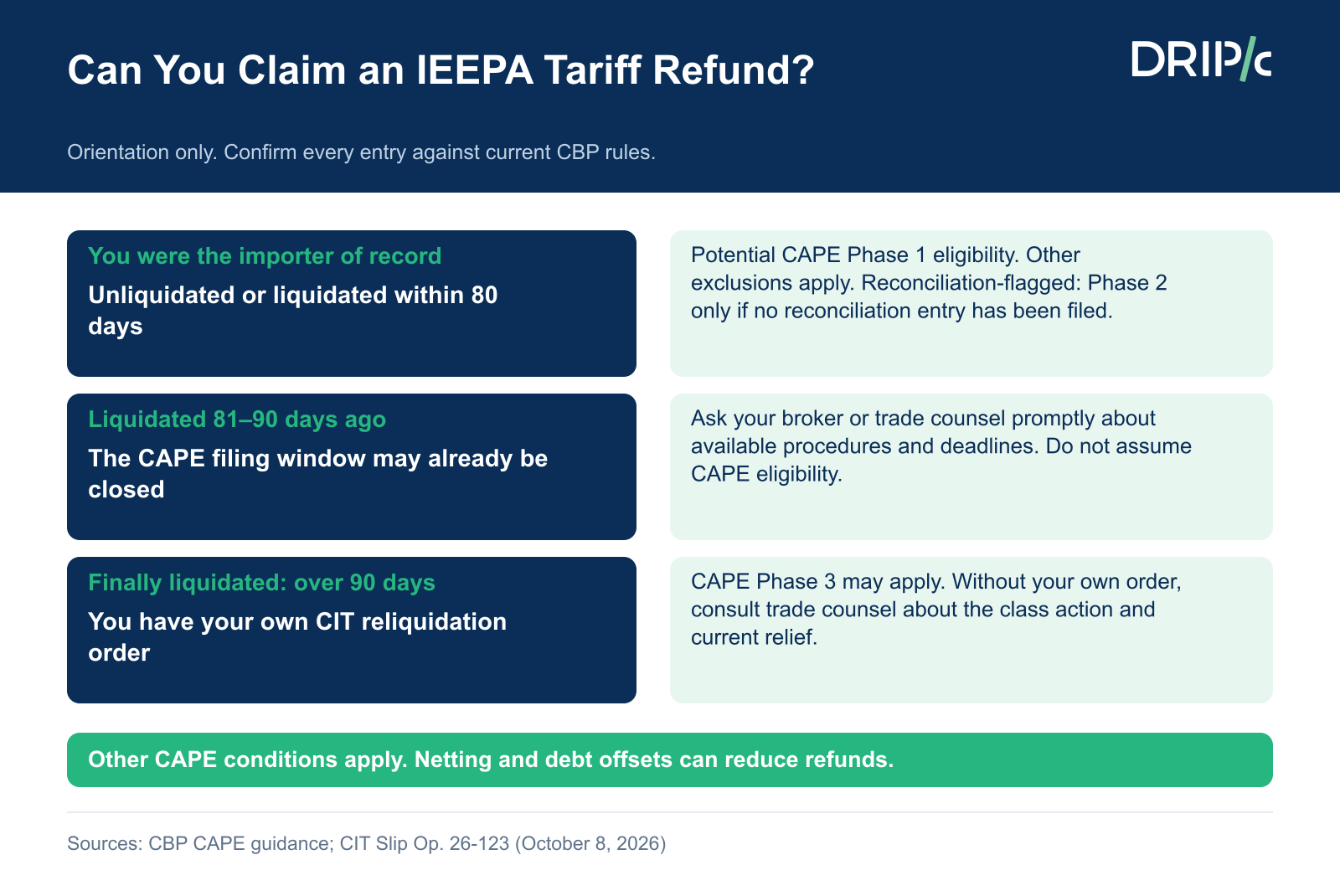
The sums are large. CBP estimated about $166 billion in IEEPA duties was paid by roughly 330,000 importers, and about $126 billion, including interest, had been refunded by October 2, 2026, according to CBP figures cited by the Court of International Trade. For the small businesses that brought the case, that money is the point:
"...the government took money from us they had no right to take. And just like paying too much in taxes, they have to give it back with interest."
Rick Woldenberg, CEO, Learning Resources (lead petitioner), PBS NewsHour, February 20, 2026
Refunds can still take months, while new duties are due as soon as goods arrive.

That timing gap is why it pays to know which parts of the refund process are still unsettled.
Refund Litigation and Dated Court Orders
• Older entries: the government has appealed the part of the CIT's April 17, 2026 order in V.O.S. Selections that directs CBP to liquidate or reliquidate all affected entries, including finally liquidated ones (Federal Circuit No. 26-1895). The CIT's October 8 opinion records that both sides had filed briefs (Slip Op. 26-123). That dated record does not establish the appeal's current outcome; check subsequent orders before relying on it for a refund claim.
• Class action: on October 8, 2026, the CIT certified a class of importers of record who paid IEEPA duties between February 1, 2025 and February 19, 2026 and did not file their own suits (Slip Op. 26-123). The October 8 certification order itself does not direct refunds to the class.
• Section 122: the CIT found the surcharge unlawful for three plaintiffs (Slip Op. 26-47); the Federal Circuit stayed that ruling on June 11, 2026 while the government's appeal is decided (stay order). Check subsequent appellate orders before relying on the stay or the underlying ruling.
• Forced-labor tariffs: importers and 25 states have challenged the Section 301 forced-labor tariffs at the CIT (New York Attorney General). A three-judge panel heard argument on September 30, 2026 (CNBC), and the tariffs stay in force unless the court rules otherwise.
• Deadlines: the deadline to sue at the CIT in cases like these is two years after the claim arises (28 U.S.C. § 2636(i)), but how it applies here is unresolved. Talk to trade counsel if you have finally liquidated entries.
Contracts, Pricing and Who Keeps the Refund
Refunds go to the importer of record, the company named on the customs entry. If you bought on delivered-duty-paid (DDP) terms, your vendor or another party may have been the importer of record. Check the entry documents and your contract to see who is named and who is entitled to any refund. If you passed tariff surcharges on to your own customers, some may ask for a share back. Review your purchase and sales contracts for tariff and price-adjustment clauses, and get legal advice before you promise or refuse anything. This is also a good time to update quotes: if your 2025 price lists still include IEEPA tariffs, remove them, since those tariffs no longer apply.
What To Do Now
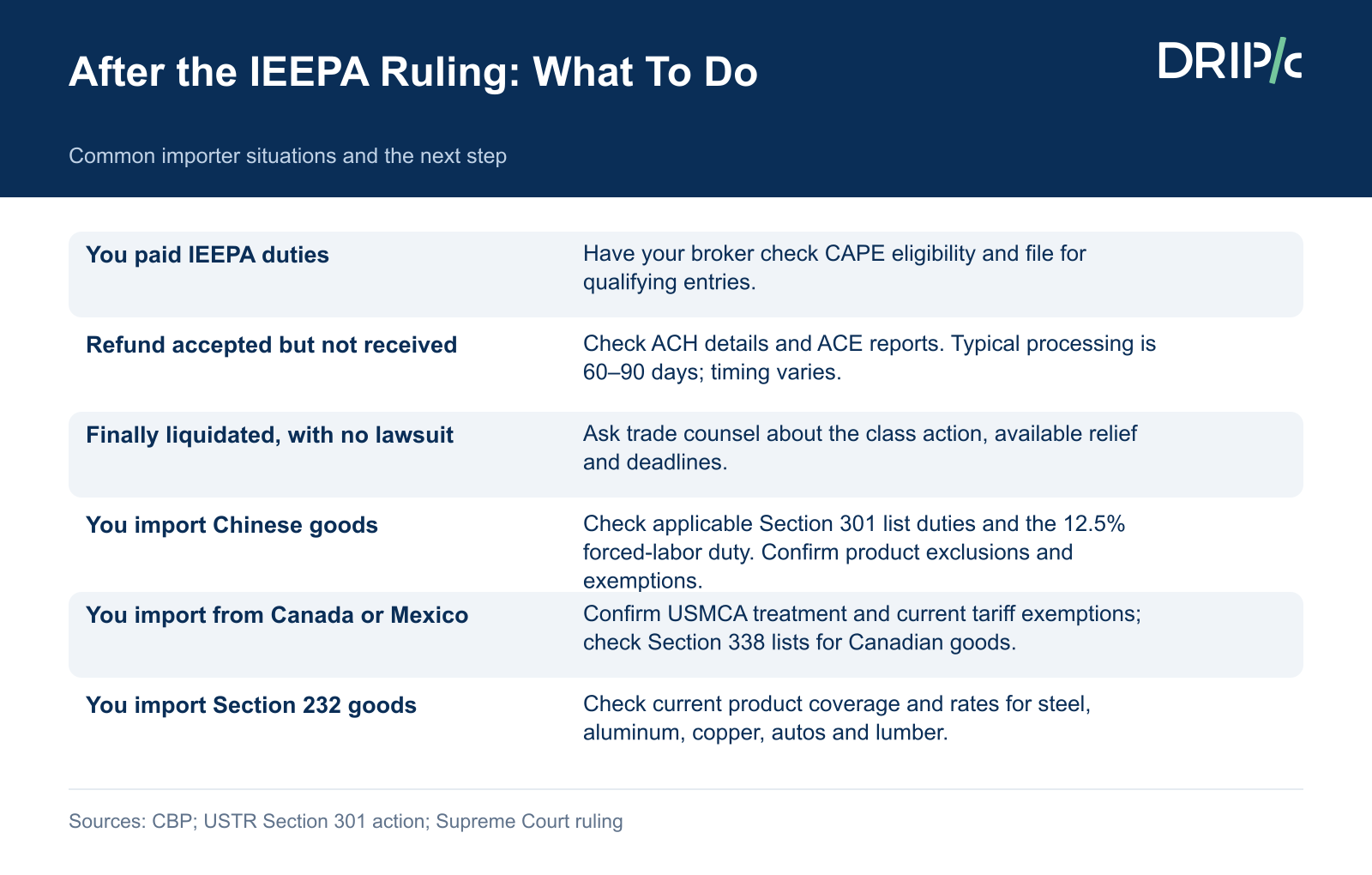
Whatever your situation after the Supreme Court tariff case, the practical next steps fall into a few groups: file for the refunds you can claim now, budget for the tariffs that still apply, and get advice on entries the courts have not settled.
How to Keep Cash Flowing While You Wait for Refunds
For small and mid-sized importers, the Supreme Court tariffs decision is good news with a timing problem. CBP's 60-to-90-day estimate has exceptions, some older entries are tied up in court, netting and debt offsets can shrink what arrives, and new Section 301 duties of 10% to 12.5% now apply to many goods. File for every eligible refund, keep your ACH details current in ACE, recalculate landed costs at today's rates, and do not spend refunds you have not received. You can also weigh whether to pay customs duty upfront or finance it.
If paying vendors is what strains your cash, Drip Capital's Vendor Financing pays your vendors so you can keep ordering, and you repay in up to 90 days. After a one-time credit decision of about 48 hours, vendors are typically paid within 24 hours of you submitting their invoice, in any country and currency, with no collateral required. It pays vendors, not CBP duties, but deferring vendor payments can leave more of your own cash for duties while refunds are pending. Check if you qualify.
Frequently Asked Questions
What was the Supreme Court tariff case about?
Learning Resources, Inc. v. Trump, decided with Trump v. V.O.S. Selections, asked whether IEEPA lets the President impose tariffs. Small businesses and 12 states challenged the 2025 fentanyl and reciprocal tariffs. On February 20, 2026, the Court ruled 6-3 that IEEPA does not authorize tariffs.
Are tariffs illegal after the Supreme Court ruling?
No. Only tariffs imposed under IEEPA were struck down. Section 232 tariffs, Section 301 tariffs on Chinese goods and the July 2026 Section 301 forced-labor tariffs remain in effect, and importers still owe them unless a court blocks them separately.
When did the Supreme Court rule on tariffs?
The Court ruled on February 20, 2026, after oral argument on November 5, 2025. CBP stopped collecting IEEPA duties on goods entered on or after February 24, 2026. Questions about refunds for older entries went back to the Court of International Trade, where some are still being decided.
Will I get a tariff refund?
If your business was the importer of record and paid IEEPA duties, you are likely eligible. You, or the licensed customs broker that filed your entries, request refunds through CBP's CAPE tool in the ACE Portal. CBP says valid refunds are generally paid by ACH within 60 to 90 days of acceptance, with exceptions, and netting or debt offsets can reduce them.
What tariffs replaced the IEEPA tariffs?
A 10% Section 122 surcharge applied from February 24 to July 24, 2026. Since July 24, Section 301 forced-labor tariffs apply to 60 economies: 10% for 17 partners including Canada and Mexico, and 12.5% for most others including China. USMCA-qualifying goods and Section 232 goods are generally exempt.
How much is being refunded?
CBP estimated about $166 billion in IEEPA duties was paid by roughly 330,000 importers. About $126 billion, including interest, had been refunded by October 2, 2026, according to CBP figures cited by the Court of International Trade. The amount you receive can differ from what you paid because of netting and debt offsets.
What if my entries are already finally liquidated?
An entry is finally liquidated once it has been liquidated for more than 90 days, past CBP's voluntary reliquidation window. CAPE takes liquidated entries only within 80 days of liquidation. Since October 6, 2026, Phase 3 accepts finally liquidated entries only for importers with their own CIT reliquidation order. The October 8, 2026 class-certification order did not itself direct refunds to the class; ask trade counsel about subsequent orders.