

C&I Loan Interest Rates: What Determines Your Price and How to Get a Better One
A bank quotes two businesses of the same size, in the same city, wildly different C&I loan interest rates for what looks like the same loan. The gap almost never comes down to luck. It comes down to a formula banks apply consistently, plus C&I loan rate factors specific to each borrower that shift where a business lands inside that formula. This guide covers current commercial and industrial loan rates, what sets them, and how to negotiate a better one.
For a broader look at how C&I loans work as a category, see our companion guide, Commercial & Industrial (C&I) Loans: What They Are & How They Work.
How Banks Set C&I Loan Rates
Every C&I loan rate starts with the same two-part structure: a benchmark plus a spread. The benchmark is a published reference rate the bank does not control day to day; the spread is what the bank adds on top to price its own risk.
Most US banks still peg C&I lending rates to the prime rate, the base rate large banks charge their most creditworthy commercial customers, published daily by the Federal Reserve. Larger, more sophisticated C&I loans increasingly price off SOFR (the Secured Overnight Financing Rate), the benchmark that replaced LIBOR for floating-rate commercial lending. Either way, benchmark plus spread equals the rate a business actually pays.
A well-documented business with strong cash flow and solid collateral gets a tight spread, often just a point or two over the benchmark. A newer or thinly capitalized business pays a wider spread on the same benchmark, sometimes several points more.
By the numbers
C&I LOAN RATES IN 2026
6.75%
Bank Prime Loan Rate,
the common pricing base, Sept 2026
6.7%-7.1%
Median urban-bank rate on new
small-business term loans, Q1 2026
0.0%
Net share of banks tightening
C&I standards, large/mid firms, Q3 2026
Source: Federal Reserve Bank of St. Louis (FRED), Federal Reserve Bank of Kansas City Small Business Lending Survey
Current C&I Loan Rates: The Benchmark Data
The Bank Prime Loan Rate sat at 6.75% as of early September 2026, per the Federal Reserve Bank of St. Louis, and remains the pricing floor most community and regional banks quote from for current C&I loan rates. It is the single most useful number for gauging commercial and industrial loan rates at a glance, since most banks price directly off it.
On the small-business side, the Kansas City Fed's Small Business Lending Survey for the first quarter of 2026 (the most recent release; no Q2 2026 edition has posted as of this writing) puts the median rate on new small-business term loans at urban banks between 6.7% fixed and 7.1% variable. Rural banks priced somewhat lower over the same period.
Lending standards have stayed loose. The Fed's Senior Loan Officer Opinion Survey shows a net 0.0% of banks tightened standards on C&I loans to large and middle-market firms in the third quarter of 2026, a calmer environment than the tightening cycle of 2023 to 2024, and part of why spreads on well-qualified deals have held steady this year.
What Moves Your C&I Loan Rate
The benchmark is the same for every borrower on a given day. The spread is not, and the main C&I loan rate factors below explain why it moves.
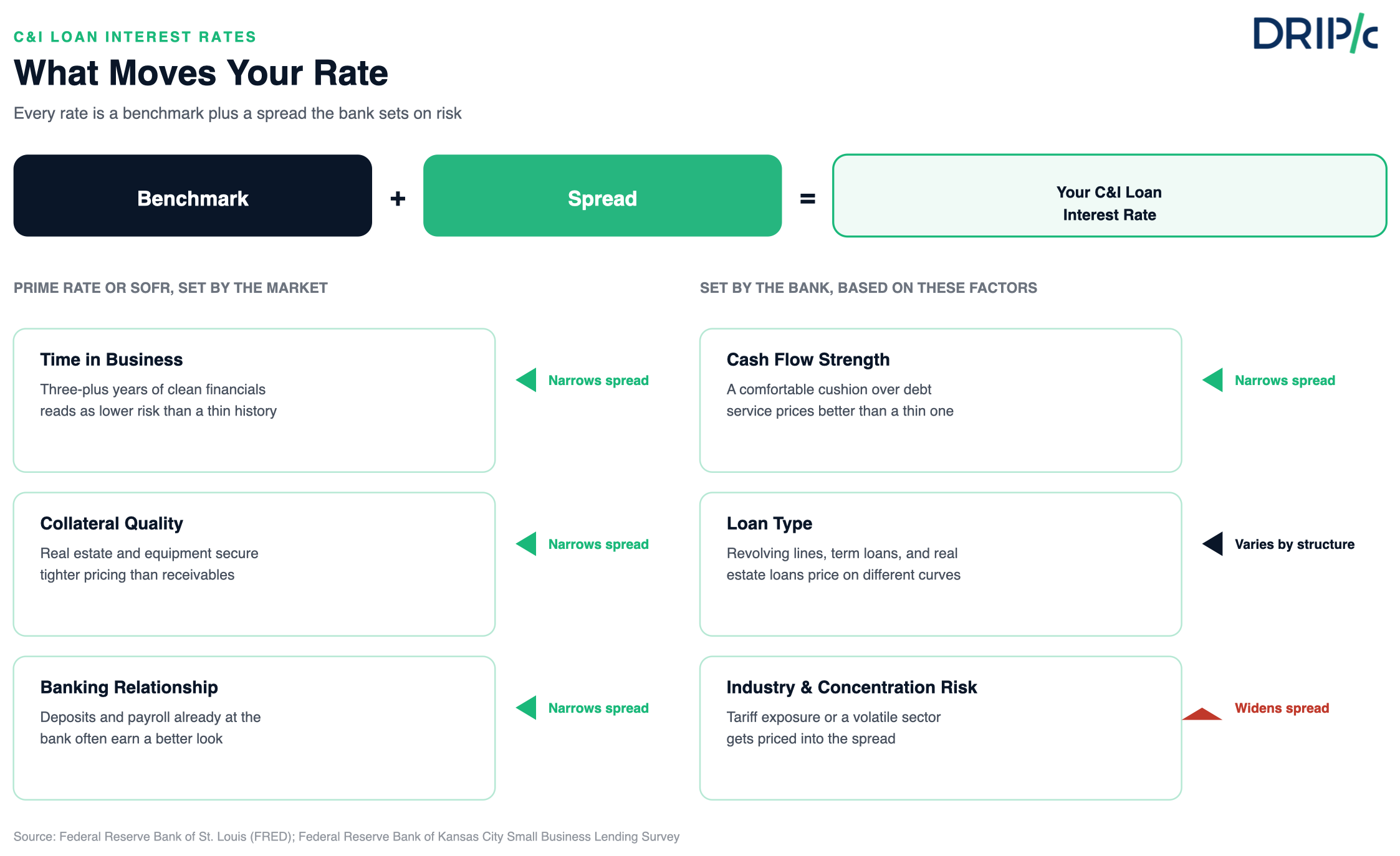
Time in business. Three to five years of clean financials underwrite with more confidence than eighteen months of history. Longer, cleaner history narrows the spread.
Cash flow strength. What matters is what is left after expenses and existing debt service, compared against the proposed payment. A comfortable cushion reads as lower risk, even at similar revenue.
Collateral quality. Real estate and equipment with a clear resale market secure the tightest pricing. Inventory and receivables still help, but they are harder to value and liquidate, so the discount is smaller.
Loan type. A revolving line of credit, a term loan, and a real estate-secured loan price differently, even at the same bank, for the same borrower. The next section covers why.
Banking relationship. A business that already keeps deposits and payroll at the lending bank often gets a better look than a new relationship walking in cold. This is one factor a borrower can build over time.
Industry and concentration risk. A bank already carrying several loans in one volatile sector, or seeing heavy tariff or supply chain exposure in a borrower's industry, prices that exposure into the spread no matter how clean the individual borrower looks on paper.
Fixed vs Variable: Which Costs Less Over Time
Every C&I loan rate is either fixed for the life of the loan or variable, resetting periodically off the benchmark. Each fits a different kind of risk tolerance.
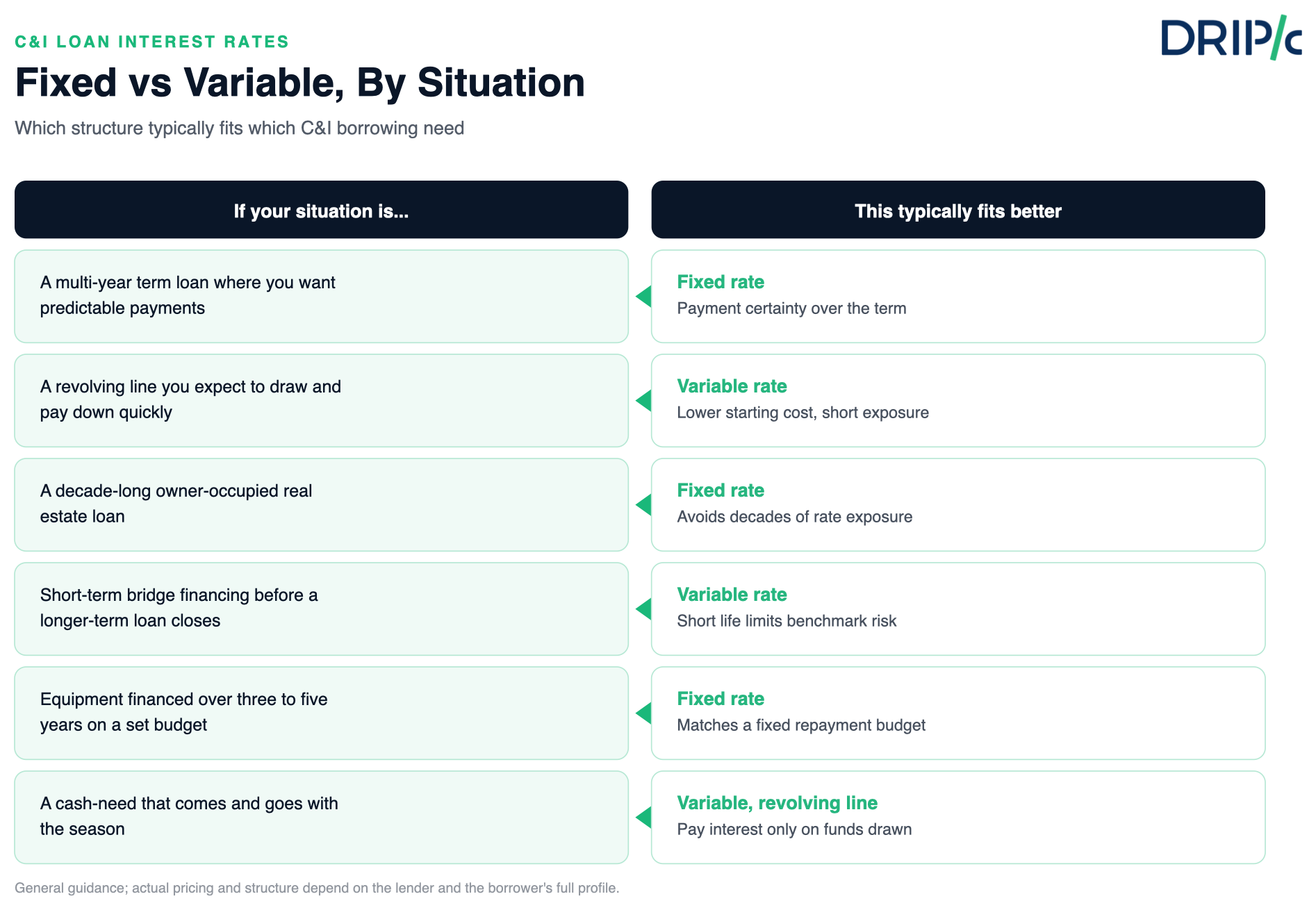
A fixed rate locks in payment certainty. It usually starts slightly higher than a comparable variable rate, since the bank gives up its ability to reprice if the benchmark rises. For a business that wants predictable payments over a multi-year term loan, that premium is often worth paying.
A variable rate starts lower and moves with the benchmark, so the payment can shrink in a falling-rate environment and grow in a rising one. It suits a shorter-term facility, or a revolving line of credit a business expects to pay down quickly, more than a decade-long real estate loan.
How to Get a Better C&I Loan Rate
A handful of concrete moves shift where a business lands inside the spread.
Strengthen the financials before applying. Clean, current statements and a clear explanation of working capital trends give a bank less reason to price in uncertainty.
Offer more collateral. Pledging additional equipment, receivables, or property can narrow the spread meaningfully on a term loan.
Shop more than one bank. Pricing on C&I lending rates varies more across banks than most borrowers expect. A second or third quote is often the fastest way to find a tighter spread.
Consider a shorter term. Shorter terms carry less rate risk for the bank, which can translate into better pricing on a fixed-rate structure.
Build the banking relationship first. Moving deposits and payroll to a lender ahead of a loan request often earns better treatment than approaching a bank cold.
None of this guarantees a specific outcome; every bank weighs these factors with its own formula. Strengthening any one of them still tends to help.

Where Drip Capital Fits
Businesses that clear a bank's underwriting bar, several years of history, steady cash flow, collateral to pledge, generally get the tightest C&I loan interest rates available. Businesses whose cash timing follows a shipping schedule instead of a calendar quarter do not always clear that bar as cleanly, even when the underlying business is healthy.
Drip Capital works with importers and exporters in that gap. Vendor Financing pays a vendor directly on a transaction basis, is collateral-free, and is available to businesses with a minimum of two years in operation and $2 million or more in annual revenue; repayment runs up to ninety days. The cost is a flat fee applied only to the amount drawn, and only while it stays outstanding.
Drip Capital's Line of Credit offers a revolving facility from $50,000 to $1 million, with a credit decision typically inside 48 hours and draws funded within 24 hours of approval. There is no prepayment penalty, no annual maintenance fee, and no blanket lien or UCC filing unless the loan goes into default. A draw fee applies, along with interest on the amount actually used.
A business buying the building it operates out of still needs a bank's real estate structure. For working capital tied to trade timing, Drip Capital's underwriting often moves faster than a benchmark-plus-spread conversation with a bank.
Frequently Asked Questions
What Is a Good C&I Loan Rate?
A good rate depends on the benchmark at the time and the borrower's own risk profile, so there is no fixed number that applies across the board. As of September 2026, a well-qualified borrower typically lands within a point or two of the Bank Prime Loan Rate, currently 6.75%, while a newer or higher-risk borrower pays a wider spread on the same benchmark.
Are C&I Loan Rates Fixed or Variable?
Both structures exist, and the choice usually depends on the loan type and the borrower's preference. Term loans and real estate loans often carry a fixed rate for payment certainty, while revolving lines of credit more commonly float against the prime rate or SOFR.
Why Did My C&I Loan Rate Go Up?
A floating rate moves automatically whenever its underlying benchmark, prime or SOFR, resets, regardless of anything the borrower did. A rate can also rise at renewal if the bank reassesses the business's financials, collateral, or industry risk and finds any of the three has weakened since the last review.
What Determines a C&I Loan Rate?
Every rate combines a benchmark, usually the prime rate or a SOFR-based index, with a spread the bank sets based on the borrower's risk: time in business, cash flow, collateral, loan type, and industry exposure all factor into that spread.
Do C&I Loan Rates Vary by Loan Type?
Yes. Revolving lines of credit, term loans, and owner-occupied real estate loans typically price differently, even for the same borrower at the same bank, because each carries a different risk and repayment profile for the lender.