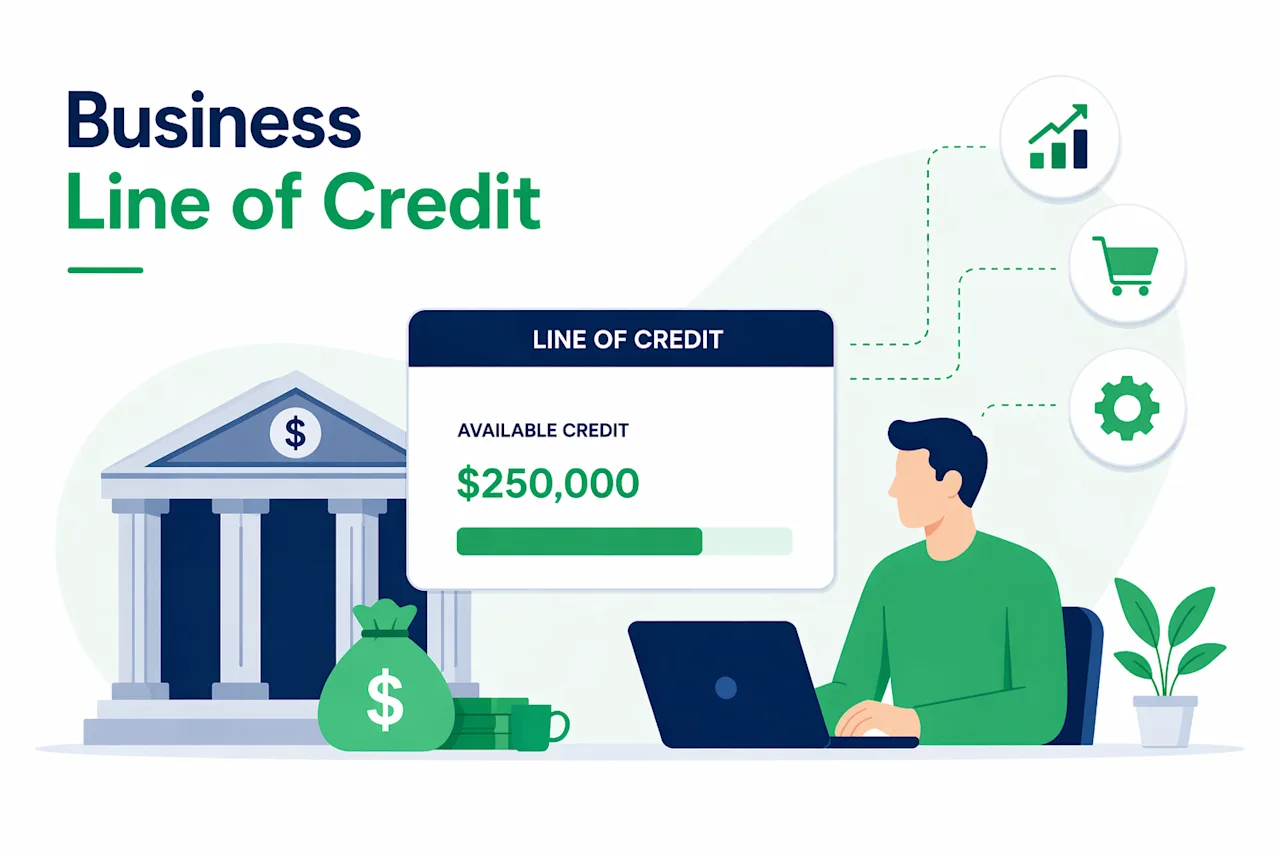
A business line of credit is one of the most flexible financing tools a growing company can have in its corner. Unlike a traditional loan that drops a lump sum in your account and starts charging interest from day one, a business line of credit works more like a safety net you can draw from when you need it, repay, and use again. You pay interest only on what you actually borrow.
For businesses dealing with uneven cash flow, seasonal demand, slow-paying clients, or sudden growth opportunities, that kind of flexibility is not just convenient. It is often the difference between capturing an opportunity and watching it pass.
According to the Federal Reserve's 2024 Small Business Credit Survey, 43% of small businesses applied for a line of credit, making it the single most sought-after financing product among small business owners in the US. And yet, a lot of business owners still don't fully understand how it works, what it costs, or whether they actually qualify.
This guide covers all of it. By the end, you will know exactly what a business line of credit is, what it costs, whether you qualify, and how to use it effectively.
What Is a Business Line of Credit?
A business line of credit is a credit facility that gives your business access to a set pool of funds up to a pre-approved limit. You draw from it when needed, repay what you've used, and the credit replenishes automatically. Think of it less like a loan and more like a financial buffer that's always there.
The key distinction from a term loan: with a loan, you receive the full amount upfront and pay interest on all of it from day one. With a business line of credit, you access only what you need, when you need it. If you have a $200,000 line and you draw $40,000, interest accrues only on $40,000.
This structure is what makes a business line of credit particularly effective for managing working capital, handling short-term obligations, and bridging the gap between when money goes out and when it comes in.
How Does a Business Line of Credit Work?

The mechanics are simple once you understand the cycle.
Step 1 - Approval and limit setting. When you apply for a business line of credit, your lender reviews your business financials, credit history, and revenue. Based on this, they approve a credit limit - for example $150,000.
Step 2 - Drawing funds. Once your business line of credit is active, you can draw funds any time through an online portal, business checking account, or dedicated card linked to the line. You choose how much to draw, up to your available limit.
Step 3 - Using the funds. Use the capital for whatever your business needs: inventory, payroll, a marketing push, a vendor payment that can't wait.
Step 4 - Repayment. You make scheduled repayments, typically monthly. Each repayment restores your available credit.
Step 5 - Reuse. Once repaid, the credit is available again. No need to reapply each time.
That structure is what makes a business line of credit fundamentally different from most other financing products. It is a standing resource, not a one-time transaction. A business line of credit stays open and available for as long as you maintain it in good standing.
Types of Business Line of Credit
Not all **business line of credit** options are structured the same. Understanding the main types helps you pick the one that actually fits your situation.
Secured vs Unsecured Business Line of Credit
| Feature | Secured | Unsecured |
|---|---|---|
| Collateral required | Yes (inventory, receivables, equipment, real estate) | No |
| Risk to your assets | Higher - lender can claim assets on default | None - no asset backing |
| Interest rates | Generally lower | Generally higher |
| Credit limits | Often higher | Varies, typically lower |
| Approval criteria | Asset value matters alongside credit | Credit and revenue focused |
| Approval speed | Slower due to asset evaluation | Faster |
| Best for | Businesses with assets willing to pledge them | Businesses prioritising speed and flexibility |
A secured business line of credit gives lenders more protection, so they often offer better rates and higher limits. But the trade-off is that a blanket lien may be placed on your business assets, which can limit your ability to access other financing.
An unsecured business line of credit requires no collateral. Approval leans more heavily on your credit score and revenue. It typically moves faster and does not encumber your assets, which is a significant operational advantage.
Revolving vs Non-Revolving
Most business lines of credit are revolving, meaning your credit replenishes as you repay. Some lenders offer non-revolving structures where the line closes once fully drawn and repaid, similar to a term loan. For ongoing working capital needs, revolving is almost always the better choice.
Business Line of Credit Interest Rates and Costs
One of the most common questions: what does a business line of credit actually cost?
Rates on a business line of credit vary significantly depending on the lender, your credit profile, the type of line, and market conditions. Here is a general reference:
| Lender Type | Typical APR Range |
|---|---|
| Traditional banks (secured) | 7% to 15% |
| Traditional banks (unsecured) | 10% to 22% |
| Online lenders | 15% to 45% |
| Credit unions | 8% to 18% |
| Alternative fintech lenders | 20% to 60% |
For comparison, business credit cards typically charge 20% APR or higher on purchases. A business line of credit from an established lender is almost always cheaper than a credit card for larger, short-term capital needs.
Beyond the interest rate, watch for these additional costs:
Origination or draw fee - Some lenders charge 1% to 3% each time you draw from the line.
Annual or monthly maintenance fee - A standing fee to keep the business line of credit open, usually $100 to $300 per year or a small monthly charge.
Unused line fee - Some lenders charge a percentage (typically 0.1% to 0.5%) on the unused portion of your credit limit each month.
Early repayment fee - Rare, but some structured lines include a penalty if you repay ahead of schedule.
Renewal fee - When your line comes up for annual review, some lenders charge 0.5% to 2% of the credit limit to renew access.
Always ask for the full fee schedule, not just the interest rate. The APR is the number that tells you the true annual cost of borrowing.
Business Line of Credit vs Business Loan
This is the most common comparison people make, and the distinction is genuinely important.
| Factor | Business Line of Credit | Business Loan |
|---|---|---|
| How funds are accessed | Draw as needed, up to limit | Full amount disbursed upfront |
| Interest charges | Only on amount drawn | On entire loan balance |
| Reusability | Revolving, reusable after repayment | One-time, cannot be reused |
| Repayment structure | Flexible, tied to draws | Fixed schedule regardless of cash flow |
| Best for | Ongoing working capital, variable needs | Specific, defined purchases |
| Speed of access | Instant once line is open | Application required each time |
| Collateral | Often unsecured options available | Often requires hard assets |
The simplest framing: a business line of credit is for flexible, recurring access to capital. Use a business loan when you have a specific, defined expense like equipment, a property purchase, or a long-term investment.
Neither is universally better. They solve different problems. The right choice comes down to what you need the capital for and how long you need it.
Business Line of Credit vs Business Credit Card
Both are revolving credit products. The differences are more meaningful than most people realise.
A business line of credit typically offers larger amounts, lower interest rates, and direct cash access - which means you can pay suppliers, make payroll, or transfer funds directly to your account. You are not limited to card-based transactions.
A business credit card is better for smaller, day-to-day purchases where the rewards program adds value. The interest rate on a card is almost always higher, and the credit limit tends to be lower.
For working capital management, a business line of credit almost always wins on cost. For routine purchases under $5,000, a card may be more convenient.
How to Qualify for a Business Line of Credit
This is where a lot of business owners get surprised. Qualification criteria vary by lender, but here are the benchmarks most lenders use:
Credit score. For unsecured lines, most traditional banks want a personal credit score of at least 680 to 720. Online lenders and fintech providers may approve from 600 upward. Scores below 600 make qualification difficult, though some secured options exist.
Time in business. Most banks require at least 2 years of operating history. Online lenders typically require 1 year. Some alternative lenders work with businesses as young as 6 months if revenue is strong.
Annual revenue. Requirements vary widely. Traditional banks often require $250,000 or more in annual revenue. Fintech lenders may start from $100,000. Some programs, including those designed for high-growth businesses, set the minimum at $2 million.
Profitability. Most lenders want to see a positive net worth and some level of profitability. A business running consistent losses will find it much harder to qualify regardless of revenue.
Documentation typically required:
- 6 to 12 months of business bank statements
- Business tax returns (1 to 2 years)
- Profit and loss statement
- Balance sheet
- Business license or incorporation documents
- Personal identification of owners
A note on personal guarantees. Many lenders - especially banks - require a personal guarantee from business owners holding 20% or more equity. This means your personal credit and assets are on the line if the business defaults. Some fintech lenders offer no-personal-guarantee structures.
Can You Get a Business Line of Credit with Bad Credit?
The honest answer is: it's harder, but not impossible.
If your personal credit score is below 620, traditional banks will likely decline. But some options remain:
Secured lines of credit - Backing the line with collateral (equipment, inventory, a deposit account) reduces lender risk and can open doors even with weaker credit.
Revenue-based providers - Some lenders weigh monthly revenue more heavily than credit score. If your business generates consistent cash flow, this can work in your favour.
Credit union programs - Credit unions often have more flexible underwriting than commercial banks, particularly for established local businesses.
Build credit first - Paying down existing debt, removing errors from your credit report, and ensuring all existing obligations are paid on time can move your score meaningfully within 3 to 6 months.
One thing worth knowing: applying for multiple lines of credit in a short window can hurt your score through hard inquiries. Pre-qualify before you formally apply wherever possible.
What Can You Use a Business Line of Credit For?
A business line of credit is not earmarked for a specific purpose. This is one of its biggest practical advantages over most loans. You can direct capital from your business line of credit wherever it is most needed at any given time. Common uses include:
- Inventory purchases - Buying stock ahead of peak season without depleting cash reserves
- Payroll - Covering wages during slow periods or when receivables are delayed
- Vendor and supplier payments - Paying on time to protect supplier relationships and secure better terms
- Marketing and customer acquisition - Front-loaded spend that takes time to return revenue
- Equipment repairs - Unplanned but urgent operational costs
- Bridging receivables gaps - Covering operating costs while waiting on 30, 60, or 90-day customer payments
- Short-term growth investments - Taking on a larger order or contract that requires upfront capital
That flexibility is what makes a business line of credit a working capital tool rather than just a financing product.
Benefits of a Business Line of Credit
Pay only for what you use. Interest accrues only on drawn amounts, not on your total approved limit. If you have a $200,000 line and draw $30,000, your interest cost is based on $30,000.
Reusable capital. Once repaid, the credit is available again. You are not starting a new application every time you need funds.
Speed of access. Once the line is open, funds can typically be accessed within 24 hours of a draw request - sometimes faster. This is meaningfully quicker than any new loan application.
No equity dilution. Unlike raising investment, a business line of credit does not require giving up any ownership stake in your business.
Builds business credit. Consistent, on-time repayment on a business line of credit builds your business credit profile over time, which improves future financing terms.
Operational stability. Having access to a standing credit facility - even if you rarely use it - means you can handle unexpected costs without panic.
Risks and Drawbacks to Know Before You Sign
No financing product is without trade-offs, and a business line of credit is no exception. It has several risks worth understanding clearly.
Variable interest rates. Most lines of credit are tied to a benchmark rate like the Prime Rate or SOFR. When rates rise, your cost rises with it - sometimes with as little as 30 days notice. If you signed when Prime was 5% and it moves to 7%, your margin increases accordingly.
Fees can accumulate. Annual fees, draw fees, and unused line fees add to your effective cost even when you are not actively borrowing. A line that costs you $500 per year in maintenance fees is effectively raising your APR if you only draw small amounts occasionally.
Risk of over-reliance. A business line of credit is a short-term working capital tool, not a substitute for equity or long-term financing. Using it to fund long-term investments or to mask structural cash flow problems is a mistake. If you find yourself drawing continuously with no ability to repay, that is a signal that the underlying business model needs attention, not more credit.
Collateral and lien implications. Secured lines often come with a UCC-1 blanket lien on your business assets. This can limit your ability to access additional financing elsewhere, since other lenders can see existing claims on your assets.
Annual renewal requirements. Most lines of credit are reviewed annually. If your financials have deteriorated, your lender can reduce your limit, increase your rate, or close the line entirely at renewal.
How to Apply for a Business Line of Credit
Applying for a business line of credit does not have to be complicated. Here is the standard process:
1. Assess your needs. Before applying for a business line of credit, ask: how much do you actually need access to? What will you use it for? This shapes which product and provider is right for you.
2. Check your credit. Pull your personal and business credit reports before applying. Fix any errors. Know your score so you can target lenders whose minimums you meet.
3. Compare lenders. Look at banks, credit unions, and fintech lenders. Compare interest rates, fees, limits, and qualification criteria. Do not just pick the first offer.
4. Gather your documents. Bank statements (6-12 months), tax returns, P&L, balance sheet, business licence. Having these ready speeds the process significantly.
5. Pre-qualify where possible. Many lenders offering a business line of credit will let you check eligibility through a soft-inquiry pre-qualification that does not affect your credit score. Use this before committing to a hard application.
6. Submit your application. Online lenders often return decisions in 24 to 72 hours. Banks can take 1 to 3 weeks.
7. Review the offer carefully. Before you sign, read the full agreement. Understand the rate (fixed or variable), all fees, the repayment structure, any lien implications, and the renewal terms.
8. Use it strategically. Once open, treat the line as a precision tool, not a general fund. Draw for specific, defined needs. Repay on schedule. Keep utilisation below 50% of your limit where possible, as high utilisation can affect your credit profile.
Business Line of Credit for Small Businesses and Startups
Small businesses face a real challenge when applying for a business line of credit. Banks want 2 years of history and strong financials. But most of the situations where a small business needs a business line of credit - rapid growth, uneven cash flow, seasonal demand - happen precisely in those early years when bank approval is hardest to get.
The options that tend to work for small businesses seeking a business line of credit:
Online and fintech lenders typically have lower revenue minimums, shorter time-in-business requirements, and faster decisions. The trade-off is higher interest rates. For a business that is growing and can service the debt from revenue, that trade-off is often worth it.
Credit unions often offer more flexible underwriting and community-focused relationships that traditional banks do not. If you bank with a local credit union already, start there.
SBA lines of credit - The US Small Business Administration does not directly lend, but it guarantees loans through partner banks. The SBA CAPLines program offers lines of credit specifically for small businesses, with government backing reducing lender risk and improving your approval odds. See sba.gov for current programs.
Build before you need it. The most consistent advice from business owners who have navigated this: apply for a line of credit when your business is doing well, not when you are in a cash crunch. Lenders approve businesses that look strong. If you wait until you need the money urgently, your financials may not support it.
How a Business Line of Credit Affects Your Credit Score
There are two types of credit inquiries involved:
Hard inquiry at application. When you formally apply, the lender pulls a hard credit check. This typically reduces your personal score by 3 to 8 points and remains on your report for 2 years. Multiple applications in a short window compound this effect.
Ongoing impact. Once open, a business line of credit affects your credit through utilisation (how much of the limit you are using) and payment history. Keeping utilisation low and making every payment on time builds your profile. Missing payments or maxing out the line damages it.
Handling a business line of credit responsibly over 12 to 24 months can meaningfully strengthen both your personal and business credit profiles, which improves the terms you can access in future financing.
Frequently Asked Questions About Business Lines of Credit
What credit score do I need for a business line of credit?
Most traditional banks look for a personal credit score of at least 680 when evaluating a business line of credit application. Online lenders and fintech providers often approve from 600 upward. Below 600, your options narrow to secured lines or revenue-focused lenders.
Can a new business get a line of credit?
Yes, though it is more limited. Some online lenders offer a business line of credit to companies as young as 6 months with consistent revenue. Traditional banks usually require at least 2 years of operating history. Having a strong personal credit score helps significantly when business history is thin.
Does a business line of credit affect my personal credit?
Applying for a business line of credit triggers a hard inquiry on your personal credit. Ongoing, if you provide a personal guarantee - which most lenders require - your personal credit is tied to the account. Late payments or defaults will show on your personal report.
What is the difference between a business line of credit and a business credit card?
Both are revolving, but a business line of credit gives you direct cash access, typically at lower rates, and usually with a higher limit. A credit card is better for smaller frequent purchases and often comes with rewards. For larger working capital needs, the line of credit almost always wins on cost.
How long does it take to get approved for a business line of credit?
Online lenders can return a decision in 24 to 72 hours. Traditional banks typically take 1 to 3 weeks, sometimes longer if additional documentation is requested. Once approved, a draw can usually be processed within 24 hours.
Can I have more than one business line of credit?
Yes. Some businesses maintain multiple business line of credit facilities - for example a bank line for larger draws and a fintech line for faster access. Lenders will see existing credit facilities when they review your application, and having too many open lines can raise questions about leverage.
What fees come with a business line of credit?
The main ones to ask about: annual maintenance fee, draw fee, unused line fee, origination fee, and any early repayment penalty. Always ask for a complete fee schedule, not just the interest rate.
What happens if I do not use my business line of credit?
The business line of credit remains available for the term of the agreement. Some lenders charge an unused line fee on the undrawn portion each month. Others do not. Check your agreement. Keeping a line open and unused is not a problem in itself - it can actually help your credit utilisation ratio - but factor in any maintenance costs.
Can I pay off my business line of credit early?
With most business line of credit structures, yes, and there is usually no penalty. Some structured lines include an early repayment fee, so confirm this in your agreement before signing. Paying down the balance early reduces interest costs and restores your available credit.
What is a blanket lien and should I be concerned?
With a secured business line of credit, a UCC-1 blanket lien is a legal filing that gives your lender a claim over all your business assets as security. The practical concern: it signals to other lenders that your assets are encumbered, which can make accessing additional financing harder. If lien-free access is important to you, look for unsecured options or providers that specifically do not require UCC filing.
Drip Capital Business Line of Credit
For businesses in trade, manufacturing, distribution, and wholesale that need reliable working capital without collateral requirements, Drip Capital offers a business line of credit built around how trade businesses actually operate.
What it includes:
- Credit lines up to $1 million
- Funds available within 24 hours of a draw request
- No personal guarantee required
- No UCC blanket lien filing
- Fully drawable and revolving structure
- Fixed monthly repayment on each draw
- Works alongside domestic and international operations
Who it is designed for:
- US-based businesses with minimum $2 million in annual revenue
- 2 years of operating history
- Positive net worth and profitable operations
Unlike traditional bank lines that tie up your assets or require lengthy approval processes, Drip Capital's facility is structured for businesses that move fast and need capital that keeps up with them.
With over $9 billion in trade transactions facilitated and more than 11,000 businesses served globally, Drip Capital has the track record and the product to support businesses at every stage of growth.
Apply now or call +1 (650) 437-0150 to speak with one of our specialists.
Also Read: