

C&I Loans vs Working Capital Loans: How to Tell Them Apart
A business owner calls a bank asking about a working capital loan and gets routed into an application for a commercial and industrial loan. Nothing went wrong. The two terms describe overlapping territory from two different directions. Understanding C&I loans vs working capital loans matters most when a business is shopping for financing and needs to know which door to walk through first, a bank's or somewhere else entirely.
What Does "C&I Loan" Mean?
A C&I loan is a bank's own classification. Regulators require banks to sort every commercial loan into a reporting category, and "commercial and industrial" is the bucket for credit extended to a business for a business purpose, as opposed to a consumer loan or one secured mainly by residential real estate. The label describes who is borrowing and under which regulatory bucket sits over the loan.
That is the core of the difference between C&I loan and working capital loan framing: a C&I loan can fund payroll during a slow month, but it can just as easily fund a piece of equipment, an expansion project, or the building a business occupies (our companion explainer, "Commercial and Industrial (C&I) Loans: What They Are and How They Work," covers this full definition and the three loan structures banks use). Our companion guide, C&I Loan Interest Rates, walks through how current interest rates get set on a C&I loan, including the benchmark-plus-spread pricing banks use across all three structures (revolving lines, term loans, and owner-occupied real estate loans).
What Does "Working Capital Loan" Mean?
A working capital loan, by contrast, is defined by purpose. It describes financing raised specifically to cover the operating cash gap between paying bills and collecting revenue: payroll, inventory, rent, and the timing lag on receivables. Nobody at a bank files a loan under "working capital" on a call report. It is a description a business owner reaches for, not a classification a regulator assigns.
Because it is purpose-defined, a working capital loan can arrive in several forms. A bank might structure it as a revolving line of credit, which happens to also be a C&I loan. Or it might come from somewhere that never touches the C&I reporting bucket at all: invoice financing, a merchant cash advance, or trade-specific financing built around a purchase order or a vendor payment. Drip Capital's own working capital guide breaks down how the cash conversion cycle creates this gap in the first place, and a separate Drip Capital post on how a working capital loan works covers the application-to-repayment mechanics without re-explaining the underlying concept here.
Where C&I Loans and Working Capital Loans Overlap
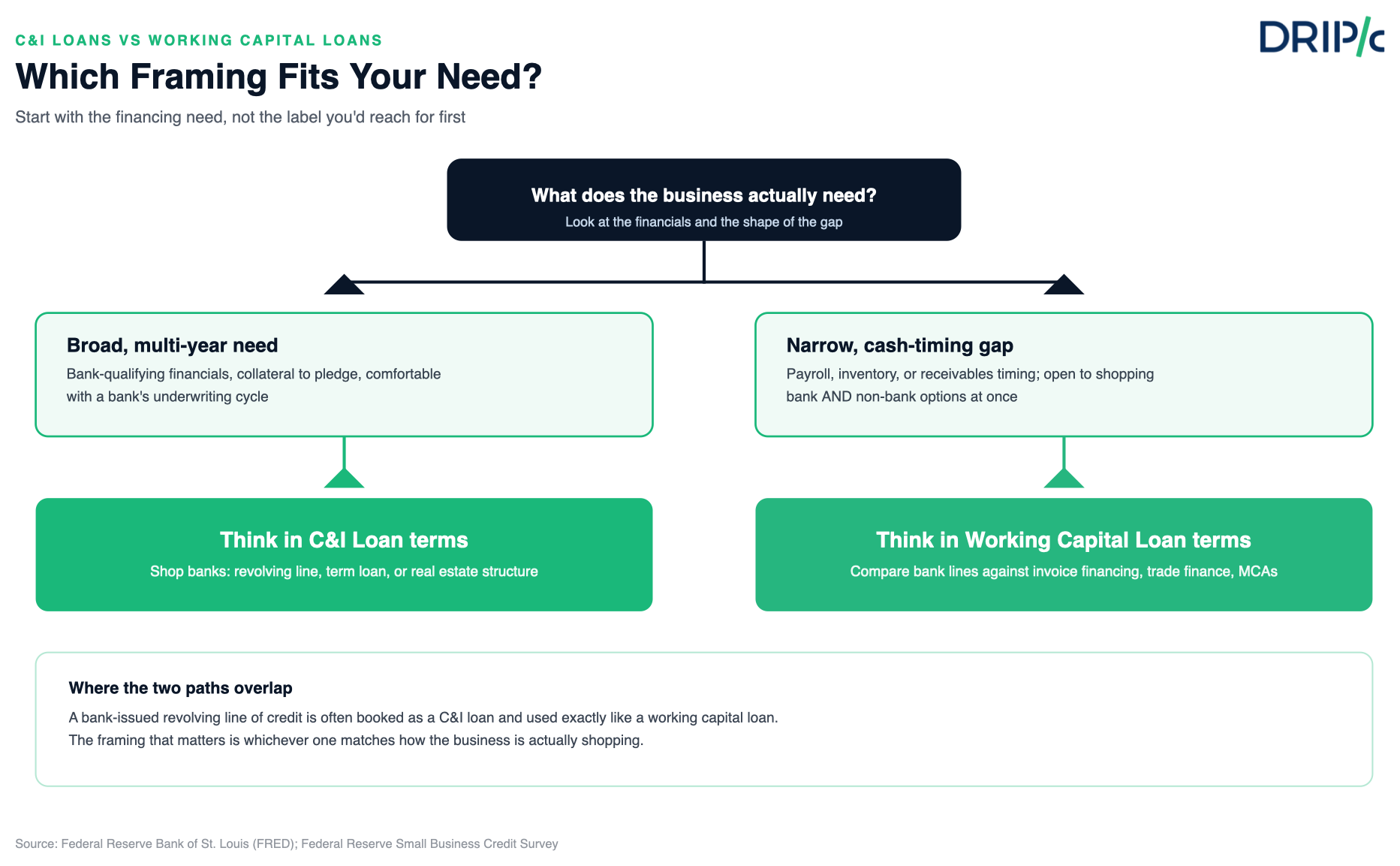
Here is where the two terms genuinely collide: a large share of C&I loans and working capital needs are the same loan, described from two different angles. A revolving line of credit that a bank books as a C&I loan is, in practice, exactly what most business owners mean when they say working capital loan. Same paperwork, same underwriting, same funds sitting in the same account. The bank calls it C&I because that is the regulatory bucket; the business owner calls it working capital because that is what the money does.
This overlap is real, but it is not total.
Where a C&I Loan Isn't a Working Capital Loan
Plenty of C&I loans fund things that have nothing to do with a cash-timing gap. A term loan for a new piece of manufacturing equipment is a C&I loan. So is a loan to buy or renovate a warehouse the business occupies itself. Both sit inside the same regulatory bucket as a working-capital-purposed revolving line, but neither one is solving an operating cash gap; they are funding a fixed asset with a repayment schedule tied to that asset's useful life.
A business asking a bank purely for a working capital loan and getting steered toward a fixed-asset term structure has landed in the wrong conversation.
Where Working Capital Financing Isn't a C&I Loan
The reverse gap matters just as much. A meaningful share of working capital vs commercial and industrial loan questions get resolved outside a bank altogether, because plenty of working capital financing never touches the C&I classification at all. Invoice factoring sells receivables to a third party outright. A merchant cash advance trades a slice of future card sales for cash today. Trade-specific financing, including the products Drip Capital offers, funds a transaction directly, without ever sitting on a bank's balance sheet as a regulatory-classified loan.
By the numbers
C&I LENDING AND WORKING CAPITAL DEMAND IN 2026
$2.90T
Total C&I loans outstanding
at all US commercial banks, July 2026
56%
Of firms that applied for financing
did so to meet operating expenses, 2026
60%
Of firms applied for financing
in the 12 months before the survey, 2026
6.75%
Bank Prime Loan Rate, the common
pricing base for C&I loans, Sept 2026
Source: Federal Reserve Bank of St. Louis (FRED), Federal Reserve Small Business Credit Survey
Structural Differences: Bank Product vs Broader Category
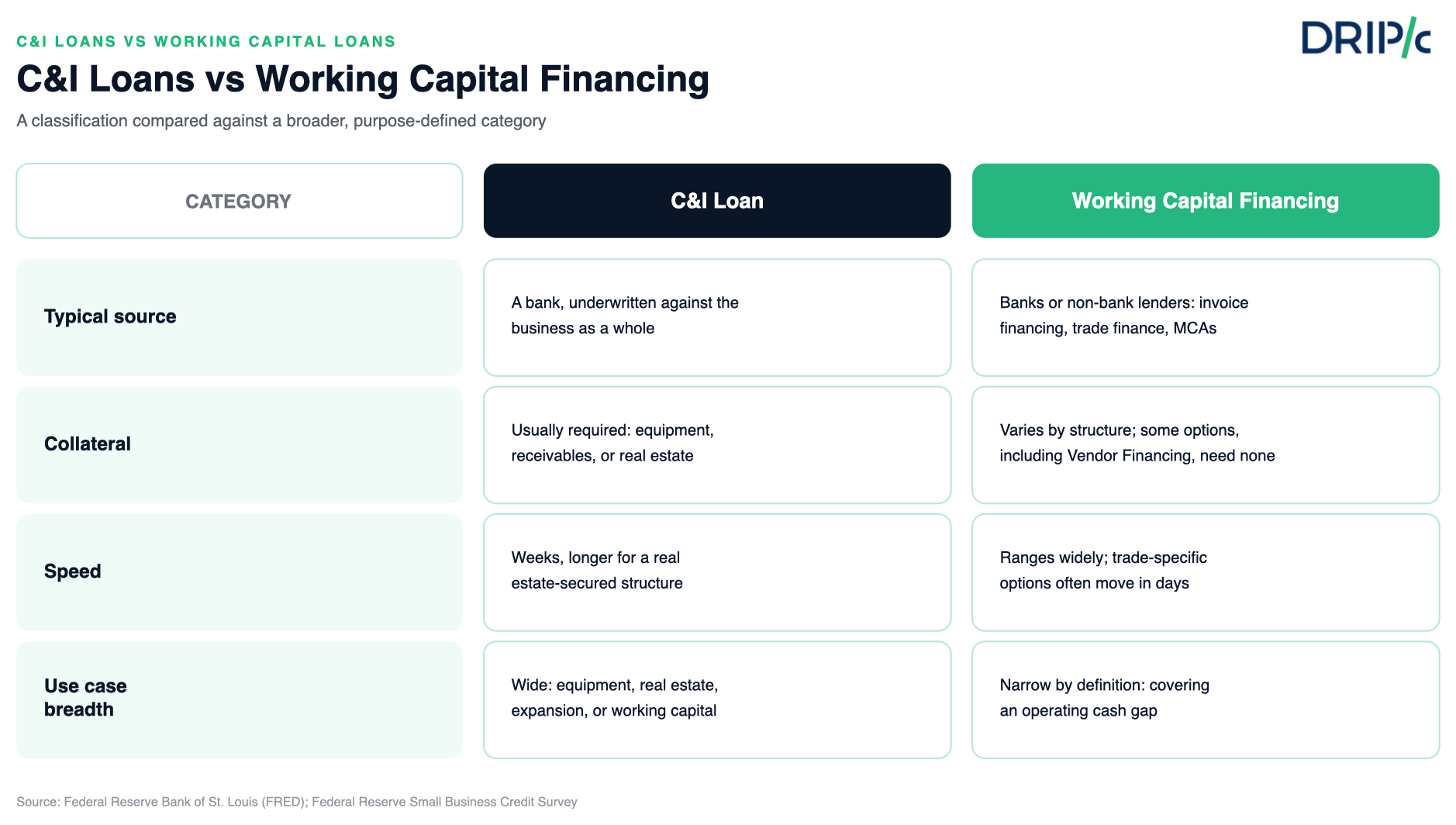
Sorting out C&I loans and working capital at the structural level makes the practical difference clearer. A C&I loan is, almost by definition, a bank product: a revolving line, a term loan, or a real estate loan, underwritten against the business's financials and usually secured by collateral, built around a multi-year banking relationship. Working capital loan is a broader category that spans both bank and non-bank options. It includes everything a C&I loan covers, plus financing that a bank's C&I desk never touches at all.
That breadth is the practical reason the two terms are not interchangeable, even where they overlap. A business asking "which loan is right for my business" purely in C&I terms has quietly narrowed its own search to banks, when the actual need, closing a cash-timing gap, might be better served by a non-bank option built around the transaction itself.

Which Framing Fits Your Business?
Think in C&I loan terms when the business has bank-qualifying financials (several years of clean statements, steady cash flow, collateral to pledge), wants one broad facility built to last several years, and is comfortable with a bank's underwriting timeline. That timeline can run weeks, longer for a real estate-secured structure.
Think in working capital loan terms when the actual need is narrower: a specific gap between a vendor payment and a customer receipt, or a seasonal inventory build that needs bridging. In that case, the smarter move is shopping across bank and non-bank options at once, since the fastest and cheapest fit does not always wear a C&I label. A business with a strong order but thin financial history, for instance, often clears a trade-specific underwriter's bar faster than a bank's.
Where Drip Capital Fits
Framing a need as a C&I loan search works well for a business with the financial history and collateral a bank wants to underwrite against. It works less well for a business whose cash timing tracks a shipping schedule or a vendor's payment terms, since that mismatch is exactly what a bank's C&I underwriting struggles to read cleanly.
Drip Capital serves that second group directly. Vendor Financing pays a vendor directly on a transaction basis, requires no collateral, and is available to businesses with a minimum of two years in operation and $2 million or more in annual revenue; repayment runs up to 90 days, and the cost is a flat fee on the invoice, applied only to the amount drawn and only while it stays outstanding.
Drip Capital's Line of Credit is a revolving facility from $50,000 to $1 million, with a credit decision typically inside 48 hours and draws funded within 24 hours of approval. There is no prepayment penalty, no annual maintenance fee, and no blanket lien or UCC filing unless the account goes into default. A draw fee applies, along with interest on the amount actually used.
Neither product is filed under a bank's C&I classification. Both exist to close the exact cash-timing gap that "working capital loan" was always meant to describe.
Frequently Asked Questions
Is a C&I Loan the Same as a Working Capital Loan?
Sometimes, but not always. A C&I loan vs working capital loan comparison comes down to classification versus purpose: a C&I loan is a bank's regulatory bucket for business-purpose lending, while a working capital loan is defined by what the money covers, an operating cash gap. Many C&I loans are used for working capital, but plenty fund equipment, expansion, or real estate instead.
What's the Difference Between C&I Loans and Working Capital Loans?
A C&I loan describes how a bank classifies the loan; a working capital loan describes what the money is for. The difference between C&I loan and working capital loan framing matters most when a business is deciding where to shop, since working capital needs can be met by non-bank lenders that never touch the C&I bucket at all.
Can Working Capital Financing Come From a C&I Loan?
Yes. A revolving line of credit or a short-term loan that a bank books as a C&I loan is often exactly what a business means by working capital financing, which is the heart of the working capital vs commercial and industrial loan overlap. The overlap is real, it just is not the whole picture.
Which Loan Is Right for My Business?
It depends on what the money needs to do and how the business's financials look on paper. A business with bank-qualifying history and a broad, ongoing need often fits a C&I loan; a business with a narrower, transaction-specific cash gap often finds a faster fit outside a bank's C&I underwriting entirely.
Does a Working Capital Loan Always Require Collateral?
No. Some working capital financing, including certain trade-specific products, is collateral-free, while many bank-issued C&I loans built for working capital do require collateral. The requirement depends on the specific lender and structure involved.