

Working Capital Loan for Business: How It Works
A working capital loan sounds like one thing and turns out to cover a wide range of structures once a business actually applies for one. The name describes a purpose: money sized to cover the gap between paying for goods, payroll, and rent now and collecting revenue later. It describes a purpose more than a single fixed product. Understanding the purpose is the easy part. Understanding what happens between the day you apply and the day you're paying it back is where most business owners get surprised.
This piece walks through the mechanics: what a working capital loan is, what a lender asks for, how the decision actually gets made, how money moves once you're approved, how repayment works across different structures, and what happens when the term ends. None of it is tied to one lender's process. It's the shape the process takes across the market, so you know what's coming before you sign anything.
What a Working Capital Loan Actually Is
A working capital loan funds short-term operating needs. It covers payroll during a slow month, a vendor payment before a customer pays, or inventory ahead of a seasonal spike. A term loan for a delivery truck or a mortgage on a warehouse works on a different logic entirely: those are tied to a specific asset with a useful life measured in years, and the loan term usually matches it.
Working capital loans are shorter and more flexible by design. Some are structured as a single lump sum repaid over months. Others are revolving, so a business draws against a credit line as needs arise and repays as cash comes back in. A few are tied directly to a transaction, like a specific purchase order or invoice. The common thread is timing: the money exists to close the gap between an expense and the revenue that eventually covers it. A long-lived asset simply isn't the target here.
Business capital used for operations behaves differently from capital used for growth. A business loan earmarked for expansion assumes the money will generate new revenue over a long horizon. A capital loan for working capital assumes the revenue already exists somewhere in the pipeline; the loan just closes the timing gap.
Applying: What a Lender Actually Wants to See
Every lender asks for a version of the same core file, even though the format and depth vary.
Financial statements
Profit and loss statements and balance sheets, usually for the last two to three years, show whether the business is generating enough margin to support new debt. A lender reads these for trend more than the latest number alone: is revenue climbing, flat, or shrinking, and does the expense line move in a way that makes sense.
Bank statements
Three to twelve months of business bank statements let a lender see actual cash movement, the real record behind any summary a business might put together itself. Average daily balance, deposit frequency, and any pattern of overdrafts all get reviewed here.
Time in business
Most working capital lenders set a minimum, commonly one to two years, before they'll consider an application. A newer business isn't automatically disqualified everywhere, but it usually faces a smaller loan size, a higher cost, or both.
Tax returns and legal documents
Business tax returns (and sometimes the owner's personal returns), a copy of the entity's formation documents, and a government ID round out most application packages. Some lenders also ask for accounts receivable aging or a current inventory count, especially when the loan is sized against a specific asset like unpaid invoices.
By the numbers
How small businesses actually borrow
38%
of firms applied for a loan or line of credit
in the prior 12 months
56%
of applicants sought financing to
meet operating expenses
42%
of applicants received the full
amount of financing they sought
22%
of applicants received none
of what they applied for
Source: Federal Reserve, 2026 Report on Employer Firms (2025 Small Business Credit Survey)
Those last two figures matter for planning. Getting a partial approval, or none at all, is common enough that a business applying for a working capital loan should build a fallback plan before submitting the application. Waiting until a decline arrives leaves too little runway.
Underwriting: What Happens During the Decision Window
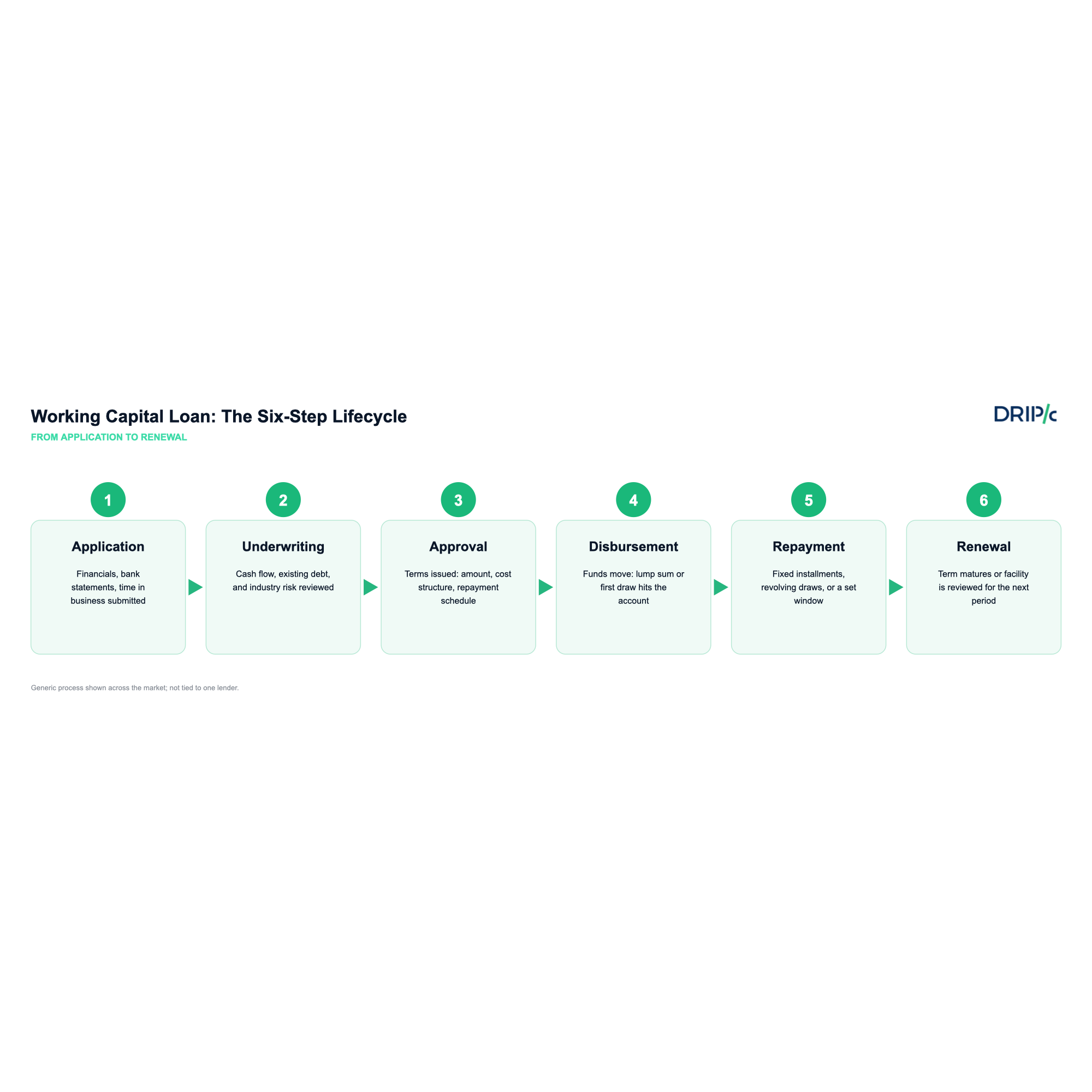
Underwriting is the review that turns a submitted application into an approval, a decline, or a counteroffer. A few things happen in this window, whether it takes two days or three weeks.
A lender reads the financials for cash flow coverage: does the business generate enough monthly cash to service the new payment on top of what it already owes. Existing debt gets pulled, often through a credit report and sometimes through a lien search, so the lender knows what else has a claim on the business's assets or revenue. Industry risk plays a role too; a business in a volatile or seasonal sector gets scrutinized more closely on cash flow timing specifically.
Some lenders layer in a personal credit check on the owner, particularly for smaller loan sizes where the business's own credit file is thin. Larger facilities lean more heavily on the business's own financial history and less on the owner's personal score.
The length of this window varies enormously. A line of credit against strong bank statements can clear in under 48 hours at some lenders. A term loan requiring a fuller financial package can take one to three weeks, longer if the underwriter comes back with follow-up questions on inventory valuation or receivable quality.
Approval and Disbursement: Getting the Funds
Once underwriting clears, the lender issues terms: loan amount, cost structure, repayment schedule, and any conditions attached (a lien on specific assets, a covenant on minimum cash balance). The business reviews and signs.
Disbursement speed depends heavily on structure. A revolving facility, once opened, can push a draw to the business's bank account within a day of the request. A term loan disbursement is usually a single deposit shortly after signing, sometimes same-day, sometimes within a few business days depending on the lender's operational process and whether funds route through a third party like a vendor being paid directly.
Repayment Mechanics: How the Money Actually Comes Back
This is where structure matters most, because "working capital loan" covers at least three distinct repayment patterns.
Term loan, fixed payments. The business receives a lump sum and repays it in equal installments (weekly, biweekly, or monthly) over a set term, typically six months to a few years. Each payment includes principal and cost, and the schedule is known in full on day one. This is the easiest structure to budget against because the number never changes.
Revolving line, draws and repayment. A business is approved for a credit limit and draws against it as needed; there's no single lump sum handed over upfront. Repayment happens on a rolling basis: some lenders require fixed installments after each draw, others allow the business to pay down the balance at its own pace and simply pay for what stays outstanding. Available credit typically replenishes as the balance is repaid, so the business can draw again without reapplying.
Transaction-tied repayment. Some working capital structures are linked to a specific event, like a vendor payment that gets repaid once the underlying sales cycle completes. These tend to carry a defined repayment window instead of a fixed installment schedule.
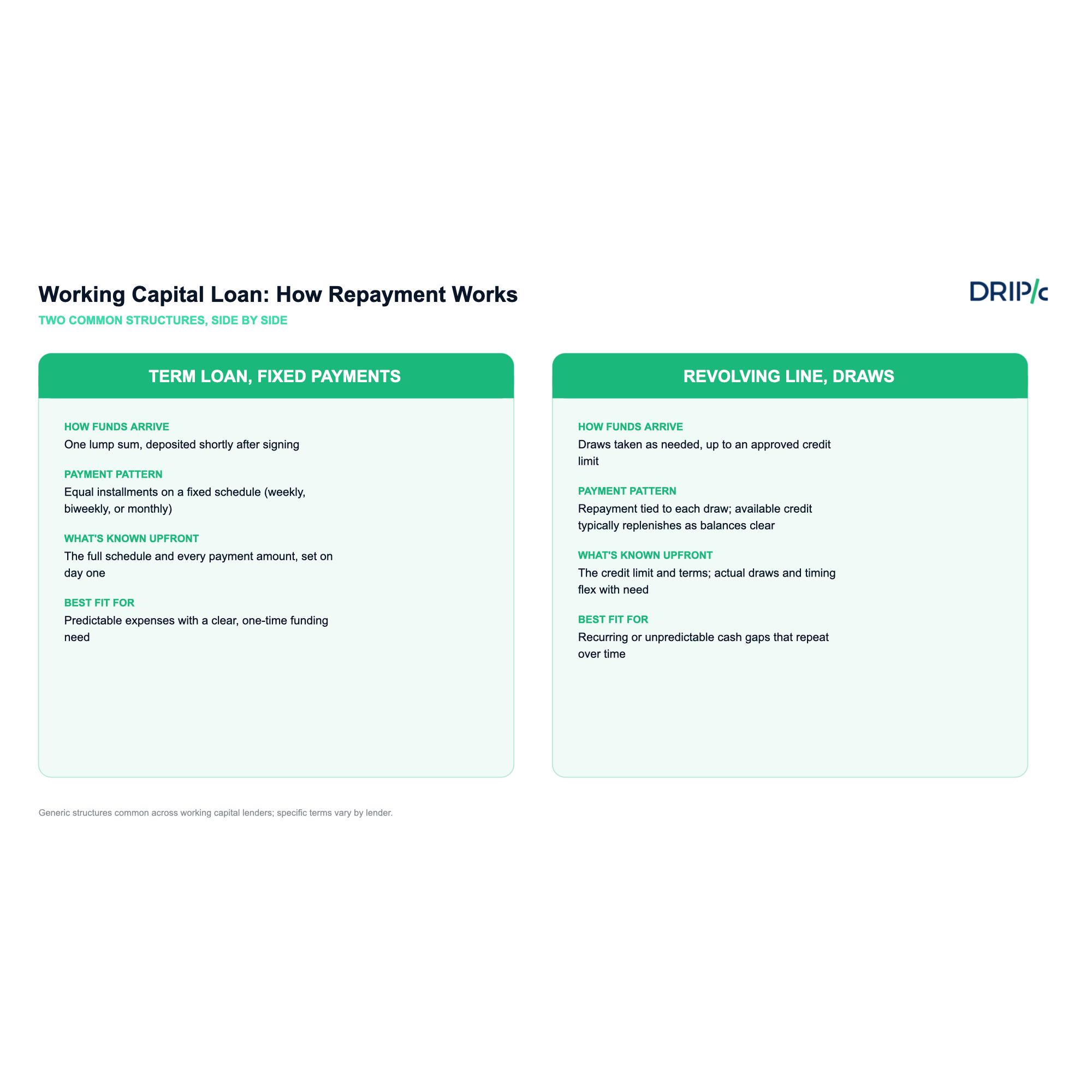

Whichever structure a business ends up in, the practical question is the same: does the repayment rhythm match the rhythm of the cash actually coming in the door. A weekly fixed payment works fine for a business with steady weekly receivables. It's a much tighter fit for a business collecting from customers on 60- or 90-day terms.
What Happens at the End of the Term
A fixed-term loan simply matures: the final payment clears and the obligation ends. Some lenders reach out near maturity with a renewal offer, particularly if the business has paid reliably, sometimes at improved terms reflecting the payment history built up.
A revolving line doesn't have a maturity date in the same sense, but it does have a review point. Most lenders revisit the facility periodically (annually is common) to confirm the business still qualifies at the same limit. Revenue has grown: the limit might increase. Revenue has softened or leverage has crept up: the lender might hold the limit flat or ask for updated financials before renewing.
Either way, businesses that treat the loan relationship as ongoing tend to get better terms over time. A lender with two or three years of on-time repayment history has less reason to price in uncertainty.
How Drip Capital's Products Execute This Lifecycle
Drip Capital runs this same lifecycle for businesses in cross-border trade specifically, through two products built for different points in that cash gap.
Vendor Financing covers the application-to-disbursement stretch when a business needs to pay a vendor before goods ship. Drip Capital pays the vendor directly, and the business repays up to 90 days later. It requires a minimum of two years in business and $2M or more in annual revenue, and it's collateral-free, so there's no lien to negotiate before funds move.
Drip Capital's Line of Credit follows the revolving structure described above, with a credit decision typically inside 48 hours and draws funded within 24 hours once approved. Repayment runs across six monthly installments per draw, there's no prepayment penalty, no annual maintenance fee, and no blanket lien or UCC filing unless the account goes into default.
For businesses that want a fuller side-by-side of financing options beyond these two structures, Drip Capital's comparison of working capital funding options and its guide to small business capital loan options both go deeper on how the alternatives stack up. Drip Capital's own working capital finance guide is a useful starting reference for the underlying concept before applying anywhere.
Frequently Asked Questions
How long does it take to get approved for a working capital loan?
It depends on the structure and the lender. A revolving line against strong bank statements can clear in under 48 hours at some lenders. A term loan requiring a fuller financial package usually takes one to three weeks. Missing documents or follow-up questions from underwriting add time either way.
What credit score do I need for a working capital loan?
There's no single threshold across the market; requirements vary by lender and by loan size. Some lenders weigh the business's own financial history more heavily than the owner's personal credit, particularly for larger facilities. Strong bank statements and consistent revenue can offset a thinner personal credit file at many lenders.
Can a new business get a working capital loan?
Most lenders set a minimum time in business, commonly one to two years, before they'll consider an application. A newer business isn't automatically excluded everywhere, but it typically faces a smaller loan size, a higher cost, or additional documentation requirements.
Is a working capital loan the same as a business line of credit?
No. A line of credit is one common structure for working capital, built around revolving draws and repayment. A working capital loan can also take the form of a fixed term loan or a transaction-tied facility. The purpose (funding short-term operating needs) is the same across all three; the repayment mechanics differ.
What happens if I can't make a payment on time?
Policies vary by lender, but a missed payment typically triggers a late fee, a credit report mark, or both. Facilities with a lien or covenant may also have specific default terms spelled out in the agreement. Reading those terms closely before signing saves a lot of confusion later, once a payment has already been missed.