

Small Business Capital Loan Options: A Framework for Comparing What's on the Table
Every business loan conversation starts the same way: a business owner needs cash and starts Googling. What comes back is a wall of loan options that all sound similar and score very differently once you look closely.
The problem is not a shortage of choices. It is that most comparisons list products one at a time, note the pros and cons, and leave the reader to build the comparison themselves. This piece works the other way. It starts with the criteria that actually decide which small business loan fits a given business, then scores the main options against each one.
The Five Criteria That Actually Separate Loan Options
Strip away the marketing and every business capital loan product gets judged on the same five things.
Speed to Funding
How long from application to cash in the account. This ranges from same-day to several months, and it is often the single biggest differentiator between products that otherwise look alike on paper.
Collateral Requirement
Whether the lender wants a lien on property, equipment, or receivables, or whether the loan is unsecured. Collateral requirements shape how much risk a business owner is personally taking on, not just whether the loan gets approved.
Cost Structure
Interest rate, factor rate, draw fees, or a flat fee on the amount used. Products that look cheap on the headline rate sometimes carry fees that only show up once you read the full agreement.
Repayment Structure
A single term schedule, a revolving line, or a percentage of daily sales. This determines how repayment interacts with a business's actual cash flow, which matters more than the sticker cost for many owners.
Eligibility Bar
Time in business, revenue minimums, credit score, and how much documentation the lender wants before saying yes. A product with a low headline requirement can still be effectively out of reach if the underwriting process is slow or opaque.
By the numbers
HOW SMALL BUSINESSES ARE ACTUALLY BORROWING
38%
of firms applied for a loan, line of
credit, or cash advance in 12 months
29%
of applicants sought an online lender,
up from 17% just five years earlier
60%
of online-lender borrowers said actual
costs ran higher than expected
2 to 10 days
SBA's own turnaround window for
a 7(a) Small loan decision
Source: Federal Reserve Banks, 2026 Report on Employer Firms (2025 Small Business Credit Survey data); U.S. Small Business Administration
Term Loans, Scored Against the Criteria
A term loan is the product most people picture when they hear business loan: a lump sum, a fixed schedule, a set number of months or years to pay it back.
Speed to funding is the weak point. A bank term loan typically closes only after a business has submitted full financials and a use-of-funds explanation, which takes real time to assemble and underwrite. Collateral is common on larger amounts; banks will often ask for equipment, real estate, or a blanket lien depending on loan size. Cost is usually the most competitive of any option here, since bank term loans carry some of the lowest rates available to small businesses that qualify. Repayment is simple: fixed monthly payments over a set term. Eligibility is the real gatekeeper. Strong personal credit, several years of financials, and steady revenue are typically expected before a bank will even schedule an underwriting call.
Term loans reward businesses that can wait for money and already look strong on paper. They are a poor match for anyone who needs cash this week.
SBA Loans, Scored Against the Criteria
SBA loans are not a single product; they are a government guarantee layered on top of a bank loan, which changes several of the criteria at once.
Speed varies by loan size and lender workload. The 7(a) Small program, covering loans of $350,000 or less, carries an SBA turnaround window of 2 to 10 business days once a lender submits the file; larger Standard 7(a) loans go through additional underwriting on top of that window, since a lender still has to assemble the full application before submitting it. Collateral rules are specific and worth knowing before applying. Under SBA Express, lenders are not required to take collateral on loans up to $50,000, but they'll typically apply their own policy above that line. Cost sits below most alternative lenders, since the SBA guarantee caps how much interest a lender can charge. Repayment stretches out further than a typical term loan, up to 25 years for real estate and up to 10 years for working capital and equipment. Eligibility is where SBA loans get their reputation for slow, paperwork-heavy underwriting: multiple years of tax returns, a detailed business plan, and often a personal financial statement from every owner with a meaningful stake in the business.
SBA loans reward patience with genuinely low cost. They are a strong fit for a business that can front-load the paperwork and does not need funding fast.
Merchant Cash Advances, Scored Against the Criteria
A merchant cash advance is not technically a loan. A funder buys a slice of a business's future card or bank sales in exchange for an upfront lump sum, then collects a fixed percentage of daily or weekly receipts until the advance is repaid.
Speed to funding is the entire pitch: approval and funding can move quickly, since underwriting mainly reviews recent bank statements. Collateral is not required in the traditional sense, since repayment is secured against future sales. Cost is the part that catches business owners off guard. Advances are priced with a factor rate, and that pricing structure can make the true cost harder to compare against a term loan or SBA loan quote for the same amount. Repayment is pulled daily or weekly as a percentage of sales, which tightens on slow days but also means a bad month reduces the payment automatically. Eligibility is the loosest of any option covered here: the funder is mainly underwriting sales volume.
A merchant cash advance solves a cash emergency. It is rarely the cheapest way to solve a recurring one.
Vendor Financing and Line of Credit: Fast, Collateral-Free Alternatives
Two categories sit apart from the products above because they are built around the deal or the relationship in front of them.
Vendor financing pays a business's vendor directly so goods can ship before the business has the cash on hand; repayment then runs on a timeline tied to the purchase, up to 90 days, without requiring collateral. Because underwriting looks mainly at the strength of the purchase order and the buyer relationship, approval can often move in days.
A revolving line of credit works differently: a business draws what it needs, repays it, and can draw again, without reapplying for a new loan every time. Structured well, a line of credit gives a business flexibility that a fixed term loan cannot; funds sit ready for the next slow month or unexpected order, and only the amount actually drawn accrues cost. Some revolving lines are collateral-free, which spares a business from reapplying for a fresh term loan every time cash gets tight, though it pays to read the fine print on what a line of credit can actually cost before signing.

Businesses with cross-border revenue or vendor relationships tend to run into a specific wall with the categories above. Many generic business loan programs are built around a US credit history and US-based collateral. A business importing from overseas vendors, or one whose receivables sit with an international buyer, often does not fit that mold cleanly, even when the underlying business is healthy and growing. That gap is white space most small business loan guides never mention, because most of them are written for a purely domestic buyer-vendor picture.
Scoring the Options Side by Side
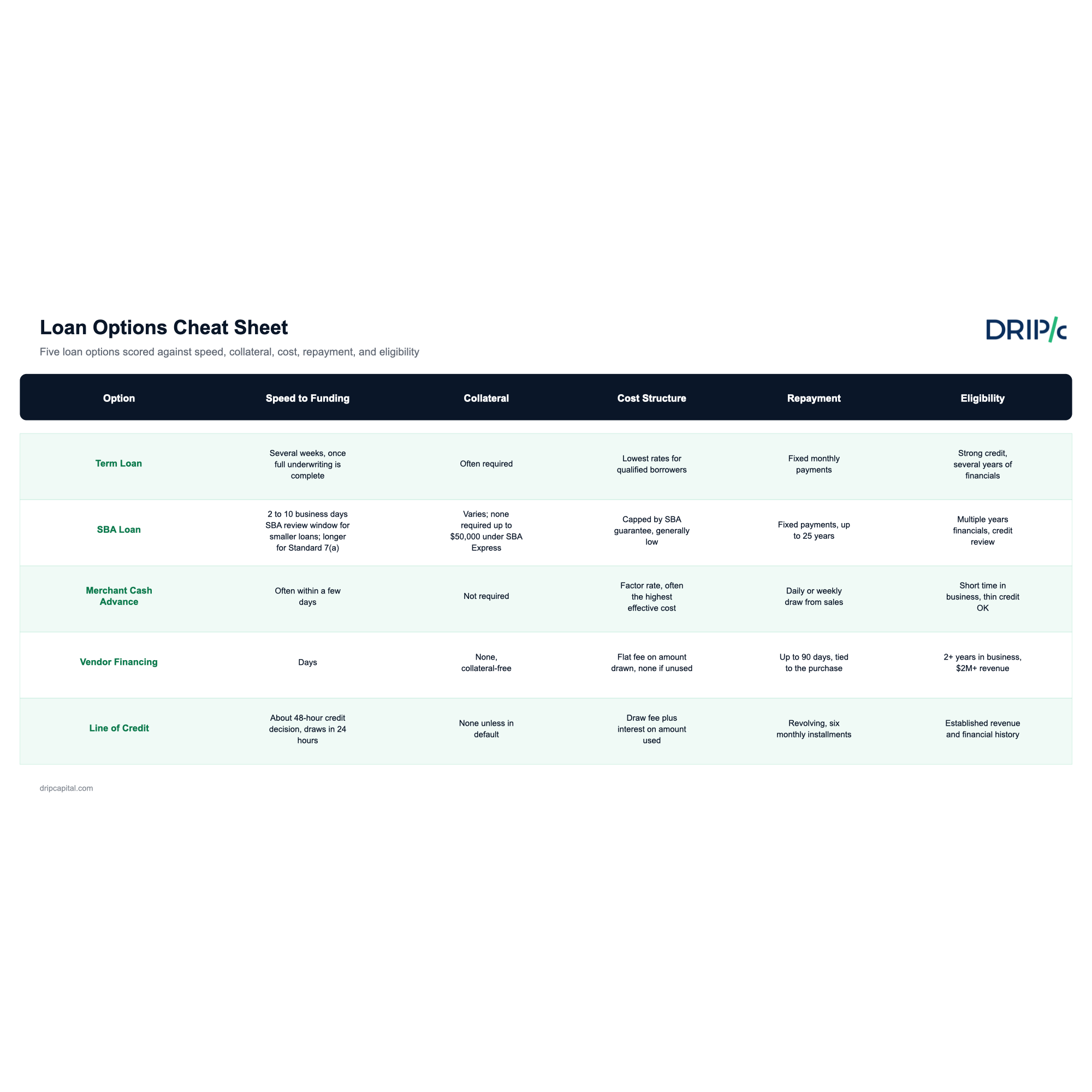
Laid next to each other, the six options split into two clear groups: the ones that reward patience and a strong credit file (term loans, SBA loans), and the ones built for speed, whether that speed comes at a real cost (merchant cash advances) or without one (Vendor Financing, Line of Credit).
How Drip Capital Fits Into the Comparison
Drip Capital offers two of the products scored above: Vendor Financing and a revolving Line of Credit, both built for businesses with cross-border trade activity that generic lenders often overlook.
Vendor Financing pays a business's vendor directly so an order can ship, then the business repays Drip Capital up to 90 days later. It is collateral-free, priced as a flat fee on the invoice, applied only to the amount drawn and only while it stays outstanding, and it is built for businesses with at least two years in business and $2M or more in annual revenue.
Drip Capital's Line of Credit is a revolving facility from $50,000 to $3 million, with draws funded within 24 hours of a one-time credit decision that typically takes about 48 hours. It repays over six monthly installments, carries no prepayment penalty, no annual maintenance fee, and no blanket lien or UCC filing unless the business defaults. That combination puts it closer to the flexibility of a bank line without the paperwork load a bank usually attaches to one.
Choosing the Right Option for Your Business
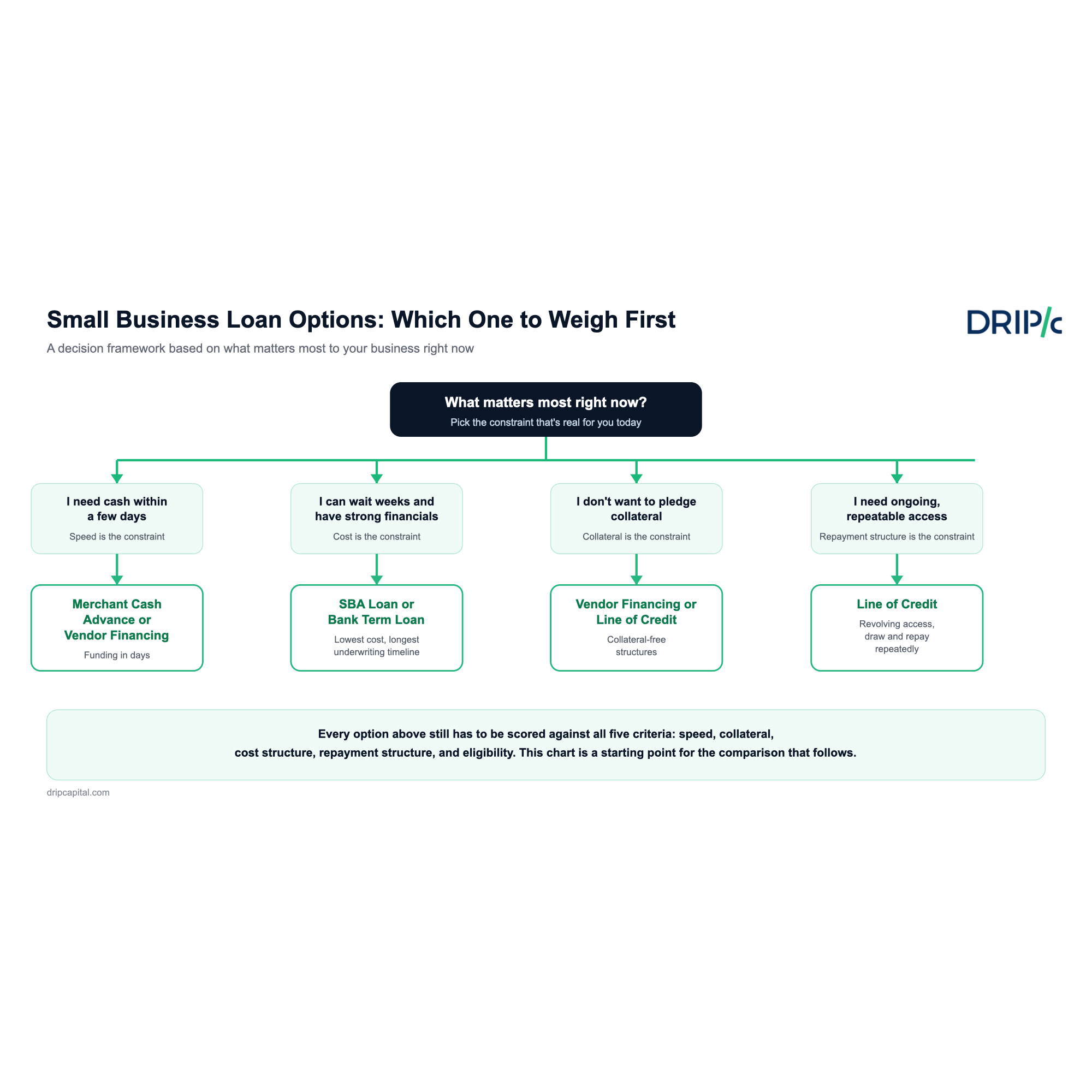
Start with whichever criterion actually constrains the decision this quarter. A business that can wait two months and has strong financials should look at SBA loans first. A business facing a cash emergency this week, with no time to build a full loan file, will likely end up looking at a merchant cash advance, cost and all. A business trying to pay a vendor before goods ship, or one that wants a flexible line without pledging collateral, fits the Vendor Financing and line of credit category best.
None of these five criteria works in isolation. The right business capital loan is the one that scores acceptably across all five for the specific situation a business faces this quarter. Headline rates and ad copy rarely capture that.
Working capital pressure rarely announces itself months in advance. The businesses that handle it well are usually the ones that already know which of these loan options fits, and have read a working capital finance guide before the pressure shows up.
Frequently Asked Questions
What is the fastest small business loan option?
Merchant cash advances and Vendor Financing tend to fund the fastest, often within a few days, because both rely mainly on transaction or sales data. Term loans and standard SBA loans generally take several weeks or longer.
Do all business loans require collateral?
No. Merchant cash advances and Vendor Financing do not require traditional collateral, and some revolving lines of credit are structured the same way. Term loans and larger SBA loans are more likely to ask for a lien on business assets or, above certain thresholds, personal real estate.
Is an SBA loan cheaper than a bank term loan?
SBA loans generally carry lower rates than alternative lenders because the government guarantee caps what a lender can charge, and can compare closely with a conventional bank term loan for a well-qualified borrower. The tradeoff for either option is a longer underwriting process than faster alternative products.
What credit score do I need for a small business loan?
Requirements vary by product and lender. Bank term loans and standard SBA loans typically expect strong personal credit and several years of financials. Merchant cash advances and Vendor Financing weigh cash flow, sales history, or the strength of a specific deal more heavily than a credit score alone.
How is Vendor Financing different from a line of credit?
Vendor Financing pays a specific vendor for a specific order and is repaid on a schedule tied to that transaction, up to 90 days. A line of credit is a revolving facility a business can draw from repeatedly for ongoing working capital needs.