

An order can be finished before the holiday and still miss the last available truck. A factory can reopen while the component vendor it depends on remains closed. For importers, Chinese New Year creates a planning problem that extends from the purchase order to the date inventory reaches the warehouse.
In 2027, the festival falls on February 6, 2027. Preparing your supply chain means confirming each vendor's operating calendar, protecting priority inventory, and budgeting for payments that may come due well before those goods generate revenue.
Photo: Airon J / Unsplash. Illustrative festival image.
When Is Chinese New Year 2027?
Chinese New Year falls on Saturday, February 6, 2027, as confirmed by the Hong Kong government's official calendar. That confirms the festival date; Hong Kong's public holiday arrangements apply to its own jurisdiction.
As of September 16, 2026, we have not verified a published mainland China holiday schedule for 2027. Treat exact mainland leave dates and make-up working days as pending confirmation. Individual factory shutdowns also require direct confirmation from each vendor.
By the Numbers
Use those figures to start the conversation. Build the purchase schedule from written commitments for your specific orders.
Why Factory Shutdowns Can Disrupt More Than Production
Component Availability and Staffing
Maersk's prior-year guidance describes reduced output before the holiday and a gradual recovery in workforce availability. An assembly plant's schedule may also depend on packaging, raw materials, and components from other businesses. Ask your vendor which dependencies could delay completion even when its own production line is staffed.
Trucking and Shipping Schedules
The same guidance identifies pressure on trucking, warehousing, container availability, and freight rates. An open port does not guarantee that your cargo can reach it or secure space on the intended vessel.
Carriers can also adjust sailings. A Maersk advisory for the 2026 holiday documented a void sailing on a Far East Asia–Arabian Gulf service. That historical example shows why a current, route-specific booking check belongs in the plan; it does not predict 2027 transpacific service changes.
Reopening and Reliable Output
Record separate dates for the office reopening, production restarting, and your order being ready for inspection. A sales representative answering emails does not establish that a shipment is ready to leave. Broader strategies for managing supply chain risk can support this vendor-level review.
Build the Purchase Calendar Backward
Start With the Warehouse Need Date
Choose the date each priority product must be available for sale or production. Work backward through receiving, customs clearance, inland transport, ocean or air transit, origin handling, inspection, and manufacturing.
Use lead times from your own recent shipments and current vendor and forwarder estimates. A single countdown from the festival date can overlook the stage where your order has the least flexibility.
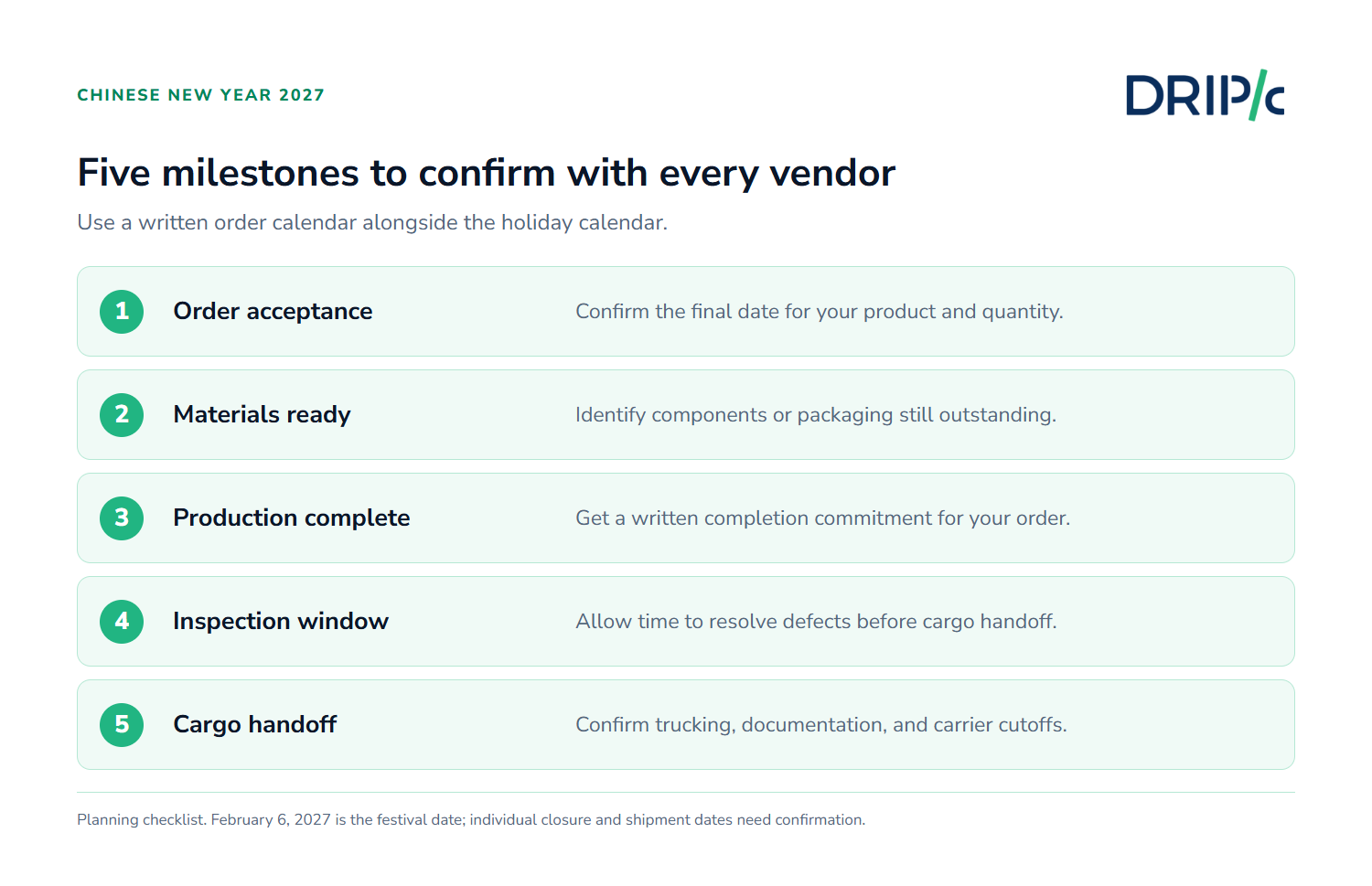
Get Five Milestones in Writing
Request the last order-acceptance date, material-confirmation date, production-completion date, inspection window, and final cargo-handoff date. Have the forwarder confirm the relevant booking, documentation, and terminal cutoffs separately.
Put the agreed milestones into your vendor contract and payment terms. Record who must approve a change and what happens if inspection identifies defects before closure.
Use Fall 2026 to Resolve Open Decisions
For Chinese New Year planning, use the fall to confirm demand, identify critical products, and ask vendors about expected closures. During the final production weeks, review exceptions frequently: missing materials, incomplete inspections, or unconfirmed transport.
This is a recommended planning sequence. Your actual order deadline depends on the product, manufacturing lead time, and confirmed handoff schedule.
How Much Inventory Should You Bring Forward?
Prioritize Products With Few Substitutes
Review committed customer orders, sales variability, replenishment lead times, shelf life, and storage limits. A slow-selling product with an available substitute may need less protection than a component that can stop an entire assembly process.
For each product, estimate demand through the next reliable replenishment, add a chosen uncertainty buffer, then subtract usable stock and inbound quantities expected to arrive in time. Avoid counting an unconfirmed shipment as available coverage.
An Illustrative Coverage Calculation
Suppose a distributor expects to sell 100 units weekly over an eight-week replenishment gap. It chooses a 100-unit buffer and has 300 usable units on hand, with no other timely inbound stock.
800 units of expected demand + 100-unit buffer − 300 units on hand = 600 additional units.
These hypothetical planning assumptions should be replaced with your own demand and stock data. At an assumed purchase cost of $40 each, that order requires $24,000 before freight, duties, and other expenses. Our guide to funding inventory for large purchase orders explores the wider funding decision.

The next step is to put those inventory decisions on the same calendar as cash receipts and payment obligations.
What the Holiday Means for Cash Flow
Map Every Payment to a Date
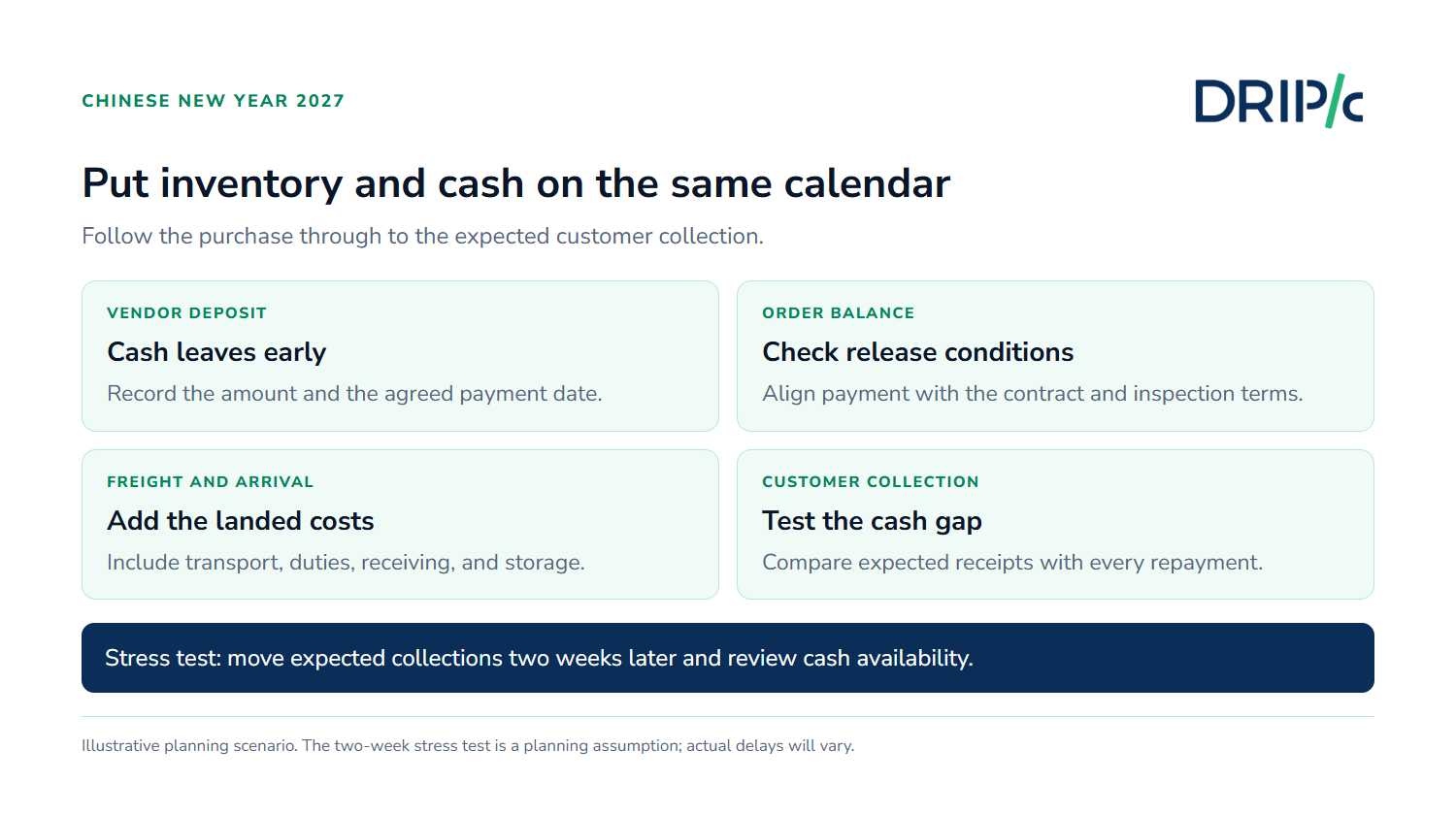
Moving an order forward can bring forward its deposit and balance payment while customer collections remain unchanged. Add inspection, freight, insurance, duties, receiving, and storage to the forecast, using the actual payment terms for each expense.
Include payroll and existing debt payments. The purchase may be profitable overall while creating a temporary cash shortfall, so review the business's cash-flow management plan alongside the shipping calendar.
Test a Delayed-Arrival Scenario
Model an illustrative extra two weeks between expected warehouse arrival and customer collections. Check whether cash covers scheduled obligations during that period and identify the smallest practical adjustment: split quantities, defer lower-priority items, or arrange appropriate financing.
When assessing Supply Chain Finance, compare when funds become available, which costs they cover, total cost, and repayment dates. Financing does not guarantee production capacity or extend a carrier cutoff.
Keep a Recovery Plan Ready
Maintain an exception list with the affected product, quantity at risk, next decision, and owner. If an order slips, ask whether a partial shipment would protect a committed customer delivery. Obtain a quote before assuming expedited freight is economical.
After the holiday, request evidence of production progress and a revised cargo-ready date. Confirm the shipping booking again before promising delivery. Review the resulting supply chain costs and missed milestones to improve the next seasonal plan.
Where Drip Capital Fits
Drip Capital's Vendor Financing pays vendors directly, with repayment terms of up to 90 days. For a pre-holiday purchase, confirm whether the vendor invoice and payment timing fit the facility before relying on it in the order plan.
A Line of Credit can provide revolving access to capital, with each draw repaid over six monthly installments. Compare that schedule with expected cash receipts and the delayed-arrival scenario.
Keep the financing decision tied to a purchase the business can support. Vendor readiness, shipment execution, and repayment capacity all need their own checks.
Frequently Asked Questions
How Long Do Factories Close for Chinese New Year?
There is no single closure period that applies to every factory. Confirm the last production day, restart date, and expected cargo-ready date directly with each vendor; component and logistics availability can affect the usable schedule.
Do Chinese Ports Close During the Holiday?
Check the specific terminal, carrier, and trucking arrangements for your shipment. Port availability alone does not establish that a container can be collected, loaded, or shipped on the intended service.
When Should I Place My 2027 Orders?
Calculate the deadline backward from your warehouse need date using confirmed manufacturing and transport lead times. Finish the vendor review early enough to resolve material, inspection, and payment requirements before committing to a shipping window.
Can Financing Help With Factory Shutdowns?
Financing can help fund an earlier purchase or a cash gap if the business qualifies and the terms fit its payment cycle. It cannot create inventory or transport capacity, so confirm operational milestones alongside the funding plan.