

Vendor Contracts and Payment Terms: What Every Business Should Know
A vendor contract is only as good as its payment-terms section. Everything else in the agreement, the specs, the delivery dates, the quality standards, depends on both sides agreeing on when money moves and what happens if it doesn't. This is usually the section businesses rush through, copying language from a template without checking whether it actually protects them.
This guide covers what belongs in Vendor Contracts: the domestic clause checklist every agreement needs for Vendor Payments, and the cross-border mechanics (Incoterms®, milestone structures, letters of credit) that come into play once a vendor is overseas. It is a contract and procurement reference. For ways to extend or optimize payment terms you already have, this guide to extending vendor payment terms covers that ground.
Why Payment Terms Deserve Their Own Clause
Businesses spend weeks negotiating price and specs, then drop payment terms into a single line: "Net 30." That line carries more operational weight than almost anything else in Vendor Contracts. It determines when your Working Capital is tied up and what recourse either side has if a deadline slips.
A payment-terms clause that is vague does not protect anyone. It just delays the disagreement until money is already on the table.
The Domestic Clause Checklist
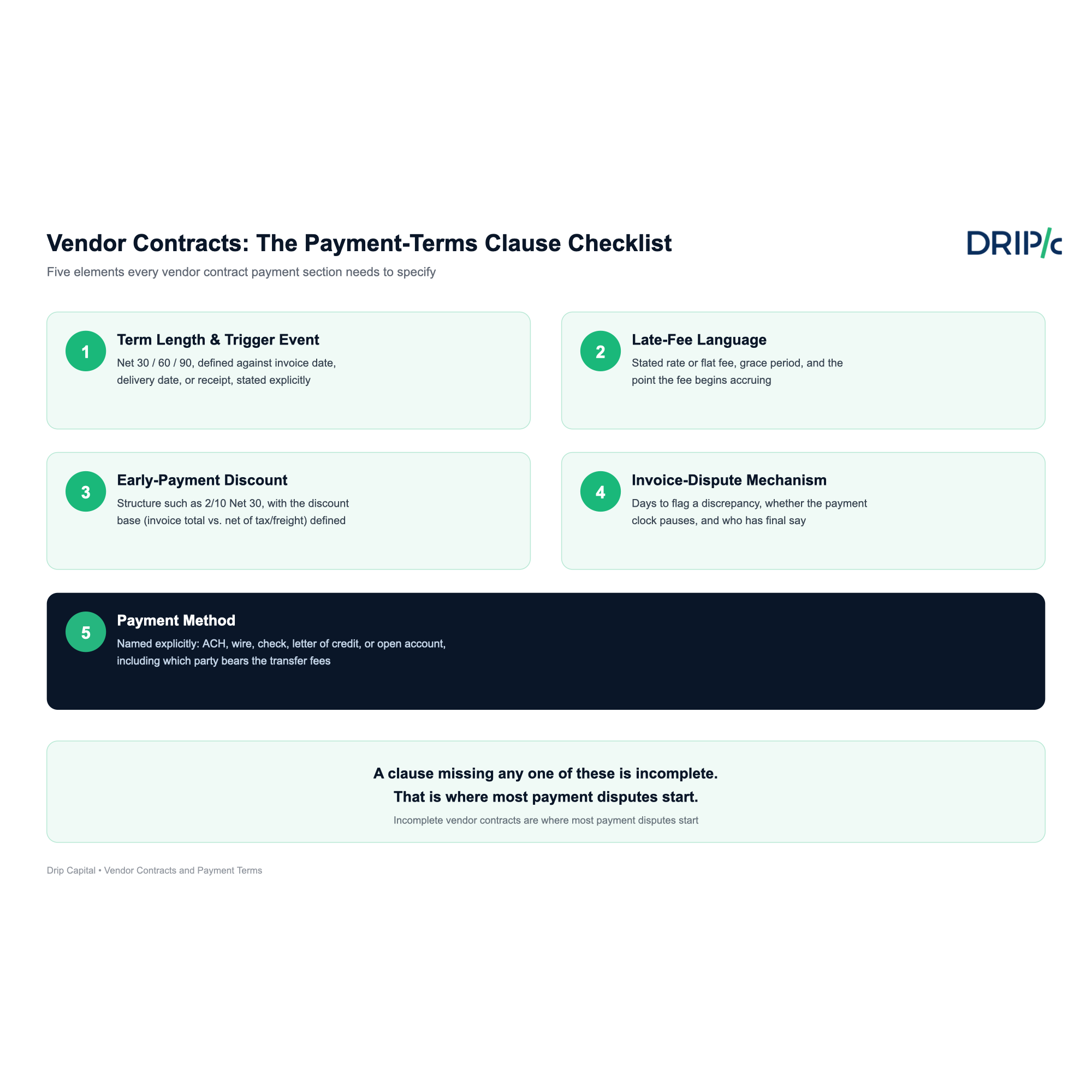
Define the Payment Term Precisely
"Net 30" sounds precise but is often ambiguous. Does the clock start at invoice date, delivery date, or receipt of goods? A well-drafted clause states the trigger event explicitly: payment due 30 calendar days from invoice date, provided the invoice is issued no earlier than delivery. Net 60 and Net 90 terms need the same specificity, and the longer the term, the more ambiguity costs if it's ever contested.
Late-Fee Language
A late-fee clause needs three things to be enforceable: a stated rate or flat fee, a grace period (if any), and the point at which the fee starts accruing. Many contracts say "interest will accrue on late payments" without a number, which makes the clause nearly impossible to enforce. State the rate as an annual percentage or flat monthly charge, and specify whether it compounds.
Early-Payment Discounts
Terms like "2/10 Net 30" (a 2% discount if paid within 10 days, full amount due in 30) reward faster Vendor Payments. If you use this structure, spell out exactly how the discount is calculated, on invoice total or after tax and freight, since that ambiguity causes more disputes than the discount is worth.
Invoice-Approval and Dispute Mechanics
The clause should define how many days the buyer has to flag a discrepancy after receiving an invoice, what happens to the payment deadline while a dispute is being resolved, and who has final say on quantity or quality disputes. Without this, a vendor can treat a legitimate quality hold as a late payment, and a buyer can use minor discrepancies to stall payment indefinitely.
Method of Payment
Specify how payment will be sent: ACH, wire, check, or a payment platform. For domestic contracts this is often an afterthought; it matters more once the vendor is overseas, covered below.
Whichever documents accompany the payment, the underlying invoice should match the terms named in the contract exactly. A mismatched due date or currency on a commercial invoice is a common, avoidable source of payment disputes.
By the numbers
Why the payment-terms clause matters
59%
of small businesses now carry invoices
overdue by 30 or more days
55%
of businesses on net-30 terms have
overdue invoices, vs. 26% on immediate terms
51%
of small employer firms cite uneven
cash flow as a financial challenge
97%
of all US exporters are small
businesses, per SBA data
Source: QuickBooks 2026 Small Business Late Payments Report; Federal Reserve 2025 Report on Employer Firms; SBA Office of Advocacy, Issue Brief No. 19
Where Cross-Border Contracts Add a Different Layer
Once a vendor is overseas, the domestic checklist still applies, but three mechanics need to be written into the contract explicitly: how Incoterms® interact with payment timing, how milestone payments are structured around production events, and which payment method the contract actually names.
What Incoterms® Actually Govern
This is the most common point of confusion in cross-border Vendor Contracts. Incoterms® 2020 rules, the standardized terms published by the International Chamber of Commerce, determine when risk of loss transfers from seller to buyer and which party pays for freight, insurance, and customs at each stage. They say nothing about when payment is due. A contract that lists "FOB Shanghai" and assumes that also sets the payment schedule is missing a clause; risk transfer and Vendor Payments timing need to be specified separately, in the same document. This Incoterms guide breaks down all eleven rules if you need the full reference.
Milestone-Based Payment Structures
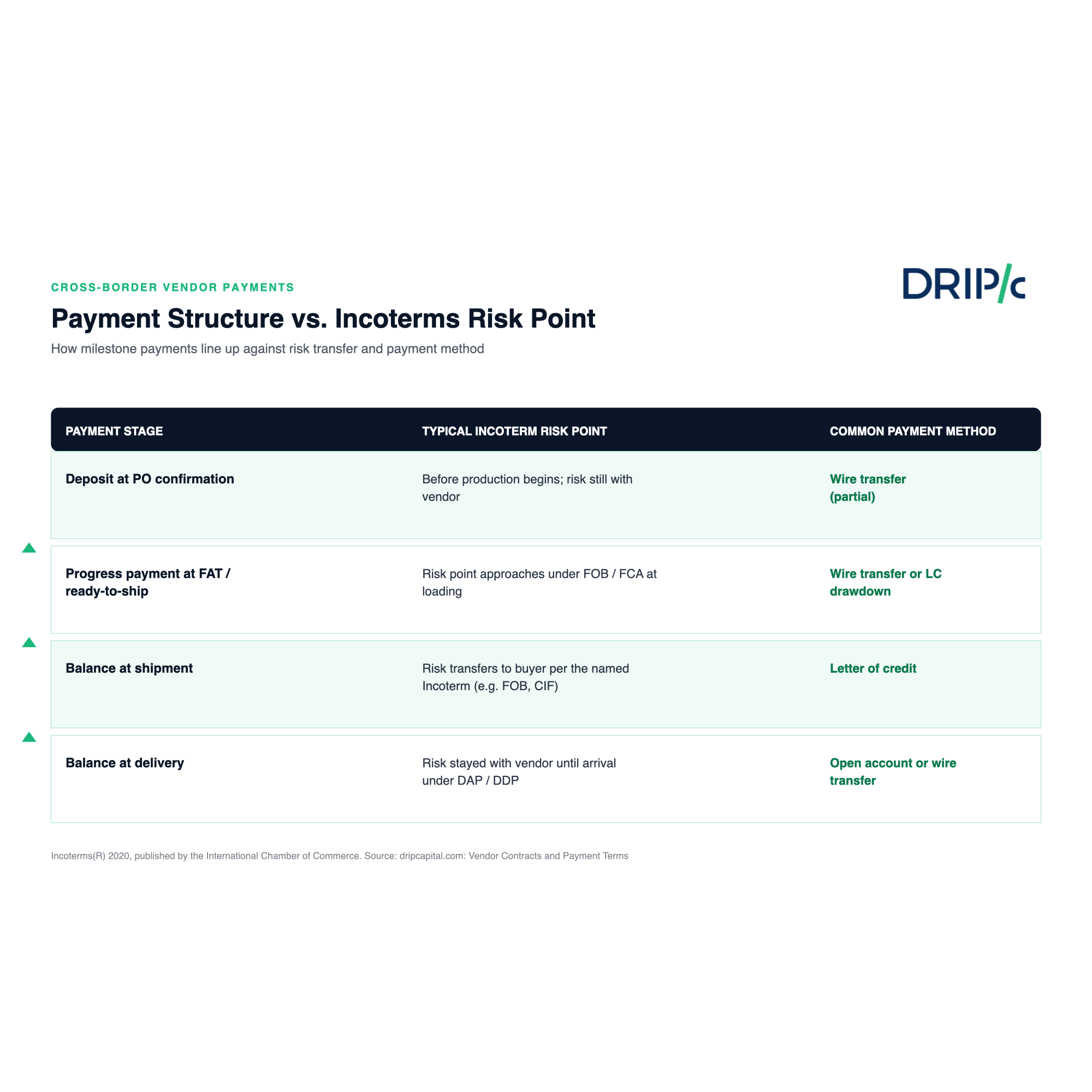
Domestic contracts often use a single term. Cross-border manufacturing relationships usually split Vendor Payments across production milestones instead, because the buyer is funding goods that don't exist yet. The deposit itself is often confirmed against a pro forma invoice, since production hasn't started and no final commercial invoice exists yet. A typical structure:
- A deposit, often 20 to 30% of order value, due at purchase order confirmation to fund raw materials and start production.
- A progress payment tied to a factory acceptance test (FAT) or pre-shipment inspection, confirming the goods meet spec before they leave the factory.
- The balance due at shipment or on presentation of shipping documents, sometimes split further when delivery and final acceptance are separated by weeks of transit.
Each milestone should be tied to a verifiable event. Production delays are common, and a date-only clause creates disputes about who is at fault when a milestone slips.

Payment-Method Mechanics, Mapped to Contract Clauses
The payment method should be named explicitly in the contract:
- Letter of credit (LC): the buyer's bank guarantees payment to the vendor's bank once specified documents (bill of lading, inspection certificate, commercial invoice) are presented. This gives payment certainty on both sides, but needs its own clause specifying which documents trigger release and who pays the LC fees.
- Wire transfer: faster and simpler than an LC, typically used once buyer and vendor have an established relationship. The contract should state currency, who bears wire fees, and the exact date each wire is due relative to its milestone.
- Open account: the vendor ships and invoices, and the buyer pays on standard terms afterward, no LC involved. This shifts collection risk to the vendor, which is why it's usually reserved for vendors with a long track record with the buyer.
A contract that names the method but not the mechanics, "payment by LC" with no document list, leaves the most disputable part of the transaction undefined.
Building the Clause: A Short Checklist
Before signing, a payment-terms section should specify, at minimum: the payment trigger event and term length; late-fee rate and grace period; early-payment discount mechanics, if offered; the invoice-dispute window and what it pauses; the payment method and who bears its fees; and, for cross-border deals, the Incoterm in use and how it relates, or doesn't, to the payment schedule. A clause missing any of these isn't wrong, it's incomplete, and incomplete Vendor Contracts are where most payment disputes start. A vendor relationship already running on supply chain finance infrastructure, of the kind described in this supply chain finance overview, often has this documentation standardized well before a new contract is drafted.
What to Do When a Vendor Pushes Back on Your Terms
Vendors negotiate payment terms too, and one with strong demand for its capacity has real leverage to push for shorter terms or a larger deposit. Two structural options worth having ready before that conversation:
Fund the deposit or milestone payments without pulling from your own cash. Drip Capital's Vendor Financing pays the vendor directly on the buyer's behalf at the point the contract requires it, whether that's a PO deposit or a shipment-triggered balance, so a vendor's shorter-term demands don't force you to renegotiate your own cash position. Vendor Financing requires no collateral, and eligibility is based on at least two years in business and $2 million or more in annual revenue.
Keep a revolving facility in reserve for whichever milestone lands at an inconvenient time. A Line of Credit draws against a set limit as milestone payments come due and repays over six installments, useful when payment timing is tied to production events instead of a fixed calendar. Before comparing lenders on this front, it's worth checking what a line of credit actually costs beyond the headline rate, since draw and inactivity fees vary and aren't always disclosed upfront. Either tool sits inside a broader Working Capital and Supply Chain Finance strategy, worth reviewing separately from the contract itself.
Neither tool changes what belongs in the contract. They change what happens on your end once the contract's terms come due.
Frequently Asked Questions
Does Net 30 mean 30 days from the invoice date or the delivery date?
It depends on how the contract defines it, which is why the trigger event needs to be stated explicitly. Most standard Net 30 terms in the US use the invoice date, but a contract that stays silent on this point invites disagreement the first time a shipment is delayed.
Do Incoterms® 2020 rules set the payment deadline for an international order?
No. Incoterms® 2020 rules define when risk and cost transfer from seller to buyer during shipping. They say nothing about when payment is due. A separate clause needs to state the payment schedule regardless of which Incoterm applies to the shipment.
What's a reasonable deposit for a cross-border manufacturing order?
Deposits commonly range from 20 to 30% of order value, though this varies by industry, vendor relationship, and order size. The deposit typically funds the vendor's raw materials and initial production costs before the balance is paid against a later milestone.
Is a letter of credit always safer than a wire transfer?
An LC gives both sides more structure since a bank verifies documents before releasing funds, which reduces risk on a first-time or high-value order. For established vendor relationships, a wire transfer is often used instead because it's faster and carries lower fees, with the risk offset by the track record between the two parties.
What happens if a vendor contract doesn't specify a payment method at all?
The parties are left to rely on past practice or informal agreement, which becomes a problem the moment there's a disagreement about timing or fees. Any vendor contract, domestic or cross-border, should name the payment method explicitly.