
Cash flow challenges rarely come from lack of sales. They come from supplier payment timing.
Suppliers expect payment before or at shipment. Manufacturers require advance deposits to allocate capacity. Logistics partners release goods only after settlement. Every stage of the supply chain demands liquidity upfront.
As order sizes grow, so do upfront commitments. Even profitable businesses feel pressure when supplier payments outpace available working capital.
Supply Chain Finance exists to solve this exact constraint. It enables businesses to pay suppliers immediately while extending repayment over a structured short term period. Instead of stretching internal liquidity, companies can align supplier payments with incoming revenue and maintain operational continuity.
It is not emergency funding. It is disciplined working capital management.
What Is Supply Chain Finance?
Supply Chain Finance, also referred to as Vendor Financing or Payable Finance, is a short term, invoice-backed financing solution where a financing partner pays suppliers directly on behalf of a buyer.
The buyer then repays the financed amount within an agreed tenure, typically up to 90 days later.
Unlike traditional loans that deposit capital into your bank account for discretionary use, Supply Chain Finance is transaction specific. Funds are deployed directly to approved suppliers based invoices.
Because it is tied directly to supplier transactions, Supply Chain Finance directs capital to the exact points that keep production and fulfilment moving.
How Supply Chain Finance Works?
The structure is intentionally simple.
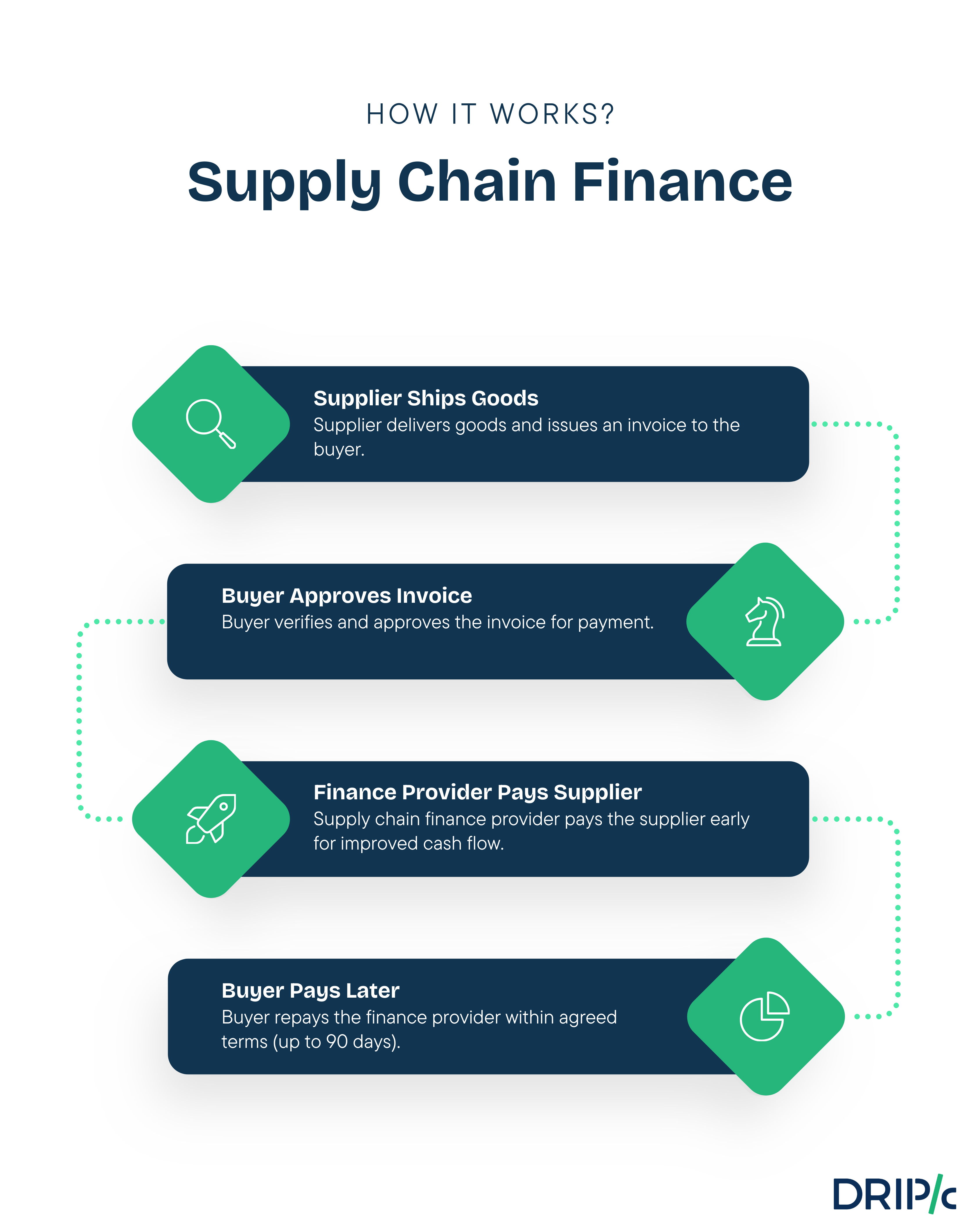
- A business submits a supplier invoice for approval.
- Once approved, the financing partner pays the supplier directly, domestically or internationally.
- Production proceeds without delay.
- The buyer repays the financed amount within 60 to 90 days.
There is no lump sum borrowing. There is no idle capital sitting unused. There is no long term debt commitment.
This transaction based structure improves capital efficiency while maintaining short-term discipline. It also ensures that businesses finance only what they actively deploy rather than carrying excess debt.
Importantly, structured Supply Chain Finance facilities can operate without a UCC filing, meaning existing borrowing bases remain unaffected.
Why Supply Chain Finance Is Strategically Important?
In competitive industries, supplier reliability determines revenue stability. Delayed payments can weaken relationships, reduce negotiation leverage, and jeopardize production timelines.
Supply Chain Finance changes that dynamic.
By ensuring suppliers are paid on time, businesses can secure priority production slots, negotiate better commercial terms, and maintain continuity during peak demand cycles. Liquidity remains available for payroll, expansion, and strategic initiatives instead of being locked into deposits and advance payments.
The benefit is not just smoother cash flow. It increases operational leverage. Companies that integrate Supply Chain Finance into their working capital strategy often scale more confidently because growth no longer competes directly with liquidity.
What Supply Chain Finance Can Be Used For?
Supply Chain Finance is purpose built for supplier and production-related expenses:
- Raw material procurement
- Advance deposits to manufacturers
- Contract manufacturing agreements
- Production cycle funding
- Packaging and labeling costs
- Freight forwarders and logistics partners
- Warehousing and third party logistics services
- Tariffs and customs duties
If the payment goes to a supplier involved in fulfilling an order, it qualifies.
Why Choose Supply Chain Finance over Traditional Loans?
| Supply Chain Finance | Traditional Loans |
|---|---|
| Designed to optimize supplier and buyer cash flow within the supply chain | General-purpose business funding not tied to supply chain transactions |
| Transaction-based and linked to invoices or purchase orders | Lump-sum loan disbursed upfront |
| Often collateral-light or unsecured depending on structure | Typically requires significant collateral and security filings |
| Faster approvals aligned with trade cycles | Slower underwriting process, can take weeks |
| Short to medium-term, aligned with operating and cash conversion cycle | Fixed medium to long-term repayment schedule |
Industries That Rely on Supply Chain Finance
Supply Chain Finance is especially relevant in sectors where supplier payments precede customer collections. These industries include manufacturing, consumer goods, electronics, packaged foods, wholesale distribution, agri products, chemicals, and software or SaaS companies with supplier-driven infrastructure costs. In each case, supplier continuity directly impacts revenue stability. Structured payable financing reduces disruption risk.
When Should a Business Consider Supply Chain Finance?
Supply Chain Finance becomes particularly valuable when:
- Suppliers require upfront or advance payments
- Production must begin before customer payments are received
- Seasonal demand increases inventory requirements
- Large purchase orders strain internal liquidity
- Customer payment cycles exceed 60 days
Rapid growth often intensifies these conditions. Without structured supplier financing, businesses may find themselves choosing between growth opportunities and liquidity preservation.
Supply Chain Finance removes that trade off.
Supply Chain Finance with Drip Capital
Drip Capital provides collateral-free Supply Chain Finance designed to strengthen supplier networks and accelerate revenue cycles.
The facility includes:
- Credit limits from 50,000 dollars to 3 million dollars
- 24 to 48 hour funding once approved
- Pre and post shipment invoice financing
- Global supplier payment coverage
- No UCC filing
- Short term repayment up to 90 days
- Fully digital onboarding with minimal documentation
By aligning supplier payments with receivable cycles, businesses can protect working capital while sustaining production momentum.
If your supply chain timing is limiting growth, structured Supply Chain Finance can provide the flexibility required to scale with confidence.
Start your application or call +1 650 437-0150 to connect with one of our experts.