

Common Uses of a Business Line of Credit: Seven Situations It Actually Solves
Most explanations of a line of credit stop at the mechanics: you get a limit, you draw against it, you pay interest on what you use. True, and not much help when you are deciding whether to open one.
The more useful question is what it is for. Eighty-six percent of firms use financing on a regular basis, and the businesses that get the most out of a revolving facility tend to have a specific job in mind before they apply. Here are seven of the common uses of a business line of credit, and how to tell which ones apply to you.
What Makes a Cost Suitable for a Line
Before the list, a filter. Almost all business line of credit use cases share two traits.
The cost recurs
A one-time purchase with a known price is usually better matched to a term loan, where you take the full amount once and repay on a schedule. The business line of credit use cases worth opening a facility for are the costs that come back.
The amount or timing is uncertain
If you knew the exact figure and date, you could plan around it. Knowing when to draw on a line of credit is easiest when the need is real but the size or timing moves.
By the numbers
How small businesses actually use financing
86%
of firms use financing
on a regular basis
60%
of firms applied for financing
in the past year
42%
of applicants received the full
amount they sought
59%
of firms with debt used
a personal guarantee
Source: Federal Reserve Banks, 2026 Report on Employer Firms
Seven Common Uses of a Business Line of Credit
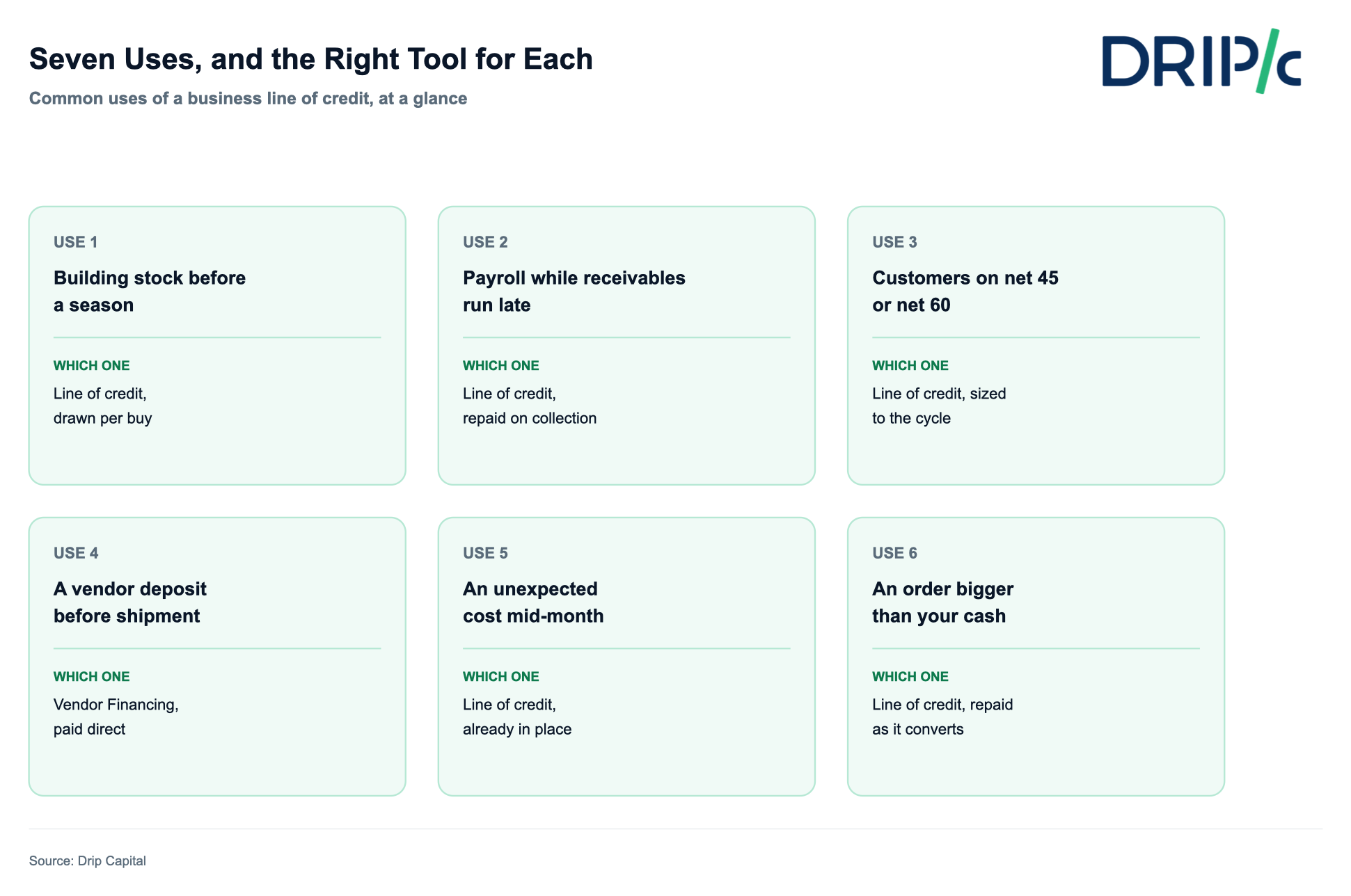
1. Buying inventory ahead of a season
The classic case. You build stock in the quiet months and sell it in the busy ones, which means paying for goods well before they generate revenue. Using a line of credit for inventory purchases lets the stock arrive without draining the account that covers everything else. For seasonal businesses, a line of credit for inventory purchases is often the reason the facility gets opened in the first place.
2. Covering payroll through a slow stretch
Payroll does not pause when receivables run late. Drawing to cover a cycle or two, then repaying when collections land, is one of the most common uses of a business line of credit for any business with staff.
3. Bridging long customer payment terms
If your customers pay on net 45 or net 60 and your own costs land immediately, that gap repeats on every order and becomes a working capital problem rather than a sales one. A line sized against that cycle covers it without renegotiating with the customer.
4. Paying vendor deposits
Many vendors want money before goods ship, particularly on custom or made-to-order items. Drawing for the deposit keeps the order moving. Where the cost is specifically a vendor payment, Vendor Financing is often a closer fit than a general-purpose line.
5. Handling an unexpected cost
Equipment fails, a shipment gets held, a vendor raises a price mid-order. Knowing when to draw on a line of credit matters most here, because the alternative is usually arranging financing under pressure, which is when terms are worst.
6. Taking an order larger than your cash
A customer offers volume you cannot fund from working capital. Turning it down protects cash and costs you the account. A line lets you take the order and repay as it converts.
7. Smoothing an uneven month
Some months simply land badly: a tax payment, an insurance renewal, and a big inventory buy in the same fortnight. Drawing to smooth the trough and repaying the following month is a legitimate use, provided it is occasional rather than structural.

When a Line of Credit Is the Wrong Tool
Three situations where reaching for a line is a mistake.
Funding persistent losses
A line covers timing gaps between money going out and money coming in. If revenue does not cover costs at all, drawing on a facility postpones the problem and adds to it.
One-time investments with a long payback
Equipment with a five-year life is better matched to financing with a comparable term. Our guide to business line of credit alternatives covers the options that fit better.
Anything you cannot repay from the same cycle
The healthy pattern is draw, convert to revenue, repay, repeat. If a draw cannot be repaid out of the cycle it funded, the balance rolls forward and the cost compounds.
How Drip Capital's Line of Credit Works
Drip Capital's Line of Credit is revolving. You draw against your limit, repay over six monthly installments, and draw again as the next need arrives. There is no prepayment penalty, no annual maintenance fee, no blanket lien on your assets unless you default, and no UCC filing unless you default.
For businesses whose gap is specifically a vendor payment, Drip Capital pays your vendor directly through Vendor Financing. Repayment falls within an agreed window, typically up to 90 days, priced as a flat fee on the invoice of roughly 1% to 2% per month, charged only on what you draw and only while it stays outstanding. It requires a minimum of two years in business, is collateral-free, and needs no personal guarantee.
Frequently Asked Questions
What is the most common use of a business line of credit?
Covering working capital gaps: inventory purchases, payroll, and the wait between paying costs and getting paid. Most of the common uses of a business line of credit come back to timing rather than a shortfall in revenue.
How often can I draw on a line of credit?
As often as you need, up to your limit, as long as you are repaying. That repeat access is the point of a revolving facility compared with a loan arranged for a single purpose.
Should I use a line of credit or a credit card for small purchases?
Cards generally suit small, everyday spending you clear each month. A line usually suits larger, less frequent draws where carrying a card balance would be expensive.
Can I use a line of credit to pay an overseas vendor?
You can, though Vendor Financing is often the better structure, since it pays the vendor directly and repays within an agreed window of up to 90 days rather than on a revolving basis.