
Funding Inventory for Large Purchase Orders
A vendor sends a quote. A buyer signs a purchase order for ten times the size of anything you have shipped before. Then the arithmetic starts. Funding inventory for large purchase orders is a different problem than day-to-day working capital, because the order does not scale with your normal cash cycle. It just shows up, with a payment deadline attached.
Most businesses can absorb a purchase order that looks like their average month. The trouble starts when the order does not look like the average month at all. That single order can be worth more than your existing credit line, more than your cash reserves, and more than what a vendor is willing to ship on trust.
Why a Large Purchase Order Breaks the Usual Cash Math
Funding inventory for large purchase orders stresses a business in a way routine reorders never do, because the vendor payment and the buyer payment sit on opposite ends of a gap that can stretch for months.
The order arrives bigger than your balance sheet
A regional distributor that normally moves $50,000 a month in inventory does not have a natural mechanism for absorbing a single $400,000 order. The vendor still wants payment up front or within a short window. The buyer, meanwhile, may not pay until 60 or 90 days after delivery. Large purchase order inventory financing exists specifically to bridge that mismatch, rather than asking the business to fund it out of retained cash it does not have.
Vendors get cautious as order size grows
Vendors extend informal trade credit to buyers they know well, but that trust has a ceiling. A vendor asked to produce or ship five times its usual volume for one buyer will often ask for a deposit, full payment before shipment, or a shortened payment window. That instinct is reasonable. It also means how to fund a large PO is rarely about convincing the vendor to wait. It is about paying the vendor on schedule without draining the business.
Your existing credit line was not built for this
A revolving line sized for normal month-to-month draws is not automatically resizable the moment one order exceeds it. Inventory financing for big orders typically runs through a separate facility or a tool designed to attach to the transaction itself, not through stretching a limit that was calibrated for smaller, steadier draws.
What Actually Needs Funding in a Large Order
Raw materials or finished goods, not the whole order value
Funding inventory for large purchase orders almost always covers the cost of the goods themselves, the amount the vendor is owed to produce or release the inventory. It does not need to cover the buyer's full order value, since that includes your margin, which you have not spent yet. Sizing the request to actual vendor cost keeps the financing proportional to the real gap.
Freight and duties layer on top
For an order that crosses a border, freight charges and import duties land before the buyer pays a cent. These costs are easy to underestimate on a large order because they scale with volume just as fast as the goods do. Large purchase order inventory financing that only covers vendor payment and ignores freight can leave a business short at the exact moment goods are in transit.
The timing gap, not just the dollar gap
Two orders of identical size can carry very different funding needs depending on how long the buyer takes to pay. A 30-day buyer term is a much smaller ask than a 90-day term on the same order. Mapping out how to fund a large PO means lining up the vendor's payment deadline against the buyer's payment date and funding exactly that window, not an arbitrary round number.
How Large Purchase Order Inventory Financing Works in Practice
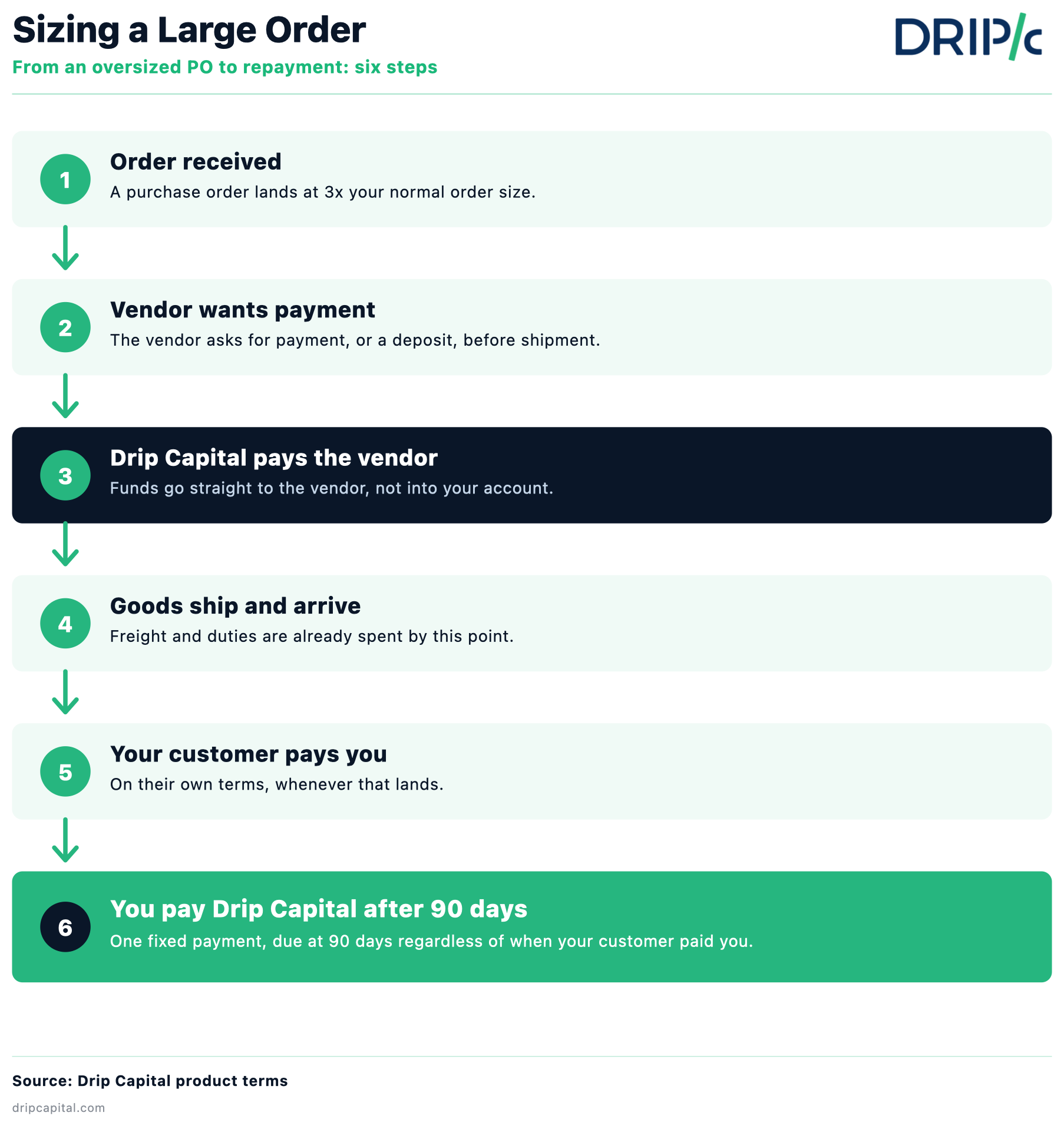
Step one: confirm the order and the vendor terms
Before approaching any financing option, get the vendor's payment schedule in writing. Inventory financing for big orders depends on knowing exactly when money needs to leave your account, since that date drives every decision after it.
Step two: separate goods cost from total order value
Break the purchase order into vendor cost, freight, duties, and your margin. Funding inventory for large purchase orders should be scoped to the first three categories. Your margin is what you are protecting, not what you are financing.
Step three: match the financing structure to the order's shape
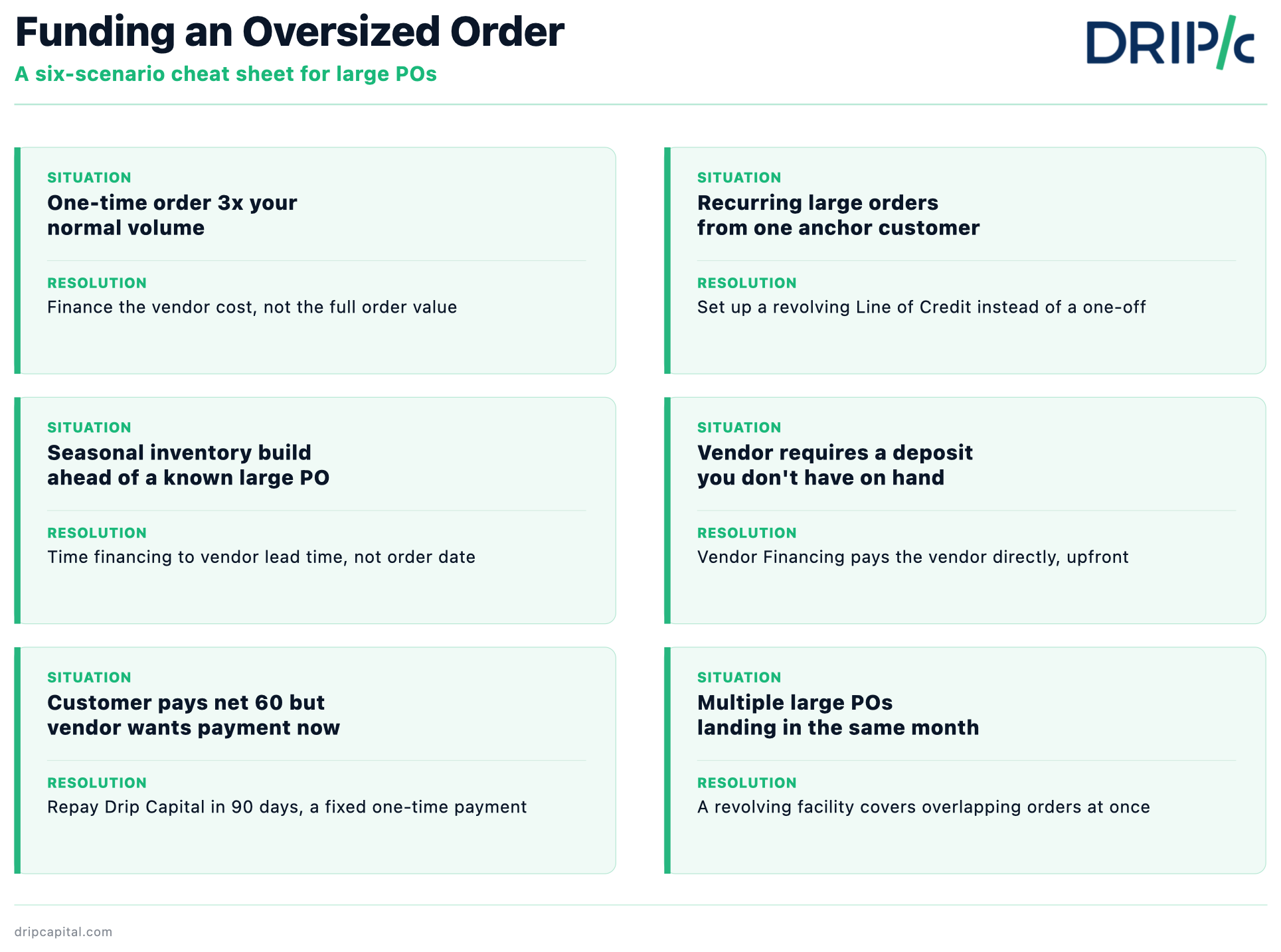
A one-time outsized order suits a facility built around a single transaction. A business that expects several large orders across a year is better served by a revolving structure it can draw against repeatedly. How to fund a large PO looks different depending on whether this is a one-off spike or the new normal for the account.
Step four: pay the vendor, then repay Drip Capital in 90 days
Once financing is in place, the vendor gets paid on schedule and the business owes a single repayment 90 days later, a fixed term that does not move based on when the buyer actually pays. Large purchase order inventory financing works best when the 90-day term is checked against the buyer's expected payment date up front, so the business knows whether it needs its own cash on hand to cover any gap between the two.
By the Numbers: How Firms Actually Finance Growth Orders
By the numbers
How employer firms actually access financing for growth
60%
of firms applied for
financing in the past year
42%
of applicants received
the full amount sought
59%
of firms with debt used
a personal guarantee
51%
of firms with debt pledged
business assets
Source: Federal Reserve Banks, 2026 Report on Employer Firms
Those numbers point to a pattern worth noticing. Less than half of applicants got the full amount they asked for, and among firms carrying debt, 59% secured that debt with a personal guarantee and 51% with business assets. Large purchase order inventory financing that avoids both of those trade-offs is not the default outcome. It has to be sought out specifically.
Common Mistakes When Sizing Financing for a Big Order
Financing the full order value instead of the cost
Requesting financing equal to what the buyer owes you, rather than what the vendor is owed, inflates the ask and can make approval harder. Funding inventory for large purchase orders works best when scoped to actual outlay.
Ignoring the vendor's production or shipping lead time
A vendor quote often assumes a payment date tied to when production starts, not when goods arrive. Missing that detail means the financing lands too late to matter.
Assuming one large order means a permanent credit increase
Inventory financing for big orders is sometimes a one-time need tied to a single buyer relationship. Treating it as a permanent limit increase can leave a business over-extended once the order cycle passes.
Underestimating the buyer's actual payment behavior
Contract terms say 60 days. Buyers do not always pay on day 60, but the 90-day repayment term is fixed regardless. Checking whether the buyer's typical payment behavior fits inside that 90-day term, not just the contract date, avoids a second scramble if the payment runs late.
Where Drip Capital Fits This Kind of Order
An order this size usually calls for paying the vendor directly rather than routing cash through your own account first. Vendor Financing from Drip Capital does exactly that: it pays the vendor directly, and you owe a single repayment in 90 days, charged as a flat fee of typically 1% to 2% per month on the amount drawn while it stays outstanding. It is collateral-free and applies to businesses with a minimum of two years in operation and $2M or more in annual revenue.
For businesses that expect this pattern to repeat, whether through the same buyer or a run of larger seasonal orders, a Line of Credit offers a revolving limit that can be drawn against and repaid over six monthly installments, with no prepayment penalty, no annual maintenance fee, and no blanket lien unless you default. Pairing Vendor Financing for the immediate order with a Line of Credit for the pattern behind it covers both the spike and what comes after it.

Frequently Asked Questions
What does funding inventory for large purchase orders actually cover?
It covers the cost the vendor charges to produce or release the goods, plus freight and duties where applicable. It does not need to cover the buyer's full order value, since that figure includes your margin, which has not yet been spent and does not need financing.
How is large purchase order inventory financing different from a regular business loan?
It is tied to a specific transaction rather than the business as a whole. The financing amount is sized around the vendor's payment date for that one order, and repayment is a single fixed payment in 90 days, rather than a monthly loan schedule spread over years.
How to fund a large PO when the vendor wants payment before shipment?
Confirm the vendor's exact payment deadline first, then arrange financing that pays the vendor on or before that date. A facility that pays the vendor directly removes the step of routing funds through your own account, which shortens the process when the deadline is tight.
Is inventory financing for big orders only for businesses that already have strong credit?
No single credit profile is required across every option. Vendor Financing, for example, is collateral-free and is built for businesses with a minimum of two years in operation and $2M or more in annual revenue.
What happens if the buyer pays late after the inventory has already shipped?
The 90-day repayment term is fixed regardless of when the buyer actually pays, so checking the buyer's real payment behavior against that 90-day term before you draw, not just the contract date, is what avoids a second cash shortfall if the payment runs late.