
Cover photo: Andy Feliciotti / Unsplash. Illustrative image.
You won the contract. Now you need to buy the goods, pay your team and deliver the order before the money arrives. Government Contract Financing helps cover that gap. The right option depends on what you need to pay for and when the contract lets you bill.
What is Government Contract Financing?
Businesses use the phrase for several ways of funding government work. Federal procurement rules use “contract financing payments” more narrowly for certain payments before acceptance, excluding ordinary invoice payments. This guide covers both private funding and contract-authorized payments; see FAR Part 32 for the federal rules.
A contract award does not automatically qualify you for government contract loans. A lender still needs to assess your business, the order and the repayment plan.
Start with the bills that arrive first
List vendor deposits, payroll, freight and other costs due before you expect payment. Then subtract cash you can safely use. Keep a buffer for delays. Size your Government Contract Financing request around that gap, rather than the contract's headline value.
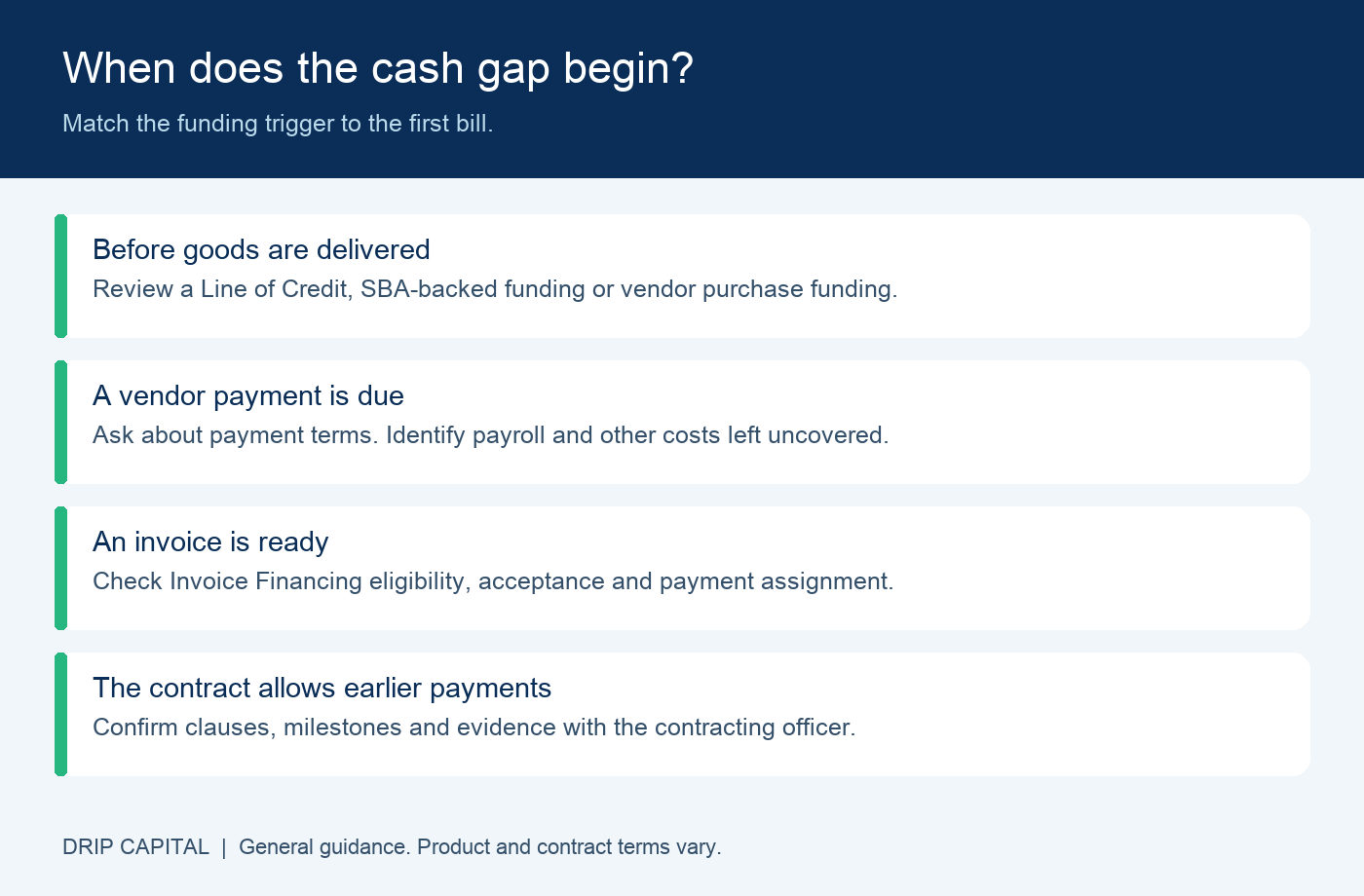
Six ways to fund a government contract
1. A business Line of Credit
A revolving facility can cover recurring working-capital expenses, subject to its terms and available limit. Compare the draw and repayment schedule with your delivery timetable. Our Line of Credit overview explains this funding structure.
2. SBA-backed working-capital funding
The SBA 7(a) program guarantees loans made by participating lenders, with working capital among the permitted uses. The maximum loan is $5 million, but your approved amount depends on eligibility and underwriting. Start the conversation early enough for the lender's process.
3. Purchase Order Financing
For a goods order, funding vendor purchases may solve the biggest upfront expense. Check what the provider actually pays for: money sent to a vendor will not necessarily cover your payroll, freight or installation work. Compare these details in our Purchase Order Financing comparison.

Keep a separate plan for costs outside the facility. Having the merchandise funded does not mean the whole contract is funded.
4. Payment terms from your vendor
A vendor may agree to a smaller deposit or a later balance payment. Ask before placing the order, and put the terms in writing. Compare any price difference with the cash you preserve. Your vendor's due date still matters if the customer pays late.
5. Invoice Financing after delivery
Once you have an invoice the financing provider accepts, Invoice Financing may release cash while you wait for payment. It cannot be assumed to fund work before that invoice exists. Disputes, acceptance requirements and payment-assignment restrictions need review.
6. Payments authorized by the contract
Some federal contracts provide progress or performance-based payments. They must be authorized under the applicable contract and rules; an award alone does not create that right. Ask your contracting officer which clauses apply and what evidence triggers payment.
By the numbers: an illustrative example
These are hypothetical business figures, not lending criteria or customer results.
Suppose vendor costs are $70,000 and payroll and freight add $20,000. With $15,000 available, the initial gap is $75,000 before any delay buffer. This simple exercise shows why financing only the vendor bill may leave part of the job uncovered.
Check who owes you the money
If you are a subcontractor, your customer may be the prime contractor. Do not assume the federal agency pays your invoice directly. Federal payment rules also do not automatically govern state and local contracts.
For federal contract financing involving an assignment of payment, have the lender and contracting officer review FAR Subpart 32.8. Required conditions and notices matter. Assigning payment rights does not transfer your responsibility to perform the contract.
Your pre-funding checklist
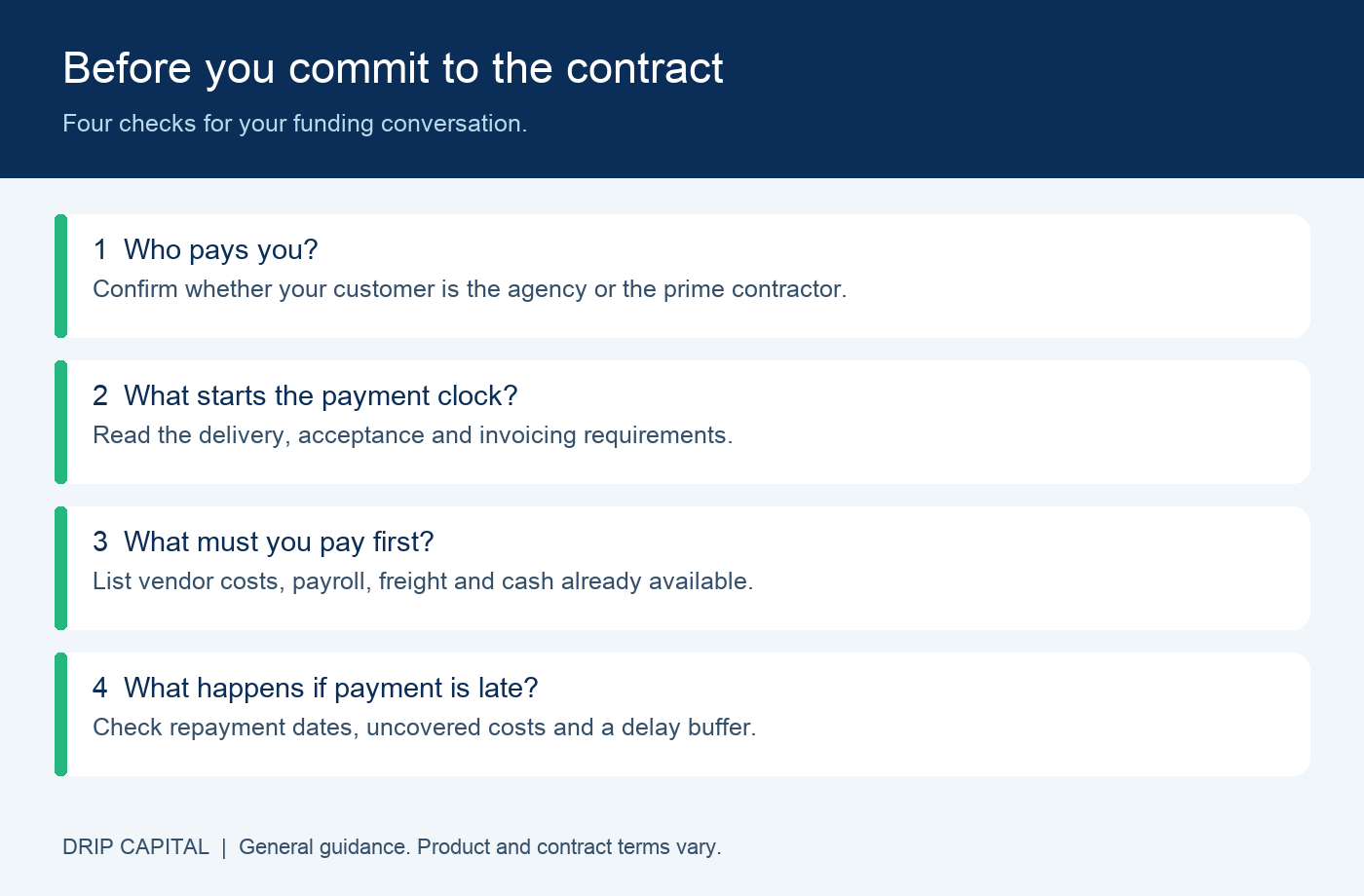
Gather the signed contract, delivery schedule, vendor quotes, invoice and acceptance requirements, current financial statements and existing debt details. Ask the lender to explain total borrowing costs, repayment dates and what happens if delivery or payment is delayed.
Choose government contract funding around the earliest cash shortage. A facility that becomes available only after delivery will not solve an earlier production bill.
Where Drip Capital fits
For businesses purchasing goods, Drip Capital's Vendor Financing pays vendors directly, with repayment terms of up to 90 days. Business eligibility, underwriting and approval apply. Discuss the specific government order with the team; this is not a promise that every contract or expense can be financed.
Frequently asked questions
Can I get Government Contract Financing before invoicing?
Some options can support purchases or other expenses before invoicing. Invoice-based funding generally requires an invoice that meets the provider's conditions, so check the funding trigger before committing.
Does winning a government contract guarantee a loan?
No. Lenders assess the business and transaction, including repayment capacity. Contract terms and any assignment restrictions can affect the available structure.
Can one facility cover the whole contract?
Possibly, depending on its permitted uses and approved amount. Check vendor costs, payroll and other expenses separately, and plan for costs the facility excludes.