
A request for quotation (RFQ) is a document a buyer sends to suppliers asking them to quote a price for a clearly defined set of goods or services. It's used when you already know exactly what you need and want to compare suppliers on price, lead time, and terms.
What is an RFQ?
An RFQ lists the items, quantities, and specifications you want quoted, and asks each supplier to respond with unit prices, lead time, payment terms, and Incoterms. Because the specs are fixed, the responses are easy to compare side by side — RFQs are mostly about price discovery.
RFQ vs. RFP vs. RFI
- RFI (Request for Information) — early-stage; you're learning what's available.
- RFQ (Request for Quotation) — you know the exact specs and want prices.
- RFP (Request for Proposal) — the need is complex and you want suppliers to propose a solution, not just a price.
What to include in an RFQ
- RFQ number, issue date, and quote-due date
- Buyer details and delivery location
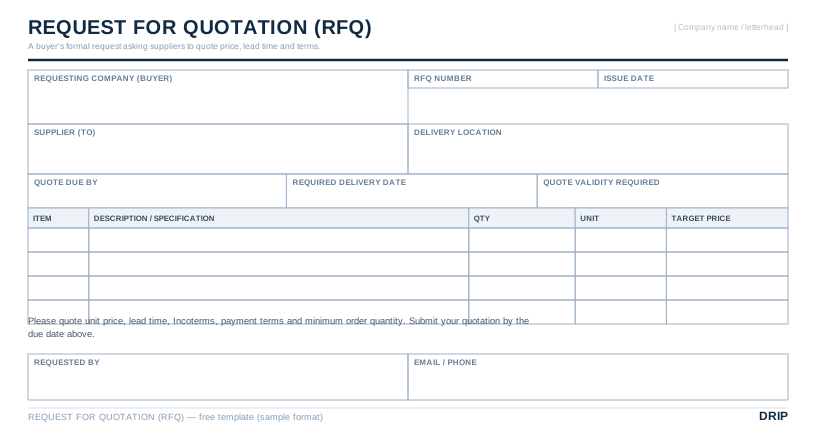
- A line-item table: description/specification, quantity, and unit of measure
- Required delivery date and quote validity period
- Instructions: ask for unit price, lead time, Incoterms, payment terms, and minimum order quantity
Free RFQ Template
Below is a free, blank request for quotation template. Download it, list the items and specifications you need priced, and send it to your shortlisted suppliers. Download the RFQ template
How to use the RFQ
Send the same RFQ to several suppliers so responses are comparable. When quotes come back, you'll typically evaluate the best one and issue a purchase order to the winning supplier. The supplier then replies with a formal sales quotation or proforma invoice before shipping.
Related free templates: purchase requisition form template.
FAQ
What is a request for quotation (RFQ)? A document a buyer sends to suppliers asking them to quote a price for a clearly specified set of goods or services, so quotes can be compared on price and terms.
What is the difference between an RFQ and an RFP? An RFQ is used when you know the exact specifications and want prices; an RFP is used for complex needs where you want suppliers to propose a full solution.
What should an RFQ include? An RFQ number and dates, buyer and delivery details, a line-item table with specifications and quantities, the quote-due date, and instructions on what to quote.
What happens after an RFQ? You compare the quotes, select a supplier, and issue a purchase order. The supplier confirms with a sales quotation or proforma invoice.
Drip Capital gives US businesses fast, collateral-free working capital to buy inventory and bridge long payment terms. See if you qualify →