

How to Claim Your Tariff Refund: A Step-by-Step Guide to the CBP CAPE Program
On February 20, 2026, the Supreme Court ruled that the president had no authority under the International Emergency Economic Powers Act to impose the 2025 "Liberation Day" tariffs. Two months later, US Customs and Border Protection rolled out a formal process for returning the duties collected under that authority: the CBP CAPE Program.
For importers who paid those duties, the ruling turned into paperwork. CBP does not cut a check automatically. Getting the money back means filing a CBP CAPE Program declaration, waiting on a review window measured in months, and hoping the entry data lines up. This guide walks through how the tariff refund process actually works, who qualifies, and what to do if the wait for an IEEPA tariff refund puts pressure on cash flow you were counting on.
What Changed: The Supreme Court Ruling on IEEPA Tariffs
In Learning Resources, Inc. v. Trump, the Supreme Court ruled 6-3 that IEEPA does not give the president authority to impose tariffs. Chief Justice Roberts wrote for the majority. The ruling left tariffs imposed under other statutes, like Section 301 and Section 232, untouched; it only reached the ones built on IEEPA's emergency powers.
All IEEPA tariffs terminated on February 24, 2026, four days after the opinion came down. Every dollar collected under that authority since 2025 became eligible for a tariff refund. That is not a small pool of money: CBP had collected roughly $166 billion in IEEPA duties before the ruling.
That's the backdrop. What happens next depends entirely on a CBP filing mechanism most importers had never heard of before this year: the CBP CAPE Program.
What Is the CBP CAPE Program?
CAPE stands for Consolidated Administration and Processing of Entries: a module inside ACE, the Automated Commercial Environment CBP already uses to process every import entry. Importers and brokers with an ACE Portal account submit a CAPE Declaration, a CSV file listing up to 9,999 entries at a time, with no separate ABI filing required.
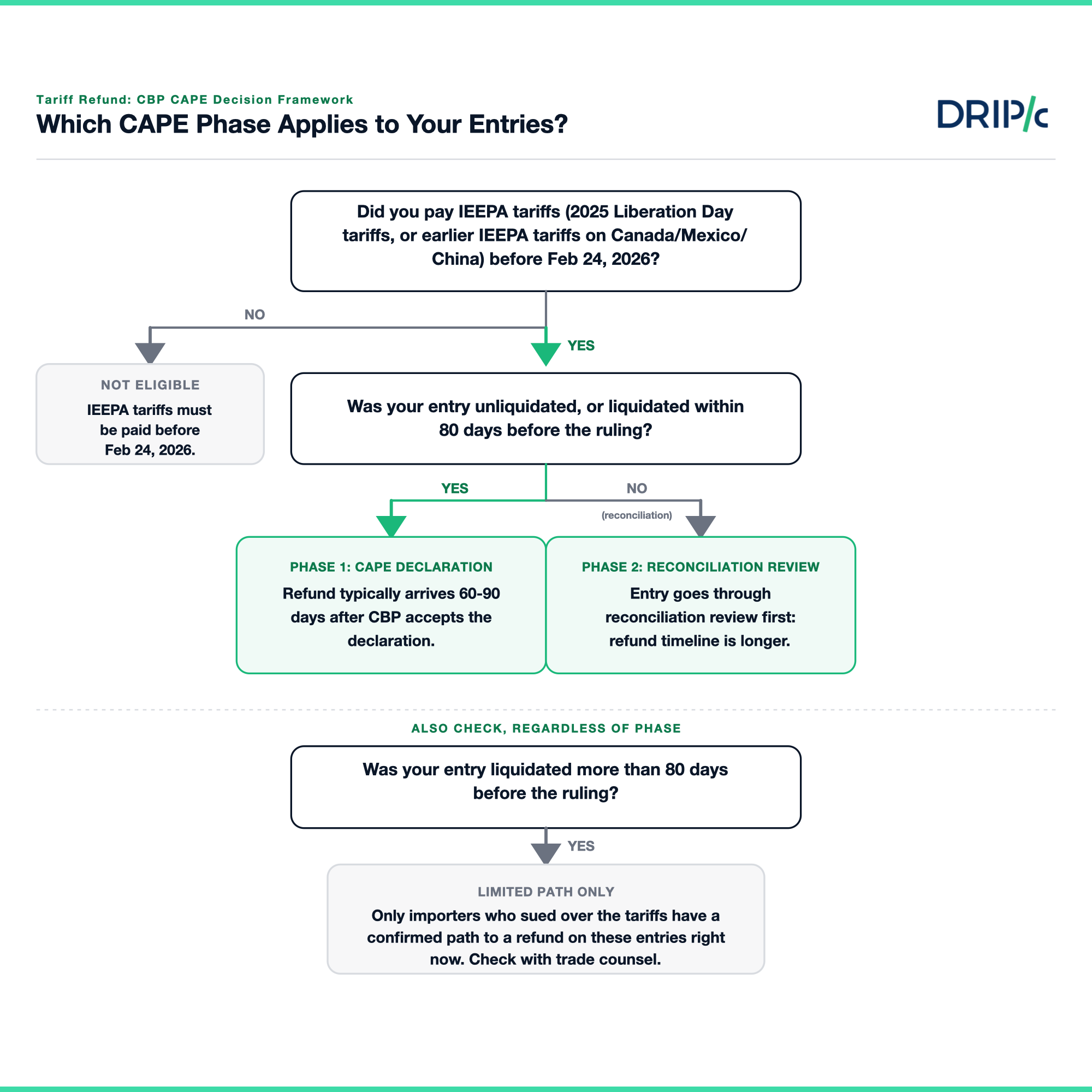
Once CBP accepts the declaration, it liquidates or reliquidates the listed entries and issues the tariff refund by ACH transfer, typically 60 to 90 days later. That window covers roughly 45 days of CBP processing plus time for the Department of the Treasury to certify the funds. CBP rolled this out in phases. Phase 1 covers entries that are unliquidated, plus entries that were liquidated within the 80 days before the ruling, since federal law gives CBP a limited window to reliquidate them. Phase 2 covers entries already flagged for reconciliation, where the underlying accounting isn't finalized yet.
"CBP CAPE Program" functions as shorthand for this mechanism in most trade press and search results. Knowing the actual name, a CAPE Declaration filed through ACE, helps when you're reading CBP's own guidance rather than a summary of it.
Who Qualifies for a Tariff Refund
Eligibility rides on two things: whether duties were paid under IEEPA authority, and where your entries sit in CBP's liquidation timeline.
If you imported goods and paid the "Liberation Day" tariffs, or the earlier IEEPA-based tariffs on Canada, Mexico, and China, before February 24, 2026, those duties are eligible for a tariff refund, with one important exception. Entries that were already liquidated more than 80 days before the ruling currently sit outside CAPE. As of this writing, only importers who were plaintiffs in the underlying litigation have a confirmed path to recovering those older, "finally liquidated" entries; CBP and the Department of Justice are still contesting broader relief in court. If your entries fall into that older category, talk to your broker or trade counsel before assuming CAPE covers you.
For everything else, Phase 1 covers unliquidated entries and entries liquidated within the 80 days before the ruling. Phase 2 picks up entries already flagged for reconciliation, where the final numbers depend on a broader accounting process across multiple shipments.
You'll also need an active ACE Portal account tied to your importer number. CBP validates every entry number in your CAPE Declaration against its own records, so the entry numbers you list need to match exactly. Missing or mismatched entry data is the single biggest reason declarations bounce back. More on that later.
Refund Progress So Far
By July 31, 2026, CBP had refunded $100 billion of the roughly $166 billion it collected in IEEPA duties, a bit over 60 percent. More than 330,000 importers across 53 million entries were affected.
The pace shows up in the numbers big importers have reported on their own earnings calls, though not all of that money has landed yet. Amazon booked a $600 million tariff refund in its second quarter. Apple reported roughly $2 billion in gross margin benefit from tariff refunds, enough to lift quarterly earnings per share by 11 cents. Ford reported a $1.3 billion tariff refund benefit in its first quarter, though its CFO noted the cash itself hadn't arrived yet. Walmart has told investors it could be eligible for roughly $2.4 billion, a figure the company has framed as a possibility rather than money already in hand.
Those are companies with treasury teams built for exactly this kind of filing. Smaller importers are working through the same CBP CAPE Program with far less staff dedicated to tracking a single filing.
Step-by-Step: How to File a CAPE Declaration and Claim Your Refund
Filing isn't complicated once you know the sequence, but each step has a way to go wrong. Here's the order CBP expects when you claim your tariff refund.
Step 1: Set Up Your ACE Portal Account
If you don't already have one, register for an ACE Secure Data Portal account tied to your importer number. Brokers filing on your behalf need their own linked account with authorization to act for you. This step alone can take a few days if your paperwork isn't current, so start here even before you pull entry data.
Step 2: Pull Your Entry Numbers
Gather the entry number for every affected shipment, formatted the way CBP's CSV template expects (11 characters, no dashes, with a leading apostrophe if the entry number starts with a zero). CBP checks each entry number against its own records and against your importer of record number on file, so the entry number itself has to be exact. Cross-check your list against your broker's records before moving on.
Step 3: Build the CAPE Declaration File
The CAPE Declaration is simpler than it sounds: a CSV file listing entry numbers, nothing more. CBP doesn't need duty amounts or other entry details in the file itself; it pulls those from its own records once your entry numbers match. Format your list into CBP's specified CSV structure, up to 9,999 entries per file. Larger importers batch multiple declarations rather than forcing everything into one file.
Step 4: Submit the Declaration
Upload the CSV through the ACE Portal. You'll get a confirmation message and a claim number showing CBP received the declaration. Approval is a separate step that happens later, during review.
Step 5: CBP Review and Treasury Certification
CBP checks the declaration against its own entry records, liquidates or reliquidates the flagged entries, and passes the certified amount to Treasury. This is the slowest part of the process and the one you have the least control over. Budget roughly 45 days here before funds even move toward payment.
Step 6: Receive Your ACH Refund
Once Treasury certifies the payment, CBP issues the refund by ACH transfer to the banking information on file for your importer number. If that information is outdated or missing, the refund stalls at this last step, even though CBP already approved it earlier in the process. Total time from declaration acceptance to funds landing typically runs 60 to 90 days.

Common Reasons Tariff Refunds Get Delayed
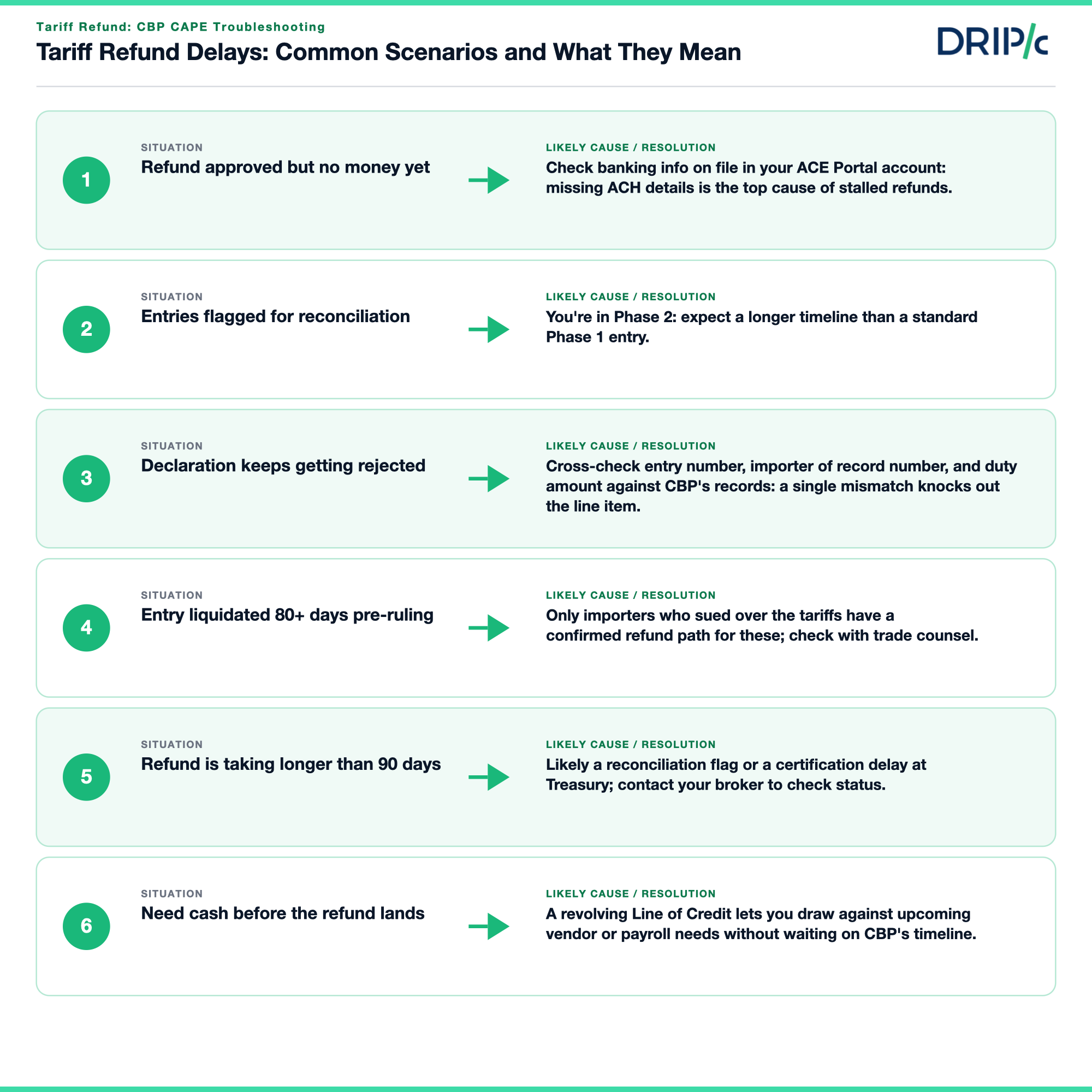
Most delays trace back to one of three things: mismatched entry data, unresolved reconciliation flags, or missing banking information.
The banking piece is more common than you'd expect. In a CBP filing covering data through late June 2026, 8,384 approved declarations had no valid ACH information on file, meaning CBP had approved the refund and had nowhere to send it.
Reconciliation flags are the second big holdup. If your entries were part of a reconciliation program before the ruling, CAPE's Phase 2 process has to work through the underlying accounting first, and that takes longer than a straight Phase 1 entry. As of CBP's late-July filing, roughly $28.7 billion in accepted declarations hadn't been paid out yet, a mix of Phase 2 entries and declarations still working through review.
The third cause is simpler: mismatched entry numbers. CBP checks every entry number in your CAPE Declaration against its own records and against your importer of record number, and a single mismatch is enough to knock that line item out. None of this is rare, and all of it is avoidable with a careful review before you submit your IEEPA tariff refund claim.
Why the 60-90 Day Wait Strains Working Capital
A tariff refund behaves a lot like an invoice you're owed, except the customer is the federal government and you don't get to negotiate the payment terms. CBP controls the timeline. You don't.
That distinction matters more than it sounds like it should. If a customer owed you money for 60 to 90 days, you'd have leverage: you could follow up, adjust future terms, maybe factor the receivable. With a pending IEEPA tariff refund, none of that applies. The money is real and it's coming, but exactly when is CBP's call.
Meanwhile your business keeps running on its normal clock. Vendors still expect payment on their terms. Inventory orders for the next season still need to go out. Payroll doesn't wait for Treasury certification. For an importer who paid tariffs at scale, the cash tied up in a tariff refund claim can be the same cash that would otherwise cover a vendor payment or a seasonal inventory build. That's true whether you're a company the size of Ford or a fraction of that size; the math changes, the pressure doesn't.
Businesses managing this kind of gap often look at their broader working capital position rather than treating the refund as a one-off event, because the same timing mismatch tends to show up again the next time a large receivable is out of your hands.
Bridging the Refund Gap With Financing
A pending tariff refund is a known amount of money arriving on an unknown date within a defined window. That's a specific kind of cash flow problem, and a revolving credit line, one you draw against as needed instead of committing to a lump sum, is a natural fit for it.
Drip Capital's Line of Credit works as a revolving facility: you draw what you need when a vendor payment or payroll run comes due before your CBP CAPE Program refund lands, then repay that draw in six equal monthly installments. If CBP's certification runs long, which happens more often with Phase 2 entries, you can draw again when the next expense comes up.
The advantage is in the timing of the draw. You're not committing to a fixed loan amount months before you know exactly what you'll need or when CBP's timeline will actually land. A 60 to 90 day window is CBP's own guidance, and actual timing can run longer with reconciliation flags or missing banking information, so the ability to draw only what's needed, when it's needed, matters more here than it would with a predictable, fixed-date expense.
For an importer whose refund is large enough to matter but whose vendor and payroll obligations don't pause for it, that structure keeps the business moving while the refund works its way through the system. It sits alongside other small business financing options worth knowing about, and it's worth a conversation with your finance team about whether the timing fits your specific obligations.
FAQ
Do all imported goods qualify for a tariff refund under CAPE?
Only duties collected under IEEPA authority qualify, mainly the 2025 "Liberation Day" tariffs and the earlier IEEPA tariffs on Canada, Mexico, and China. Duties from Section 301 or Section 232 tariffs are not affected by this ruling.
How long does a CBP CAPE Program refund actually take?
Most refunds land 60 to 90 days after CBP accepts your CAPE Declaration, covering roughly 45 days of review plus Treasury certification. Phase 2 entries tied to reconciliation can run longer.
What if my entries were already liquidated before the ruling?
Entries liquidated more than 80 days before the ruling currently sit outside CAPE processing. Only importers who sued over the tariffs have a confirmed path to recovering those older entries while the broader issue is still being litigated, so check with your broker or trade counsel if this applies to you.
Why hasn't my refund arrived even though CBP approved it?
The most common reason is missing or outdated banking information tied to your importer number; CBP cannot send an ACH transfer with nowhere to send it. Log into your ACE Portal account and verify your banking details are current.
Can I use financing while I wait for my IEEPA tariff refund?
Yes. A revolving facility like Drip Capital's Line of Credit lets you draw against upcoming vendor or payroll obligations without waiting on CBP's timeline, then repay each draw over six equal monthly installments.