
Photo: Diwei Zhu on Unsplash
What does Mexico buy from the US? The largest categories are computer accessories, vehicle parts, petroleum products, electric apparatus and semiconductors. In total, Mexico bought $337.3 billion of goods from the United States in 2025, overtaking Canada ($333.6 billion) as the largest market for US goods, according to U.S. Census Bureau data. The top imports of Mexico from the US were computer accessories ($28.1 billion), other vehicle parts and accessories ($22.9 billion), other petroleum products ($20.7 billion), electric apparatus ($20.0 billion) and semiconductors ($18.5 billion). Purchases kept growing in 2026, up 17.6% from January through September.
So what does Mexico import from its northern neighbor, and what does that mean if you sell there? Put another way, what does Mexico import from the US most, and why? This guide covers the top products, how Mexico passed Canada, the trade rules that apply in 2026 and a practical checklist for exporting to Mexico. Annual figures are 2025 data, the latest full year.
| US exports to Mexico at a glance | |
|---|---|
| US goods exports to Mexico, 2025 | $337.3 billion (up 0.8% from 2024) |
| Rank among US export markets | #1 (Canada #2 at $333.6B) |
| Largest product (end-use category) | Computer accessories, $28.1B (up 63% in value) |
| 2026 so far (January to September) | $297.6 billion, up 17.6% year over year |
| US companies exporting to Mexico | 53,547 (2024) |
Top Imports of Mexico: What Mexico Buys From the US (2025 Data)
The table ranks Mexico top imports from the US by 2025 value, using the Census Bureau's end-use product categories. Changes are in dollar value.
| Rank | Product (end-use category) | 2025 US exports to Mexico | Change vs 2024 |
|---|---|---|---|
| 1 | Computer accessories | $28.1B | +63.1% |
| 2 | Other vehicle parts and accessories | $22.9B | −5.8% |
| 3 | Other petroleum products | $20.7B | −19.3% |
| 4 | Electric apparatus | $20.0B | −3.9% |
| 5 | Semiconductors | $18.5B | +7.1% |
| 6 | Other industrial supplies | $10.9B | +0.5% |
| 7 | Plastic materials | $9.6B | −6.3% |
| 8 | Finished metal shapes | $8.9B | −5.7% |
| 9 | Other industrial machines | $8.8B | −8.3% |
| 10 | Civilian aircraft, engines and parts | $8.6B | +38.6% |
Source: U.S. Census Bureau, US exports to Mexico by 5-digit end-use code, 2025 annual, revised June 2026. Excludes low-value "minimum value shipments."
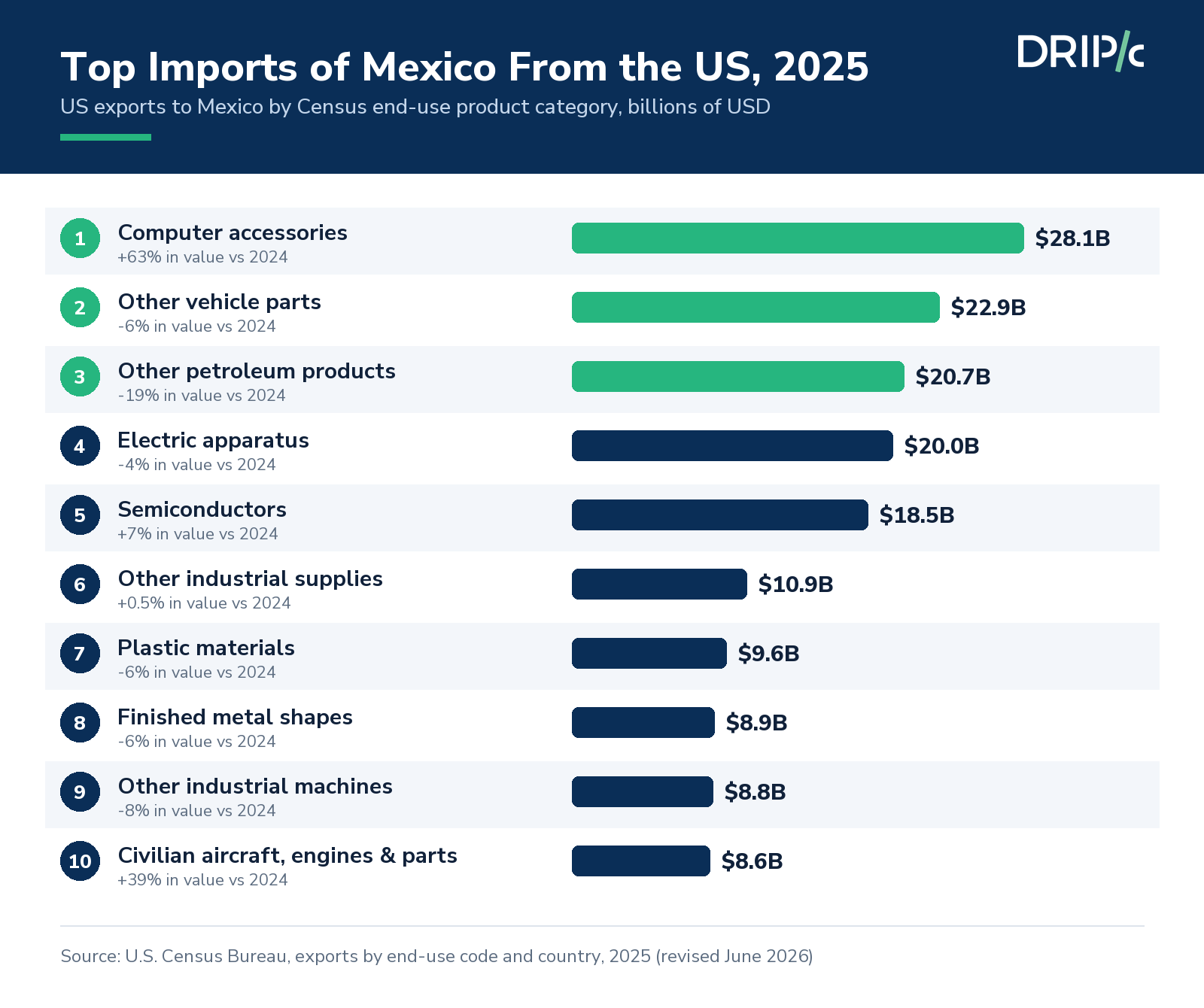
Three patterns stand out in Mexico imports from the US. Electronics grew fastest among the largest categories: computer accessories rose 63% and computers 268% in value. Energy is a large block: other petroleum products, fuel oil and natural gas together came to nearly $35 billion. And vehicle parts flow both ways, with US-made parts going south and Mexican-built vehicles coming back north. In 2025 US export data by broad HS chapter, as reported by the US to UN Comtrade (reporter USA, exports, HS 2-digit), machinery and computers led at $65.9 billion, followed by electrical machinery at $57.2 billion and mineral fuels at $37.4 billion.
Mexico Is Now the #1 Market for US Exports
For years Canada bought more US goods than any other country. In 2025, Mexico passed it, as Mexico's own business community pointed out:
"...Mexico has become, for the first time in annual terms, the largest export market for the United States in 2025, surpassing Canada."
Consejo Coordinador Empresarial (CCE), Mexico's Business Coordinating Council, press release, February 19, 2026
| Year | US exports to Mexico | US exports to Canada |
|---|---|---|
| 2016 | $230.2B | $266.7B |
| 2020 | $212.5B | $256.2B |
| 2024 | $334.5B | $350.6B |
| 2025 | $337.3B | $333.6B |
| 2026 (Jan–Sep) | $297.6B | $265.9B |
Source: U.S. Census Bureau (2016–2025 revised June 2026; 2026 from the September 2026 FT-900 release).
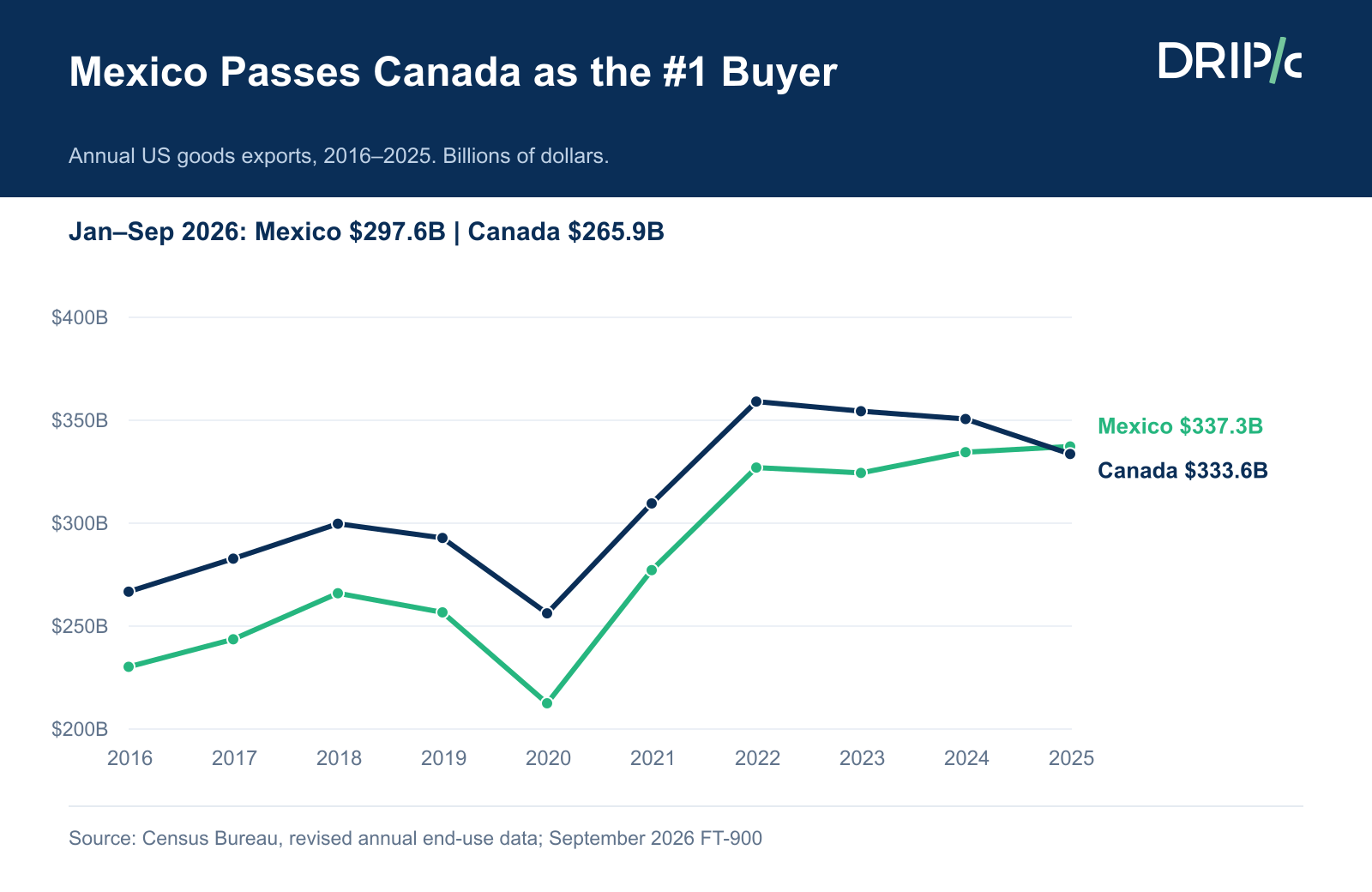
US exports to Mexico grew 46% between 2016 and 2025, against 25% for Canada, and the gap widened in 2026: Mexico's purchases are up 17.6% year to date versus 4.9% for Canada.
Who Sells to Mexico?
The top imports of Mexico are not only shipped by large manufacturers. The Census Bureau's exporter profile counted 53,547 US companies that exported to Mexico in 2024, second only to Canada's 91,731. Across all markets, Census classified 97.1% of identified US exporters as small and medium-sized enterprises (a group that includes companies with fewer than 500 employees and some with unknown employment), and 60% of exporters shipped to just one country. For a small exporter selling to Mexico, its tariff rules and payment terms can shape the whole export business.
Why the US and Mexico Trade So Much
Much of US–Mexico trade is co-production. US companies ship parts, chips, plastics and fuel to factories in Mexico, which assemble cars, computers, electrical equipment and medical devices, many of which return to the US. Mexico was also the largest source of US goods imports in 2025, at $534.3 billion (Census). The United States-Mexico-Canada Agreement (USMCA) allows duty-free trade for goods that meet its rules of origin; see our guide to the USMCA agreement. For many US exporters, that means steady orders from Mexican manufacturers and distributors, who may ask for time to pay.

Beyond manufacturing inputs, one sector stands out in what Mexico buys from the US: food and agriculture.
US Farm Exports to Mexico
Mexico is the largest market for US agricultural exports. In calendar year 2025, US farm exports to Mexico totaled $30.6 billion, according to USDA's Foreign Agricultural Service, which was 17.9% of all US agricultural exports (USDA ERS). Corn ($5.93 billion), pork ($2.85 billion), dairy products ($2.57 billion) and soybeans ($2.31 billion) led the list. For farm groups, the USMCA's future is a bottom-line issue:
"Getting USMCA right matters enormously to our industry, which ships more than 40 percent of all U.S. dairy exports by value to Mexico and Canada..."
Shawna Morris, Executive Vice President, National Milk Producers Federation and U.S. Dairy Export Council, quoted by USTR, July 2, 2026
Tariffs and Trade Rules for US–Mexico Trade in 2026
US goods going to Mexico. Goods that meet USMCA rules of origin generally enter Mexico duty-free. The importer claims that treatment based on a certification of origin, which the exporter, producer or importer can complete. One certification can cover a single shipment or multiple shipments of identical goods over a period of up to 12 months (USMCA Articles 5.2 to 5.4). Keep the records that support it. Since January 1, 2026, Mexico has charged higher tariffs, averaging about 35% and up to 50%, on about 1,463 tariff lines for goods from countries without a trade agreement with Mexico, such as China, South Korea and India (Secretaría de Economía). Goods that qualify for USMCA treatment are not covered, and trade.gov notes the change could increase demand for US components that clearly comply with USMCA.
Mexican goods coming into the US. Since July 24, 2026, a 10% Section 301 tariff applies to Mexican goods, but products entered duty-free under USMCA are exempt (USTR). Section 232 tariffs still apply to covered goods such as steel, aluminum, copper, autos and auto parts. The IEEPA tariffs on Mexico ended after the Supreme Court ruled on February 20, 2026 that IEEPA does not authorize tariffs (Learning Resources v. Trump); see our Mexico tariff page.
The USMCA Review: What It Means for Exporters
At the USMCA's first joint review on July 1, 2026, the US declined to confirm a 16-year extension:
"The United States did not agree to renew the USMCA in its current form. As a result, the USMCA is not renewed."
Office of the U.S. Trade Representative, statement on the USMCA joint review, July 1, 2026
The same statement said the agreement remains in force. Under USMCA Article 34.7, the three countries now hold a joint review every year. For exporters, duty-free access continues for now, but the terms could be renegotiated while the reviews continue. Three habits help: keep your USMCA origin documentation complete and up to date for every product, watch USTR announcements before each review date, and avoid depending on a single Mexican buyer or a single product line, so a rule change in one area does not stall your whole export business.
How to Start Exporting to Mexico
Before you ship any of the top imports of Mexico, the questions below decide whether your product enters duty-free, and the checklist after them shows who usually handles each step. The ITA's Mexico Country Commercial Guide covers Mexico's import rules in more detail.
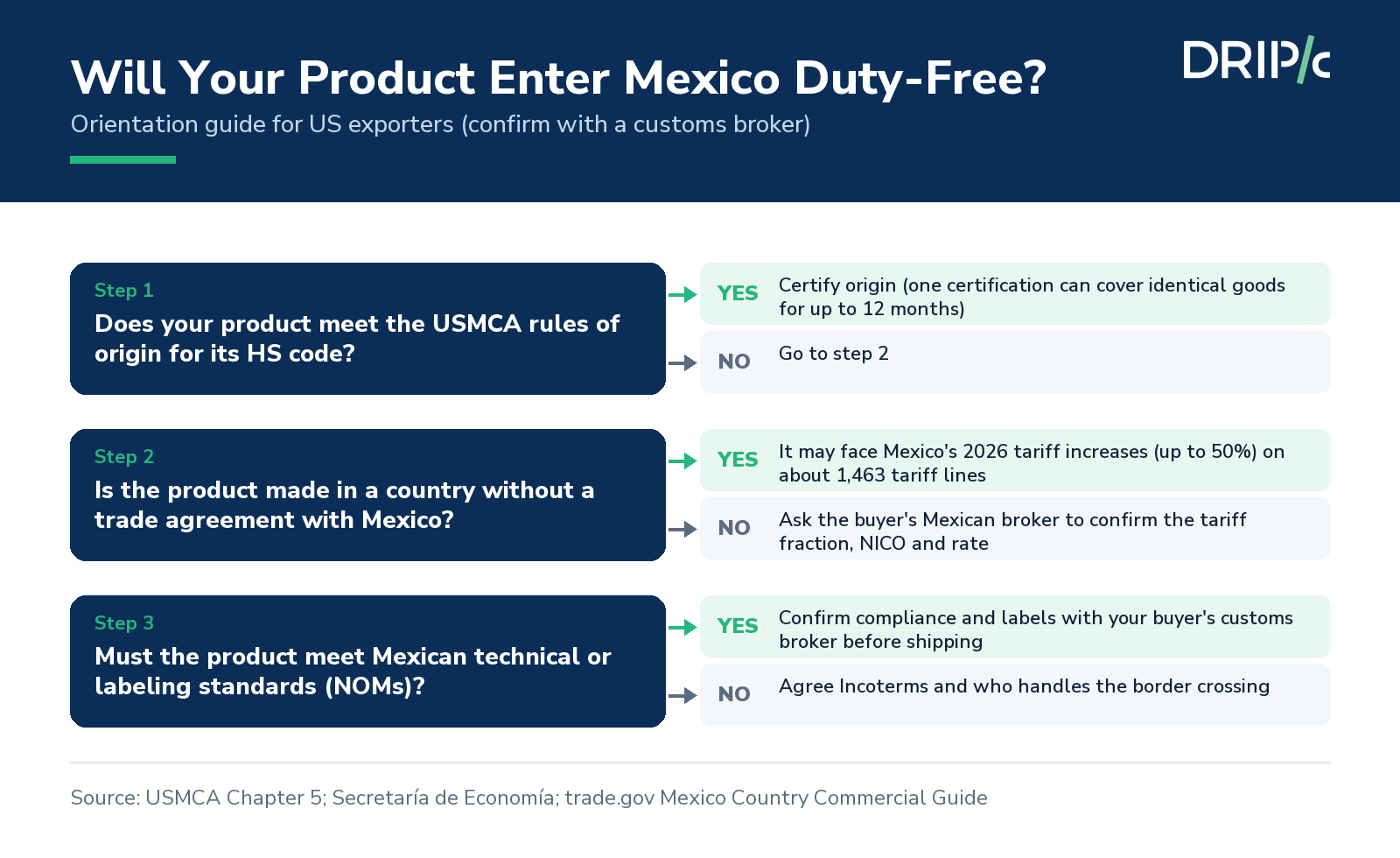
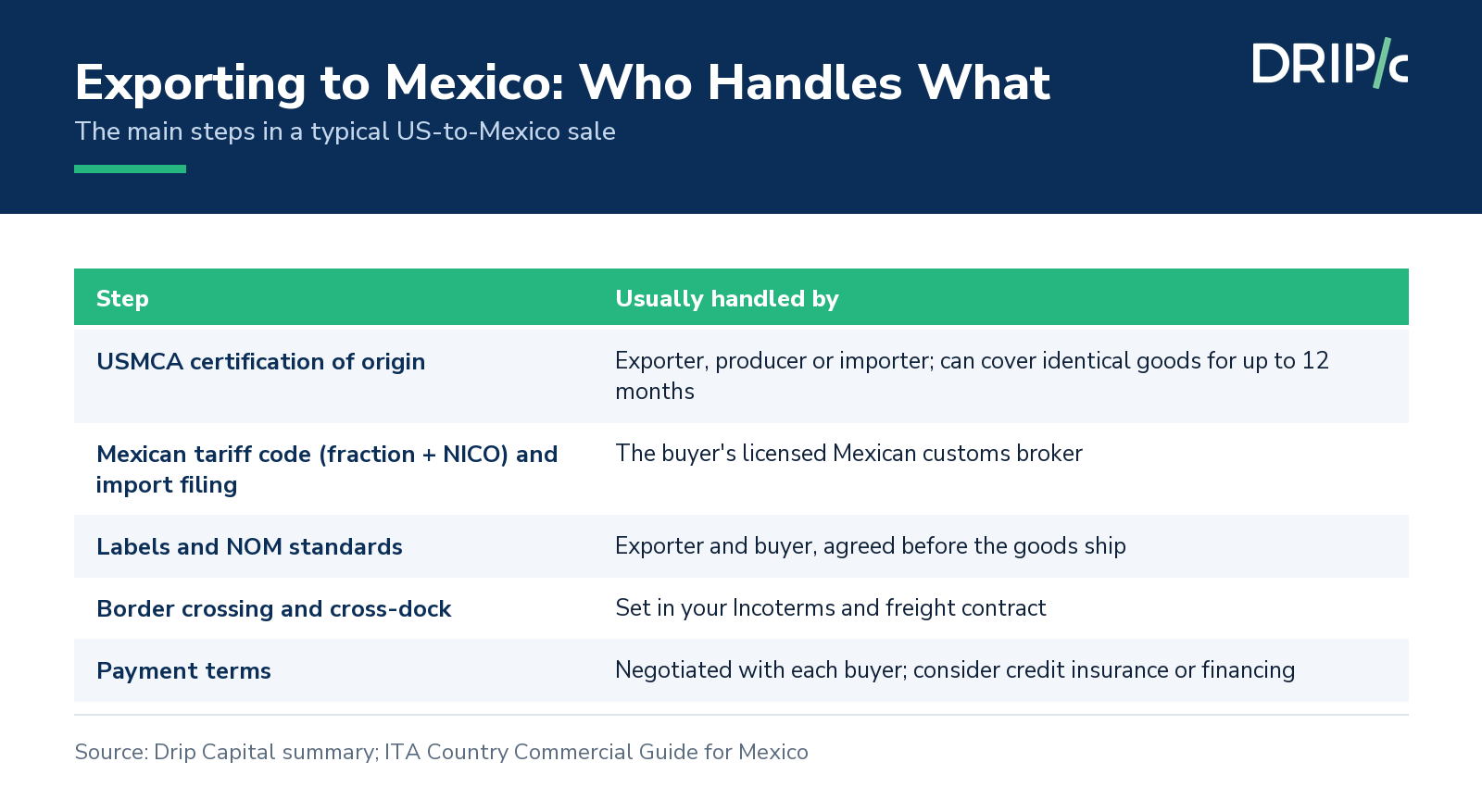
Mexico classifies imports under its own tariff schedule, using an 8-digit tariff fraction plus a 2-digit NICO statistical code (trade.gov). Your US Schedule B or HTS code is only a starting point, so ask your buyer's licensed Mexican customs broker to confirm the fraction and NICO, which set the duty and any permits or standards. About 85% of US–Mexico freight by value moves by truck or rail (BTS), and the importer's customs broker usually files the Mexican import declaration, the pedimento (trade.gov). Agree early on labels, documents and who handles the border crossing:
Selling to Mexican Buyers: Payment Terms and Cash Flow
Whatever you sell among the top imports of Mexico, Mexican manufacturers and distributors may ask to buy on open account, with payment terms you negotiate, while you have already paid for materials, production and freight. Common ways to manage that gap include letters of credit or trade credit insurance for payment risk, pre-shipment finance for production, and receivables financing for invoices you have already issued.
If paying vendors for materials and production is what strains your cash before a Mexican order ships, Drip Capital's Vendor Financing pays your vendors, in any country and currency, before or on shipment, and you repay in up to 90 days. After a one-time credit decision of about 48 hours, vendors are typically paid within 24 hours of you submitting their invoice, with no collateral required. Check if you qualify.
Frequently Asked Questions
What does Mexico import from the US the most?
In 2025, Mexico's largest imports from the US by Census end-use category were computer accessories ($28.1 billion), other vehicle parts and accessories ($22.9 billion), other petroleum products ($20.7 billion), electric apparatus ($20.0 billion) and semiconductors ($18.5 billion). By broad HS category, machinery and computers led at $65.9 billion.
How much does Mexico buy from the United States?
Mexico bought $337.3 billion of US goods in 2025, the most of any country and just ahead of Canada at $333.6 billion. From January through September 2026, it bought $297.6 billion, up 17.6% from the same months of 2025. These are US-reported goods exports on a Census basis.
Is Mexico the largest buyer of US exports?
Yes. In 2025 Mexico passed Canada, according to Census data; Mexico's Business Coordinating Council called it the first time in annual terms. The lead widened in 2026, with Mexico buying $297.6 billion of US goods from January through September versus $265.9 billion for Canada.
What US farm products does Mexico buy?
Mexico is the largest market for US agricultural exports, buying $30.6 billion in 2025, according to USDA. The leading products were corn ($5.93 billion), pork ($2.85 billion), dairy products ($2.57 billion) and soybeans ($2.31 billion). That was 17.9% of all US agricultural exports.
Do US exports to Mexico pay tariffs?
US goods that meet USMCA rules of origin generally enter Mexico duty-free when the importer claims USMCA treatment. Mexico's 2026 tariff increases of up to 50% apply to goods from countries without a trade agreement with Mexico, such as China, South Korea and India, not to goods that qualify for USMCA treatment.
What tariffs does the US charge on Mexican goods in 2026?
Since July 24, 2026, a 10% Section 301 tariff applies to Mexican goods, but products entered duty-free under USMCA are exempt. Section 232 tariffs still apply to covered goods such as steel, aluminum, copper, autos and auto parts. The IEEPA tariffs on Mexico ended after a Supreme Court ruling in February 2026.
Is the USMCA ending?
No. USMCA remains in force. At the July 2026 joint review the US did not agree to renew it in its current form, which triggers annual reviews. If the countries never agree to extend it, USMCA would expire in 2036 (Article 34.7).