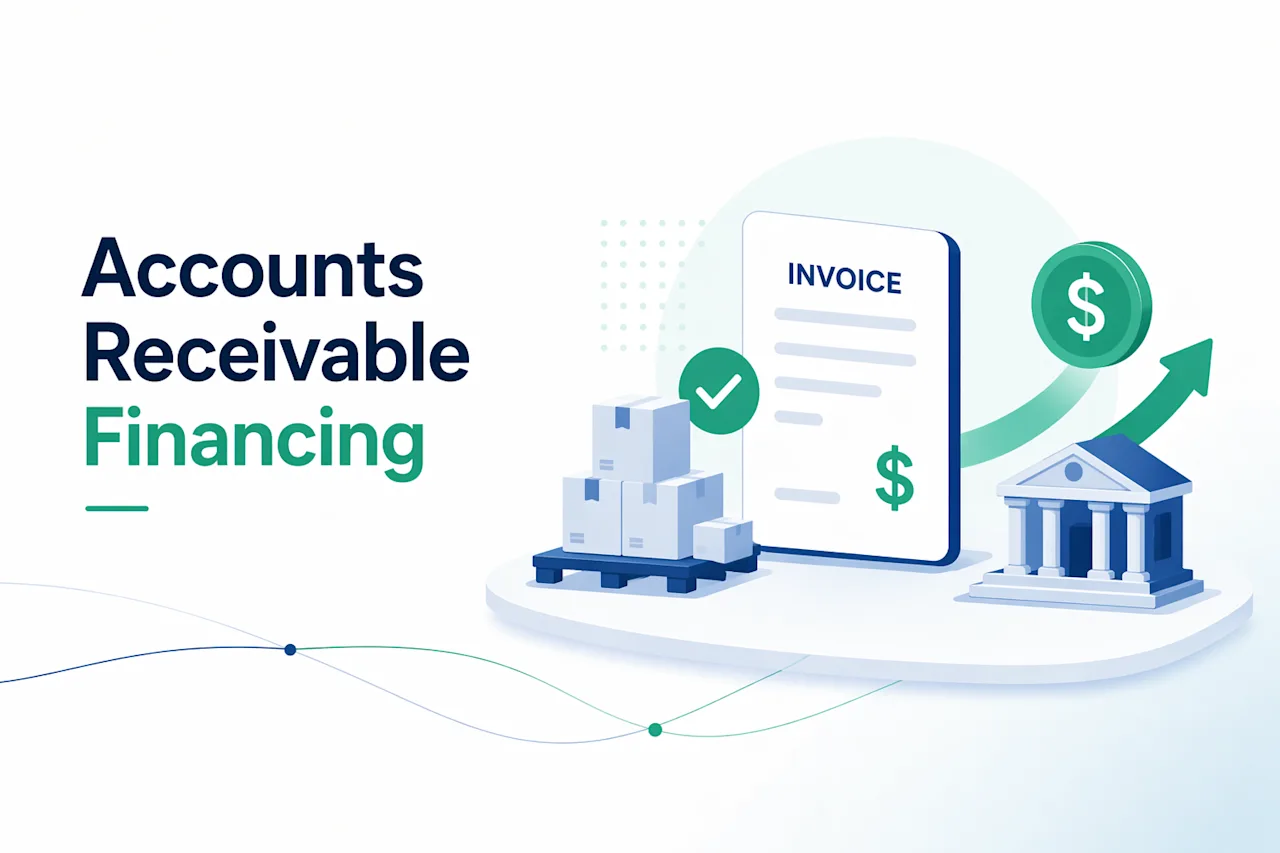
Accounts receivable financing is how businesses stop waiting and start moving. You've delivered the goods, completed the service, sent the invoice - and now you're sitting on a 30, 60, or 90-day payment cycle while your operational costs run on a completely different clock. That mismatch is one of the oldest cash flow problems in business, and accounts receivable financing is one of the most direct ways to fix it.
The idea behind accounts receivable financing is straightforward. Your outstanding invoices represent money you've already earned. Rather than waiting for customers to pay on their terms, you use those invoices to access capital right now, either as collateral for a loan or by selling them to a financing company that advances a percentage of their value.
According to NetSuite, the average accounts receivable collection time in the US sits at approximately 37 days. In many industries, it's double that. For businesses operating on thin working capital, that gap is not just inconvenient. It is a real constraint on growth, and accounts receivable financing is the most direct structural fix for it.
This guide covers everything: what accounts receivable financing actually is, how the structures differ, what it costs, how it compares to factoring and bank loans, and who it works best for.
What Are Accounts Receivable?
Before getting into the financing side, it's worth being clear on what accounts receivable actually means, because the term gets used loosely.
Accounts receivable (shortened to AR) is money owed to your business by customers for goods or services already delivered. When you complete a job and issue an invoice on net-30 or net-60 terms, that outstanding invoice becomes an account receivable - a current asset on your balance sheet.

For most B2B businesses, accounts receivable can represent 20% to 40% of total assets at any given time. In manufacturing and wholesale, that proportion is often higher.
The problem is not that the money does not exist. It just is not available yet. Accounts receivable financing exists to close that window, and receivable financing has been a core working capital tool for B2B businesses for decades.
What Is Accounts Receivable Financing?
Accounts receivable financing, also called receivable financing or AR financing, is a funding arrangement where a business uses its outstanding customer invoices to access immediate working capital. There are two core structures:
As a loan (invoice discounting): The business pledges invoices as collateral and receives a percentage of their value as a loan or line of credit. It retains ownership, manages its own collections, and repays the lender when customers pay.
As an asset sale (factoring): The business sells its invoices outright to a financing company, called a factor, at a discount. The factor takes over collections and assumes responsibility for chasing payment.
In both cases, the lender or factor evaluates the creditworthiness of your customers, not your own credit score. That's a key reason why accounts receivable financing is accessible to businesses that wouldn't qualify for traditional lending.
Advance rates in accounts receivable financing typically run 70% to 90% of the invoice face value. Some lenders go as high as 97%, depending on the quality of the receivables and the buyer profile.
How Does Accounts Receivable Financing Work?
The process is consistent across most providers. Here's the full flow from invoice to settlement:

Step 1 - You deliver goods or complete the service. The work is done. An invoice goes out with agreed payment terms: net-30, net-60, or net-90.
Step 2 - You submit the invoice to an AR financing provider. The provider reviews the invoice and assesses the creditworthiness of the customer who owes you, not your own financial history.
Step 3 - You receive an advance. The provider funds 80% to 90% of the invoice value, typically within 24 to 48 hours. That's your working capital injection.
Step 4 - Your customer pays. In factoring, payment goes directly to the factor. In invoice discounting, the customer pays you and you repay the provider.
Step 5 - You receive the remaining balance. Once the invoice is settled, the provider releases the remaining percentage minus their fee.
Here's what accounts receivable financing looks like in practice: A wholesale distributor receives a $500,000 purchase order on 90-day terms. They submit the invoice through an accounts receivable financing arrangement. The provider advances 85% - $425,000 - within 48 hours. The distributor restocks, fulfills the next order, keeps payroll running. When the buyer pays on day 85, the remaining $75,000 is released minus a 2.5% fee ($12,500). Total cost of accessing $425,000 for three months: $12,500.
Types of Accounts Receivable Financing
Not all accounts receivable financing is structured the same way. The right type depends on your business size, how important customer relationships are, and how much control you want to keep.
| Type | Who Collects | Customer Notified? | Best For |
|---|---|---|---|
| Invoice Factoring | Financing company | Yes | Speed, lower admin overhead |
| Invoice Discounting | Your business | No | Confidentiality, client relationships |
| Selective AR Financing | Depends on structure | Depends | Flexibility, specific invoices |
| Asset-Based Lending | Your business | No | Larger businesses, revolving credit |
| Non-Recourse Factoring | Financing company | Yes | Credit risk protection |
Invoice discounting keeps everything confidential. Your customers pay you as normal; the accounts receivable financing arrangement stays entirely in the background.
Invoice factoring hands off collections to the factor. Faster and lighter operationally, but your customers will know a third party is involved.
Asset-based lending (ABL) is a revolving line of credit secured against your full receivables book. Suited for businesses with $1M or more in monthly receivables. More flexible but requires more ongoing reporting.
Non-recourse accounts receivable financing means the factor absorbs the loss if a customer doesn't pay. The recourse version means you're still liable. Non-recourse costs more but offers meaningful protection when buyer reliability is uncertain.
Accounts Receivable Financing vs Business Loans
Both provide capital. The similarities end there.
A traditional bank loan is approved based on your business's credit profile and financials. You receive a lump sum. You repay it on a fixed schedule regardless of your actual cash flow timing.
Accounts receivable financing is approved based primarily on your customers' creditworthiness. You draw capital only when you have eligible invoices. Repayment is naturally tied to when those invoices are paid.
| Factor | AR Financing | Business Loan |
|---|---|---|
| Approval based on | Customer credit quality | Your credit and financials |
| Speed of funding | 24 to 48 hours | Days to several weeks |
| Repayment structure | Follows invoice payment | Fixed schedule |
| Collateral | Invoices | Often hard assets or personal guarantee |
| Cost model | Only when used | Interest from day one on full balance |
| Balance sheet impact | Minimal in most structures | Adds to long-term debt |
For businesses where the problem is timing rather than the absence of revenue, accounts receivable financing is almost always the more targeted tool. It doesn't load the balance sheet with debt, it doesn't require collateral beyond the invoices themselves, and it moves fast.
Who Qualifies for Accounts Receivable Financing?
Qualification criteria are more accessible than most people expect. The key requirements across most accounts receivable financing providers:
- B2B invoices (business-to-business only, not consumer)
- Invoices for work already completed - goods delivered or services rendered
- Customers with a verifiable and reasonably clean payment history
- Invoices free from disputes, liens, or conditional payment terms
- Minimum annual revenue, typically $1M to $2M depending on the provider
- At least 1 to 2 years of operating history
The most important factor is the credit quality of your customers. A business with modest financials but a roster of creditworthy B2B clients can often access accounts receivable financing when a bank would say no.
Most providers will not finance invoices issued to individual consumers, related entities, or invoices with active disputes attached. Government receivables exist in a grey area - some providers specialise in them, others avoid them.
Industries That Use Accounts Receivable Financing
Receivable financing is used across sectors wherever B2B payment terms create working capital gaps. Some industries rely on it as standard practice.
Manufacturing: Production costs hit weeks before any invoice is even issued. Accounts receivable financing bridges that gap without halting the line.
Wholesale and distribution: Distributors buy on short terms and sell on 60 to 90-day terms. The mismatch is structural. AR financing absorbs it.
Staffing and recruitment: Agencies pay staff weekly but invoice clients monthly. The float is constant, and invoice factoring is one of the most common tools used to manage it.
Construction and contracting: Project timelines are long. Payment timelines are longer. Accounts receivable financing keeps subcontractors paid and the site moving.
Transportation and freight: Trucking carriers invoice on delivery and wait. Freight factoring - a sector-specific form of invoice factoring - is deeply established across the US logistics industry.
Healthcare: Providers wait on insurance reimbursements and institutional payers. AR financing against verified claims is widely used.
Import-export and trade: Cross-border payment cycles stretch 90 to 120 days in some corridors. Accounts receivable financing within supply chain finance structures is how trade businesses stay liquid between shipments.
Benefits of Accounts Receivable Financing
The advantages are practical, not theoretical. Here is what accounts receivable financing actually delivers.
Working capital without new debt. In factoring structures especially, you're selling an asset - not taking on a liability. That means receivable financing often doesn't add to your debt load the way a bank loan does.
Approval based on your customers, not just your history. Younger businesses, businesses without significant hard assets, and businesses recovering from a rough year all face barriers with conventional lenders. Accounts receivable financing sidesteps most of those.
Scales with your revenue. As you invoice more, you can finance more. There's no fixed cap that becomes obsolete when business picks up.
24 to 48-hour turnaround. Bank loans take weeks. Accounts receivable financing moves in days. When cash flow pressure is real, speed genuinely changes what's possible.
Preserves equity. No investors. No dilution. No new stakeholders at the table. You're monetising money that's already owed to you.
Optional outsourcing of collections. With invoice factoring, the factor chases payment. For businesses running lean on finance staff, that's a real operational benefit.
Cost of Accounts Receivable Financing and What to Watch For
Pricing across accounts receivable financing products follows a consistent structure, even if the numbers vary.
Discount rate or factor fee: The main cost. Usually 1% to 5% of the invoice value per 30-day period. This is what you pay for access to the advance.
Service or administration fee: Some providers charge a flat fee per invoice or per facility on top of the discount rate. Not universal, but common enough to ask about.
Advance rate: The percentage of the invoice you receive upfront. 70% to 90% is standard. Some lenders go higher for high-quality receivables.
Here's what it looks like on a $100,000 invoice at a 2% monthly discount rate over 60 days:
| Advance Rate | Advance Received | Fee (2% x 2 months) | Released at Settlement | Net Total |
|---|---|---|---|---|
| 75% | $75,000 | $2,000 | $23,000 | $98,000 |
| 85% | $85,000 | $2,000 | $13,000 | $98,000 |
| 90% | $90,000 | $2,000 | $8,000 | $98,000 |
Total cost across all scenarios: $2,000 on a $100,000 invoice. Whether that's cheap or expensive depends entirely on what you can do with the advance in those 60 days.

What to watch for: Always ask for the total annualised cost, not just the monthly rate. A 2% monthly rate is 24% annually. Some accounts receivable financing arrangements look cheap upfront but carry concentration limits, minimum volumes, or recourse clauses that change the picture. Read everything.
Days Sales Outstanding and Accounts Receivable Financing
One metric worth tracking alongside accounts receivable financing is Days Sales Outstanding, or DSO.
DSO measures the average number of days between issuing an invoice and receiving payment. Formula: (accounts receivable balance / total credit sales) x number of days.
The US average DSO is approximately 36.7 days. In manufacturing and B2B services it's typically 50 to 75 days. Trade businesses sometimes see DSOs exceeding 90 days.
Accounts receivable financing doesn't lower your DSO - your customers still take just as long to pay. What it does is decouple your cash position from that waiting period. You get funded in 48 hours. Your customer pays in 60 days. Your DSO stays the same. Your working capital doesn't suffer. That's the structural value of receivable financing at a business level.
Frequently Asked Questions About Accounts Receivable Financing
What's the difference between accounts receivable financing and factoring?
In AR financing (invoice discounting), you borrow against invoices and keep control of collections. In factoring, you sell the invoices and the factor collects from your customers. Same end result - faster cash - different structure and ownership.
Does accounts receivable financing affect my credit score?
Less than a traditional bank loan in most cases. Factoring is structured as an asset sale rather than debt, so it may not register as a liability on your balance sheet. That said, it varies by provider and structure. Confirm before signing.
Can a startup use accounts receivable financing?
Yes, if you have eligible B2B invoices and creditworthy customers. Most providers require 1 to 2 years of operating history and a minimum annual revenue floor, but the qualification bar is lower than a bank loan.
How long does approval take?
24 to 48 hours for established clients. First-time setup typically takes 3 to 7 days while the provider verifies your business and customer details.
What happens if my customer doesn't pay?
In recourse arrangements, you're responsible for repaying the advance regardless. In non-recourse factoring, the factor absorbs the loss. Most small business AR financing is recourse - worth confirming before you choose a provider.
How is accounts receivable financing different from a line of credit?
A line of credit is a fixed revolving facility based on your creditworthiness. Accounts receivable financing ties directly to specific invoices and scales with your billing volume. You pay only for what you use, not for standby availability.
Are there industries where accounts receivable financing doesn't work?
It's a B2B product. Consumer-facing businesses, and in some structures government contractors, won't qualify through standard providers. Some lenders specialise in government receivables - worth asking if that's your market.
Drip Capital Accounts Receivable Financing
For American businesses in trade, manufacturing, and distribution that need accounts receivable financing aligned with how they actually operate, Drip Capital offers a straightforward, fast facility with no UCC lien requirements.
What the facility includes:
- Financing lines from $50,000 to $3 million
- 80% advance on eligible invoices
- Funding within 24 to 48 hours of invoice submission
- No personal guarantee required
- No UCC filings
- Works for both domestic and international invoices
How it works:
- Submit your invoice - domestic or international
- Get funded - 80% advanced within 24 to 48 hours
- Settlement - Once your buyer pays, Drip Capital transfers the remaining balance minus fees
Without this facility, businesses typically wait 60 to 120 days for payment, face cash flow delays, and tie their growth to buyer payment cycles. With Drip Capital's accounts receivable financing, you get paid in 24 hours, maintain steady liquidity, and keep growth moving on your terms.
Over $9 billion in trade transactions facilitated. More than 11,000 businesses served globally.

For immediate assistance and tailored financial guidance, speak directly with our finance specialist. Call us on +1 (650) 437-0150.