

Working Capital Funding: How Vendor Financing Stacks Up Against Other Options
What Working Capital Funding Actually Solves
Every growing business runs into the same math problem eventually. Vendors want payment before or shortly after they ship. Customers want 30, 60, or 90 days before they pay. The business sits in the middle, carrying the cost of that gap out of its own cash.
Working capital is simply the cash a business has on hand to cover its day-to-day obligations: vendor payments, payroll, inventory, and the ordinary cost of keeping operations moving. When that cash runs short relative to what a growing order book demands, a business needs a working capital fund it can draw on without waiting for its own customers to pay first.
That's where working capital loans, lines of credit, invoice financing, and Vendor Financing all compete for the same job: bridging the gap between what a business owes now and what it collects later. They are not interchangeable, though. Each is built around a different point in the cash cycle, and picking the wrong one usually means paying for capital you don't actually need, or worse, not having it when the vendor payment is due.
The Working Capital Gap: Where the Squeeze Happens
The gap shows up in a predictable place. A business places an order, the vendor asks for payment upfront or within a short window, and the finished goods don't turn into cash until the end customer pays weeks or months later. Business capital tied up in that stretch can't be used anywhere else: not for the next order, not for payroll, not for growth.
The Federal Reserve's most recent Small Business Credit Survey found that 60% of small employer firms applied for financing in the twelve months before the survey, a sign of how common this squeeze has become even among established businesses. Business lines of credit were the single most-sought product, chosen by 43% of financing applicants, ahead of term loans and credit cards.
Why the Gap Widens for Import-Heavy and Growth-Stage Businesses
Businesses that source overseas feel this earlier and harder. A vendor in another country typically wants payment (or at least a deposit) before the goods leave the dock, but the buyer's own customers, big-box retailers especially, often run net 60 or net 90 terms. That leaves weeks or months where cash is committed on one end and not yet collected on the other. Add a busy season, a larger-than-usual purchase order, or a new vendor relationship that hasn't earned open terms yet, and the gap widens fast.
By the numbers
THE WORKING CAPITAL SQUEEZE, IN DATA
60%
of small employer firms applied for financing
in the past 12 months
43%
of financing applicants sought a business
line of credit, the top product chosen
56%
of small businesses are currently owed
money on unpaid invoices ($17,500 avg.)
120 days
cash conversion cycle for smaller US
companies, the longest of any size tier
Sources: Federal Reserve 2026 Report on Employer Firms; Intuit QuickBooks 2025 Small Business Late Payments Report; KPMG Working Capital Trends in the US Market (2025)
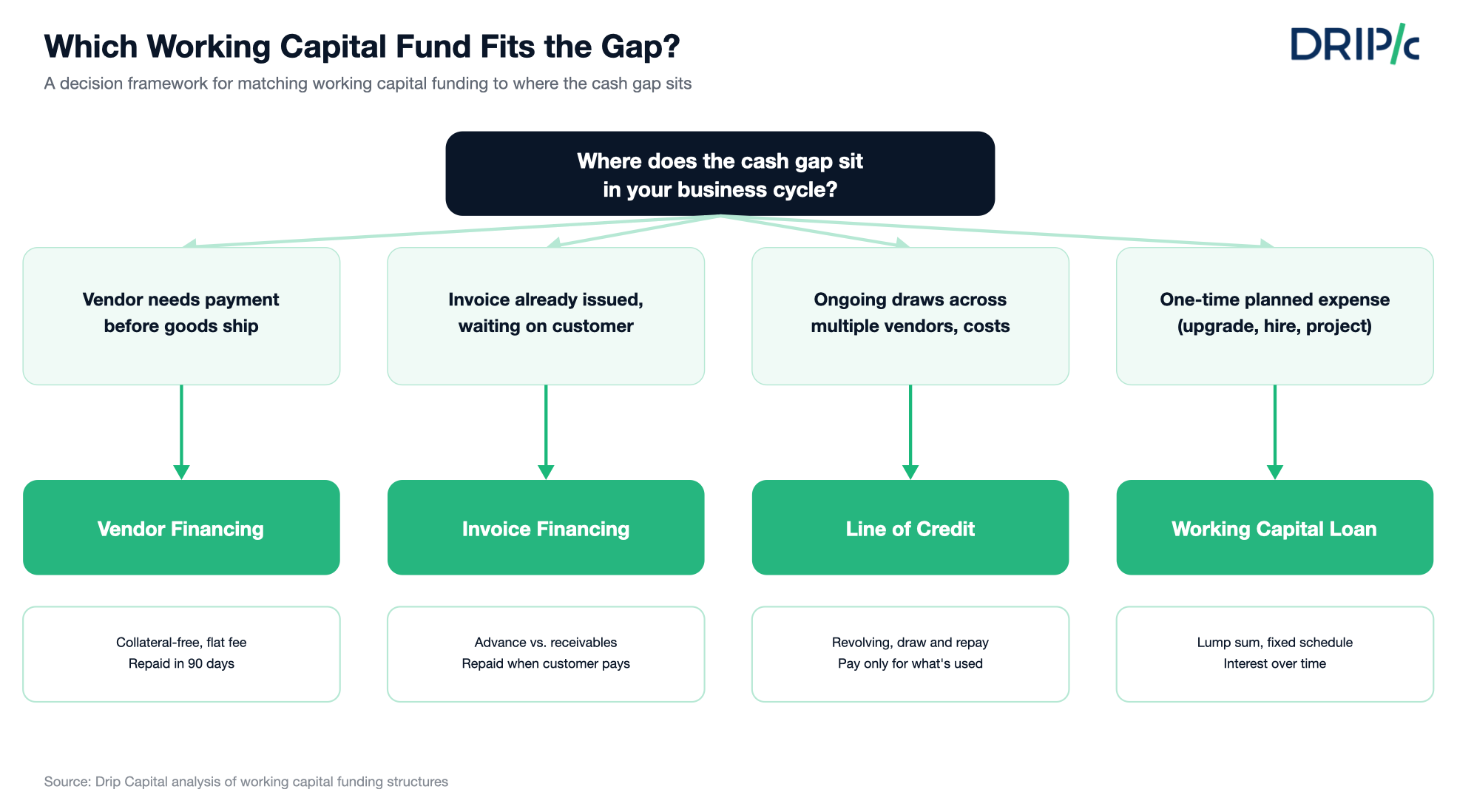
The Working Capital Funding Options on the Table
Most businesses looking at working capital loan options end up comparing four structures. Each solves the cash gap differently, and each has a cost model and qualification bar attached.
Working Capital Loans
A traditional working capital loan is a lump sum, repaid on a fixed schedule with interest, usually over months or years. It works well for a known, one-time need: covering a slow season, funding a specific project, or smoothing a temporary dip. Approval typically leans on time in business, credit history, and often collateral, so it tends to move slower than the other three options here and suits a planned need more than an urgent one.
Business Line of Credit
A Line of Credit is revolving: draw what you need, repay it, and the credit becomes available again. It fits businesses with recurring, unpredictable cash needs, since you only pay for what you actually draw. The tradeoff is that qualifying for a meaningful credit limit usually takes an established banking relationship and a longer track record than a single-transaction product would need.
Invoice Financing
Invoice Financing (also called factoring or Receivable Financing) advances cash against invoices a business has already issued, then repays once the end customer settles the invoice. It's a strong fit for a business sitting on solid receivables from creditworthy buyers but waiting on the clock to run out. The catch: it only helps once the invoice already exists. It does nothing for the earlier problem of paying a vendor before that invoice is even generated.
Vendor Financing
Vendor Financing works earlier in the cycle than any of the three above. Instead of advancing cash against something a business already owns (an invoice, a credit history, collateral), it pays the vendor directly on the buyer's behalf, closing the gap before the goods even ship. A business repays Drip Capital in 90 days, as a single payment. It's collateral-free, priced as a flat fee of 1% to 2% per month on the amount drawn while it's outstanding, and approval weighs the strength of the purchase order and the vendor relationship heavily.

That earlier entry point matters. A business can have perfect invoices and a strong bank history and still come up short if the actual constraint is paying a vendor before the goods leave the factory.
How Vendor Financing Compares to Loans, Lines of Credit, and Factoring
| Funding type | Where it acts in the cycle | Repayment structure | Collateral |
|---|---|---|---|
| Working Capital Loan | One-time, planned expense | Fixed schedule over months or years | Often required |
| Line of Credit | Recurring, ongoing needs | Revolving draw and repay | Varies by lender |
| Invoice Financing | After the invoice is issued | Repaid when customer pays | The invoice itself |
| Vendor Financing | Before the vendor ships | Single payment, in 90 days | None |
Reading the table this way makes the pattern clear: the earlier in the cycle the need sits, the fewer of these options actually apply. A working capital loan or Line of Credit can sit alongside almost any need. Invoice Financing only works once a receivable exists. Vendor Financing is the one built specifically for the moment before that, when the vendor payment is the obstacle and nothing has shipped yet.
When Vendor Financing Is the Better Fit
Vendor Financing tends to win out in a few recurring situations. A vendor requires payment, or a deposit, before production or shipment begins. A business is entering a new vendor relationship and hasn't earned open payment terms yet. A single large purchase order is bigger than the business's available cash, but the underlying deal itself is solid. In each case, the constraint isn't creditworthiness in the abstract; it's the specific timing gap between paying the vendor and collecting from the customer, and Vendor Financing is priced and structured around exactly that gap.
Where a Working Capital Loan or Line of Credit Still Wins
Vendor Financing isn't the answer to every version of the working capital squeeze. A business planning a facility upgrade, a marketing push, or a hiring round needs a lump sum tied to a plan, which is what a working capital loan is for. A business managing several vendors and unpredictable draws across the year benefits more from a Line of Credit's revolving structure than from financing tied to a single purchase order. And a business sitting on strong receivables that simply haven't been paid yet is better served by Invoice Financing against those specific invoices. Matching the fund to where the gap actually sits is the difference between paying for capital that solves the problem and capital that just sits on the balance sheet.
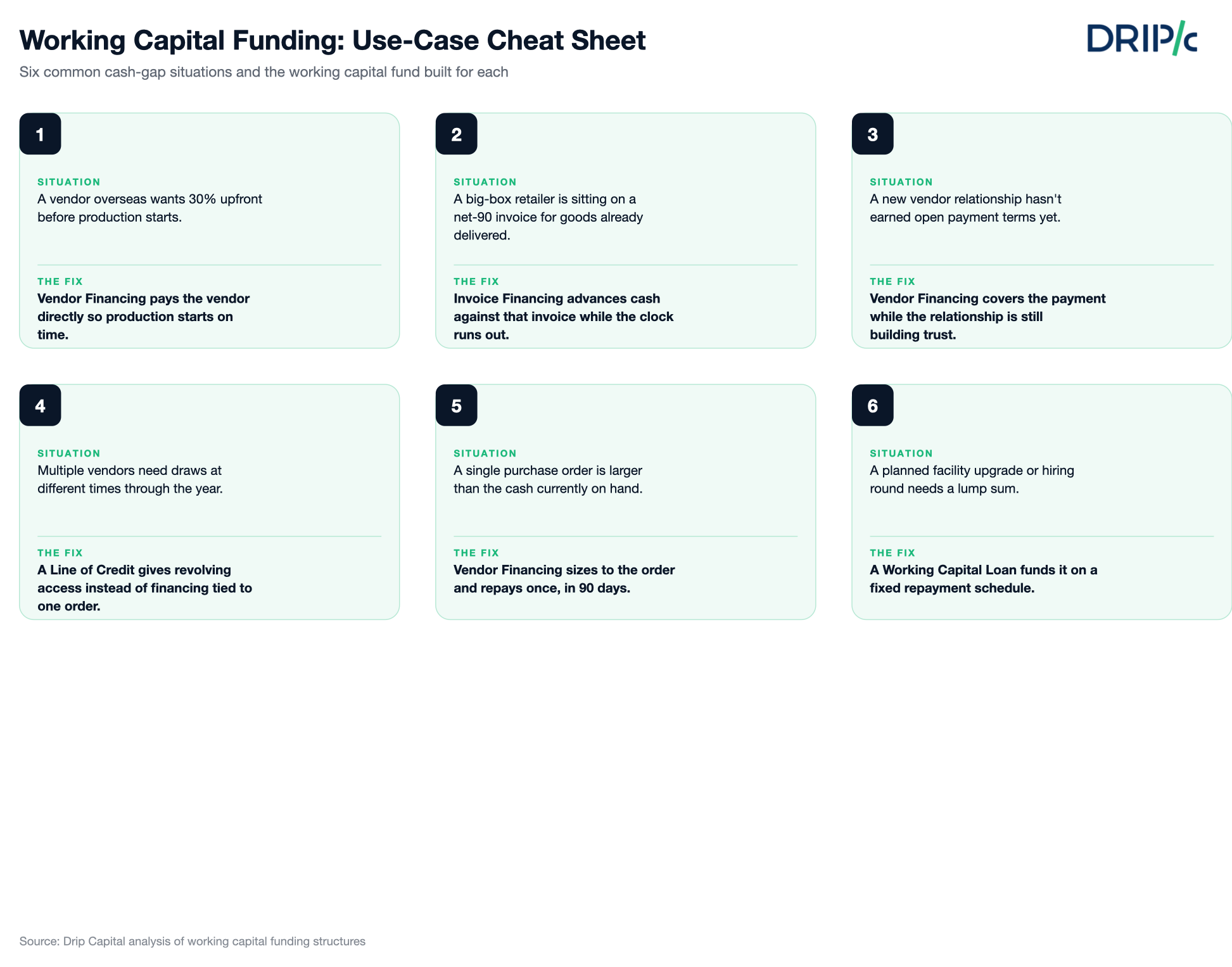
Matching the Fund to the Gap
None of these four options is a universal fix, and that's the point. A working capital fund only earns its cost if it's matched to the specific stretch of the cash cycle it's meant to cover. Businesses that source from overseas vendors, deal with long customer payment terms, or scale purchase orders faster than their own cash flow allows tend to run into the vendor-payment version of this gap most often, which is why Vendor Financing has become a standard tool alongside loans, lines of credit, and invoice financing, each covering its own piece of the cycle. The right move is rarely picking one product for good; it's knowing which one fits the gap in front of you right now. For a broader look at how these pieces fit together, the working capital financing guide and small business financing options guide walk through the full menu in more depth.
Getting Vendor Financing From Drip Capital
Drip Capital's Vendor Financing pays the vendor directly once a purchase order is in place, so the goods move without the business draining its own cash first. It's collateral-free, priced as a flat fee of 1% to 2% per month on the amount drawn, and repaid in 90 days as a single payment. Eligibility rests on two things together: a minimum of two years in business, and Drip Capital's stated target of businesses with $2M or more in annual revenue. Drip Capital also offers a Line of Credit for businesses that need a revolving facility across multiple vendors and draws over time.
FAQ
What's the difference between a working capital loan and Vendor Financing?
A working capital loan is a lump sum repaid on a fixed schedule, usually approved against credit history and often collateral. Vendor Financing instead pays the vendor directly on a specific purchase order and is repaid in 90 days as a single payment, with approval weighted more toward the strength of that order than years of banking history alone.
Is Vendor Financing the same as a business line of credit?
No. A Line of Credit is a revolving facility a business draws against repeatedly over time. Vendor Financing is transaction-specific: it funds one vendor payment tied to one purchase order, then closes out with a single repayment in 90 days.
Who qualifies for Vendor Financing?
Vendor Financing generally requires a minimum of two years in business, and Drip Capital's stated target customer is a business with $2M or more in annual revenue. Approval also weighs the strength of the purchase order and the vendor relationship more heavily than a bank loan typically would.
Does Vendor Financing require collateral?
No. Vendor Financing is collateral-free. It's priced instead as a flat fee, typically 1% to 2% per month, applied only to the amount drawn and only while it remains outstanding.
When does invoice financing make more sense than Vendor Financing?
Invoice Financing fits a business that already has unpaid invoices out with creditworthy customers and needs cash while it waits for those invoices to be paid. Vendor Financing fits the opposite end of the cycle: paying a vendor before goods ship, before any invoice to the end customer even exists.