

Credit Line for New Business: What You Need to Qualify
Why a New Business Gets a Different Kind of Review
The US Census Bureau recorded 473,679 new business applications in a single month of 2025, seasonally adjusted. Most of those founders will need outside money before their second birthday: a line of credit to cover a slow month, restock inventory, or bridge the gap between paying a vendor and getting paid by a customer.
Most guides to getting a credit line assume a business with two or three years of bank statements to show. A newer company does not have that file, so it faces a shorter track record and thinner business credit history. That changes what a lender asks, and what a young business can do to close the gap.
If your company is past that stage, our general line of credit requirements guide covers the fuller picture. This one is for the earlier stage: applying as a new business, with only a few months of records behind you.
By the Numbers
By the numbers
STARTING A BUSINESS AND FINANCING IT ARE TWO DIFFERENT CLOCKS
473K+
New business applications
filed in a single month
69%
Of new employer firms survive
at least two years
60%
Of firms applied for
financing in the past year
78%
Of applicants got at least
some financing approved
Source: US Census Bureau, Business Formation Statistics (Sept 2025); SBA Office of Advocacy; Federal Reserve Banks, 2026 Report on Employer Firms
What Actually Changes When the Applicant Is New
A lender evaluating any line of credit application is trying to answer one question: how likely is this business to repay what it draws? For an established company, the answer comes mostly from history. For a new business, that history barely exists, so the underwriter leans on what does.
Time in business carries unusual weight
Sixty percent of firms applied for financing in the 12 months leading up to the survey, and a newer company is more likely to be one of them, since it has not built the cash reserves an older business leans on instead. Lenders know this, which is why most banks treat time in business as a hard cutoff. Many will not open a revolving credit line for a company under two years old at all.
That two-year mark is not arbitrary. About seven in ten new employer businesses survive at least two years, and the curve keeps dropping after that. A lender pricing risk on a new business is pricing against that curve.
Personal credit does more of the talking
An established company can point to its own bank credit history: a business card paid on time, a term loan closed out cleanly, trade lines with vendors. A new business usually cannot, so the underwriter leans on the owner's personal credit file instead, often for a bigger share of the decision than expected. A personal score in the high 600s or above tends to open more doors. Below that, expect a smaller limit, a higher rate, or a request for collateral.
Revenue gets read differently
Two years of tax returns is the standard ask for business credit review. A newer company will not have them, so lenders substitute recent bank statements, usually six to twelve months, and read them for one thing: whether deposits are steady or lumpy. A company with $30,000 landing every month tells a cleaner story than one $200,000 quarter followed by silence.
Paperwork fills in for the missing years
With no long file to lean on, a new business application gets scrutinized harder at the document level. Formation documents, an EIN, a separate business bank account, and a current profit-and-loss statement all carry more weight than they would for a company with ten years of returns on file. Skipping one tends to read as a red flag.
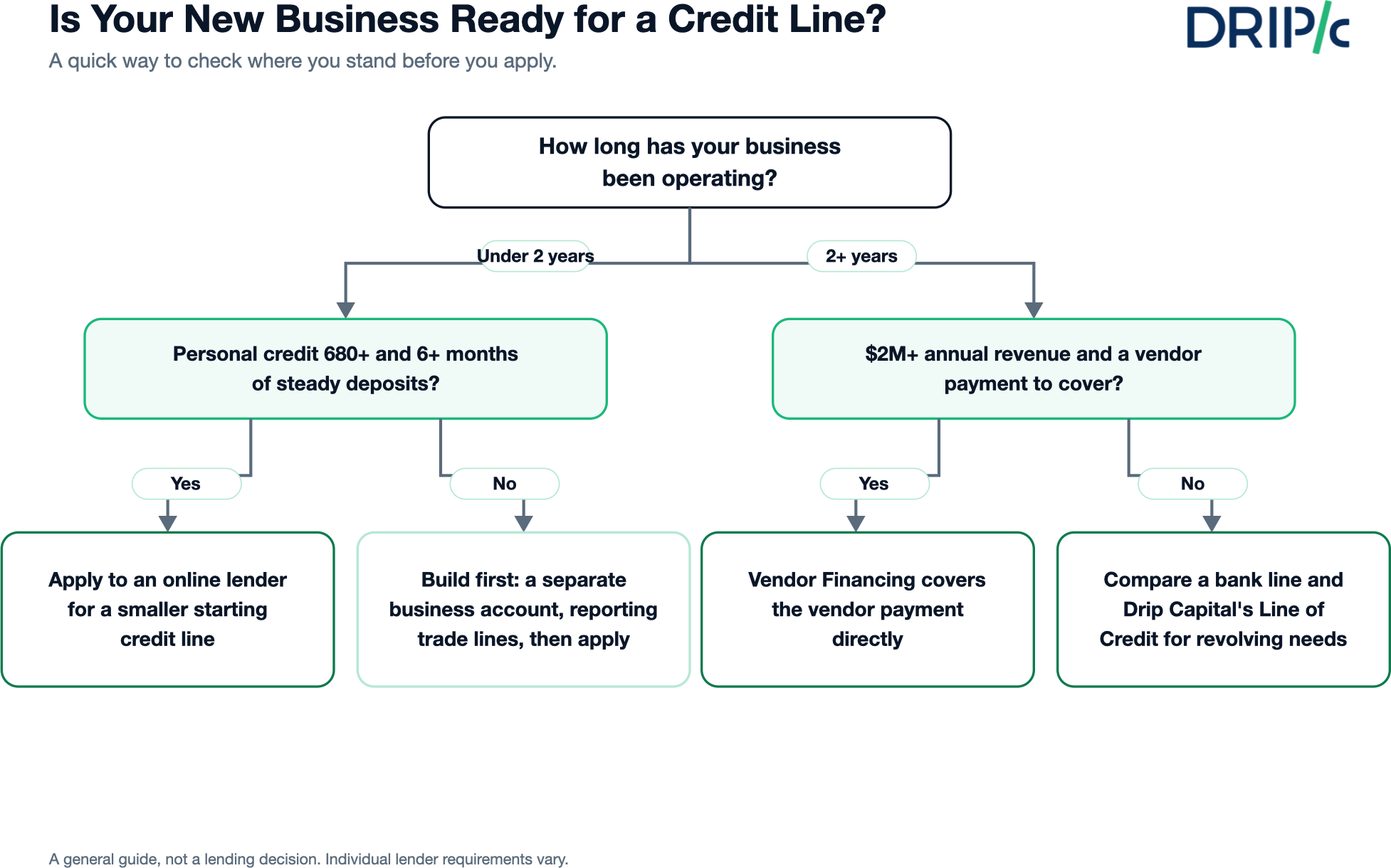
Bank Credit Line vs Other Ways to Fund a New Business
A traditional bank credit line is not the only door, and for a company under two years old, it is often not the first one that opens.
Traditional banks
Banks want the longest track record and cleanest paperwork, and offer the lowest rates in return. Most set a minimum time in business, commonly two years, before considering a revolving credit line. A brand-new company applying at a bank is usually applying too early.
Online and alternative lenders
These lenders move faster and accept a shorter history, sometimes six months to a year, for a higher rate and a smaller limit. They weigh recent bank statement cash flow more heavily than years filed, which suits a company with strong deposits but no long paper trail yet.
Vendor Financing as a working-capital alternative
Some funding gaps a new business faces are not really a credit line problem. When the issue is paying a vendor before goods ship, Vendor Financing covers that payment directly and is repaid up to 90 days later. It requires a minimum of two years in business and $2M or more in annual revenue, so it suits a company past the earliest stage but not yet a fit for a bank's revolving facility. Below both thresholds, the credit-building steps below are the better place to start; our small business financing options guide lays out the full menu by stage.

How to Strengthen a Credit Line Application Before You Apply
A thin file is not permanent. A few habits, kept consistently, change what the lender sees.
Separate business and personal finances immediately. A dedicated business bank account, opened on day one, starts a business credit file that is not tangled up with personal spending.
Open trade lines with vendors that report. Not every vendor reports payment history to the commercial bureaus, but the ones that do turn every on-time payment into a data point a future lender can see.
Keep deposits steady. A lender wants a pattern it can trust to repeat; smoothing revenue where you can does more for an application than one great month buried in three quiet ones.
Apply for a smaller limit first. A modest credit line, drawn and repaid on schedule, builds a track record faster than waiting for a bigger one.
Build personal credit deliberately. A new business leans on the owner's personal file more than an established company does, so cleaning it up ahead of time is worth the effort.
Common Reasons New Business Applications Get Turned Down
Most declines trace back to a handful of gaps, nearly all fixable with lead time. Revenue that looks inconsistent month to month, even when the total is healthy, is one of the most common triggers. Missing or outdated documentation, especially a stale profit-and-loss statement, is another. A personal credit score below a lender's cutoff shows up often, since it carries more weight without a business credit file to back it up. Applying to a lender whose minimum time in business the company has not reached is a mismatch no paperwork fixes; confirm that threshold first. Our note on hidden line of credit charges is worth reading before signing anything, new business or not.
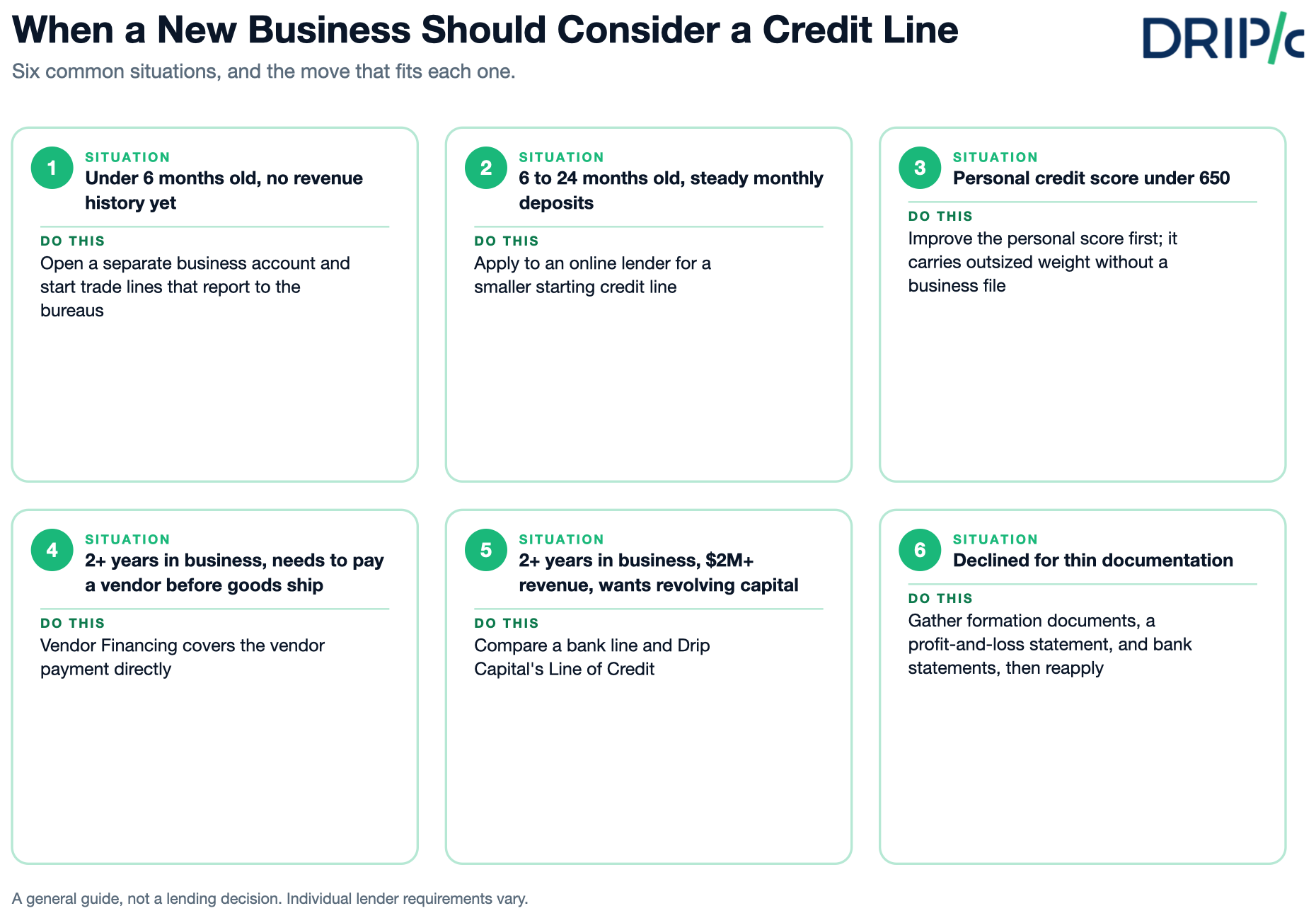
How Drip Capital's Line of Credit Fits Into This
Drip Capital's Line of Credit is a revolving facility: draw what you need, repay over six installments, and the limit opens back up as you go. It carries no prepayment penalty, no blanket lien on business assets unless the account goes into default, and no annual maintenance fee, so the terms that quietly cost the most elsewhere are not buried in the fine print here. For a company that has cleared the early survival curve and wants an ongoing capital credit relationship, it is worth comparing against what a bank or online lender offers on the same terms.
Frequently Asked Questions
Can a brand-new business get a line of credit?
It is possible but harder. Most banks set a minimum time in business, often two years, before offering a revolving credit line. A younger company usually has better luck with an online lender, a smaller starting limit, or a working-capital product tied to a specific transaction.
What credit score does a new business need?
There is no universal cutoff, but a personal score in the high 600s or above tends to open more doors. A new business rarely has its own credit file yet, so the owner's personal score carries unusually heavy weight.
How much revenue do I need to qualify?
Requirements vary by lender. A newer company is usually judged on the consistency of recent bank deposits, since two years of tax returns do not exist yet. Steady monthly revenue reads better than one large, irregular quarter.
Is a bank or an online lender better for a new business?
Banks offer lower rates but the longest requirements for time in business and documentation. Online lenders move faster and accept a shorter history, usually for a higher rate. Which fits depends on how long the company has operated and how quickly the funding is needed.
What documents should I prepare before applying?
Formation documents, an EIN, a separate business bank account, six to twelve months of bank statements, and a current profit-and-loss statement. A new business without two years of tax returns should expect these to carry more weight in the review.