
How to Get Funding Against a Purchase Order
A customer sends over a purchase order for more than you can comfortably fund out of pocket. The order itself is good news. The problem is that your vendor wants payment before the goods ship, and your customer will not pay you until well after they arrive. That gap sits right in the middle of every growing order, and it is exactly what funding against a purchase order is built to close.
This guide walks through the mechanics: what a lender actually looks at, what documents you need ready, how the timeline from application to funded order typically runs, and where the money goes at each step. It does not cover who qualifies or whether a startup can use it. It covers how the process itself works once you decide to use it.
What Funding Against a Purchase Order Actually Means
Funding against a purchase order is not a loan against your balance sheet. It is money tied to one specific transaction: your customer's confirmed order and your vendor's invoice for the goods that order requires.
The deal itself is what gets evaluated
Instead of pledging equipment or inventory you already own, the lender looks at the confirmed order and the vendor invoice behind it. This kind of financing can be collateral-free, since the underlying transaction is what gets evaluated rather than your company's general assets.
It pays your vendor, not you
This distinction trips people up. How to get purchase order funding starts with understanding that the funds usually go straight to your vendor to cover the goods, not into your bank account as a lump sum for you to disburse.
Why the Gap Exists in the First Place
Vendors want payment up front
Most vendors, especially overseas ones, expect payment before or at shipment. Waiting for your customer's payment to arrive before you pay your vendor is not an option they will accept.
Customers pay on their own schedule
Buyers, particularly larger ones, often run on net 30, net 60, or longer. That is standard in most industries and unlikely to change just because you have a cash flow problem.
The two schedules rarely line up
Put those together and there is a window, sometimes 60 days, sometimes more, where you have delivered nothing yet but already owe your vendor money. Financing a customer purchase order exists specifically to cover that window.
By the numbers
How small businesses actually use financing
86%
of firms use financing
on a regular basis
60%
of firms applied for financing
in the past year
42%
of applicants received the full
amount they sought
59%
of firms with debt used
a personal guarantee
Source: Federal Reserve Banks, 2026 Report on Employer Firms
The Documents You Need Before You Apply
Your customer's purchase order
The order itself, with quantities, pricing, and terms spelled out. This is the anchor document; everything else supports it.
Your vendor's invoice or pro forma
A vendor invoice or pro forma invoice showing what you owe to produce or ship the goods. How to get purchase order funding moving quickly usually comes down to having this ready alongside the customer PO, not chasing it down after you apply.
Basic business and banking records
Standard items: business registration, recent bank statements, and information on the transaction history between you and both parties if this is a repeat relationship. None of this is unusual paperwork; it is the same kind of documentation most financing applications ask for.
Step by Step: How the Process Actually Runs
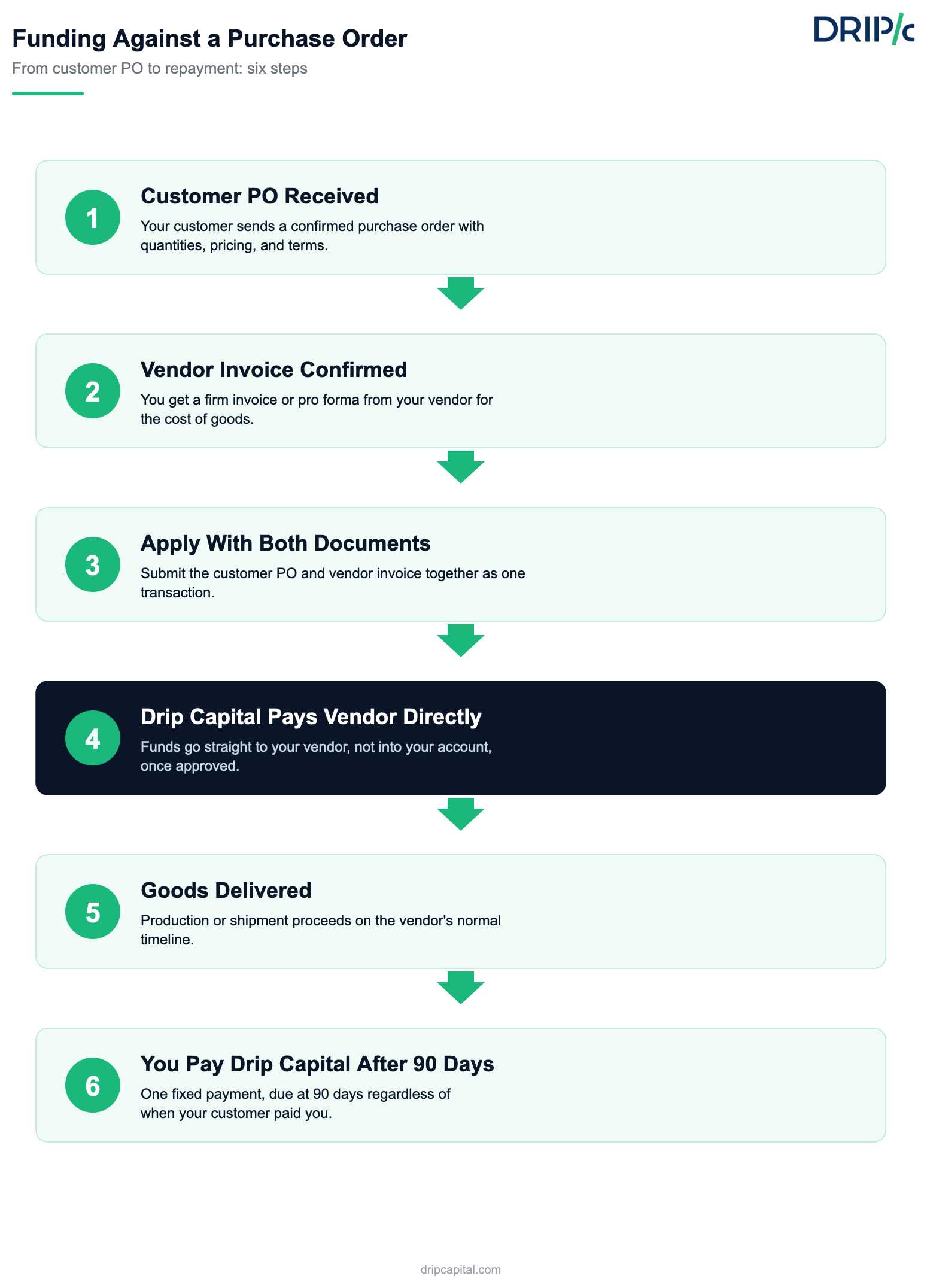
Step one: the customer PO lands
The order arrives and you confirm the terms and delivery date are workable.
Step two: you confirm the vendor cost
You get a firm invoice or pro forma from your vendor covering the cost of goods for that specific order.
Step three: you apply with both documents
You submit the customer PO and vendor invoice together. This is the core of funding against a purchase order: the application is built around one transaction, not a general credit review.
Step four: the vendor gets paid directly
Once approved, the lender pays your vendor, not you. That keeps the deal moving without you fronting the cash yourself.
Step five: goods ship and are delivered
Production or shipment proceeds on the vendor's usual timeline, now unblocked by the payment.
Step six: you repay Drip Capital in 90 days
You owe a single fixed repayment 90 days from when funds were released, regardless of when your own customer pays you.

Once the mechanics click, the practical questions tend to be about specific situations rather than the process itself.
Common Situations, Answered
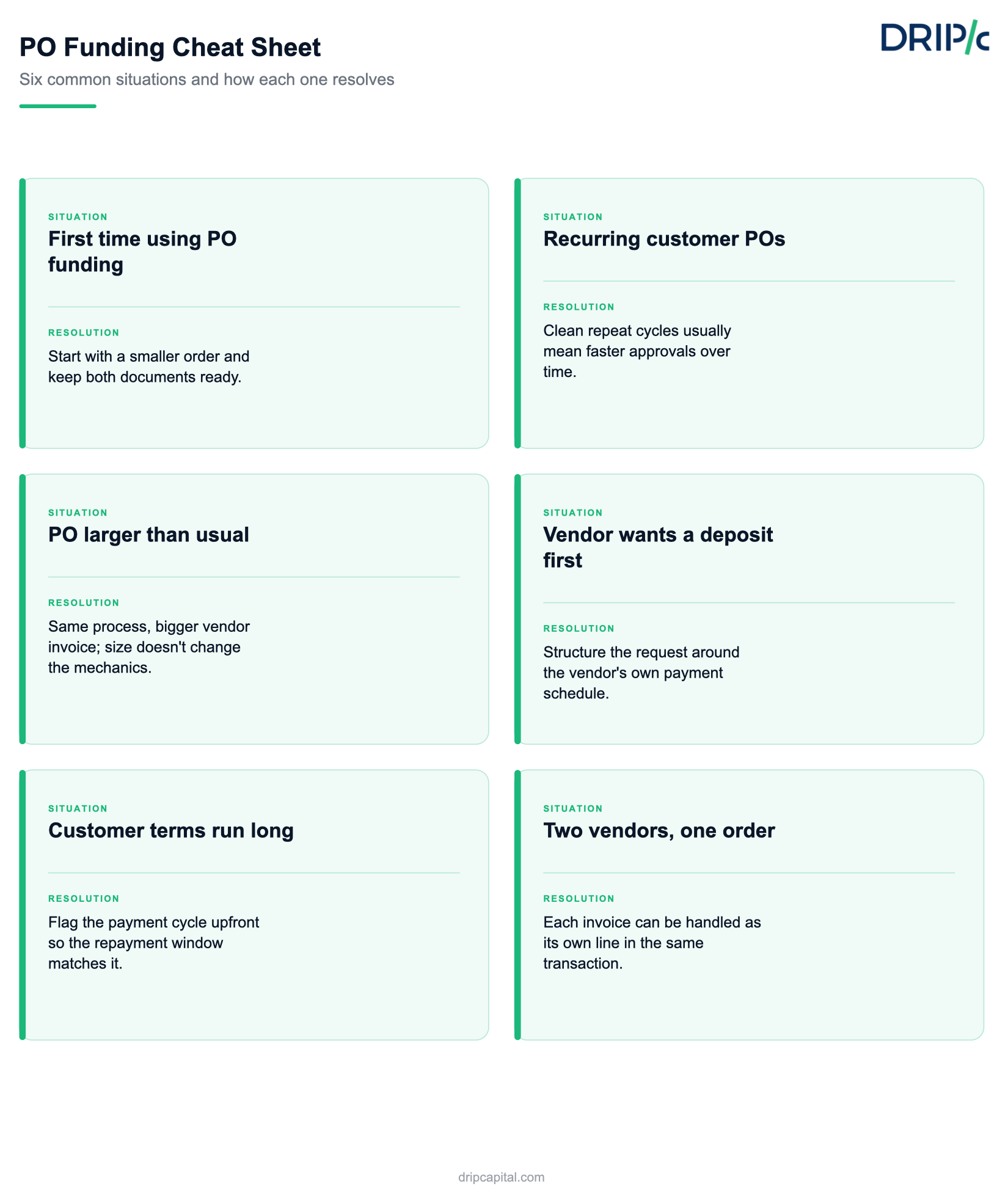
First time using PO funding for a customer order
Start with a smaller order if you can. A clean first transaction, with both documents ready and clear terms, makes the second and third round faster.
A recurring customer sends POs every month
Once a lender has seen a few clean cycles from the same buyer and vendor, later rounds usually move faster since the underlying relationship is already established.
The order is larger than your usual size
A bigger PO means a bigger vendor invoice to fund. This works the same way mechanically; the amounts change, not the process.
Your vendor wants a deposit before the full invoice
Some vendors ask for a partial payment upfront and the balance closer to shipment. Structure the application around the vendor's actual payment schedule rather than treating it as one lump sum.
Your customer's payment terms are unusually long
A longer customer payment cycle affects how the repayment window lines up with when cash actually comes in. Flag this upfront so the repayment terms match reality.
You need to fund two different vendor payments for one order
Some orders involve components from more than one vendor. Each invoice can typically be handled as its own line within the same transaction, keeping the paperwork tied to the underlying order.
How Drip Capital Handles Funding Against a Purchase Order
Drip Capital's Vendor Financing is built around exactly this mechanic. Drip Capital pays your vendor directly once your customer's purchase order and vendor invoice are confirmed. Repayment is due in 90 days, a single fixed payment, priced as a flat fee on the invoice of 1% to 2% per month, charged only on the amount drawn and only while it stays outstanding. It is collateral-free and applies to businesses with a minimum of two years in operation and $2M or more in annual revenue. You can read more about how Vendor Financing works for a single transaction like this.
For businesses juggling several customer orders at once, or costs beyond a single vendor payment, a Line of Credit gives you a revolving limit you draw against and repay over six monthly installments, with no prepayment penalty, no annual maintenance fee, and no blanket lien on your assets unless you default. Our guide on common uses of a business line of credit covers when that structure fits better than a single-transaction facility.
Getting the Timeline Right
The single biggest lever on speed is having both documents, the customer PO and the vendor invoice, ready at the same time. Applications that arrive with one and not the other spend their first days chasing the missing piece instead of moving toward a funding decision.
It also helps to loop your vendor in early. A vendor who knows payment is coming through a financing partner, rather than directly from you, can confirm shipment timing faster once funds are confirmed. None of this changes what the lender ultimately needs; it just removes the back and forth that slows a first-time application down.
Frequently Asked Questions
How long does funding against a purchase order usually take?
It depends heavily on how complete the application is at submission. Applications with both the customer PO and the vendor invoice ready from the start move noticeably faster than ones missing a document.
Does the money come to me or go straight to my vendor?
In most funding against a purchase order structures, the lender pays your vendor directly rather than depositing funds into your account. That keeps the financing tied to the actual transaction it was meant to cover.
Can I use this for more than one customer order at a time?
Yes, though each order with its own PO and vendor invoice is generally evaluated as its own transaction. Businesses with several recurring orders sometimes pair this with a revolving facility like a Line of Credit for broader flexibility.
What happens if my customer pays late?
Repayment is due within the agreed window regardless of exactly when your customer pays, which is why it helps to size that window against your customer's typical payment timeline upfront rather than assuming it will match exactly.
Is financing a customer purchase order the same as a bank loan?
No. A bank loan usually looks at your overall business credit and collateral. Financing a customer purchase order is tied to one specific transaction, the confirmed order and the vendor invoice behind it, rather than your balance sheet as a whole.