How To Forecast A Year You Can't See
Nobody can. The question is how much of the year you commit to anyway.
Ask an importer what changed and almost nobody says tariffs first. They say "I can't plan."
The national numbers show wholesalers carrying less inventory relative to sales. In July 2026, wholesale sales were up 13.0% from a year earlier, while inventories grew 5.7%. The inventory-to-sales ratio fell from 1.28 to 1.20. In a Freightos and Clearit survey of 250 small business importers conducted in November 2025, the most common response to rising costs was cutting shipment volumes.
Why forecasting the year stopped working
Say you buy $1.2 million of goods a year and sell them for $2.5 million. You pay the factory 30% when you place the order and 70% when it ships. From order to warehouse is about five months. Your customers pay you 45 days after you invoice them.
Now suppose you put in one order to cover the whole year. You agree the price with your factory on the day you order. But you don't pay the import tariff until the goods reach the port, four or five months later. The applicable tariff generally depends on when the goods are entered for consumption, or withdrawn from a bonded warehouse for consumption, along with their classification, origin, and any exemptions.
This year, tariff rules changed while importers already had goods at sea.
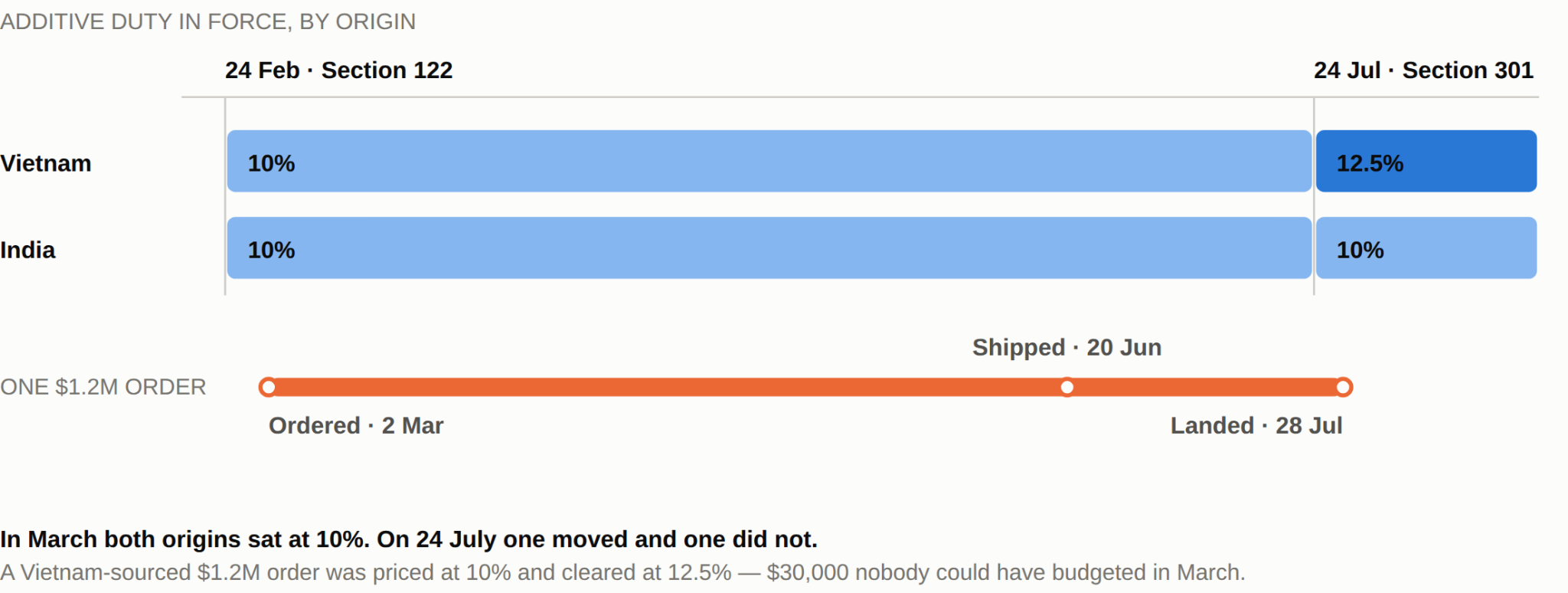
Figure 1 caption: An illustrative order placed on March 2 and entered for consumption on July 28, 2026. The chart compares the additional tariff layer for covered, non-exempt goods from Vietnam and India, excluding ordinary customs duties and other applicable measures. Section 122 introduced a temporary 10% surcharge from February 24, with exemptions. From July 24, the Section 301 forced-labor action set additional rates of 12.5% for Vietnam and 10% for India, subject to product exemptions. Its in-transit exception required entry before July 28, so it does not apply to this example.
For covered, non-exempt goods ordered from Vietnam on March 2 and entered for consumption on July 28, the additional tariff layer rose from 10% to 12.5%. On a $1.2 million customs value, that is $30,000 more duty than the original budget allowed, on goods committed to nearly five months earlier. For the same covered goods from India, that additional tariff layer remained at 10%. Other applicable duties are excluded from this illustration.
You can't fix that with a better forecast.
Would smaller orders be worth the extra cost?
Instead of placing one order for the whole year, you could split the same annual purchase into four smaller orders. That means committing less cash upfront and giving yourself time to adjust later orders as demand and tariffs change. The trade-off is that smaller orders can cost more.
For the importer buying $1.2 million of goods a year, suppose splitting the purchase into four orders adds $77,000 in higher factory prices, extra freight, and tariffs. That is roughly 3% of their $2.5 million in annual sales. Whether that extra cost is worthwhile depends partly on how much clearance stock you avoid.
Suppose you normally sell all your stock for $2.5 million. Selling 8% of it at a 40% discount would reduce your revenue by about $80,000. If ordering in smaller batches helps you avoid that loss, it would cover the extra $77,000.
If you rarely discount unsold stock, buying in bulk may still be cheaper. If demand is harder to predict and you regularly have stock left over, smaller orders may be worth the higher price. You would also have less cash tied up at once. But before changing your ordering pattern, check how it would affect your borrowing.
Check your funding before changing your orders
Smaller orders can reduce the cash tied up in stock. But if your credit line depends on the stock in your warehouse and unpaid customer invoices, holding less stock may also reduce how much you can borrow.
That does not necessarily leave you worse off: smaller orders also need less cash. What matters is whether the funding available covers your payments when they fall due.
If the lender only funds stock once it reaches the warehouse, or invoices once a sale is made, those earlier vendor payments need another source of cash.
Before switching to smaller orders, check what your lender will fund, when that funding becomes available, and whether it covers the gap between paying your vendor and getting paid.
If you need a hand covering that gap, talk to Drip Capital about financing for your vendor payments and working capital needs. Happy to chat through your plans for 2027.