
Hero photo: medino marketing / Unsplash. Illustrative packaged merchandise.
A small parcel can carry a substantial customs bill. The familiar Section 321 exemption for low-value imports is suspended, so an order below $800 does not automatically enter the US duty-free.
This guide covers commercial merchandise and the current postal and non-postal routes. Separate provisions for qualifying gifts and travelers' articles have their own conditions.
What Section 321 used to allow
The Section 321 de minimis provision commonly used for ecommerce covered qualifying merchandise imported by one person on one day, within a $800 limit. The valuation and anti-splitting conditions appear in 19 CFR 10.151.
That historical threshold remains visible in older guidance. Its presence does not establish present eligibility.
By the numbers
$800Historical de minimis limitExemption now suspended$2,500General postal informal limit
Eligibility conditions apply
Source: CBP, July 2026 postal guidance. The informal-entry limit is not a duty-free allowance.
Where the rules stand in October 2026
Non-postal shipments
CBP's non-postal regulation indefinitely suspends the exemption. Commercial courier, air-cargo, ocean, and land shipments need an appropriate entry route and assessment of applicable duties and charges.
International mail
The postal exemption is also suspended under 19 CFR 145.31. CBP introduced a new postal informal entry process in July 2026, generally for qualifying mailed merchandise valued at $2,500 or less. Informal entry still involves customs requirements and applicable duties.
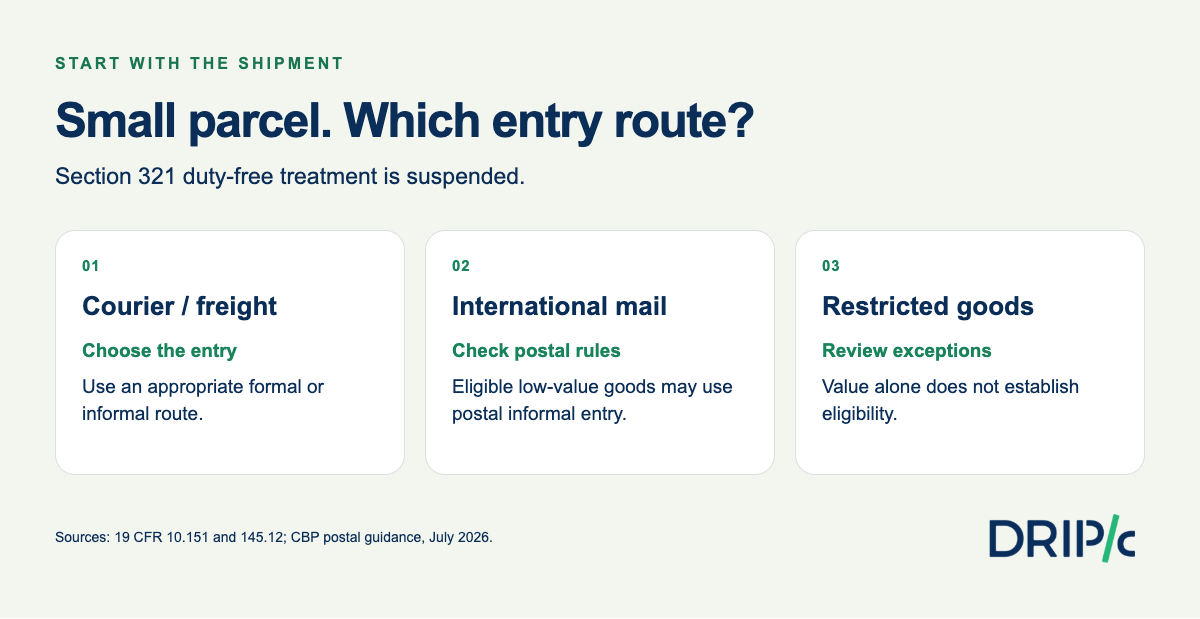
Which entry route applies?
Courier or freight
An old Section 321 entry workflow needs reassessment. A broker or qualified filer determines the applicable formal or informal entry, considering value, product restrictions, and agency requirements. The US customs clearance guide explains the broader process.
Postal informal entry
Under CBP's postal guidance, eligible filers must arrange the required bond, submit shipment data, and pay duties. Data include origin, value, and applicable 10-digit HTS classifications. The standard postal process has reporting and payment deadlines on the seventh day of the following month.
Electronic mail entries and exceptions
CBP's voluntary Entry Type 13 test, implemented in September 2026, provides an electronic ACE route for qualifying mail, including certain goods outside the standard postal process. Antidumping/countervailing-duty and quota shipments remain excluded from the test.
The postal rule also sets an October 22, 2026 compliance deadline for specified agency, Chapter 98/99, and free-trade-agreement cases. From that date, those shipments need another appropriate route, such as eligible Entry Type 13 or formal entry. Confirm shipment-specific treatment with the filer.
How costs change
There is no universal replacement Section 321 tariff rate. Product classification, origin, customs value, and applicable trade measures determine the assessment. A zero ordinary tariff rate can still require review of additional duties and charges.
For illustration, assume a parcel has a $500 customs value and an applicable 10% duty. Duty is $50. Add any applicable entry, brokerage, bond, transport, or handling costs separately; these assumptions are not a tariff quote.

A practical budget separates government assessments from service-provider charges. The customs duty calculator can support an estimate, while the filer confirms the shipment-specific treatment. See also how customs costs affect cash flow.
What belongs in the shipment file?
Product and origin
Use a specific description, accurate value, and substantiated country of origin. Match the commercial invoice to the actual goods and transaction.
Quantities and delivery terms
Reconcile quantities against the packing list. Record who handles clearance and pays charges, alongside tracking and entry records.
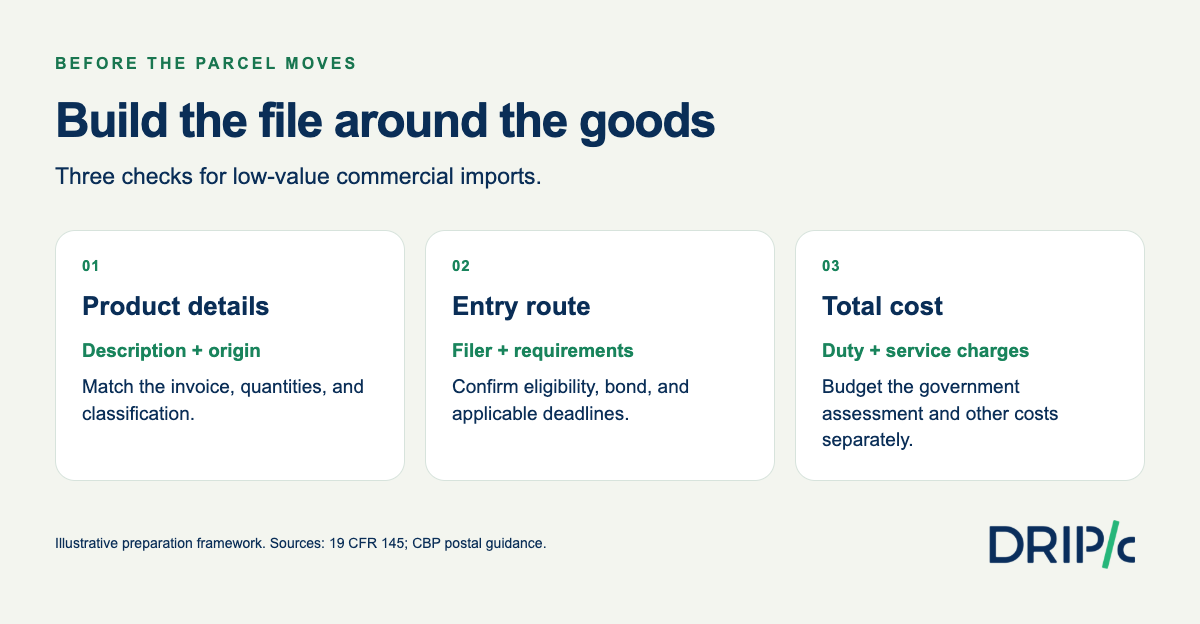
Cash timing
Put vendor payments, customs costs, and expected sales receipts into the same forecast. Small parcel size does not remove the funding gap between those dates.
Planning vendor payments with Drip Capital
Drip Capital's [Vendor Financing](https://www.dripcapital.com/en-us/resources/finance-guides/vendor-financing) pays vendors directly, with repayment terms of up to 90 days, subject to approval and agreed terms. Businesses can assess it alongside their customs-cost budget and collection cycle.
Financing does not establish customs eligibility or change the tariff assessment. Keep the entry review with the qualified customs filer.
Frequently asked questions
Is the $800 exemption available for commercial imports?
The exemption commonly called Section 321 de minimis is currently suspended for postal and non-postal merchandise. Review the current entry requirements even when a parcel is below $800.
Does every small parcel require formal entry?
Some shipments qualify for an informal process. Value, commodity restrictions, and the available filing route determine eligibility.
Can splitting an order restore duty-free treatment?
Splitting an order does not restore the suspended exemption. The historical rule also restricted deliberate splitting to secure free entry or avoid applicable requirements.
Is there one tariff rate for all low-value shipments?
No single rate applies to all products and origins. Classification, valuation, trade measures, and any valid preferential claim must be assessed for the shipment.