
US FDA Prior Notice: What Food Importers Need to File Before Arrival
Picture a reefer container of frozen shrimp sitting on a chassis at the Port of Los Angeles. It cleared the ocean crossing from Ecuador without incident: eighteen days, temperature logs clean, paperwork in order, or so the importer thought. Then a hold notice comes through. One data field on the FDA prior notice didn't match the customs entry filed with CBP: a manufacturer registration number, off by a digit. The shrimp cannot move. The shipping schedule no longer matters. What matters now is spoilage, ticking by in hours, on a refrigerated box that is racking up demurrage and losing shelf life at a dock in Long Beach.
This is a composite scenario. It is not a documented case. But the mechanics behind it are real, and they are the reason FDA prior notice compliance deserves more attention than importers usually give it. Most guides on this topic read like a checklist: define the rule, list the fields, done. That misses what actually makes prior notice dangerous. It is not complicated. It is unforgiving of small errors, and the penalty for a small error is a shipment that cannot enter the country.
What FDA Prior Notice Actually Requires
Prior notice is a filing requirement under the Public Health Security and Bioterrorism Preparedness and Response Act of 2002: before a shipment of food imports reaches the United States, the FDA must receive advance notice of what is arriving, from where, and through which port. The rule applies to nearly all food intended for humans or animals entering US commerce, whether by ocean, air, truck, rail, or international mail. It exists so the FDA can review a shipment for potential threats while it is still in transit.
Every US FDA prior notice filing carries specific data: the identity of the food, the manufacturer, the grower or shipper where known, the country of origin, the importer, the consignee, and the anticipated arrival information (port, date, and mode of transport). Get one of these fields wrong, and the filing can be rejected or the shipment flagged for review even if nothing is actually wrong with the food itself.
Who Has to File
The importer, the importer's customs broker, or another authorized filer can submit the US FDA prior notice on the importer's behalf, but the legal responsibility for accuracy sits with the importer. Most importers rely on a licensed customs broker to file it alongside the CBP entry, since the two filings need to match and brokers already handle that side of the process (the purchase order financing guide covers how a broker fits into the wider import timeline). A small business bringing in its first container of packaged food should confirm, in writing, who on their team or their broker's team owns this filing. It is not automatic.
The Filing Windows Are Tight, and They Vary by Mode
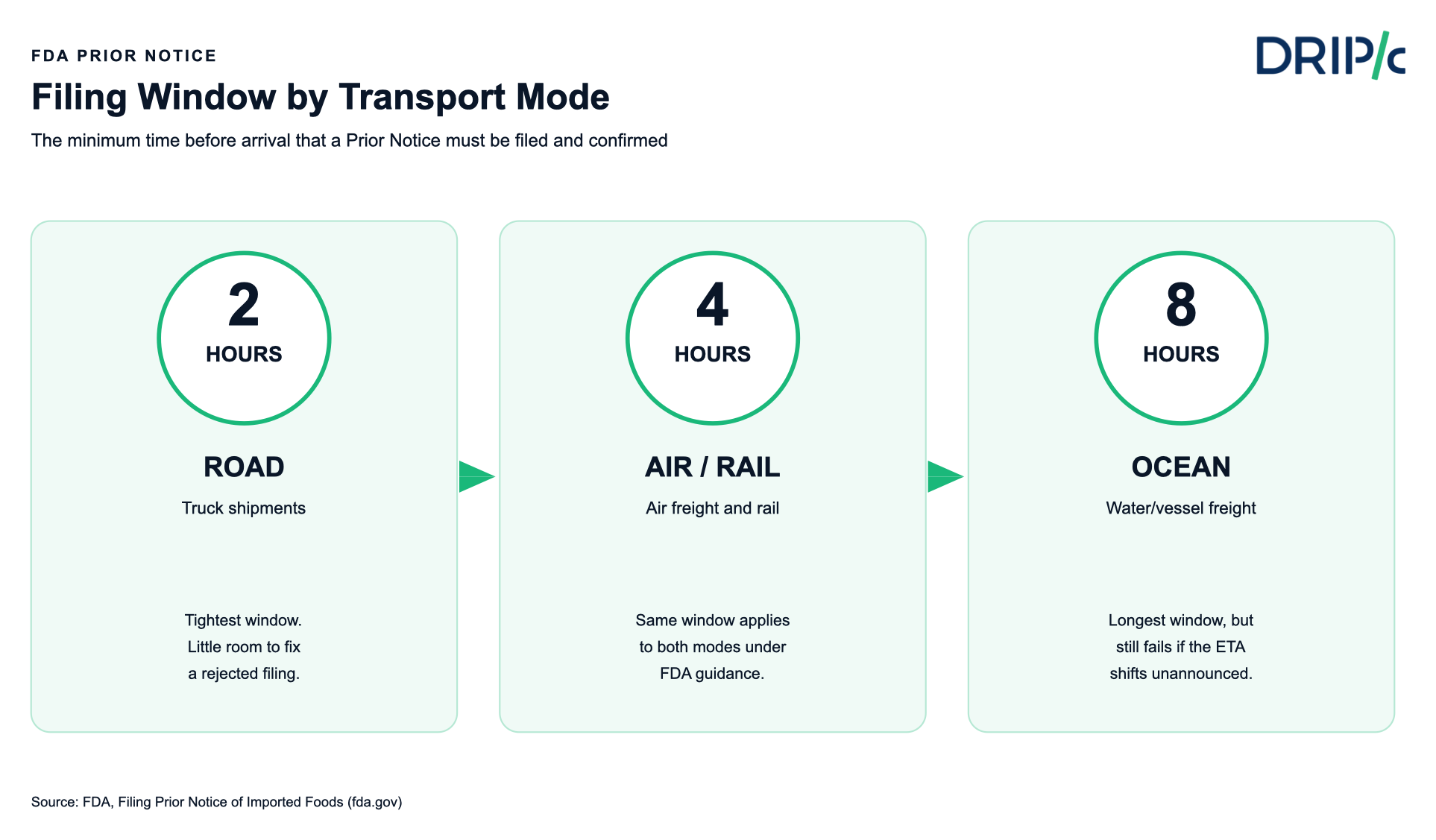
This is where FDA prior notice stops being a paperwork exercise and starts being a logistics problem. Under 21 CFR § 1.279, the notice must be submitted and confirmed by the FDA within a minimum window before the shipment's arrival, and that window depends entirely on the mode of transport:
- 2 hours before arrival for food arriving by road (truck)
- 4 hours before arrival for food arriving by air or rail
- 8 hours before arrival for food arriving by water (ocean freight)
Two hours for a truck is not much room for error. If a filing has a mistake, the correction has to happen, get resubmitted, and get confirmed, all before that window closes. Miss it, and the truck sits at the border.
An Early Filing Can Still Fail
There is a companion wrinkle that catches importers who think they have solved the problem by filing early. Prior notice filed through the FDA's own Prior Notice System Interface can go in up to 15 calendar days before the anticipated arrival date, while a filing made through the CBP interface used with a customs entry can go in further out, up to 30 calendar days ahead. Filing early feels safe.
But a prior notice is tied to a specific expected arrival: port, date, and mode. If the vessel gets rerouted, the ETA shifts, or the mode of entry changes, the original filing no longer matches reality. The importer or broker has to amend it, and the amendment itself is subject to the same window rules above. An early filing does not buy protection against a late logistics change. It just moves the risk earlier in the process, where it is easier to forget about.
A Mismatch With the CBP Entry Can Sink an Otherwise Correct Filing
Prior notice does not exist on its own. It has to line up with the separate customs entry that the importer or broker files with CBP for the same shipment. If a product code, manufacturer registration number, or other key field in the prior notice does not match what is on the CBP entry, the shipment gets flagged. The food itself can be perfectly fine, correctly labeled, and safe to eat. The mismatch alone is enough to trigger a hold.
By the numbers
FDA Prior Notice, in numbers
2 hrs
Minimum notice window
for food arriving by road
8 hrs
Minimum notice window
for food arriving by ocean
15 days
Furthest a filing can
go in through FDA's PNSI
2
Ways a refused shipment
can leave the port: held or exported
Source: FDA, Filing Prior Notice of Imported Foods; 21 CFR § 1.283
Refusal Under Prior Notice Is Not a Paperwork Fix
Federal law treats this as more than an administrative step. Importing or offering to import a food shipment in violation of the prior notice requirements is a "Prohibited Act" under the Federal Food, Drug, and Cosmetic Act, the same statutory category that covers adulterated or misbranded food. Food imported without adequate prior notice is subject to refusal of admission.
And refusal has a specific, narrow outcome under 21 CFR § 1.283: the food must be held at the port of entry unless CBP or the FDA directs otherwise, or it must be exported from the port of arrival under CBP supervision. There is no third path where the importer simply refiles and moves on while the goods keep traveling. The shipment stops.
Facility Registration Is a Separate Requirement That Can Still Break Prior Notice
Prior notice is not the only registration a food importer needs to keep current. Under a related requirement of the Bioterrorism Act, foreign facilities that manufacture, process, pack, or hold food for the US market must register with the FDA, and that registration has to be renewed periodically. A prior notice filing references the facility's registration number, and importers who assume registration is a one-time task, filed once and forgotten, risk finding out otherwise at the worst possible time: when a shipment is already in transit and the registration behind it has lapsed. Confirming registration status alongside the prior notice filing is worth building into a standard pre-shipment routine.
What Counts as "Food" Under This Rule
The FDA's definition is broad. It covers packaged and unpackaged food and beverages for humans and animals: fresh produce, seafood, meat and poultry products regulated by FDA, dietary supplements, food additives, infant formula, and animal feed and pet food. A handful of categories are excluded or handled differently, including certain personal shipments, food carried by travelers for personal use, and food regulated separately by USDA (most meat, poultry, and egg products fall under USDA jurisdiction). Importers who deal in a mixed product line, say, packaged snack foods alongside USDA-regulated meat items, should confirm the category for each item individually.

A hold at the port is a compliance problem first. It is also, quietly, a cash-timing problem for Food imports businesses, which is a separate issue worth understanding on its own terms.
What to Do If a Shipment Gets Held
The first step is establishing why: an unconfirmed prior notice, a mismatch with the CBP entry, or an expired facility registration each call for a different fix. A customs broker experienced in FDA-regulated goods can usually diagnose this quickly, since they see the rejection codes directly. From there, the importer amends and resubmits the prior notice, confirms the facility registration status if that is the issue, and works with CBP on whether the goods can be held pending review or need to be exported. None of this is fast. For Imported Food, especially anything perishable, every day of delay is a day closer to product loss, on top of demurrage and storage charges accruing at the port. Importers weighing their broader financing options during a stretch like this can find a fuller rundown in Drip Capital's small business financing options guide.
The Honest Cash-Flow Connection
This section covers cash flow. Drip Capital's products do nothing to fix a prior notice hold. But the cash-flow squeeze that follows a held shipment is real and worth naming plainly. A business that pays its vendor upfront or on tight terms, then has that inventory stuck at a port for a week or two while a filing gets corrected, is carrying a cash gap that has nothing to do with whether the paperwork eventually clears.
Vendor Financing exists for the first half of that gap: it pays the vendor directly, so the importer is not funding a shipment sitting in limbo out of its own working capital. It requires a minimum of two years in business and Drip Capital's stated target of $2M or more in annual revenue, and it is collateral-free. Repayment runs up to 90 days. Drip Capital's Line of Credit covers the broader version of the same problem, a revolving facility, $50,000 to $3 million, repaid over six monthly installments with no prepayment penalty and no annual maintenance fee, useful when delays keep recurring across shipments. Neither product resolves an FDA hold. Both exist so a hold does not also become a working capital crisis. For a wider view of how importers bridge timing gaps like this, the working capital finance guide walks through the options side by side.
A Pre-Shipment Checklist
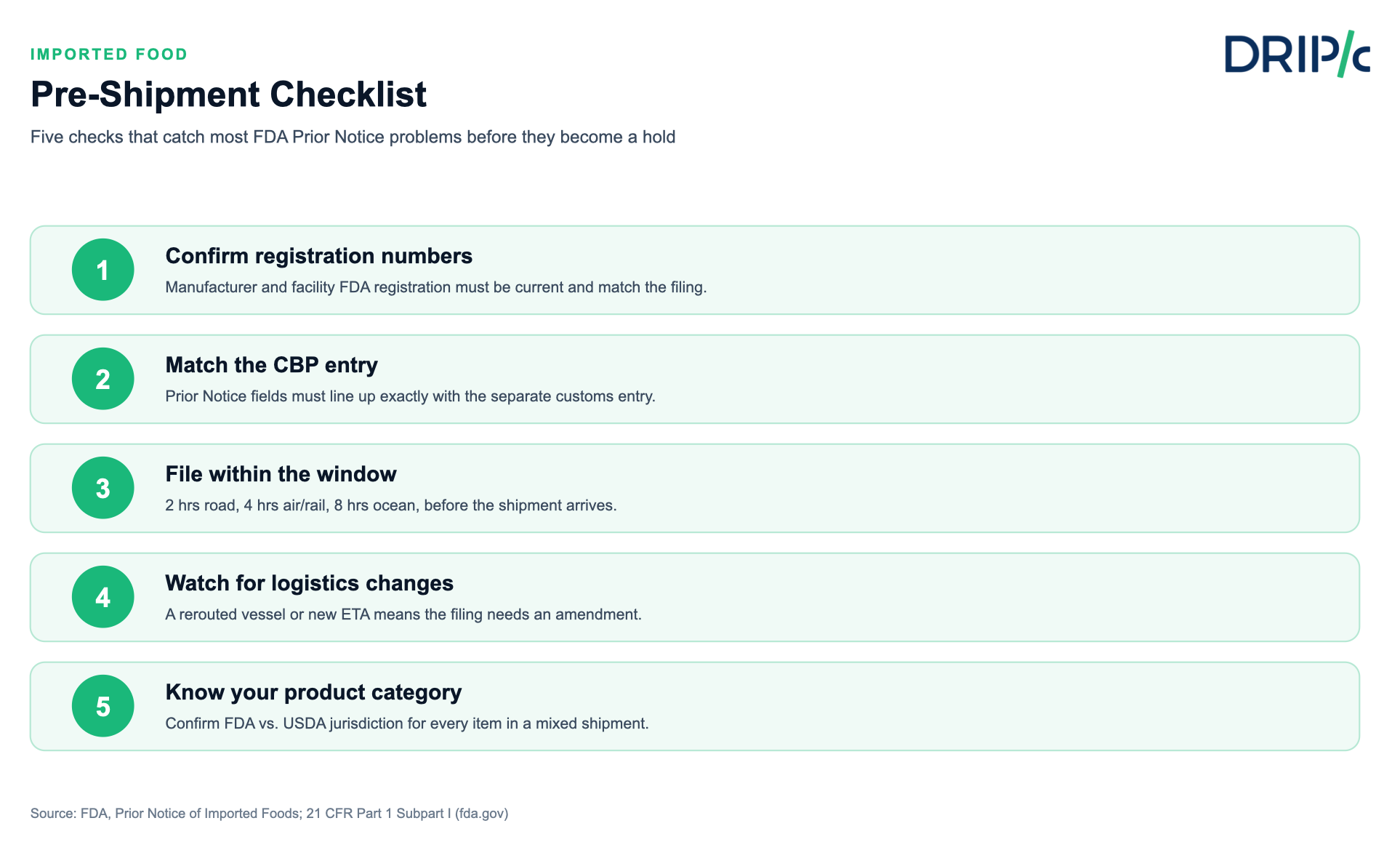
Before a Food imports shipment leaves the origin port, a few checks catch most FDA prior notice problems before they become a hold:
- Confirm the manufacturer and facility FDA registration numbers are current and match what will go on the prior notice.
- Confirm the broker or filer has the exact anticipated arrival port, date, and mode of transport, and that this matches the CBP entry being prepared.
- File the prior notice within the FDA's window, allowing time for a resubmission if the first filing is rejected.
- If logistics change (rerouted vessel, changed ETA, different port), amend the prior notice immediately. The original filing does not automatically carry over.
- Verify which regulatory category the product falls under (FDA versus USDA) before assuming one filing covers it.
FAQ
Does FDA prior notice apply to every food shipment entering the US?
It applies broadly to food and beverages for humans and animals crossing into US commerce by any mode. Some categories are excluded or handled under separate rules, including most meat, poultry, and egg products under USDA jurisdiction, and certain personal-use shipments. Importers with a mixed product line should check category by category.
Who is legally responsible if a prior notice is filed incorrectly?
The importer carries the legal responsibility for an accurate filing, even when a customs broker or other authorized filer submits it. Confirming who owns this task, and how they coordinate with the CBP entry filer, is worth doing before the first shipment moves.
Can a shipment still be held if the prior notice was filed correctly?
Yes. A correctly filed prior notice can still be flagged if it does not match the separate CBP customs entry, or if it is tied to a facility whose FDA registration has lapsed. Both are separate failure points from the prior notice filing itself.
How far in advance can prior notice be filed?
Up to 15 calendar days before the anticipated arrival date through the FDA's own Prior Notice System Interface, or up to 30 calendar days ahead through the CBP interface used with a customs entry. Filing early does not protect against a later change in the vessel's route or arrival time, which requires an amendment.
What happens if a shipment is refused for inadequate prior notice?
Under federal regulation, the food must be held at the port of entry unless CBP or the FDA directs otherwise, or it must be exported from the port of arrival under CBP supervision. There is no option to simply refile while the goods continue moving.