
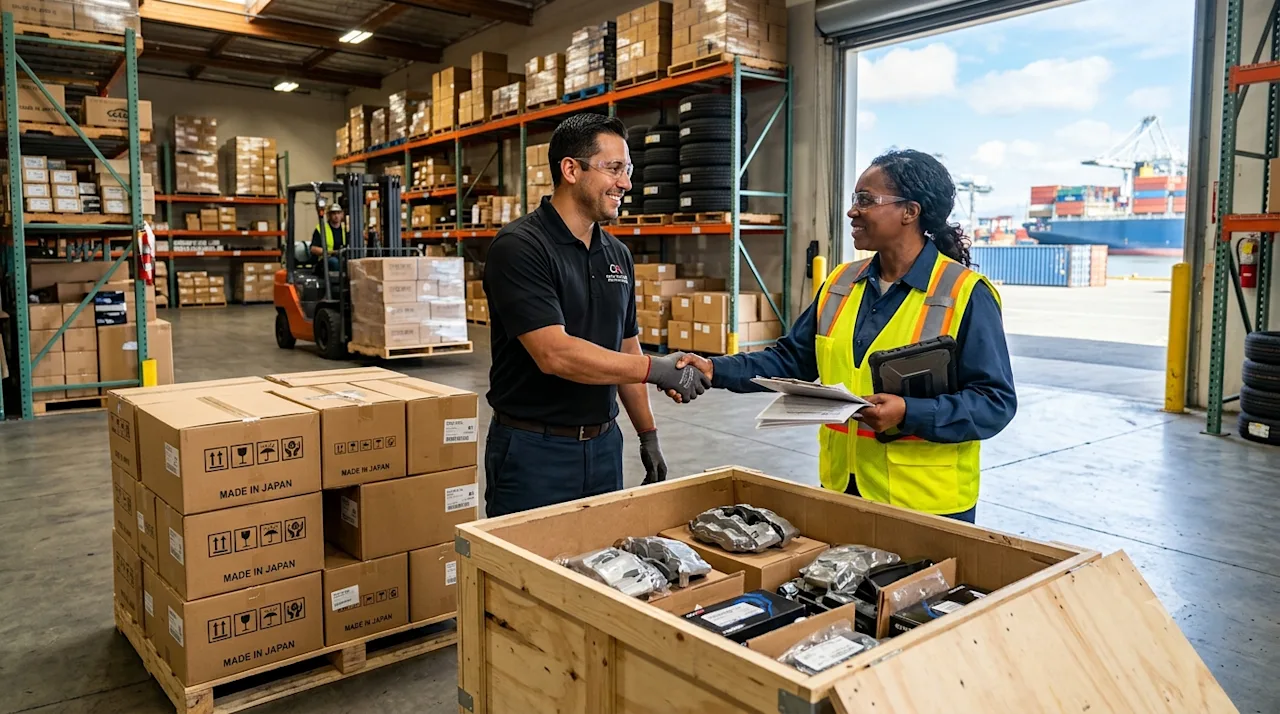
California's ports are among the largest auto parts import gateways in the US. The Port of Los Angeles and Port of Long Beach together handle roughly 31% of all US containerized trade, while California's ports overall account for approximately 40% of all US containerized imports, according to the state Legislative Analyst's Office. A significant share of that volume is automotive: engines from Japan, brake components from South Korea, aftermarket body parts from Taiwan, electrical assemblies from China, and OEM components from Germany.
If your business is part of that supply chain, you already know the problem. Overseas vendors want payment before they ship. Your customers in California want 30 to 60 day terms before they pay you. The gap between those two events - paying out and collecting in - is where cash disappears, growth stalls, and good orders get turned down.
Vendor Financing is built specifically for this gap. This guide explains how it works for California auto parts importers, why traditional bank financing falls short, and how businesses across California's auto aftermarket corridor are using it to pay overseas vendors faster and carry more inventory without draining their operating cash.
The California Auto Parts Import Landscape in 2026
California's auto parts import sector is large, concentrated, and under significant financial pressure heading into 2026.
Since May 3, 2025, a 25% Section 232 tariff has applied to covered imported auto parts, layered on top of standard duties. Trade agreements have since capped the rate at 15% for covered parts from Japan, South Korea (retroactive to November 1, 2025), and the European Union (effective July 1, 2026), while parts from China, Taiwan, and other non-deal countries still face the full 25%. Either way, the landed cost of every container is materially higher than it was two years ago, while customer pricing has not moved at the same pace.
The combination of higher landed costs, longer payment cycles from customers, and vendor payment-on-shipment requirements creates a cash flow gap that is wider in 2026 than it has been in years. Many importers are combining financing with efforts to extend their vendor payment terms to manage it from both sides.
The Southern California auto aftermarket corridor - home to a dense concentration of SEMA-member businesses across Los Angeles, Orange County, and the Inland Empire - represents one of the largest concentrations of auto parts importers, distributors, and aftermarket specialists in the US, with a further cluster in the Bay Area. These businesses source from multiple countries simultaneously, manage complex lead times, and operate on margins that leave little room for working capital inefficiency.
Why the Cash Flow Gap Is Structural for Auto Parts Importers
The cash flow gap facing California auto parts importers is built into the structure of the business model.
An importer buying brake rotors from a Korean manufacturer pays at the time of order confirmation or shipment - typically 30 to 60 days before the container even arrives at the Port of Long Beach. Once it arrives, customs clearance, drayage, and warehouse receiving add another 5 to 15 days. The importer then sells to distributors, repair shops, or online channels on net-30 or net-60 terms.
Add those stages together and the total cycle from vendor payment to customer collection typically runs 90 to 150 days, depending on origin country and customer terms. Consider a business doing $2 million in annual imports: at that cycle length, it effectively has $500,000 to $750,000 tied up at any given time. That is cash that cannot be used to fund the next order, take advantage of a volume discount, or onboard a new vendor.
For a business growing at 20% or 30% annually, this gap compounds. Every new order requires more upfront vendor payment before the existing stock has converted to collected revenue. Growth actually accelerates the cash flow problem for buyers who are not using a financing facility to manage it.
What Vendor Financing Is and How It Works for Auto Parts Importers
Vendor Financing is a working capital facility where a finance provider pays your overseas vendor directly, and you repay the provider within 30 to 90 days. Your vendor receives payment on their standard terms. You receive the goods. The cash gap is bridged without touching your operating reserves.
The mechanics for an auto parts importer look like this:
Step 1: You confirm an order with your Japanese engine vendor, Korean parts manufacturer, or Chinese aftermarket distributor. The vendor issues an invoice.
Step 2: You submit the vendor invoice to your Vendor Financing provider. The provider reviews and approves the transaction.
Step 3: The provider pays your vendor directly in full. The vendor confirms the order and ships.
Step 4: Your goods transit, clear customs at Long Beach or LA, and move into your warehouse. You sell to your customers on your standard terms.
Step 5: Once your customers pay you, you repay the Vendor Financing provider within the agreed window - typically 30 to 90 days from invoice payment.
The key difference from a bank loan or line of credit: you are not drawing down general-purpose debt and repaying it on a fixed schedule regardless of your sales cycle. Vendor Financing is self-liquidating. Each transaction is funded by the revenue it generates, and repayment aligns with your actual cash collection timeline rather than a calendar imposed by a lender.
Why Bank Loans and Lines of Credit Fall Short for This Use Case
California auto parts importers frequently attempt to solve this working capital gap with traditional bank financing: revolving lines of credit, SBA loans, or equipment loans. Each falls short in a specific way.
Bank lines of credit are often capped well below what a growing importer needs. A business doing $3 million in annual imports may qualify for a $300,000 to $500,000 line based on its balance sheet, while its actual working capital need is $700,000 to $900,000 given the import cycle.
SBA 7(a) loans can offer competitive interest rates but typically involve longer approval timelines and documentation requirements that may not suit the transactional, invoice-by-invoice nature of import financing.
Traditional revolving credit charges interest from the first day of drawdown regardless of when inventory sells or when customers pay. A business that draws $200,000 on a line and takes 90 days to collect pays interest for the full 90 days on the entire balance.
Import financing through a Vendor Financing structure avoids all three problems. It scales to the invoice volume rather than a fixed credit limit, approves and funds within 24 to 48 hours post approval, and charges only for the actual duration the funds are outstanding.
What Vendor Financing Can Cover for Auto Parts Importers
For California auto parts importers, Vendor Financing can cover the full vendor payment stack associated with getting parts into your warehouse and ready to sell:
- Vendor invoices for auto parts inventory from any country of origin
- Advance deposits required by overseas manufacturers to start production
- Freight and logistics vendor invoices from freight forwarders and shipping lines
- Customs broker fees and duty payments on import shipments
- Warehousing and 3PL vendor invoices for parts storage
- Quality inspection and compliance vendor costs
This coverage reflects how import businesses actually operate. Freight, duties, brokerage, and warehousing all need to be paid on top of the vendor invoice before the inventory is available to sell, so a facility that covers the full payables picture is significantly more useful than one that only funds the purchase price of the goods.
Tariff Costs and the 2026 Import Financing Reality
The Section 232 tariff on imported auto parts, effective May 3, 2025, has added a direct and immediate cost to every covered shipment entering California. The rate depends on origin: parts from China, Taiwan, and other countries without a US trade deal pay the full 25%, while parts from Japan, South Korea, and the EU are capped at 15% under agreements reached in 2025 and 2026.
For a container of Chinese-origin brake rotors previously costing $80,000 landed, the 25% tariff adds $20,000. For an importer running multiple containers per month, that figure is a significant increase in working capital requirement that arrived without any increase in customer payment terms.
The broader tariff picture has shifted several times in 2026. Auto parts covered under Section 232 are exempt from the 10% global surcharge under Section 122 of the Trade Act of 1974. The surcharge is scheduled to expire by operation of law on July 24, 2026, unless Congress acts to extend it. Given how quickly this is moving, importers should confirm the current rate and status with CBP or their customs broker before finalizing landed-cost projections.
For California importers, this means the working capital gap analysis from 2024 needs to be recalculated for 2026. If your annual import spend was $2 million before the Section 232 tariff and your parts are Chinese-origin at the full 25%, your landed cost is now effectively $2.5 million, and your working capital gap has grown by $125,000 to $175,000 without any change in your business volume. A Vendor Financing facility that scales with invoice volume absorbs this increase automatically.
You can check the specific tariff rates applicable to your HTS codes using Drip Capital's tariff rates guide to understand the exact working capital impact on your import program.
How California Auto Parts Importers Qualify for Vendor Financing
The qualification criteria for fintech-based Vendor Financing are meaningfully different from bank lending criteria. There is no hard credit score minimum. No collateral is required. No UCC blanket lien is filed.
Providers evaluate:
- Business revenue and cash flow consistency - Is the business generating consistent revenue that supports a 30 to 90 day repayment from operating receipts? Clean bank statements showing regular import and sales activity are the primary signal.
- Vendor invoice authenticity - Is the invoice from a genuine, verifiable overseas vendor? Does the purchase fit the business's normal import activity?
- Existing debt position - The business should not already be carrying debt obligations that would make an additional repayment within 30 to 90 days unmanageable.
- Operating history - Most fintech providers work with businesses that have at least one year of operating history.
How Drip Capital Supports California Auto Parts Importers
Drip Capital's Vendor Financing is built for US businesses buying from overseas and domestic vendors alike - including the auto parts distributors, aftermarket specialists, and OEM parts importers across Los Angeles, the Inland Empire, Orange County, and the Bay Area. Whether you source brake components from South Korea or buy from a warehouse in Texas, the facility works the same way.
- Credit lines from $50,000 to $3 million
- Funding within 24 to 48 hours post approval
- No collateral required
- No personal guarantee
- Covers vendor payments from Japan, South Korea, China, Germany, Taiwan, and all other import corridors, as well as US-based vendors
- Repayment within 30 to 90 days
We have worked with over 11,000 businesses across 100+ countries and have financed more than $9 billion in trade transactions to date.
Apply now or speak with a Drip Capital specialist about your California import financing needs.
Frequently Asked Questions
Can Vendor Financing cover auto parts purchases from China given current tariffs?
Yes. Vendor Financing pays your vendor regardless of the country of origin. The tariff cost increases your landed cost per shipment, which increases your working capital need. Vendor Financing addresses exactly that gap. The tariff itself is paid separately to CBP; Vendor Financing covers the vendor invoice and related import costs.
How quickly can a California auto parts importer get funded?
With Drip Capital, vendor payment happens within 24 to 48 hours post approval. Initial onboarding on the first transaction may take slightly longer. Repeat transactions on an established facility fund quickly, which is important for buyers managing multiple orders simultaneously.
Can I use Vendor Financing for both small and large shipments?
Yes. Drip Capital offers credit lines from $50,000 to $3 million. Whether you are funding a single container of Japanese brake components or multiple simultaneous orders from different origin countries, the facility scales with your invoice volume.
Does Vendor Financing work if my vendor requires a deposit before production?
Yes. Advance deposits required by overseas manufacturers - often 30% to 50% of the order value paid before production begins - are a legitimate use case for Vendor Financing. The provider pays the deposit to your vendor, and you repay when the goods arrive and sell.
What is the difference between Vendor Financing and a Line of Credit for import financing?
A Line of Credit gives you a revolving pool of general-purpose cash. Vendor Financing pays specific vendor invoices directly. For auto parts importers, Vendor Financing is more precise: the payment goes directly to your vendor. Many buyers use both - Vendor Financing for vendor invoices and a Line of Credit for operational expenses.
What auto parts vendors can Vendor Financing pay?
Vendor Financing can pay any legitimate, verifiable vendor - Japanese engine manufacturers, Korean brake component suppliers, Chinese aftermarket distributors, German OEM parts exporters, Taiwanese body parts manufacturers, and domestic US suppliers. The vendor must issue a proper commercial invoice for goods to be delivered.