

Common Vendor Financing Mistakes Businesses Make
Vendor Financing solves a simple problem: your vendor wants to be paid before your customer pays you. A financing company covers that gap, you repay on a set schedule, and everyone gets paid on time. The mechanics are simple enough that businesses sign up without fully learning how the product works, and that is where the mistakes start.
Sixty percent of firms applied for financing in the past year, so most growing businesses will face this decision at some point. Getting it right the first time saves real money and real stress.
Why Vendor Financing Mistakes Are Easy to Make
Vendor Financing reads like a simple tool: pay the vendor, repay later. But the details, who qualifies, what triggers repayment, what the true cost looks like, are easy to skim past when a shipment deadline is bearing down. Most mistakes on this list come from moving fast on the basics and skipping the fine print.
Five Vendor Financing Mistakes to Avoid
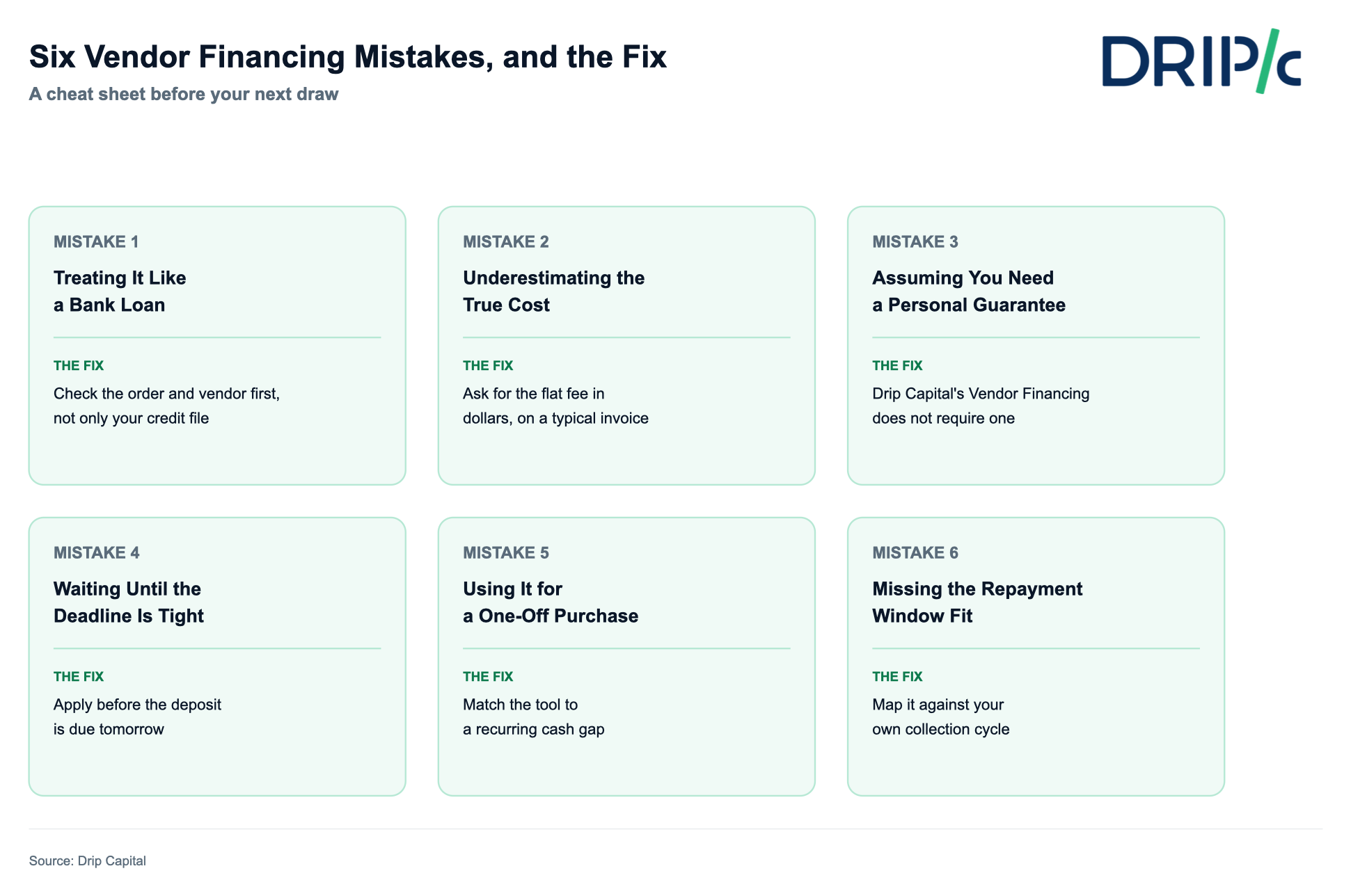
Treating It Like a Bank Loan
Vendor Financing is not underwritten the way a bank loan is. A bank studies years in business, credit history, and collateral first. Vendor Financing weighs the order and the vendor relationship more heavily, though a minimum of two years in business still applies. Businesses that assume the same approval logic as a bank often misjudge whether they qualify, or misjudge how fast a decision will come back.
Underestimating the True Cost
The headline rate rarely tells the whole story. Sixty percent of businesses that borrowed from online lenders reported that actual costs came in higher than expected, compared with 37% at small banks and 32% at large banks. That points to a disclosure problem: costs turning up after the fact instead of before it.
That makes this one of the easiest mistakes to design out. Vendor Financing is usually priced as a flat fee on the invoice, typically 1% to 2% per month, and the fee applies only to what you draw and only while it stays outstanding. Ask for that figure in dollars on a typical invoice before you sign. A provider that can produce it in one line has answered the question. A provider that cannot has answered it too.
Skipping the Fine Print on Personal Guarantees
Fifty-nine percent of firms with outstanding debt used a personal guarantee, and 51% pledged business assets. That is common enough that most businesses expect to sign one somewhere. Vendor Financing through Drip Capital is collateral-free and does not require a personal guarantee, so this is one fine-print risk you do not have to check for here, though it is worth confirming with any other financing you compare it against.
Waiting Until the Vendor Deadline Is Already Tight
Vendor Financing moves faster than a bank loan, but it still needs a few days to set up the first time. Businesses that wait until a deposit is due tomorrow lose the option to shop terms or fix a weak spot in their application, and sometimes lose the option to use financing at all for that order.
Not Matching the Repayment Window to Your Cash Cycle
Repayment falls within an agreed window, typically up to ninety days. If your own customers pay slower than that window, the bill can come due before the cash from the sale arrives. Map your own working capital collection cycle against the repayment window before you draw, not after.
By the numbers
How businesses are actually borrowing right now
60%
of firms applied for
financing in the past year
60%
of online-lender borrowers
saw costs run higher
59%
of firms with debt
signed a personal guarantee
51%
of firms with debt
pledged business assets
Source: Federal Reserve Banks, 2026 Report on Employer Firms
How to Use Vendor Financing the Right Way
A few habits prevent most of the mistakes above.
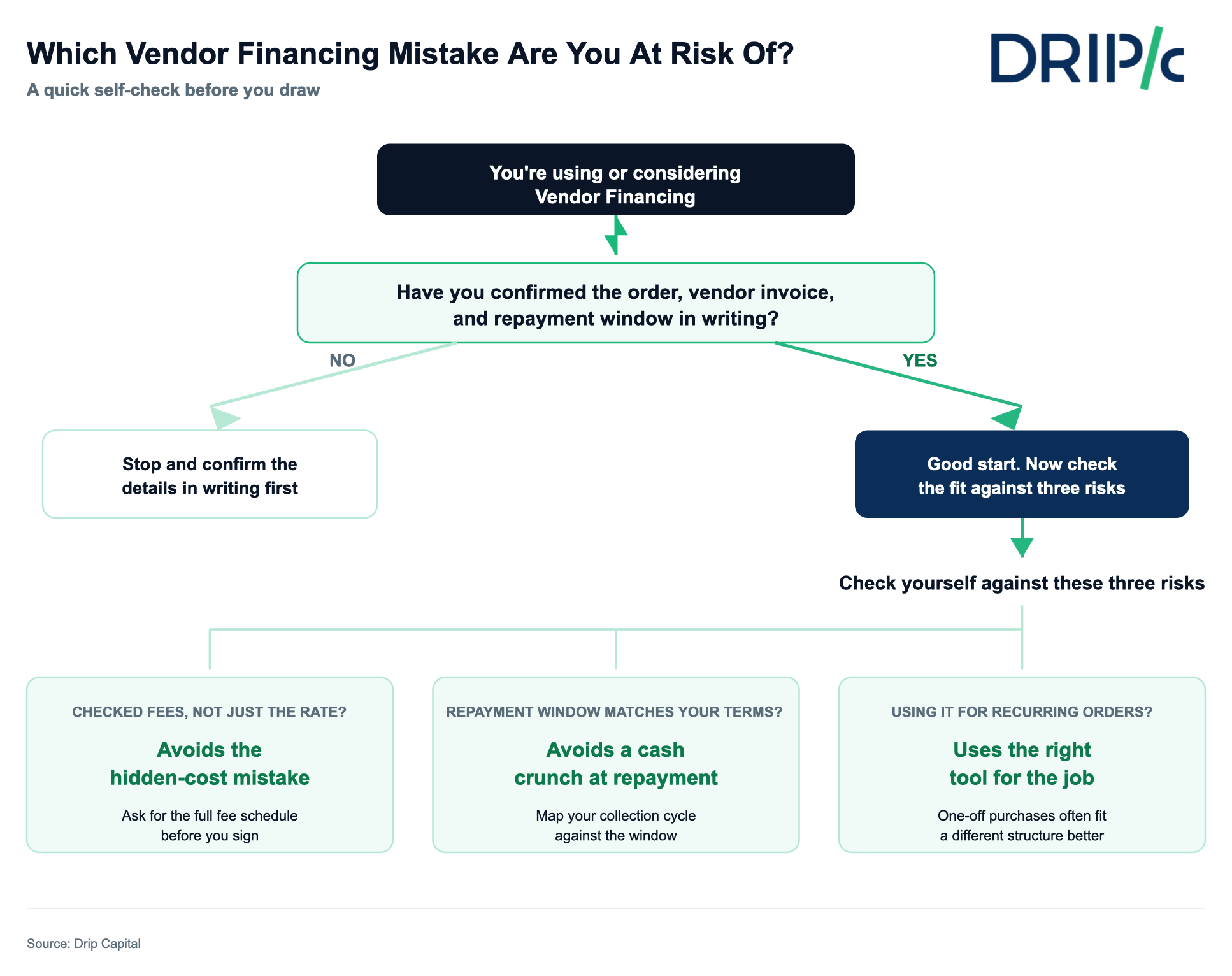
Confirm the Order and Vendor Details Upfront
Have the confirmed order, the vendor's invoice or pro forma, and your own formation documents ready before you apply. Clean paperwork moves faster and reduces back-and-forth that can push a deposit deadline out of reach.
Read the Full Fee and Repayment Structure Before Signing
Ask specifically for the repayment window and any fees beyond the headline number. A financing company that explains this clearly upfront is telling you something about how it operates.
Match the Financing to a Real, Recurring Cash Gap
Vendor Financing earns its cost when it is solving a cash gap that comes up again and again, not a single unusual purchase. If the need is one-time, compare it against other small business financing options before committing.

How Drip Capital Helps You Avoid These Mistakes
Drip Capital pays your vendor directly, and repayment falls within an agreed window, typically up to ninety days, so the terms are clear before you draw. Vendor Financing through Drip Capital requires at least two years in business, and the strength of your order and vendor relationship carries real weight in approval.
Frequently Asked Questions
Is Vendor Financing the same as a business loan?
No. A bank loan is underwritten mainly on your credit history and collateral. Vendor Financing weighs the strength of your order and vendor relationship more heavily, though a minimum time in business still applies.
What is the biggest mistake businesses make with Vendor Financing?
Not reading the full fee and repayment structure before signing. The headline rate is rarely the whole cost, and the repayment window needs to line up with when your own customers pay.
Can a newer business qualify for Vendor Financing?
It depends on meeting the minimum time in business, typically two years, alongside a confirmed order and a reliable vendor. A strong deal helps, but it does not replace that baseline.
Does Vendor Financing work for a single, one-time purchase?
It can, but it fits best for recurring vendor payments. A single unusual purchase, like equipment, is often better served by a different financing structure like borrowing against a Line of Credit.