A certificate of origin (CO or COO) is a document used in international trade that certifies the country where goods were manufactured, produced, or processed. Importing-country customs authorities, banks handling letters of credit, and free trade agreements all rely on it to decide how a shipment is treated — including whether it qualifies for reduced import duty.
It is usually a one-page declaration — attached to or cross-referenced with the commercial invoice — that lists the exporter, the consignee, a description of the goods, and the country of origin, signed by the exporter and certified by an authorized body.
Non-preferential vs. preferential certificates of origin
There are two kinds:
- Non-preferential (ordinary) certificate of origin — certifies where the goods were made but grants no duty reduction. This is the everyday CO many importing countries' customs authorities and letter-of-credit terms require. In the US, these are typically certified by a local chamber of commerce.
- Preferential certificate of origin — lets qualifying goods claim reduced or zero duty under a free trade agreement. For trade with Canada and Mexico under the USMCA, this is the USMCA certification of origin, which has no official form and is completed by the exporter, importer, or producer. The US has free trade agreements with about 20 countries, each with its own rules of origin.
Who issues a certificate of origin in the US?
Unlike some countries, the US has no single government agency that issues ordinary certificates of origin. Instead:
- Non-preferential COs are prepared by the exporter and certified (stamped) by a local chamber of commerce. Many chambers issue them through the electronic Certificate of Origin (eCO) system, which is faster than paper and widely accepted. The exporter's signature is usually notarized, and the chamber applies its signature and stamp.
- Preferential (FTA) COs are self-certified by the exporter, producer, or importer under the specific agreement's rules — for USMCA, by supplying the nine required data elements. No chamber certification is needed.
When do you need a certificate of origin?
- The importing country's customs requires one to clear the goods.
- A letter of credit lists it among the required documents.
- You want to claim preferential duty under a free trade agreement.
- The goods are subject to country-specific controls where proof of origin matters.
If you are unsure, check the importing country's requirements or ask your freight forwarder or customs broker before shipping.
How to get a certificate of origin: step by step
- Prepare the certificate. Complete a certificate of origin with the exporter and consignee details, a description of the goods, the HS code, the country of origin, and the declaration. Use the standard chamber template below, or the specific form the importing country requires.
- Attach supporting documents. Have your commercial invoice and packing list ready — the certifying body and customs cross-check them.
- Get it certified. For a non-preferential CO, submit it to a local chamber of commerce (in person or through their eCO portal). Your signature is notarized and the chamber stamps and signs it.
- Legalize if required. Some destinations — parts of the Middle East, for example — require the CO to be legalized by their embassy or consulate, or apostilled, after chamber certification.
- For preferential trade, self-certify under the relevant FTA instead — for example, complete the USMCA certification of origin.
Certificate of Origin Template (Free Sample)
Below is a free, blank certificate of origin template in the standard chamber-of-commerce format used for exports. Use it as a reference and have it completed and certified by your local chamber of commerce or authorized issuing body. Download the certificate of origin template
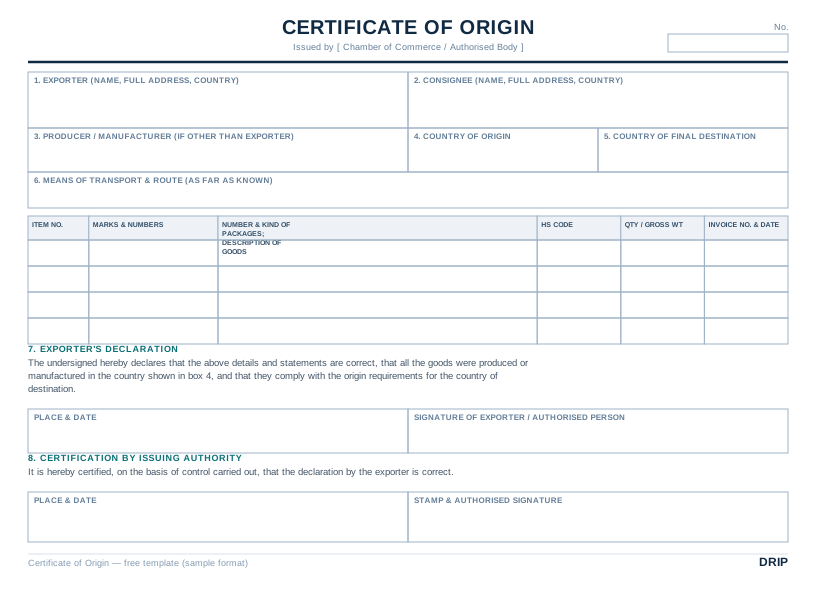
What a certificate of origin contains
- Exporter (name, address, country)
- Consignee / importer
- Means of transport and route (optional)
- Description of goods, marks, and quantities
- HS tariff classification
- Country of origin
- Exporter's declaration and signature
- Certification by the chamber of commerce (signature, stamp, and date)
Certificate of origin vs. other export documents
A certificate of origin states where goods were made; the commercial invoice states what they are and their value; the bill of lading is the contract of carriage. Customs at the destination treats each as a separate document in the export set.
Final thoughts
The certificate of origin captures where a product originates, which determines whether it is eligible for import and whether — and how much — duty applies. Customs authorities at the destination treat it as a document separate from the commercial invoice and the packing list.
For a non-preferential CO, destination customs expect to see the exporter's notarized signature together with the signature and stamp of an authorized chamber of commerce; many countries now also accept electronically signed e-COs. For preferential trade under a US free trade agreement, the exporter self-certifies instead — so getting the origin determination and rules of origin right is what protects your buyer's duty savings.
FAQ
What is a certificate of origin? A document that certifies the country where goods were manufactured or produced, used by customs, banks, and free trade agreements to decide how a shipment is treated.
What is the difference between a preferential and a non-preferential certificate of origin? A non-preferential CO simply certifies origin with no duty benefit; a preferential CO lets qualifying goods claim reduced or zero duty under a free trade agreement such as the USMCA.
Who issues a certificate of origin in the US? There is no single government issuer. Non-preferential COs are certified by a local chamber of commerce (often via the electronic eCO system); preferential FTA certifications are self-certified by the exporter, producer, or importer.
Do I need a certificate of origin to export from the US? Only when the importing country's customs, a letter of credit, or a free trade agreement requires one. Check the destination's rules or ask your freight forwarder before shipping.
Is a USMCA certification of origin the same as a certificate of origin? It is a preferential certificate of origin specific to the USMCA. It has no official form and only needs the nine required data elements, unlike a general chamber-certified certificate of origin.
Drip Capital gives US businesses fast, collateral-free working capital to buy inventory and bridge long payment terms. See if you qualify →