
Illustrative photograph. Photo: Priyanshu Kumar / Unsplash.
A warning label can look almost right and still need another round of artwork. For importers of products that use button or coin batteries, that is the detail to check before the next production run.
CPSC’s November 18, 2026 direct final rule updates the standard for covered consumer products to ANSI/UL 4200A-2026. The button battery warning label requirements for 2027 include a clearer size requirement for the safety-alert symbol and a clarification for certain product icons.
The useful question for your vendor is simple: which artwork version will be used for each production batch?
When do the new requirements apply?
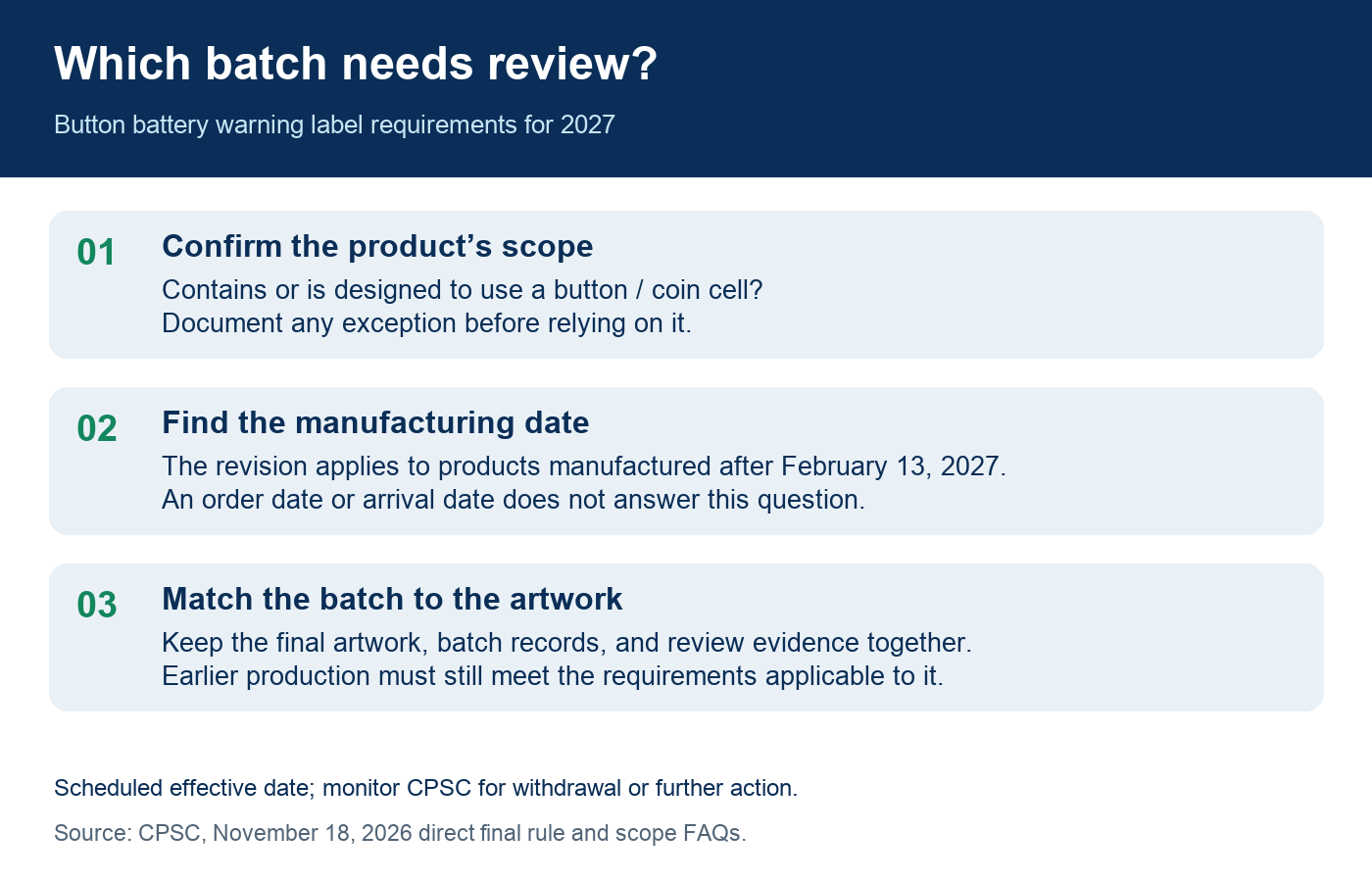
The rule is scheduled to take effect February 13, 2027, and applies to products manufactured after that date. Comments are due December 18, 2026. CPSC says it will withdraw this direct final rule if it receives significant adverse comment, so check its status again before approving production. Source: rule, Dates and Section XI.
Follow the manufacturing date
An arrival date does not establish which version applies. A shipment arriving in March might contain products made in January or products made in late February. Ask for batch-level manufacturing records; a purchase-order date alone will not answer that question.
Earlier production is still subject to the requirements that apply to it. This update does not make older, noncompliant stock acceptable.
Which products should importers review?
Start with consumer products containing or designed to use button or coin cells. Shipping the product without a battery does not, by itself, remove it from scope. Check the battery specification rather than assuming every remote control, light, or electronic accessory uses the same battery type. CPSC scope FAQs.
The toy exception has conditions
Toys designed, manufactured, or marketed as playthings for children under 14 are excepted from section 2 of Reese’s Law if they comply with the battery-accessibility and labeling requirements of 16 CFR part 1250. “It’s a toy” is not enough: keep the evidence supporting the exception. Other exclusions, including the treatment of zinc-air cells, also need a product-specific review. CPSC exceptions.
What changes in the warning artwork?
Check the safety-alert symbol’s height
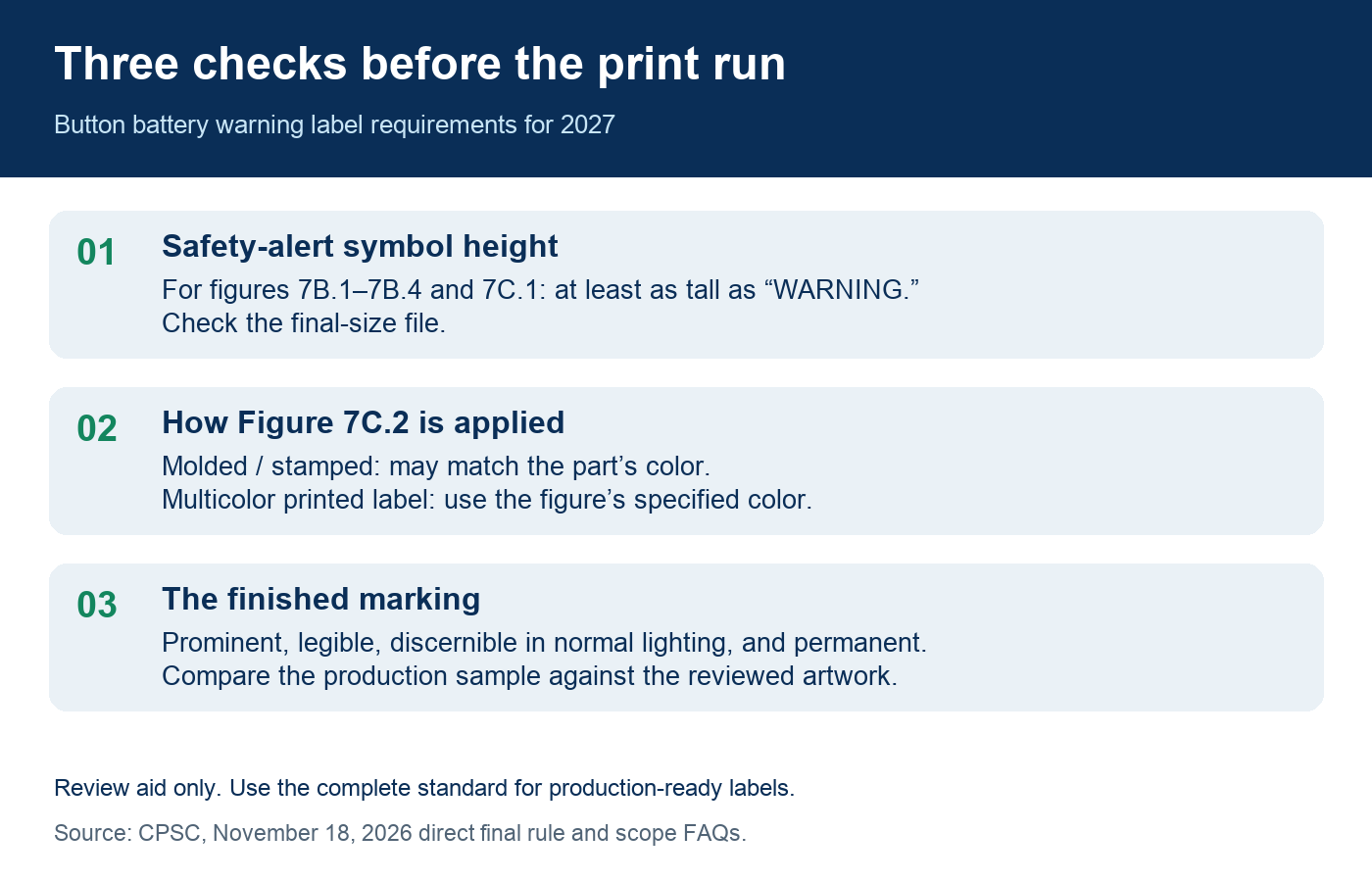
In warning figures 7B.1 through 7B.4 and 7C.1, the revised standard makes the safety-alert symbol at least as tall as the signal word “WARNING.” The earlier illustrations showed it slightly smaller. Ask your vendor to check the final-size artwork, not just send a screenshot that looks close. Rule, Section II.
Check how the product icon is made
Section 7C.2 clarifies the alternative product marking in Figure 7C.2. A stamped or molded icon may be the same color as the part. On a printed label using more than one color, the icon must use the color shown in the figure.
The existing requirement remains: markings must be prominent, legible, easily discernible under normal lighting, and permanent. A same-color molded icon still has to be readable. Rule, Section II.
What should you ask your vendor to send?
Use this checklist to assemble a review file for each product and artwork version. These are practical purchasing controls, rather than a separate CPSC filing requirement.
- Product model, battery specification, and the basis for any claimed exception.
- Manufacturing dates tied to the relevant batches.
- Final-size packaging artwork and the applicable product markings.
- A dimensioned check of the safety-alert symbol against “WARNING.”
- Confirmation of whether the icon is molded, stamped, or printed, including its colors.
- Production-sample photos and the applicable test reports and certificate.
Keep one named person responsible for closing open questions. Put artwork approval, substitutions, and responsibility for reprinting into your vendor contract and payment terms.
A vendor’s updated PDF is only one part of the handoff. Confirm that the factory and packaging printer are using the same version, then compare the production sample against it before the order moves forward.
Does every product need to be retested?
The revision does not change testing requirements, equipment, or protocols. CPSC says laboratories accepted for the 2023 standard remain capable of testing to the 2026 version. The artwork update therefore does not establish a universal requirement to rerun every test. Rule, Section V.
Existing certification obligations continue. General-use products require a General Certificate of Conformity based on testing or a reasonable testing program; children’s products subject to these requirements need the applicable third-party testing and Children’s Product Certificate. Have your compliance team or laboratory review whether existing evidence supports the actual product being supplied, especially if its design also changes.
Keep product labels and battery packaging separate
This rule updates the standard incorporated in 16 CFR 1263.3 for consumer products. Separate battery-packaging warnings under 1263.4 and special packaging obligations under Reese’s Law remain separate checks. Updating the product carton does not settle every battery-packaging question. CPSC requirements overview.
Plan the cash impact with Drip Capital
The avoidable expense may be a second print run, discarded cartons, or an order waiting for artwork approval. Build those possibilities into your vendor-deposit cash-flow plan before committing to the next batch.
For businesses managing vendor payments alongside these costs, Drip Capital’s Vendor Financing pays vendors directly, with repayment terms of up to 90 days, subject to approval and agreed terms. Keep financing decisions separate from the product-compliance sign-off.
Frequently asked questions
Is February 13, 2027 an import-arrival deadline?
No. The rule says the revised standard applies to products manufactured after its effective date. Keep manufacturing records and recheck the rule’s status before relying on the scheduled date.
Do labels already meeting the revised standard need a redesign?
An artwork change may be unnecessary if the existing design meets the revised requirements. Review the applicable figures and the finished marking before deciding; this article’s visuals are review aids, not production-ready warning labels.
Where can I check the complete standard?
CPSC’s rule links to UL’s free read-only standards portal. Use ANSI/UL 4200A-2026 to review the full button battery warning label requirements for 2027, alongside CPSC’s rule and product-specific requirements.