

Photo: Ritul Bhattacharjee / Unsplash. Illustrative image.
A purchase order can look affordable when you compare its total with expected sales. The cash problem becomes clearer when you put the deposit, final payment, shipping costs, and customer receipts on a calendar.
Vendor deposits move part of the purchase cost forward. Before accepting the terms, work out how much cash leaves the business, when the remaining costs fall due, and what happens if delivery or sales take longer than expected.
What a vendor deposit changes
A deposit is an advance payment toward a purchase under the agreed contract. Its amount, purpose, refund conditions, and treatment against the final invoice need to be clear.
The International Trade Administration explains that cash-in-advance terms can create cash-flow pressure for buyers and exposure to the risk that goods are not shipped. A partial deposit creates a similar planning question for the amount paid early.
Separate price from timing
A lower total price may still require more cash upfront. Compare offers using payment dates as well as purchase totals. A promised discount should be assessed alongside the cash committed and the risks attached to the order.
Use the vendor agreement guide for the broader contract structure. This article focuses on the cash schedule behind the purchase.
Define the payment trigger
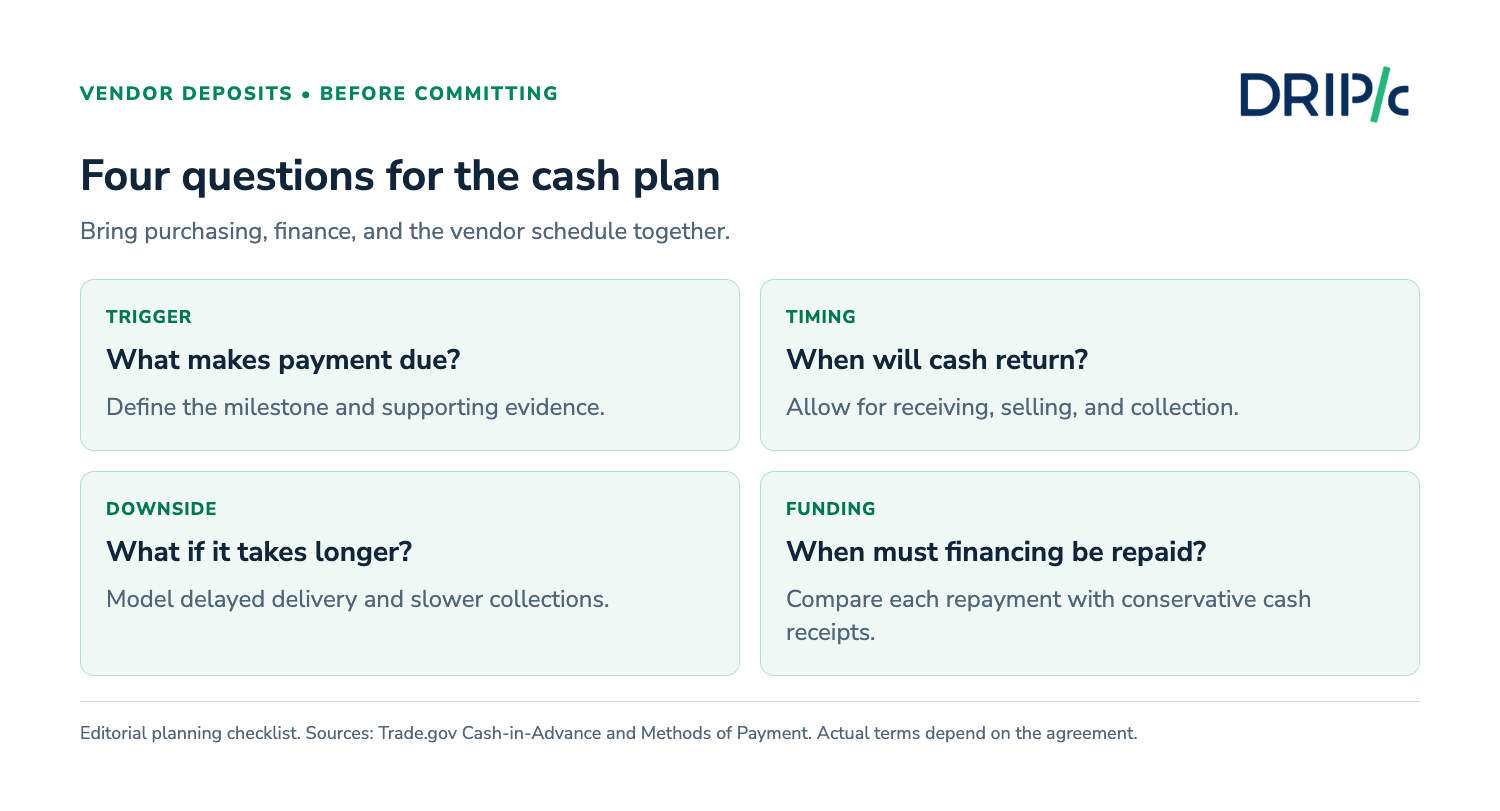
Write down what makes each installment due: order acceptance, completion of a production stage, inspection, shipment, or another agreed event. Include who confirms that the event occurred and which documents support payment.
The vendor contracts and payment terms guide covers the wording questions to discuss with your adviser.
Build a cash calendar for one order
Put every outflow on a date
Start with the deposit and balance. Add freight, insurance, duties, handling, storage, and any other relevant charges. Use the agreed responsibility for each cost and the current shipment estimate.
A landed-cost calculation gives the total. The cash calendar shows when that total needs funding.
Put receipts on realistic dates
Inventory arriving at your warehouse does not necessarily create cash that day. Allow for receiving, selling, invoicing, and collection. For credit sales, connect the expected receipt to the customer's actual payment terms.
Keep uncertain receipts visible as assumptions. Avoid using an unconfirmed customer order to cover a fixed vendor-payment deadline without a fallback.
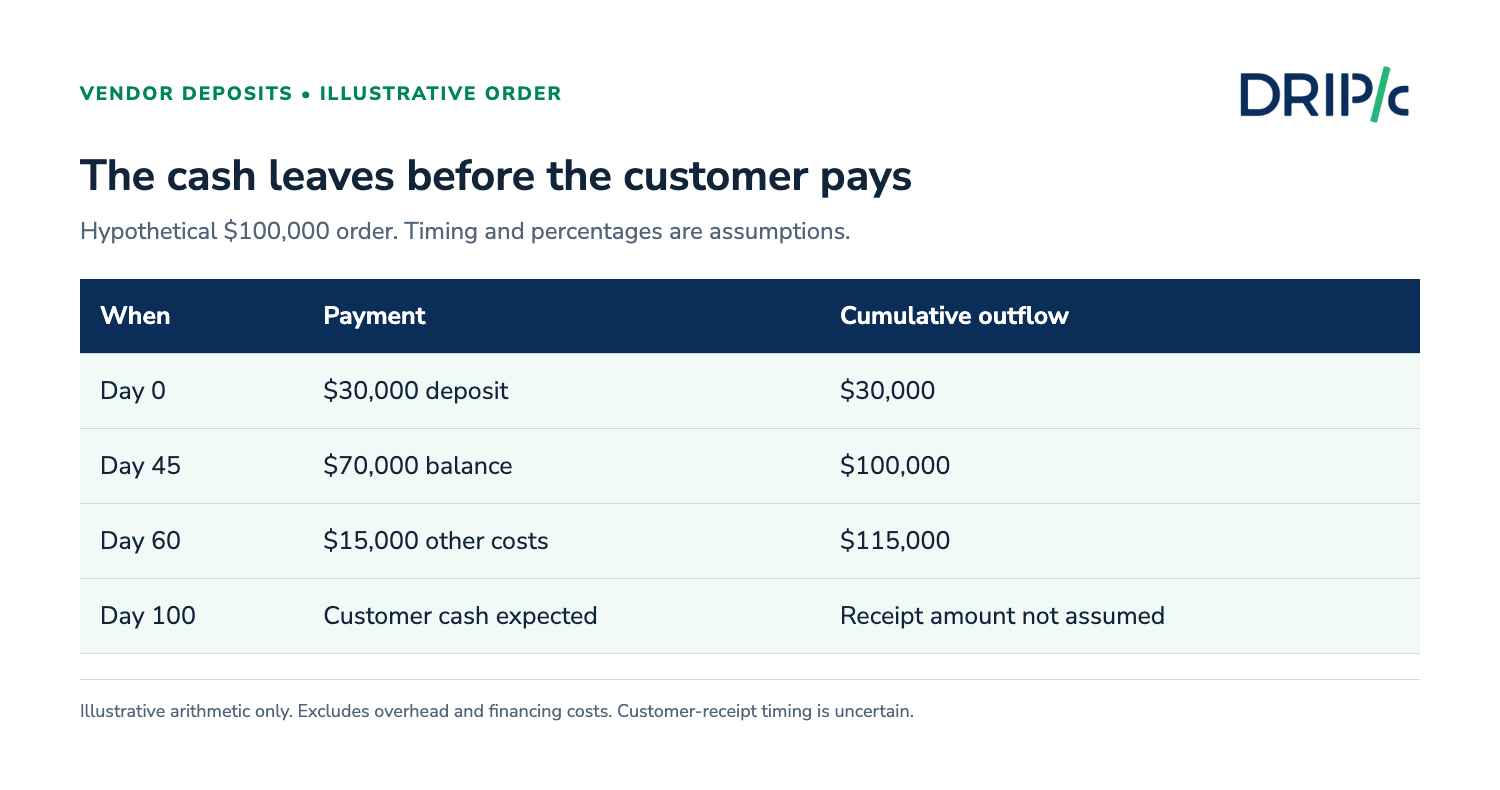
A worked vendor deposit cash-flow example
Consider a hypothetical $100,000 order with a 30% deposit on day zero and the remaining 70% due on day 45. Assume another $15,000 of import and delivery costs is paid on day 60, with customer cash arriving on day 100.
Follow the cumulative cash commitment
The deposit is $30,000. The balance is $70,000. By day 60, this order has required $115,000 before customer receipts, excluding overhead and financing costs.
Those figures are illustrative. The deposit percentages and dates are assumptions for this example.
Test a delivery delay
If the remaining payments stay fixed while customer receipts move to day 130, the business carries the same $115,000 for another 30 days in this simplified example. Actual delays could also add storage or other charges.

Now compare the order schedule with payroll, rent, tax payments, and other purchases. The company's peak cash requirement depends on all overlapping commitments, its opening cash, and other receipts.
By the numbers
For context, the International Trade Administration describes open-account sales as commonly payable in 30, 60, or 90 days after shipment and delivery. Vendors are not required to offer these credit terms. Your written agreement determines the actual dates.
Compare changes that could reduce the cash peak
A smaller deposit
A lower advance can preserve cash early in the cycle. Check whether it changes the total price, production priority, or later payment requirement. Moving the deposit into the final balance can simply shift the cash peak to a later date.
Staged deliveries
Smaller releases may spread payments and inventory arrivals. Compare any benefit with additional freight, handling, minimum-order constraints, and the vendor's production requirements. Confirm whether the deposit applies to the whole order or each release.
A different payment method
A letter of credit can introduce bank-backed payment against stipulated documents. The government's payment-methods guide explains the mechanics and alternatives. Ask the bank about fees, credit requirements, and document conditions before comparing the option with an advance payment.
Match financing to the full cash cycle
Start the repayment clock at funding
For purchase order cash-flow planning, compare financing repayment dates with conservative customer-receipt dates. Funding the deposit starts a financing period before production, transport, and selling are complete.
Keep a downside case
Use a second scenario with slower sales or later collections. Identify the cash available for repayments if the expected receipt misses its date. The cash-flow forecasting guide provides the wider planning context.
Where Drip Capital fits into the purchase
Drip Capital's Vendor Financing pays vendors directly, with repayment terms of up to 90 days, subject to underwriting and agreed terms. Discuss whether the proposed deposit or purchase payment can be financed before signing terms that depend on it.
In the hypothetical example, a payment funded on day zero could require repayment before customer cash arrives on day 100. Funding can support a purchase, but the business still needs a workable repayment plan.
Frequently asked questions
Is a 30% vendor deposit standard?
The 30% figure here is an example. Deposit terms vary by product, order, relationship, and contract. Compare the actual offers available to your business.
Does financing remove the risk of non-delivery?
No. The vendor's performance and your financing obligations need separate assessment. Review the commercial protections and repayment terms before committing.
Should I count inventory arrival as a cash receipt?
Only if the commercial arrangement actually creates a cash receipt then. Many businesses still need to sell the goods and collect payment after arrival.
How much financing does the order need?
Calculate the dated shortfall after opening cash, other receipts, and overlapping business payments. The order value alone cannot establish the amount or duration required.