

What Is a Vendor Agreement? A Guide for Businesses
Every business that buys goods or services from an outside party is relying on some kind of agreement, whether anyone wrote it down or not. A Vendor Agreement is what happens when that reliance gets put into words: a document that spells out what each side owes the other, and what happens when something goes wrong.
Businesses that source from multiple vendors, place recurring orders, or depend on one vendor for a critical input tend to feel the absence of a real agreement first. A missed delivery date, a quality dispute, or a vendor that suddenly changes its price all land differently depending on whether there was a clear contract in place. This guide walks through what a Vendor Agreement actually is, what it should contain, when a business needs one, and where these documents most often go wrong.
What Is a Vendor Agreement, Exactly?
A Vendor Agreement is a legally binding contract between a business and a vendor that governs the supply of goods or services. It defines what the vendor will provide, what the business will pay, and the conditions under which either side can walk away.
That legal weight is the whole point. A verbal understanding or a string of emails might capture the general shape of a deal, but it rarely holds up when a disagreement turns serious. A signed Vendor Agreement is enforceable in court; an informal understanding usually is not, unless a party can prove the elements of a contract existed anyway (offer, acceptance, consideration, and mutual intent to be bound). Courts have repeatedly held that clear, signed terms carry far more weight than a reconstructed memory of what was discussed on a call.
This distinction matters more as a business grows. A small, one-off purchase rarely needs the same rigor as a vendor relationship that a business will depend on for years.
The Anatomy of a Vendor Agreement
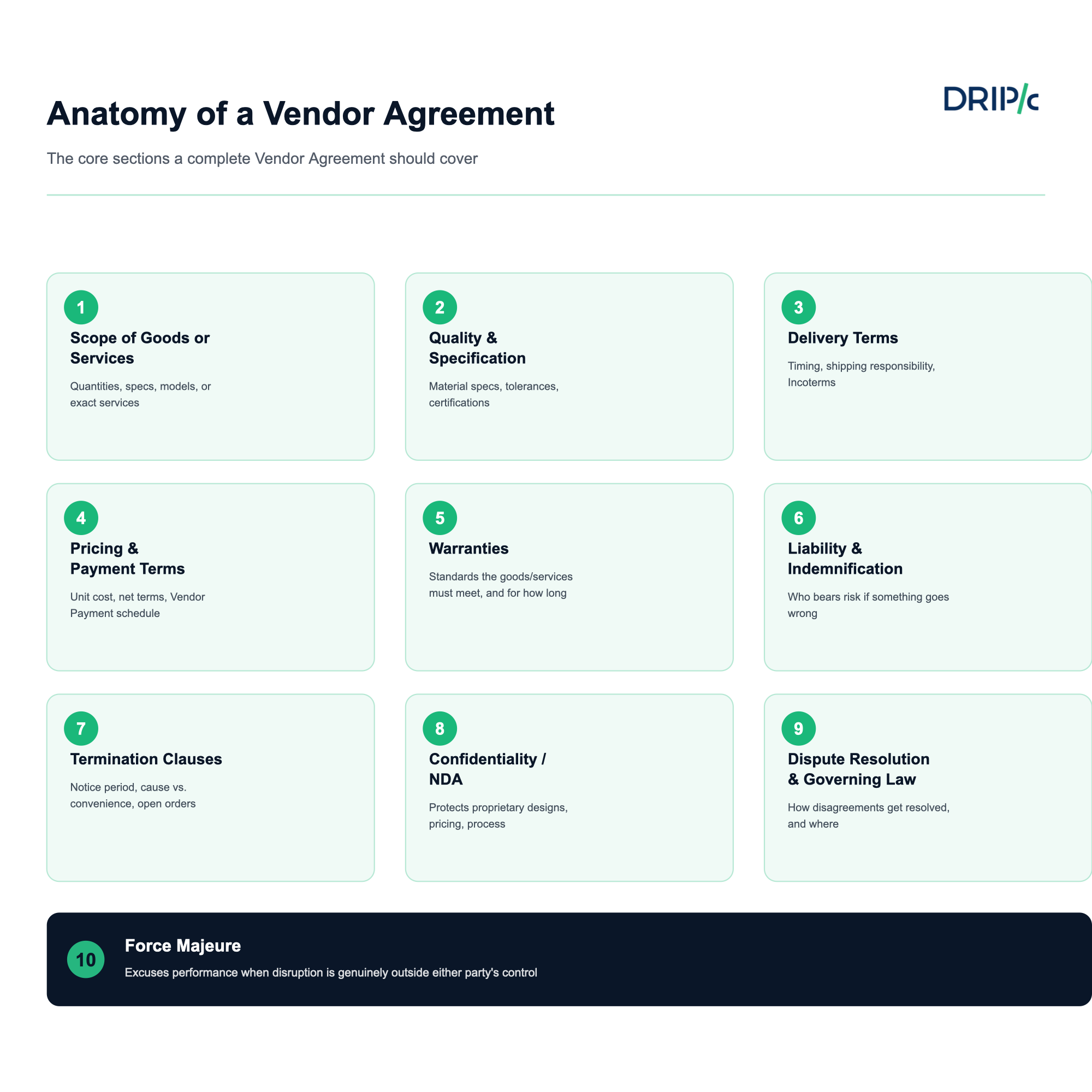
A complete Vendor Agreement covers several distinct areas, each doing a different job. Skipping one does not just create a gap; it creates a specific risk.
Scope of Goods or Services
The agreement should describe exactly what the vendor is providing: quantities, specifications, models, or the precise services rendered. Vague scope language is one of the most common sources of later disputes, because both sides can genuinely believe they agreed to something different.
Quality and Specification Standards
Beyond scope, the agreement should state the quality bar the vendor must meet: material specifications, tolerances, certifications, or industry standards. Without this, a business has little recourse when a shipment technically matches the order but fails to meet an unstated expectation.
Delivery Terms
Delivery terms cover timing, shipping responsibility, and risk transfer, often by reference to Incoterms® 2020 rules like FOB or DDP. This piece won't go deep on delivery mechanics; Drip Capital's guide to Incoterms covers that ground in detail.
Pricing and Payment Terms
Pricing sets the unit cost, and payment terms set when and how the business pays: net 30, net 60, milestone payments, or Vendor Payment on delivery. This is also where a business might reference financing tools it uses to bridge the payment gap, such as vendor financing, which lets a business pay a vendor promptly without tying up its own cash. This piece keeps that section brief on purpose: Drip Capital's vendor contracts and payment terms guide is the deeper resource on payment-clause specifics, including late fees, early-payment discounts, and dispute mechanics for Vendor Payment terms.
Warranties
Warranties commit the vendor to standards the goods or services must meet, and for how long. A warranty clause with no defined duration or remedy is close to meaningless.
Liability and Indemnification
This section allocates risk: who is responsible if the vendor's product causes damage, injury, or a third-party claim. Indemnification clauses can be broad or narrow, and the difference has real financial consequences if something goes wrong downstream.
Termination Clauses
Termination clauses spell out how either party can end the relationship: notice period, cause versus convenience, and what happens to open orders. A vendor agreement without clear termination rights can trap a business in a relationship it wants out of, or let a vendor walk away mid-project with no consequence.
Confidentiality and NDA Provisions
If the relationship involves proprietary designs, pricing, or business processes, a confidentiality clause (or a standalone NDA referenced in the agreement) protects that information from being shared or reused elsewhere.
Dispute Resolution and Governing Law
This section sets how disagreements get resolved: negotiation first, then mediation or arbitration, and which state's law and court system apply. Without it, a dispute can turn into a costly fight over jurisdiction before the actual issue is even addressed.
Force Majeure
A force majeure clause excuses either party from performance when something genuinely outside their control (a natural disaster, a war, a government order) makes performance impossible. It should define what counts, and what happens to the contract if the disruption drags on.
By the numbers
Why vendor terms carry real financial weight
48%
of small employer firms source at least
some inputs from outside the US
77%
of firms cited rising costs or tariffs
as a financial challenge in 2025
13%
of firms facing input cost increases
switched to a domestic vendor
38%
of firms applied for a loan or line of
credit in the prior 12 months
Source: Federal Reserve, 2026 Report on Employer Firms (2025 Small Business Credit Survey)
When Do You Actually Need a Formal Vendor Agreement?
Not every purchase justifies a full contract. A one-time order for a small quantity of a standard item, paid up front, carries little risk either way; a simple purchase order is often enough.
The picture changes once a relationship becomes ongoing. A business placing repeat orders with the same vendor, depending on that vendor for a critical component, or extending payment terms over multiple cycles is exposed every time it relies on a PO alone. A PO typically confirms quantity, price, and delivery date for a single transaction. It usually says nothing about warranties, liability, confidentiality, or what happens if the vendor misses three deliveries in a row.
That gap becomes expensive the moment something goes wrong. A vendor that ships defective goods with no PO-referenced quality standard leaves a business with little formal ground to demand a remedy. A vendor that raises prices mid-relationship, with no agreement locking in terms, leaves the business negotiating from a weaker position than it should be in.
A useful rule of thumb: if a business would be hurt by losing this vendor on short notice, or by that vendor's failure to perform, the relationship has outgrown a bare purchase order.

Common Types of Vendor Agreements
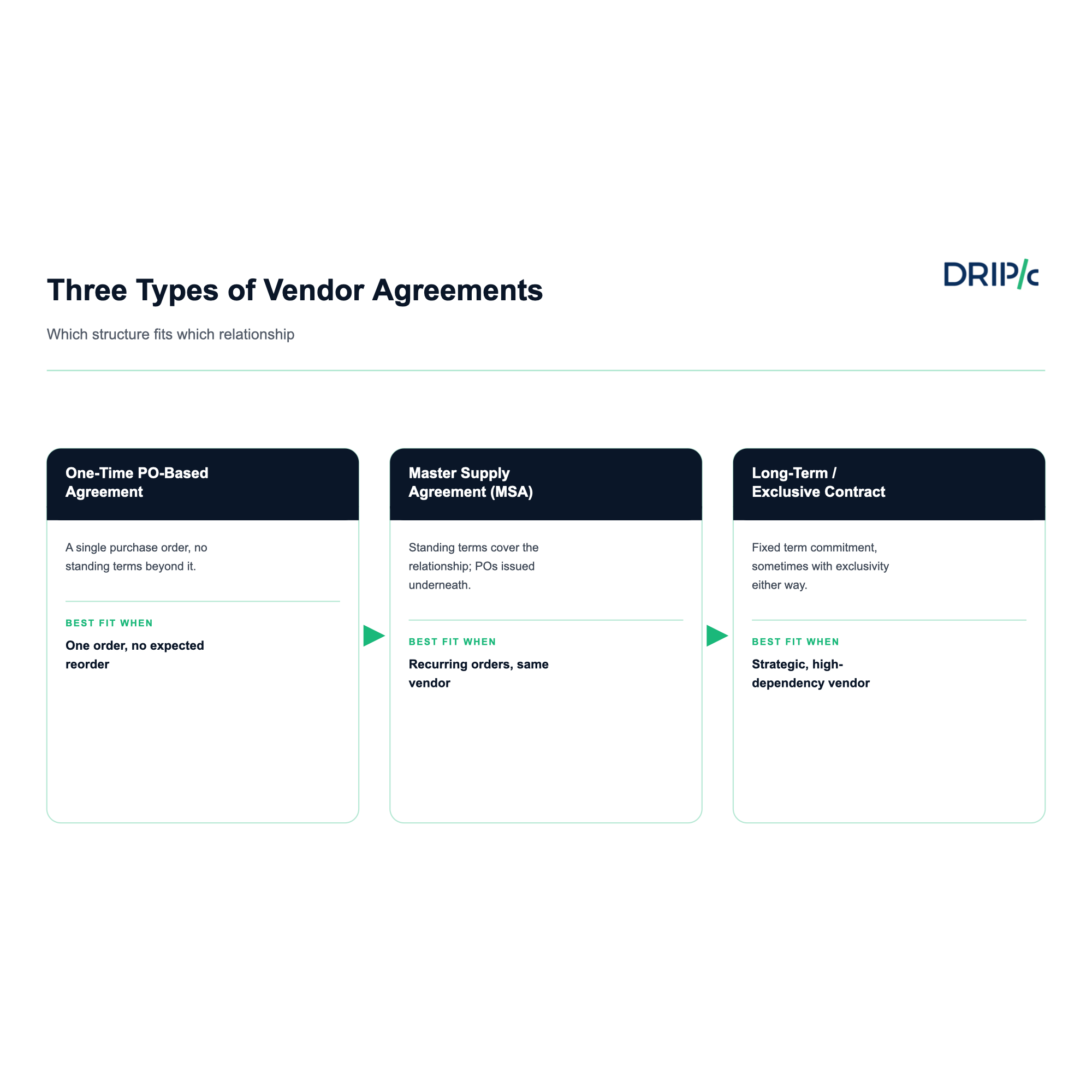
Most vendor Contracts fall into one of three structures, and the right one depends on how the relationship is actually shaped.
One-Time PO-Based Agreement
Here, the purchase order itself functions as the agreement: quantity, price, delivery date, and little else. This works for a single transaction with a vendor the business does not expect to reorder from regularly.
Master Supply Agreement (MSA)
An MSA sets the standing terms (quality standards, payment terms, liability, dispute resolution, and more) that govern an entire ongoing relationship. Individual purchase orders are then issued under that MSA, each one only needing to specify quantity, item, and delivery date. This is the standard structure for a business that reorders from the same vendor repeatedly, since it avoids renegotiating the same terms every time.
Long-Term or Exclusive Vendor Contract
A long-term contract commits both sides for a defined period, sometimes with exclusivity (the vendor agrees not to supply a competitor, or the business agrees to source only from that vendor). These carry more upside, often better pricing or guaranteed capacity, but also more risk if the relationship sours, since exiting early usually carries a real cost.
Common Mistakes Businesses Make With Vendor Agreements
A handful of mistakes show up again and again in vendor agreements, and most are avoidable with a careful first read.
Accepting a vendor's own template without review is the most frequent one. Vendors write their standard agreements to protect their own position, and a business that signs without adjusting liability, warranty, or termination language is accepting whatever balance the vendor built in.
Vague scope language causes trouble later even when it looked fine at signing. "Approximately 500 units of standard grade material" invites a disagreement the moment a shipment arrives short or off-spec.
Missing or one-sided termination rights leave a business stuck. If only the vendor can terminate for convenience, the business has no clean way out of a relationship that stops working for it.
No clear remedy for late or non-conforming delivery is another common gap. An agreement that describes delivery timing but says nothing about what happens if the vendor misses it gives the business no leverage when that inevitably happens.
Finally, treating Vendor terms as fixed once signed is a mistake in itself. Terms should be revisited as a relationship matures, particularly around pricing, volume commitments, and payment terms; leaving them untouched for years lets the agreement drift away from reality.
How Drip Capital Fits Into Vendor Relationships
None of this changes the fact that meeting the payment terms in a Vendor Agreement still requires cash on hand, and that timing does not always line up with a business's own receivables. Drip Capital's Vendor Financing pays a vendor directly on a business's behalf, with repayment due up to 90 days later. It requires a minimum of two years in business and $2M+ in annual revenue, and it is collateral-free. For businesses juggling multiple vendors and purchase cycles that want one standing facility to draw on, Drip Capital's Line of Credit is a revolving facility with no prepayment penalty, no annual maintenance fee, and no blanket lien on assets unless the business defaults. Either tool lets a business meet the Vendor Payment terms it signed up for without straining working capital, which is a separate problem from what the agreement itself covers. For a broader look at how working capital fits around vendor and supply-chain timing, see Drip Capital's working capital guide.
A Quick Note
This guide is educational and general in nature; it is not legal advice. A business drafting or reviewing an actual Vendor Agreement should have qualified counsel review the specific terms before signing.
Frequently Asked Questions
Is a vendor agreement the same as a purchase order?
No. A purchase order typically covers one transaction: quantity, price, and delivery date. A Vendor Agreement is broader and can govern an entire relationship, including quality standards, liability, termination, and dispute resolution, with individual POs issued under it.
Does a vendor agreement need to be in writing to be enforceable?
Verbal agreements can sometimes be enforced if a court finds the basic elements of a contract were present, but proving the exact terms is difficult without a signed document. A written Vendor Agreement removes that uncertainty and gives both sides a clear reference point.
What happens if a vendor breaches the agreement?
The remedy depends on what the agreement specifies. Well-drafted contracts define what counts as a breach, what notice is required, and what remedy follows (repair, replacement, refund, or termination), so this should never be left to interpretation after the fact.
Can a business negotiate a vendor's standard contract template?
Yes, and it generally should. A vendor's template is written to protect the vendor first, so a business should review and adjust the scope, liability, warranty, and termination language before signing.
How is a master supply agreement different from a one-time agreement?
A master supply agreement sets standing terms for an entire ongoing relationship, with individual purchase orders issued under it for specific quantities and delivery dates. A one-time agreement, often just the PO itself, covers a single transaction and nothing beyond it.