

Increase lets businesses build bank accounts and payment functions into their software. A platform can use its APIs to organize customer accounts, initiate payments, and track money movement. The practical starting point is choosing a specific workflow, such as paying vendors or matching incoming payments to customer records.
This Increase Bank Review explains the current banking structure, how an integration works, and the operating responsibilities to plan for. It is based on published documentation, without hands-on testing of a production account.
Illustrative developer workspace. Photo by Bayu Syaits on Unsplash.
What Is Increase Bank?
Increase Bank launched in July 2026. Its launch announcement describes a bank built around Increase's existing API technology and says its relationships with other bank partners continue.
The company's current disclosure separates the entities: Increase Technologies, Inc. provides technology services as a non-bank. Banking services are offered by Increase Bank, Grasshopper Bank, First Internet Bank of Indiana, or Core Bank, depending on the arrangement. Those institutions are identified as FDIC members.
Before onboarding, establish which bank will hold the deposits and which agreements govern your program. Deposit insurance applies to eligible deposits under the applicable rules and protects against an insured bank's failure. It does not establish protection against every payment error or fraud loss.
Where Banking as a Service Fits
Banking as a Service describes an arrangement through which a business can incorporate banking capabilities into its own offering. Embedded Finance is the customer-facing result: a financial function becomes part of the software someone already uses.
For example, a wholesale marketplace could build vendor payments into its ordering system. It would still need to define account ownership, approval rights, and how each payment relates to an invoice. Understanding vendor agreements and payment terms helps establish those business requirements before development begins.
By the Numbers
These are individual processing fees. Monthly pricing varies by use case, custom pricing is available, and other charges can apply. Obtain a complete proposal for your intended volume and payment mix.
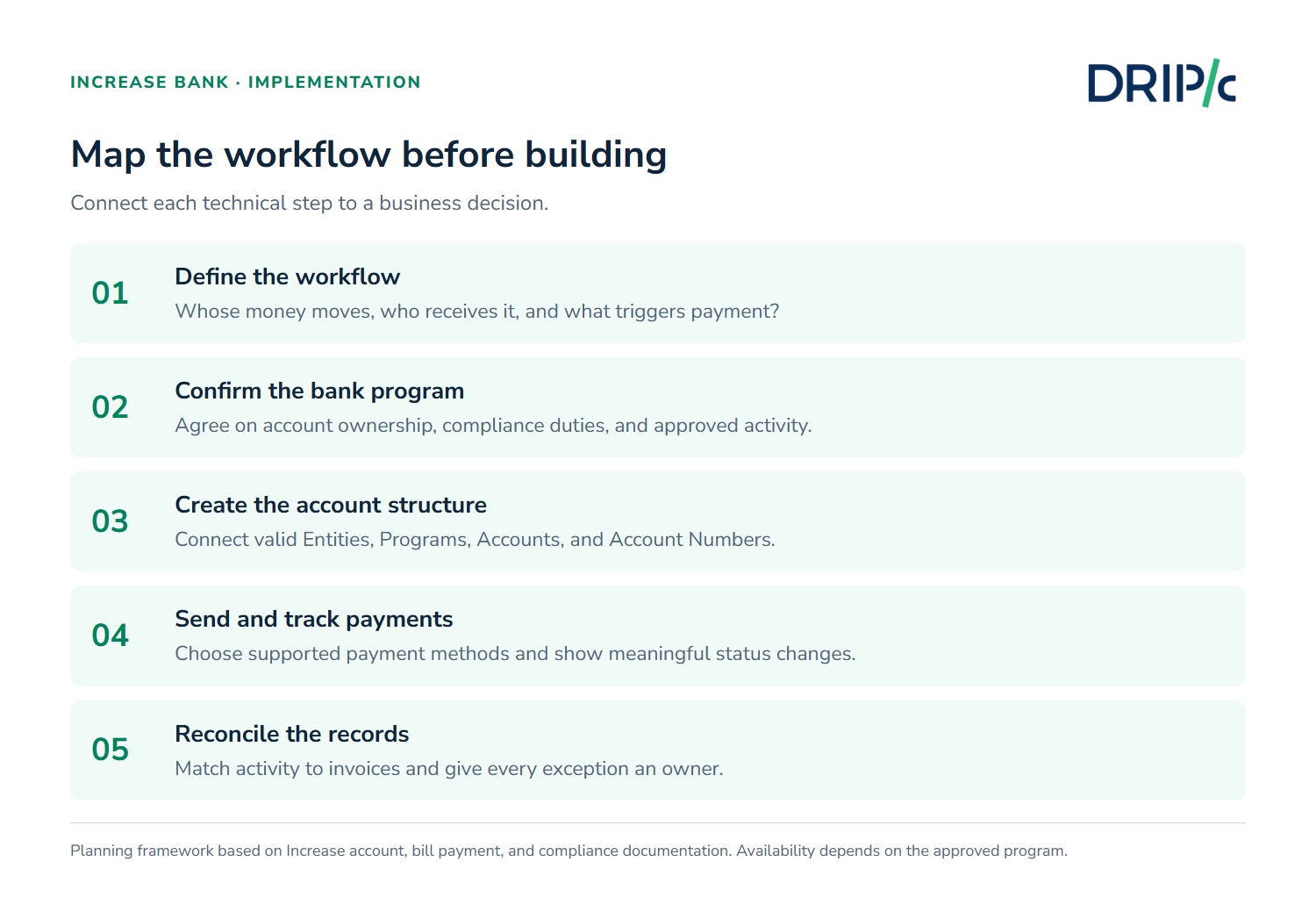
What Can You Build With Increase?
Accounts That Help Identify Payments
Increase distinguishes an Account from an Account Number. An Account holds funds; multiple Account Numbers can point to it. Its account documentation explains how this can help associate incoming payments with a customer, project, or other identifier.
An Account must be associated with a valid Entity and Program. The legal account structure requires bank approval. Your team should agree on who owns the funds and how accounting records will reflect that ownership before creating accounts at scale.
Vendor Payments Across Different Payment Networks
Increase's bill payment guide describes collecting funds and disbursing them through supported networks, including ACH, wires, and checks. Funding and payout can use different networks.
Choose the method around timing, cost, and exception handling. Link the payment to the underlying commercial invoice so your operations team can trace what was paid. For an importer, separately confirm the supported destination and currency before designing an overseas payment workflow.
Payment Status Inside Your Software
An API Banking Platform can let software respond to account activity. Increase's events and webhooks notify your application when relevant events occur; the application can retrieve the associated record for details.
Define what staff and customers should see at each stage. An instruction being created, submitted, or returned should produce an appropriate status and an identifiable next action. Give exceptions an owner so an automated workflow still has someone responsible when it stops.
How to Get Started With Increase
1. Define One Workflow and Its Funding Source
Write down whose money moves, who receives it, and what triggers the instruction. Include approvals, failed payments, and reconciliation. Begin with one use case that your team can test from end to end.
For an operating business, use a working capital forecast to establish when money is available. Payment automation depends on that funding plan.

2. Confirm the Program and Compliance Model
Increase offers managed and customized compliance models. Under managed compliance, the bank handles key Bank Secrecy Act and anti-money-laundering functions, including identity verification, sanctions screening, and transaction monitoring. The platform still has responsibilities such as customer support, fraud monitoring, information security, and supplying requested customer information.
Under customized compliance, the platform maintains its own compliance program under bank oversight. Confirm the model, responsibilities, documentation, and review process for your proposed activity. The API documentation alone cannot establish approval for a business model.
3. Build and Test in the Sandbox
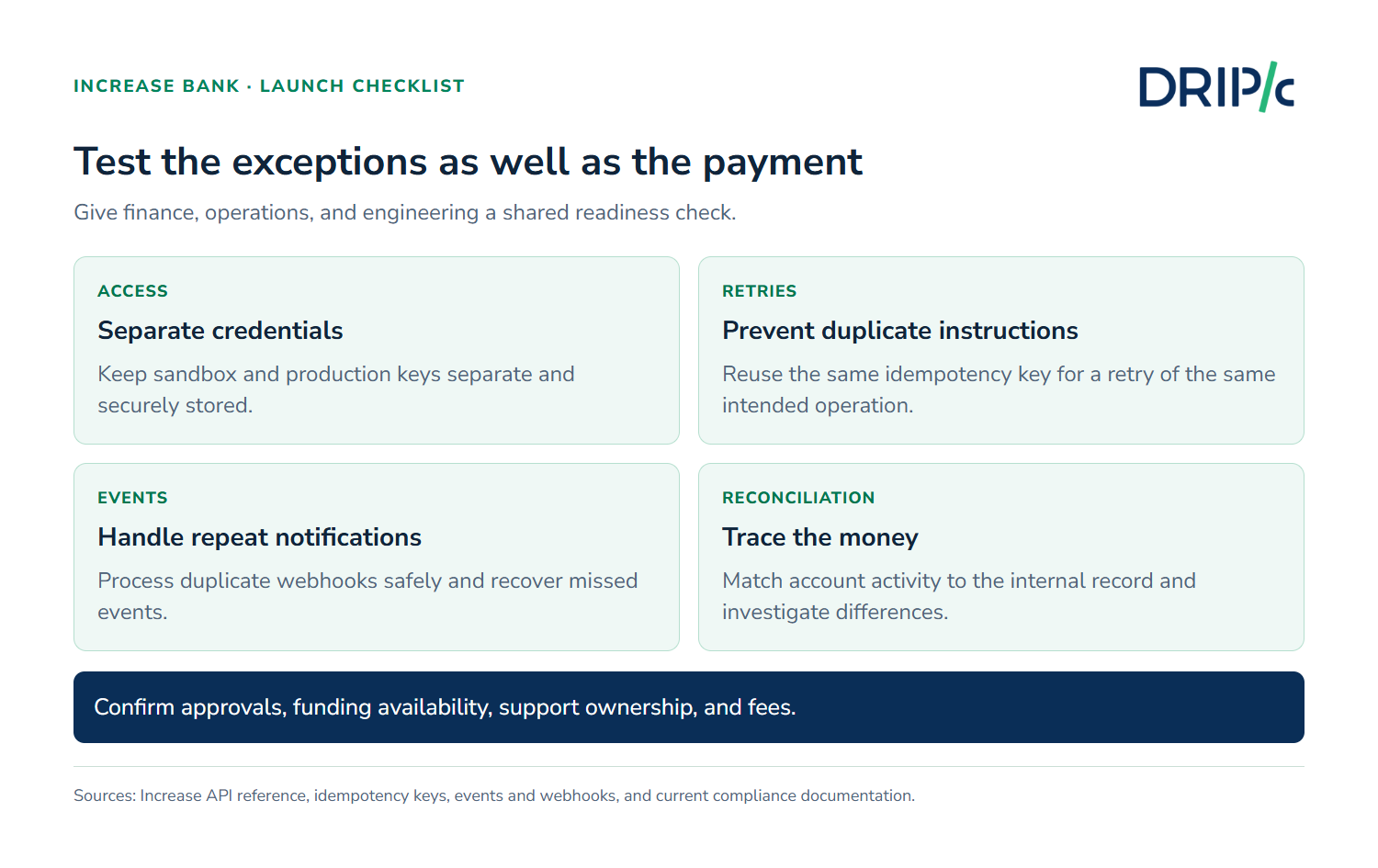
Increase provides separate sandbox and production API keys. Its API reference explains that sandbox activity moves no real money and supports simulations of external events.
Have engineering test account setup, successful payments, returns, missing information, and disrupted requests. Store credentials securely and keep the environments separate. Agree on acceptance criteria with finance and operations before moving beyond test activity.
4. Protect Against Duplicate Instructions
A network interruption can leave your application uncertain whether a request succeeded. Increase supports idempotency keys: reusing the same key with the same creation request lets the system return the original object instead of creating another one.
Use a consistent identifier for each intended operation. Test what happens when a request is retried, and verify that the original payment remains traceable. This control belongs in the integration's design from the beginning.
5. Reconcile and Prepare for Exceptions
Match the bank activity to the invoice, customer, and internal record. Handle repeated webhook deliveries safely, and define a recovery process for missed events using Increase's event retrieval guidance.
Separately track the underlying accounts receivable or payable. A payment status and an accounting balance answer different questions; your close process needs both.
Is Increase a Good Fit for Your Business?
Increase Bank deserves consideration when your business needs banking functions embedded in software and has people to build and operate the integration. Evaluate it against a defined workflow, a complete cost estimate, and the responsibilities your team can support.
For a business with modest payment volume, compare the build and maintenance effort with the tools already available in its banking or accounting software. A useful Increase Bank Review should make that implementation work visible.
Also separate payment functionality from borrowing. Our business financing options guide covers funding structures to assess when available cash is the constraint. Access to a payment API does not itself establish a credit facility.
Where Drip Capital Fits
Drip Capital addresses funding needs that can arise alongside a payment workflow. Vendor Financing pays vendors directly, with repayment up to 90 days. Its Line of Credit lets an eligible business draw against an approved limit, with each draw repaid over six monthly installments.
Eligibility includes at least two years in business and $2M+ in annual revenue. Evaluate those terms against the payment schedule and expected collections. This discussion describes separate services and does not imply an integration or partnership with Increase.
Frequently Asked Questions
Is Increase a Bank or a Technology Company?
Increase Bank and Increase Technologies, Inc. are distinct entities. The current disclosures identify the latter as a non-bank technology provider and list multiple banks that may provide banking services.
Do I Need Developers to Use Increase?
Building banking capabilities into your own software through an API Banking Platform requires technical implementation and ongoing support. Confirm whether the dashboard or an existing software integration can meet your narrower requirements before commissioning a custom build.
Does Increase Offer a Sandbox?
Yes, its API reference documents a sandbox with separate credentials and simulated activity. No real money moves in that environment, so production readiness also requires the applicable onboarding and operational checks.
Does Banking as a Service Remove Compliance Work?
Banking as a Service arrangements allocate responsibilities among the participants. Increase's managed and customized models assign different duties, and platforms retain operational responsibilities even under managed compliance.