

A financing offer can solve Friday's cash shortage and create a new problem on Monday. With a Merchant Cash Advance, the money coming in is only half the decision. The deductions that follow determine how much remains for payroll, inventory, rent, and the next vendor payment.
Before accepting an offer, work through three questions: how much cash will actually reach your account, how collections change when sales fall, and whether the business can operate through the repayment period. This guide explains the mechanics and provides a practical way to test them.
Illustrative photo by Dan Meyers on Unsplash.
What Is a Merchant Cash Advance?
A Merchant Cash Advance generally provides upfront funding in exchange for a purchased amount of future business receipts. Collections may come through a share of card sales or withdrawals from a business bank account. The FTC's staff perspective on small-business financing examines these structures and their consumer-protection issues.
The agreement controls the details. Read how it defines receipts, calculates collections, and handles a decline in revenue. A sales pitch describing flexible payments cannot establish what the signed contract actually requires.
Merchant Cash Advance vs. Loan: Read the Structure
The phrase MCA Loan appears in searches and marketing, but agreements often describe a purchase of future receivables. Legal treatment depends on the terms, facts, and applicable law. A contract label alone cannot settle that question.
For a Merchant Cash Advance vs. Loan comparison, identify the payment formula, estimated duration, adjustment process, and default provisions. Our business financing comparison framework covers the broader options; this article concentrates on the cash consequences of an advance.
Read the Offer in Dollars First
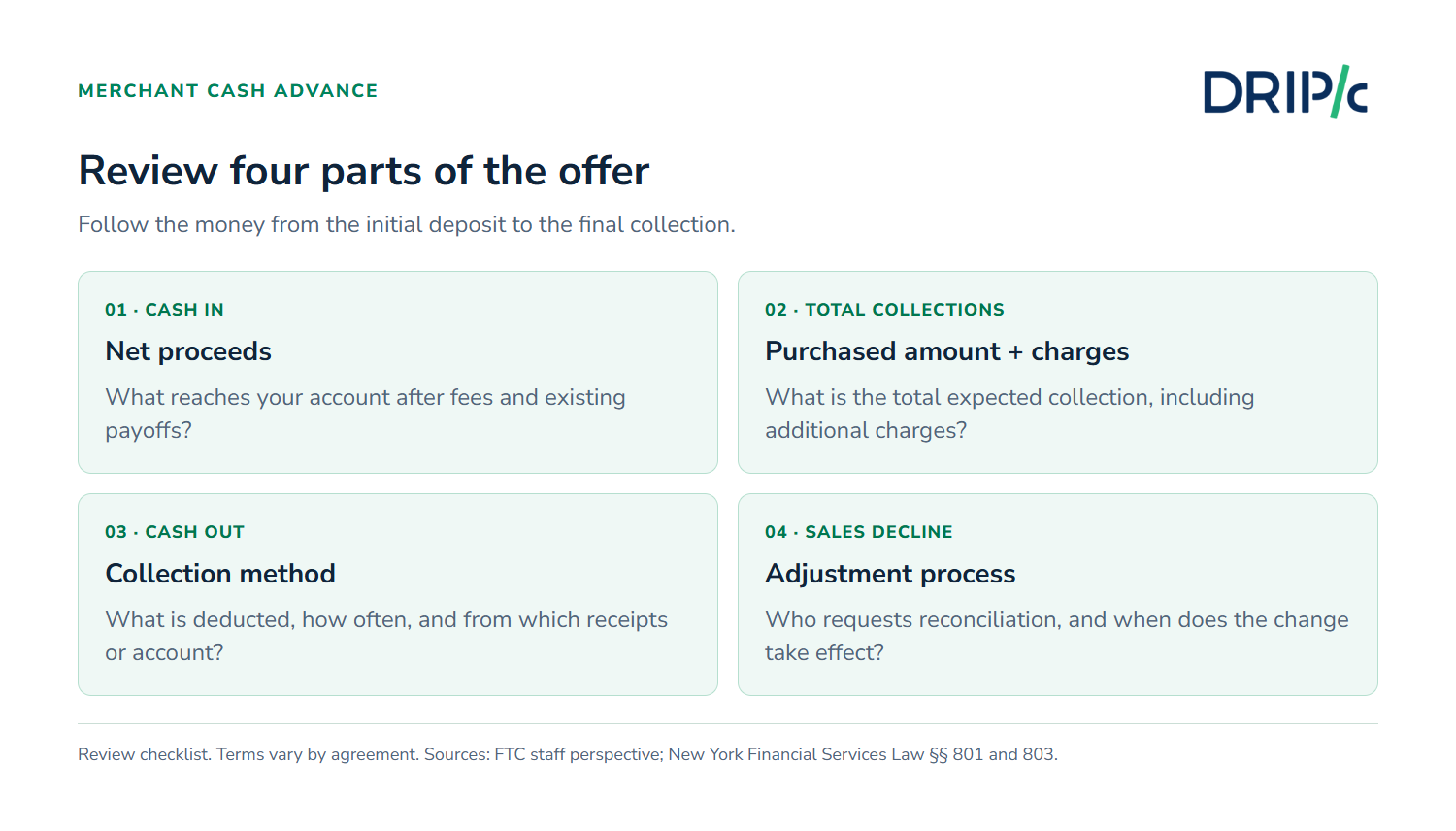
Factor Rate and Total Collections
Consider an illustrative offer: a $50,000 advance with a 1.30 factor produces a $65,000 purchased amount. The difference is $15,000 before any additional fees. These figures are hypothetical and do not represent a provider's quote or a market average.
A factor expresses a multiplier. An annualized cost comparison also needs the timing of the funding and collections. Calling this example a 30% APR would be inaccurate. Ask for the estimated APR, its assumptions, and the complete payment schedule or calculation method.
Net Proceeds and Extra Charges
Confirm the amount deposited after any fees, broker charges, or payoff of existing financing. Two offers showing the same advance can leave different amounts available to spend. Record the net proceeds next to the total expected collections.
New York's sales-based financing disclosure law requires covered providers to disclose items including disbursement, finance charge, estimated APR, payment mechanics, and prepayment terms. Requirements vary by jurisdiction and transaction. These fields also make a useful comparison checklist wherever your business operates.
How Collections Reach Your Operating Account
Percentage-Based Collections
With a percentage-based arrangement, the collection moves with the receipts covered by the agreement. In a hypothetical example, 15% of $20,000 in weekly covered receipts is $3,000. If covered receipts fall to $15,000, the same percentage produces $2,250.
That adjustment can help, but operating costs may remain unchanged. A lower deduction still leaves less cash overall when sales decline.
Fixed Withdrawals and Reconciliation
An agreement may use fixed estimated withdrawals with a process for adjusting them to actual revenue. New York's statutory definition expressly includes sales-based financing with this kind of reconciliation mechanism.
Ask who initiates an adjustment, which records are required, how often requests are allowed, and when the change takes effect. Model the period before approval as well as the adjusted payment. Do not assume the bank debit automatically falls the day receipts decline.
Stress Test a Slow Week Before Signing
Start With Cash Received
Use actual expected collections, including customer payment delays. Booked sales can look healthy while the account funding payroll stays thin. The distinction between cash flow and revenue matters especially for wholesalers selling on terms.
Build a weekly forecast showing opening cash, customer receipts, operating payments, existing debt service, and proposed advance deductions. Carry the closing balance into the following week. Extend it through the estimated collection period, with a separate slower-sales scenario.
Compare the Same Week Under Two Assumptions
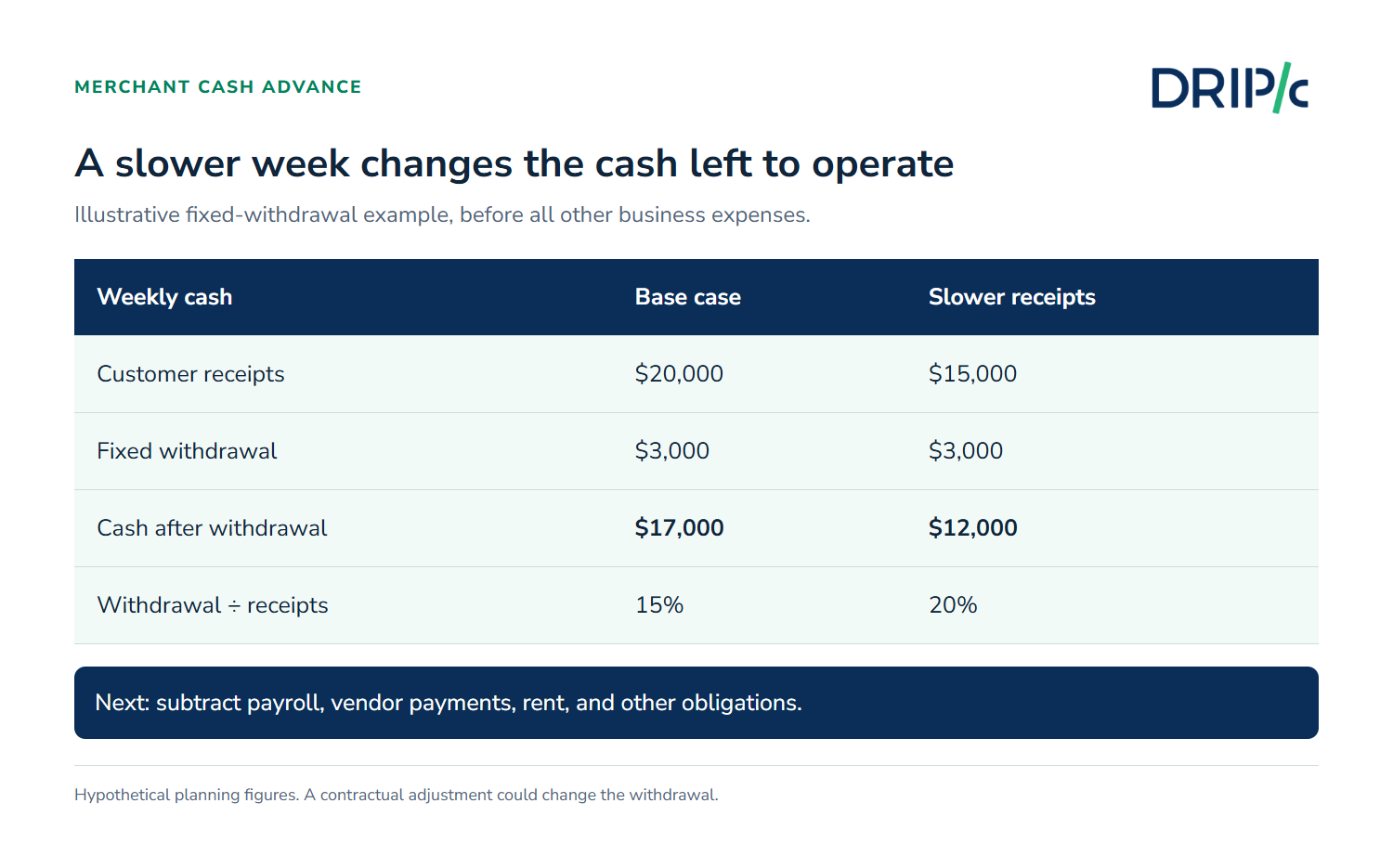
Suppose weekly receipts decline from $20,000 to $15,000 while a fixed withdrawal remains $3,000. Cash after that withdrawal falls from $17,000 to $12,000, before other expenses. The deduction consumes 20% of the slower week's receipts, compared with 15% previously.
This stress test uses illustrative assumptions. Replace every figure with your own operating costs and agreement terms. Pay particular attention to the lowest cash balance before payroll or a large vendor invoice comes due.

A forecast is useful only if it includes the payments that are difficult to move. Use a cash-flow management process to update the assumptions as collections arrive. Set a minimum operating cash reserve before deciding how much financing the business can support.
By the Numbers: Why Cost Clarity Matters
The findings come from the 2025 Small Business Credit Survey, a nationwide convenience sample. The online-lender figure covers multiple financing products and should not be read as an MCA-specific result. It reinforces the value of comparing the written cost with the cash your business actually receives.
Questions to Ask Merchant Cash Advance Companies
Early Payoff and Renewal
Ask for a written payoff calculation. Returning funds early may leave some or all of the fixed finance charge payable; the contract determines the result. A renewal also deserves a fresh review: establish how much of the new advance pays an old balance and how much reaches your account.
When comparing Merchant Cash Advance Companies, obtain answers before signing. The FTC advises businesses to investigate financing providers, clarify unfamiliar terms in writing, and seek independent advice.
Overlapping Obligations
If other financing is outstanding, list every withdrawal together. Check restrictions on additional financing and any security interests. A second advance can increase cash today while committing more of the same future receipts.
Treat MCA Funding as a decision about the entire operating account. If the forecast requires another advance simply to cover existing deductions, revisit the amount, structure, or underlying spending plan before proceeding.
Compare Alternatives Against the Expense
For a recurring gap, review Line of Credit uses and the proposed draw repayment schedule. For a defined operating need, examine how a Working Capital Loan works. Compare net proceeds, total cost, payment timing, and qualification requirements on the same basis.
The decision should survive a slower collection week. Access to funding has limited value if the resulting payment schedule repeatedly leaves essential expenses uncovered.
Where Drip Capital Fits
Drip Capital's Line of Credit allows businesses to draw as needed, subject to their terms and available credit. Each draw is repaid over six monthly installments. Include applicable fees and every scheduled payment in the forecast before borrowing.
For businesses whose pressure begins with vendor invoices, Drip Capital's Vendor Financing pays the vendor directly, with repayment up to 90 days. Evaluate that window against the expected cash cycle. Neither structure removes the need for sufficient repayment cash.
Frequently Asked Questions
What Is a Merchant Cash Advance Used For?
A Merchant Cash Advance can provide cash for business expenses, subject to the agreement. Assess the expected benefit of the spending alongside the deductions from future receipts.
Does a Factor Rate Show the Annual Cost?
A factor rate shows the multiplier used to calculate the purchased amount. An annualized comparison also requires funding dates, payment timing, fees, and assumptions about receipts.
Do Payments Automatically Fall When Sales Decline?
That depends on the collection method and contract. Percentage-based collections move with covered receipts, while fixed withdrawals may require a reconciliation request before they change.
Can Early Repayment Reduce the Cost?
The agreement determines whether any finance charge is reduced. Request a written payoff amount and compare it with the remaining scheduled or estimated collections before making the decision.