

Business Line of Credit vs Term Loan: Which One Fits Your Cash Gap
Two businesses borrow the same amount in the same month. One draws it in pieces across a season and pays it back as customers settle up. The other takes it all on day one and pays a fixed amount every month for three years. Same money, completely different shape.
That shape is the whole question in business line of credit vs term loan. Picking wrong rarely means getting declined. It means paying for money you are not using, or running out of room halfway through a season.
The Structural Difference
The revolving credit vs installment loan distinction drives everything else, and it comes down to one thing: whether the money arrives all at once or in pieces.
How a term loan is structured
A term loan hands you the full amount up front. You repay on a fixed schedule over a set period, and interest applies to the entire balance from day one, whether the money is working yet or sitting in your account. When people ask about revolving credit vs installment loan structures, this is the installment side: predictable, fixed, and finished when the term ends.
How a line of credit is structured
A Line of Credit gives you a limit rather than a lump sum. You draw against it when a cost lands, repay, and draw again. Interest applies to what you have actually drawn, not the limit. The facility stays open between draws, so it is available the next time without a new application.
That availability is the real product. A line of credit for working capital is less about the money and more about not having to arrange money on short notice.
By the numbers
What financing actually looks like for small businesses
60%
of online-lender borrowers found
costs higher than expected
42%
of applicants received the full
amount they sought
59%
of firms with debt used
a personal guarantee
51%
of those firms pledged
business assets
Source: Federal Reserve Banks, 2026 Report on Employer Firms
When a Term Loan Is the Better Answer
The installment structure wins in specific, identifiable situations.
One-time purchases with a known cost
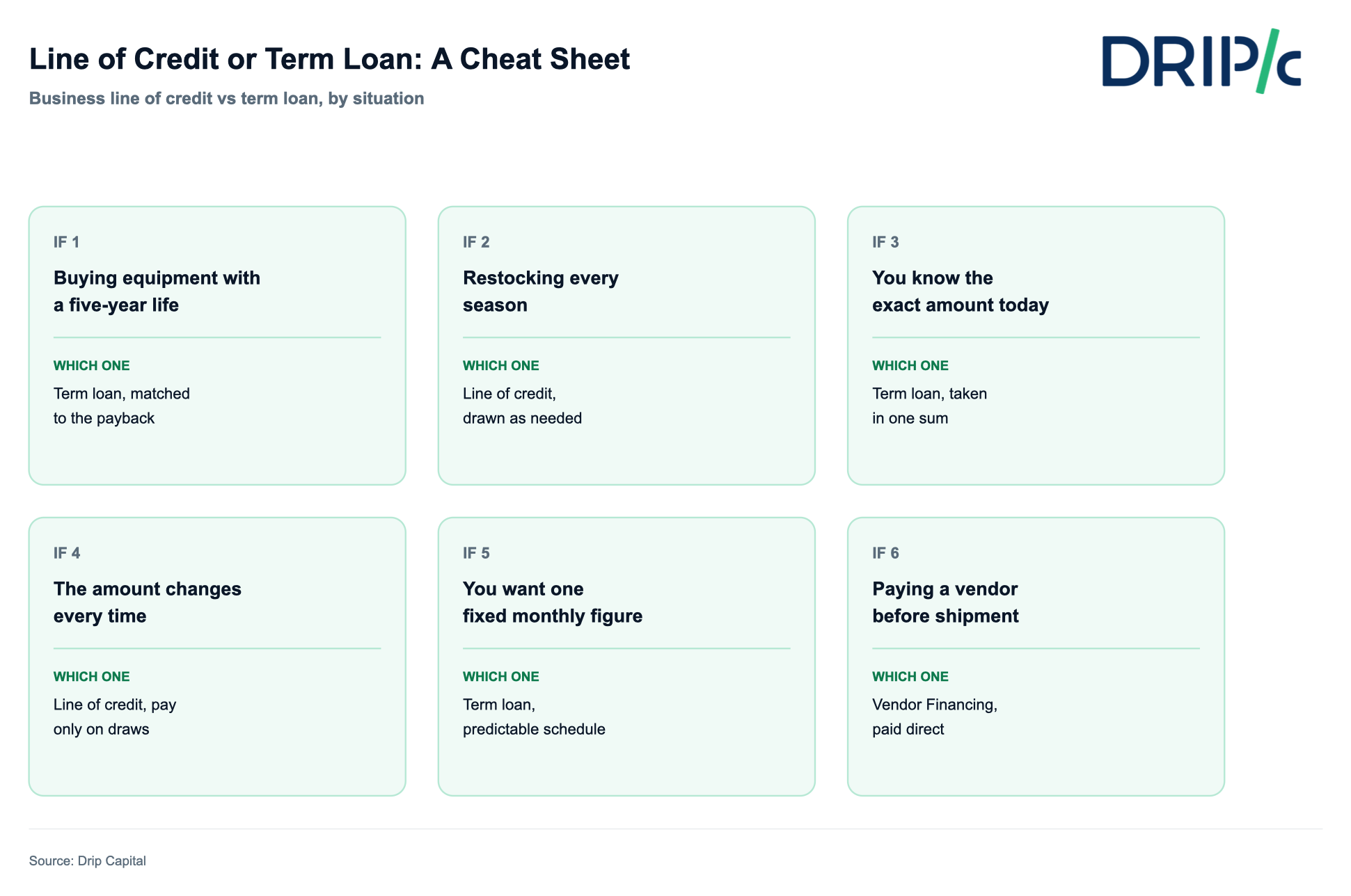
Buying a piece of equipment, fitting out a warehouse, or acquiring another business are one-time events with a number attached. You know the amount, you need all of it at once, and you will use it immediately. There is no benefit to a facility that lets you draw in pieces when you need every piece on day one.
Long payback periods
If the thing you are buying pays for itself over four years, matching that with four years of fixed payments is sensible. Understanding when to use a term loan usually comes down to this: the asset has a long life, and the repayment schedule can mirror it.
You want payment certainty
A fixed monthly figure is easy to plan around. For an owner who wants the same number in the same row of the same spreadsheet every month, that predictability has real value.
When a Line of Credit Is the Better Answer
The revolving structure wins when the need is recurring or unpredictable.
Costs that repeat but vary
Inventory buys, vendor deposits, payroll during a slow quarter, the everyday working capital costs of running a business. These recur, and the amount is different every time. Drawing what you need and repaying as cash comes in fits that pattern in a way a fixed schedule does not.
Gaps you can see coming but cannot time
You know a seasonal build is coming. You do not know precisely when the order lands or how big it is. A line of credit for working capital is arranged before the gap opens and used when it does.
You want to pay only for what you use
This is the sharpest practical difference in business line of credit vs term loan terms. Take a $200,000 term loan and you pay interest on $200,000. Hold a $200,000 line and draw $40,000, and the cost applies to the $40,000.

Cost, Speed, and Qualification
Three practical differences decide most cases once the structure question is settled.
The cost you will actually pay
The headline rate is rarely the whole price on either product. Sixty percent of businesses that borrowed from online lenders reported that actual costs came in higher than expected, against 37% at small banks and 32% at large banks. Ask for the all-in cost of a typical draw or a typical month, in dollars, before you sign either one. Our guide to hidden line of credit charges covers what to look for.
Speed and repeat access
A term loan is arranged once for one purpose. A line is arranged once and used repeatedly, which matters when the next need arrives faster than an application can be processed.
What lenders ask for
Sixty percent of firms applied for financing in the year before the survey, and 42% of applicants received the full amount they sought, while 36% received some or most and 22% received none. Both products lean on credit history, time in business, and revenue consistency. Among firms holding debt, 59% used a personal guarantee and 51% pledged business assets, so read what is being secured on either structure.
How Drip Capital Fits
Drip Capital's Line of Credit is a revolving facility. You draw against your limit and repay over six monthly installments, then draw again as the next cost lands. There is no prepayment penalty, no annual maintenance fee, no blanket lien on your assets unless you default, and no UCC filing unless you default.
Where the cost is a vendor payment specifically, Vendor Financing may fit better than either structure here. Drip Capital pays your vendor directly, and you repay within an agreed window, typically up to 90 days, with a flat fee on the invoice of roughly 1% to 2% per month, charged only on what you draw and only while it stays outstanding. It requires a minimum of two years in business, is collateral-free, and needs no personal guarantee.
Frequently Asked Questions
Is a line of credit cheaper than a term loan?
Not automatically. Term loans often carry lower headline rates, but you pay interest on the full amount from day one. A line usually costs more per dollar drawn and can total less if you draw only part of the limit. Compare the all-in cost of your actual usage pattern.
Can a business have both at the same time?
Yes, and many do. A term loan funds a specific long-term investment while a line covers recurring working capital gaps. They solve different problems, so holding both is common.
Which is easier to qualify for?
It depends more on your profile than the product. Both weigh credit history, time in business, and revenue consistency. Financing tied to a specific transaction, such as Vendor Financing, weighs the order and the vendor relationship more heavily, though a two-year minimum in business still applies.
What happens to a line of credit if I do not use it?
It stays open and available. Terms vary by provider, so check whether an inactivity or maintenance charge applies during quiet periods before you sign.