

Photo: Erik Mclean / Unsplash. Illustrative image of a downstream rubber product.
A $100,000 shipment of Chinese CBS rubber accelerator now carries a preliminary countervailing-duty cash deposit of $107,570. For a chemical importer, that can change the cash needed for an order before a single bag reaches a customer.
Commerce’s October 8, 2026 determination covers one specific rubber-processing chemical. It also reaches back to certain unliquidated entries from July 10, 2026. The measure allows imports to continue subject to the applicable requirements; it does not impose an import ban.
Updated October 9, 2026.
What changed for Chinese CBS imports?
Commerce preliminarily found countervailable subsidies and set a 107.57% rate for every named company and “all others.” An exporter’s absence from the named list therefore does not remove the deposit requirement for covered merchandise.
The China CBS rubber accelerator countervailing duty case is C-570-235. Commerce used adverse inferences because respondents failed to provide requested information. The companion antidumping investigation is separate; 107.57% represents the preliminary CVD rate alone. Other applicable import charges are additional. Determination and rate table.
Which products are covered?
Chemical identity and product names
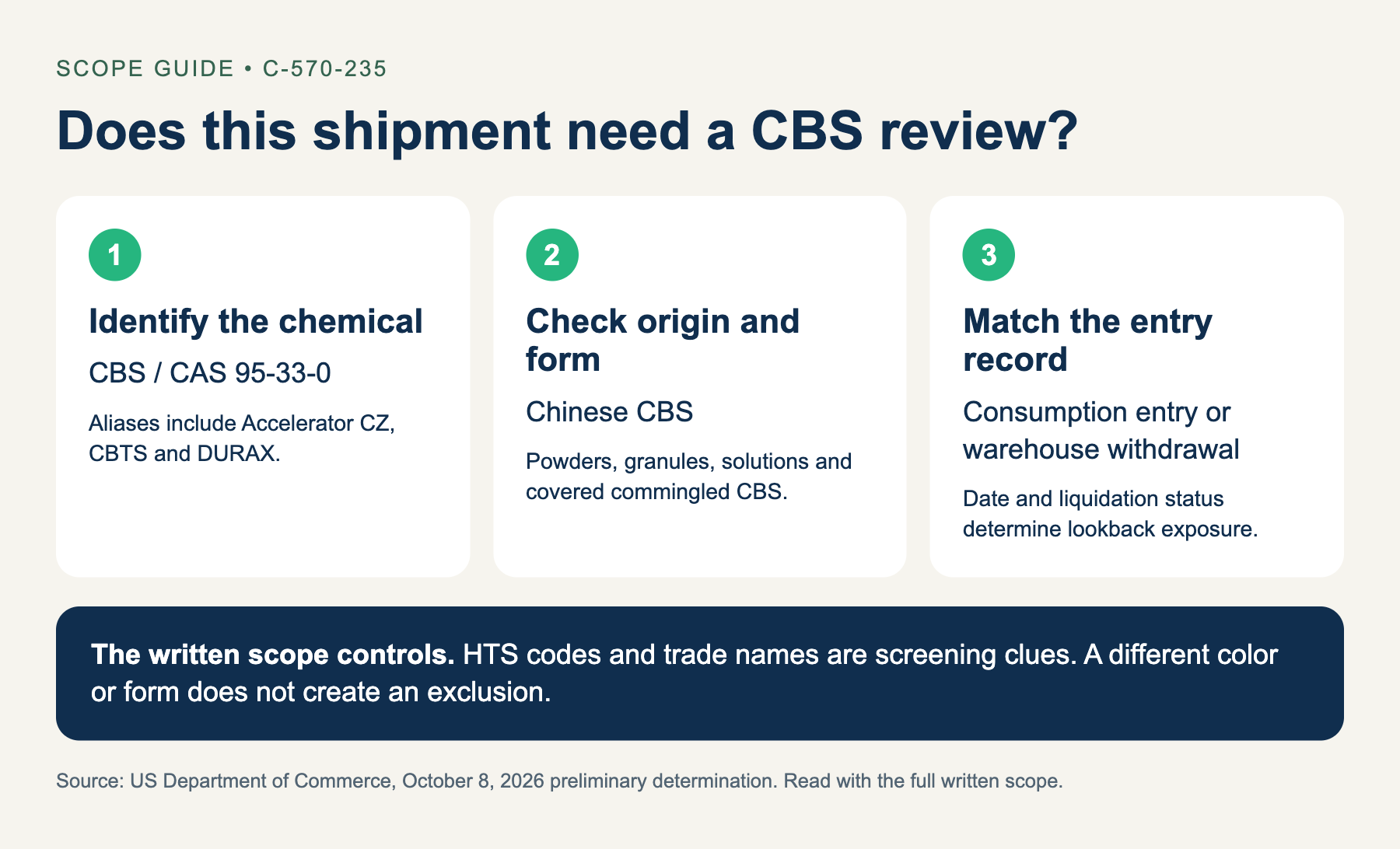
The written scope covers Chinese N-Cyclohexylbenzothiazole-2-sulfenamide, or CBS rubber accelerator, CAS 95-33-0. Listed aliases include Accelerator CZ, CBTS, Thiohexam, HIP4, Curax, DURAX, Conaca, Conach, Conacs and Celacs. Commerce’s product scope.
Forms, solutions and commingled CBS
| Scope detail | What it means |
|---|---|
| Powder, oiled powder and granules | Other colors or forms are also included. |
| Solutions | The scope identifies benzene, ethanol and acetone solutions. |
| Commingled CBS | Mixing covered CBS with CBS from nonsubject sources is expressly included. |
| Common assay of 94–99% | This describes typical concentrations; the notice does not make it an exclusion threshold. |
HTS codes are a starting point
The notice lists 2934.20.8000, 3812.10.1000 and 3812.10.5000. Its written description controls coverage. An HTS code lookup helps identify classifications, but a code alone cannot settle whether a shipment falls within this investigation.
Why does the lookback start in July?
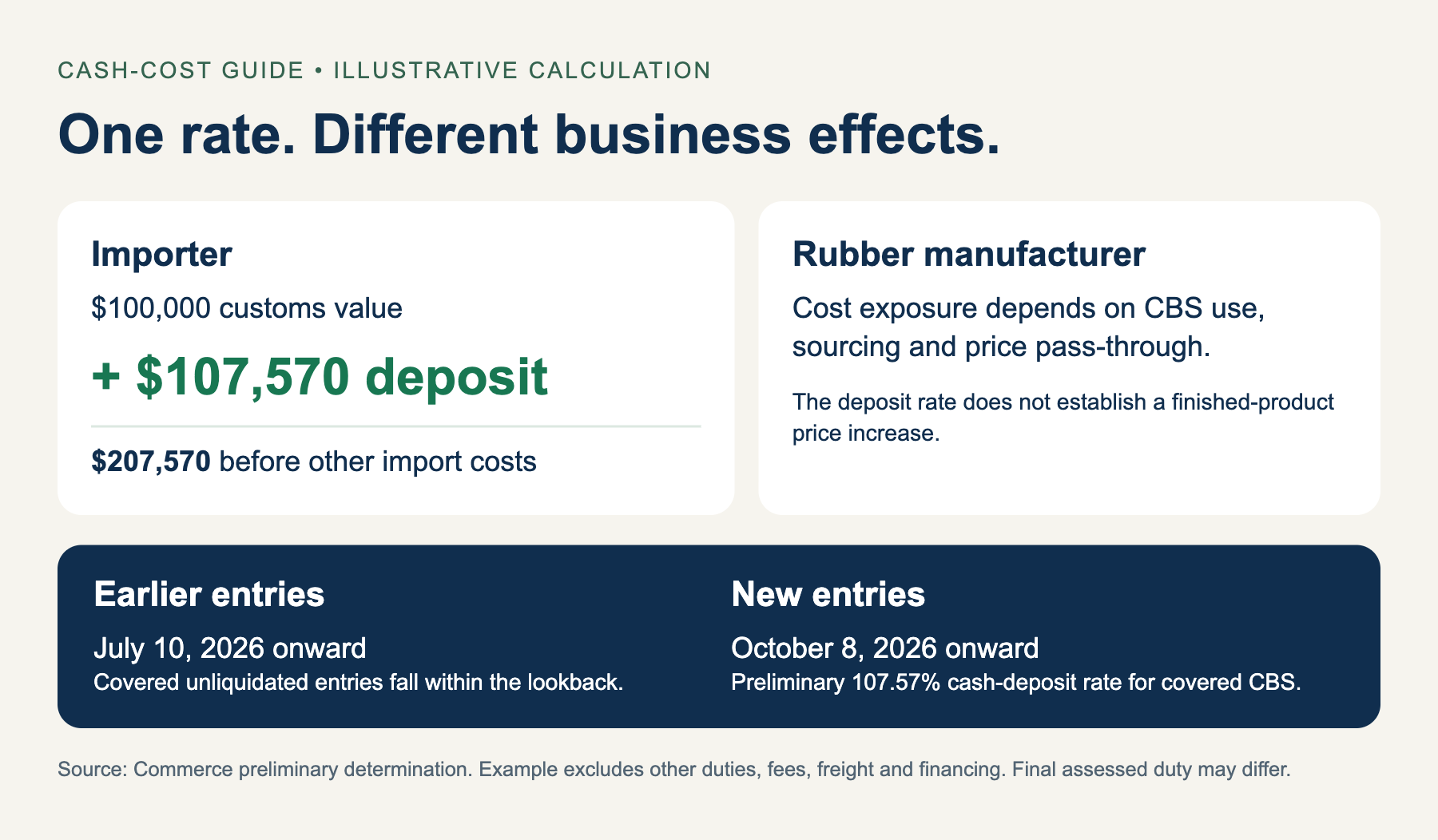
Commerce’s preliminary critical-circumstances finding extends suspension of liquidation to covered, unliquidated entries entered or withdrawn from warehouse for consumption from July 10, 2026: 90 days before publication. Liquidation is the final settlement of an entry’s duties. Suspension instructions.
A purchase-order date or vessel departure date does not answer the lookback question. The relevant records are the consumption-entry or warehouse-withdrawal date and liquidation status. For earlier entries, the broker-led review also needs the case-specific CBP cash-deposit instructions.
What does 107.57% mean in dollars?
A shipment-level example
Assume the applicable customs value is $100,000. The countervailing duty cash deposit is $100,000 × 1.0757 = $107,570. Together, the goods value and this deposit equal $207,570, before freight, other applicable duties, fees and financing costs.
This illustration isolates the CVD deposit. The cash-flow impact of import duties depends on when those amounts become payable and when the importer collects from customers.

The deposit is an estimated-duty payment. Final liability can differ as the proceeding and any subsequent administrative review determine assessment. Commerce’s explanation of deposits and assessments.
What reaches the customer’s price?
A manufacturer’s finished-product price depends on the CBS quantity used, other production costs, margins and how much additional cost is passed through. The announcement therefore supplies no percentage increase for tires, hoses or other finished rubber products.
What does an entry review cover?
A customs broker can reconcile the product and entry records:
- Chemical name, CAS number, specification, safety data sheet and certificate of analysis.
- Country of origin, producer/exporter and any commingling.
- Commercial invoice, customs value, entry number and consumption-entry or withdrawal date.
- Liquidation status, applicable case number, CBP instructions and deposits already collected.
These records connect the scope decision with the amount and timing of cash required.
What sourcing options do businesses have?
US production and domestic inventory
Commerce identifies LANXESS Corporation as a domestic CBS producer. A US-produced purchase has no import deposit under this China-specific case. Its delivered price, specification and availability still need a current quote. Stock held by a US distributor may have been imported, so a domestic invoice alone does not establish origin or eliminate earlier import costs embedded in its price.
Non-Chinese production
India-based NOCIL lists Pilcure CBS in powder and pellet forms. That establishes a product alternative, without establishing the origin, availability or price of any particular shipment. Non-Chinese CBS remains subject to its own applicable import treatment, logistics and qualification costs.
How the cost comparison changes
For the same usable quantity and specification, a hypothetical $150,000 delivered US quote would be $57,570 below the Chinese goods-value-plus-CVD-deposit subtotal above. That comparison excludes other Chinese import costs and measures the deposit as cash required. Final assessed expense may differ. It demonstrates why the lowest factory quote may require more upfront cash.
Where Drip Capital fits
A higher deposit can leave less cash available for vendor payments. Drip Capital’s [Vendor Financing](https://www.dripcapital.com/en-us/resources/finance-guides/vendor-financing) pays vendors directly, with repayment terms of up to 90 days, subject to underwriting and applicable terms.
Keep the broker-confirmed customs obligation separate from the vendor invoice when planning funding. Talk to Drip Capital about financing vendor payments; this product description does not establish funding for CBP deposits.
Frequently asked questions
Does this cover every rubber accelerator from China?
Coverage follows the written CBS scope. Other rubber chemicals require their own classification and scope analysis.
Can changing the vendor avoid the deposit?
All other producers and exporters receive the same preliminary rate. A different vendor selling covered Chinese CBS therefore does not, by itself, change that rate.
Are all July entries affected?
The lookback begins on July 10, 2026 and concerns covered unliquidated consumption entries or warehouse withdrawals. Earlier July entries fall outside this notice’s 90-day window.
Is 107.57% the final duty?
The China CBS rubber accelerator countervailing duty determination is preliminary. Commerce currently schedules its aligned final determination no later than January 11, 2027, unless postponed; final injury findings and subsequent assessment procedures also matter. Case timeline.