

Commercial Line of Credit Rates: What to Expect in 2026
Ask three business owners what they pay for a line of credit and you will get three different answers, and probably three different products. Commercial line of credit rates span a wide range, from single-digit bank pricing to merchant cash advance costs that can run into triple digits when converted to an annual rate. The gap is not random. It comes down to who is lending, how they get repaid, and how much risk they are taking on to give you money fast.
This piece breaks down what a commercial line of credit actually costs across the three paths most small and midsize businesses end up choosing between: a bank line, an online or alternative lender line, and a merchant cash advance. It also covers why underwriting across the industry has gotten tighter for some borrowers this year, and why that tightening lands harder on businesses with import or export exposure.
What "commercial line of credit rates" actually means
A credit rate on a revolving line is not one fixed number quoted once and forgotten. Most lines carry a variable rate tied to a benchmark, commonly the prime rate, plus a margin set by your risk profile. As of late August 2026, the Federal Reserve's H.15 report puts the effective federal funds rate at 3.63% and the bank prime rate at 6.75%, and both had held steady for two straight Federal Open Market Committee meetings. That prime rate is the floor most bank pricing builds from; a bank line priced at prime plus two to five percentage points moves along with Fed movement.
Online and alternative lenders often do not tie pricing to prime at all. Many price as a flat fee per draw or a factor multiplier instead of a stated annual percentage rate, which is one reason two "line of credit rates" quotes from two different lenders can look completely different on paper while costing something similar in practice, or vice versa.
Bank lines of credit: the lowest cost, the highest bar
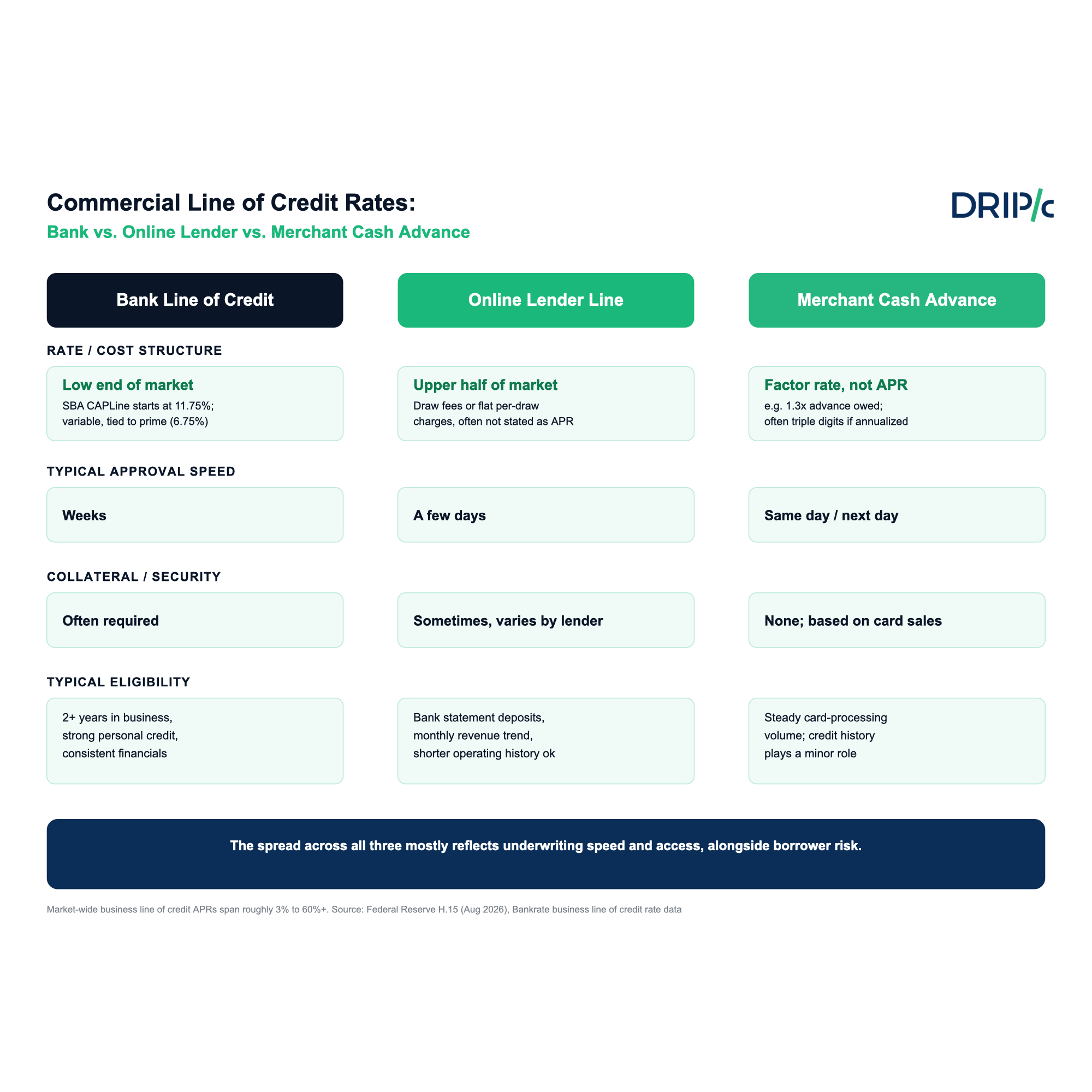
Bank-issued commercial lines of credit are the cheapest financing on this list for a business that can qualify. According to Bankrate's coverage of small business line of credit pricing, rates across the market run from as low as 3% up to 60% or higher depending on the lender and the borrower's creditworthiness, and bank lines occupy the lower end of that spread; the most established, best-qualified borrowers land closest to the floor, while thinner-file or riskier borrowers get pushed higher. SBA-backed CAPLines, a government-guaranteed revolving option offered through banks, started at 11.75% as of Bankrate's most recent figures, a useful anchor for what a solidly qualified borrower can expect from a bank-adjacent line.
The tradeoff for that pricing is access. Banks generally want two or more years of tax returns, consistent revenue, a strong personal credit score, and often collateral or a personal guarantee before they will extend a revolving facility. Underwriting can take weeks. For an established company with clean financials, that is a fair trade. For a newer business, or one whose numbers look unusual because of seasonal import cycles or lumpy cross-border receivables, it can mean a slow no instead of a fast yes.
Online and alternative lenders: faster, pricier, more flexible criteria
Online lenders fill the gap for businesses that need a decision in days, or that do not fit a bank's underwriting box at all. The cost of that speed and flexibility shows up in the rate. Pricing on business line of credit products from online and alternative lenders commonly lands well above bank pricing, closer to the upper half of that broad 3% to 60%-plus market range once fees are converted to an annualized figure, since many charge draw fees, maintenance fees, or a flat percentage per draw instead of a single clean interest rate.
What online lenders weigh more heavily than banks: recent bank statement deposits, monthly revenue consistency, and how a business's cash flow actually behaves month to month, sometimes more than a personal credit score or years in business. That makes this tier a realistic option for a business that is growing quickly but has not built the multi-year track record a bank wants to see.
By the numbers
Commercial credit costs, by the numbers (2026)
6.75%
The bank prime rate
as of late August 2026
3-60%
Full range of business
line of credit APRs quoted
11.75%
Starting rate on an
SBA CAPLine facility
Q1 2026
Banks reported tighter
small-business C&I standards
Source: Federal Reserve H.15, Federal Reserve SLOOS, Bankrate
Merchant cash advances: priced differently, and worth understanding on their own terms
A merchant cash advance is not technically a line of credit at all; it is an advance against future card or receivable sales, repaid through a fixed daily or weekly percentage of revenue. MCAs are priced with a factor rate: typically a multiplier applied once to the amount advanced, instead of a stated APR. A business that takes a $50,000 advance at a 1.3 factor rate owes $65,000 total, regardless of exactly how fast it is repaid, and when that flat cost is converted into an annualized figure for comparison purposes, it commonly lands far above bank and even online-lender line pricing, sometimes into triple digits depending on how quickly the advance is repaid.
MCAs exist because they solve a specific problem: same-day or next-day funding with almost no paperwork, approved primarily off card-processing volume, with credit history playing a much smaller role. For a business with weak credit and urgent, short-term cash needs, that speed has genuine value. It is also, however, dollar for dollar, the most expensive way to access working capital on this list, and the daily repayment structure can strain cash flow in a way a monthly line payment does not.
The bank-online-MCA cost spread mostly reflects speed and access
It is tempting to read the entire gap between an 8% bank line and a triple-digit MCA as pure risk-based pricing: worse borrower, worse rate. That is only part of the story. A large share of the spread reflects how fast the lender can say yes, how much documentation they require, and whether they are lending against collateral, a personal guarantee, or nothing but recent revenue.
A bank can offer its lowest pricing because it takes weeks to underwrite, wants collateral or a strong personal guarantee, and only approves the safest files. An online lender prices higher because it approves faster and against thinner documentation. An MCA provider prices highest of all because it approves almost anyone with steady card sales, with next to no underwriting delay. Speed and access cost money; that is the honest version of the spread, more than "risky borrowers get punished."
What actually determines your rate
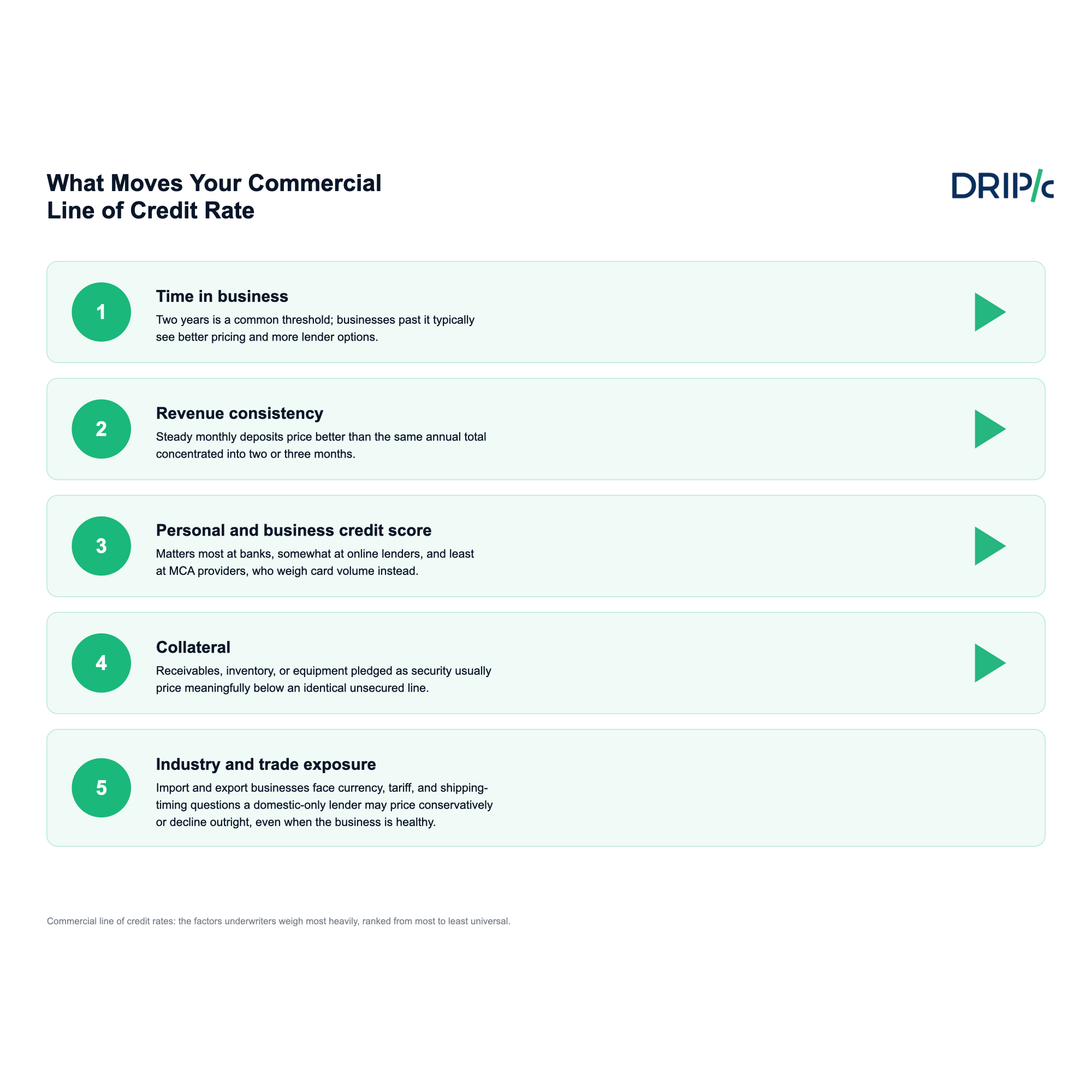
Five factors do most of the work in setting where a specific business lands within any of these ranges.
Time in business. Two years is a common threshold lenders use to separate an established operating history from a newer venture, and businesses on the newer side of that line typically see higher pricing or narrower options across all three lender types.
Revenue consistency. A lender reading twelve months of bank statements is looking for steady deposits across the year, beyond just a healthy annual total. A business with the same revenue spread evenly across the year usually prices better than one with the identical annual total concentrated in two or three months.
Personal and business credit score. This still matters most at banks, somewhat at online lenders, and least of all at MCA providers, who often skip a credit pull almost entirely in favor of processing volume.
Collateral. A secured line, backed by receivables, inventory, or equipment, usually prices meaningfully below an identical unsecured line, because the lender has something to recover if repayment fails.
Industry and trade exposure. Import and export-heavy businesses face underwriting questions that a domestic-only retailer never encounters: currency exposure, tariff classification, shipping-lane risk, and customs timing. A generic lender that does not work in trade finance every day may price that uncertainty conservatively, or decline it outright, even when the underlying business is healthy.
Key insight: The cheapest credit rate and the fastest approval are usually mutually exclusive. Pick the tradeoff that fits the timeline you actually have.
For a full breakdown of the fee types that sit on top of a quoted rate, from draw fees to inactivity charges, see this guide on hidden line of credit charges, and for the collateral question specifically, this comparison of secured versus unsecured lines of credit.

Why underwriting has gotten more stringent for some borrowers this year
Lending standards do not move uniformly, and 2026 has been a good example of that. The Federal Reserve's Senior Loan Officer Opinion Survey, the primary source for how bank credit standards are actually shifting, showed that in the first quarter of 2026 banks reported tighter standards on commercial and industrial loans to small firms on balance, and the banks that tightened pointed mainly to a less favorable or more uncertain economic outlook, worsening conditions in specific industries, and reduced risk tolerance. By the second quarter, the same survey showed standards for small-firm C&I loans holding roughly steady, with banks actually easing some loan terms, citing competition from other lenders and a somewhat less uncertain economic backdrop.
The survey itself does not name tariffs or geopolitical disruption as a reason banks gave for tightening; that connection is honest context, not an assertion the survey itself makes. Still, the economic uncertainty and industry-specific concerns banks did cite line up with a genuinely turbulent trade environment this year. Washington imposed an additional 50% Section 338 tariff on a range of Canadian goods in the summer, covering close to $20 billion in imports across alcohol, dairy, and motor vehicles. Earlier in the year, the Supreme Court struck down a separate set of tariffs imposed under the International Emergency Economic Powers Act, a ruling that triggered a still-ongoing refund process for tens of billions of dollars in duties already collected, adding its own layer of planning uncertainty for importers. On top of the tariff picture, Red Sea shipping disruptions have kept most container traffic on the longer Cape of Good Hope route through 2026, extending transit times and adding cost on Asia-Europe and Asia-US lanes.
None of that shows up as a line item in a SLOOS release. What it does is make the operating picture of an import or export-heavy business genuinely harder to read from the outside: revenue timing shifts when a shipment reroutes, landed cost changes when a tariff schedule updates, and a generic lender evaluating that business against a domestic-only peer may reasonably read more risk into normal trade-cycle noise. A domestic-only business selling the same product at the same margin does not carry that same layer of uncertainty in a lender's eyes right now.
How Drip Capital fits into this picture
This is where the honest version of the story matters. A business that looks riskier to a bank or a generalist online lender right now, because its cash flow reflects tariff timing or a rerouted shipment, with no real deterioration in the underlying business, is not actually a worse credit. It is a business whose risk profile and generalist underwriting model was not built to read.
Drip Capital's Line of Credit was built around that exact pattern. Instead of underwriting a business the way a domestic bank would, it is designed to work with the trade cycle itself: cross-border or domestic purchase timing, vendor payment terms, and the revenue rhythm of an importer or exporter or even a domestic trader, for that matter. The facility runs from $50,000 to $3 million, decisions typically come back within about 48 hours, and approved draws fund within 24 hours, with repayment spread across six monthly installments, no prepayment penalty, no annual maintenance fee, and no blanket lien or UCC filing unless the account goes into default. It works well alongside the patterns covered in common uses of a business line of credit, and a newer business specifically can see what qualifying looks like in Drip Capital's guide to credit lines for new businesses. For businesses whose vendor relationships sit at the center of the working-capital gap, Vendor Financing is worth a look too: it requires at least two years in business and $2 million or more in annual revenue, is unsecured, and repays Drip Capital up to 90 days after the vendor is paid.
Neither product is a way to sidestep the rate conversation this piece has walked through. It is a lender that specializes in reading exactly the risk pattern that is getting other trade-exposed businesses penalized elsewhere right now. Drip Capital's working capital guide covers how these financing tools fit into the broader cash-flow picture beyond just a single rate quote.
A quick framework before you shop rates
Before comparing quotes, get honest with yourself on four questions: how fast do you actually need the money, can you offer collateral, how consistent does your revenue look on paper versus in reality, and does your business carry import or export exposure that a generalist lender might misread. The answers point toward a tier before you ever see a single quote.
A business with two years of clean financials, steady monthly revenue, and time to wait three weeks should shop banks first. A business that needs funding in days and can tolerate a higher credit rate for it should look at online lenders. A business in a genuine cash crunch with weak credit and strong card volume may find an MCA is the only door open, with eyes open about the cost. And a business whose numbers look complicated purely because of cross-border trade cycles should look for a lender built around that pattern specifically.
FAQ
What is a good commercial line of credit rate in 2026?
For a bank-issued line, anything close to prime plus two to three points, roughly 9% to 10% given the current 6.75% prime rate, counts as strong pricing. Online lender lines commonly run well above that, and merchant cash advances price differently altogether through a factor rate instead of a stated APR.
Why do commercial line of credit rates vary so much between lenders?
The spread mostly reflects underwriting speed and access, alongside borrower risk. A bank that takes weeks and requires collateral can offer its lowest rate; a lender that approves in a day against thin documentation prices higher to cover that speed and the added uncertainty.
Does time in business affect my credit rate?
Yes. Two years in business is a common threshold lenders use to judge whether a company has an established track record, and businesses past that mark typically see better pricing and more lender options across bank, online, and alternative channels.
Are merchant cash advances the same as a line of credit?
No. An MCA is an advance against future sales repaid through a fixed percentage of revenue, priced with a factor rate. A line of credit is a revolving facility you draw against and repay on a set schedule, priced with an interest rate.
Why are import and export businesses seeing tighter underwriting right now?
Broader economic uncertainty and industry-specific pressure have led some lenders to tighten standards this year, and 2026's tariff changes and ongoing shipping-route disruptions add real volatility to how trade-exposed businesses look on paper, even when the underlying business is healthy.
Does collateral always lower my rate?
Usually, yes. Offering receivables, inventory, or equipment as collateral gives a lender something to recover if a loan defaults, and that typically shows up as meaningfully better pricing compared with an identical unsecured line.