
November 6 publication update: Drewry's November 5, 2026 assessment reports Shanghai–Los Angeles at $7,539 and Shanghai–New York at $9,303 per 40ft container. The comparison table, historical chart and worked example below retain their explicitly dated October benchmarks. Use a current written quote for a new booking.
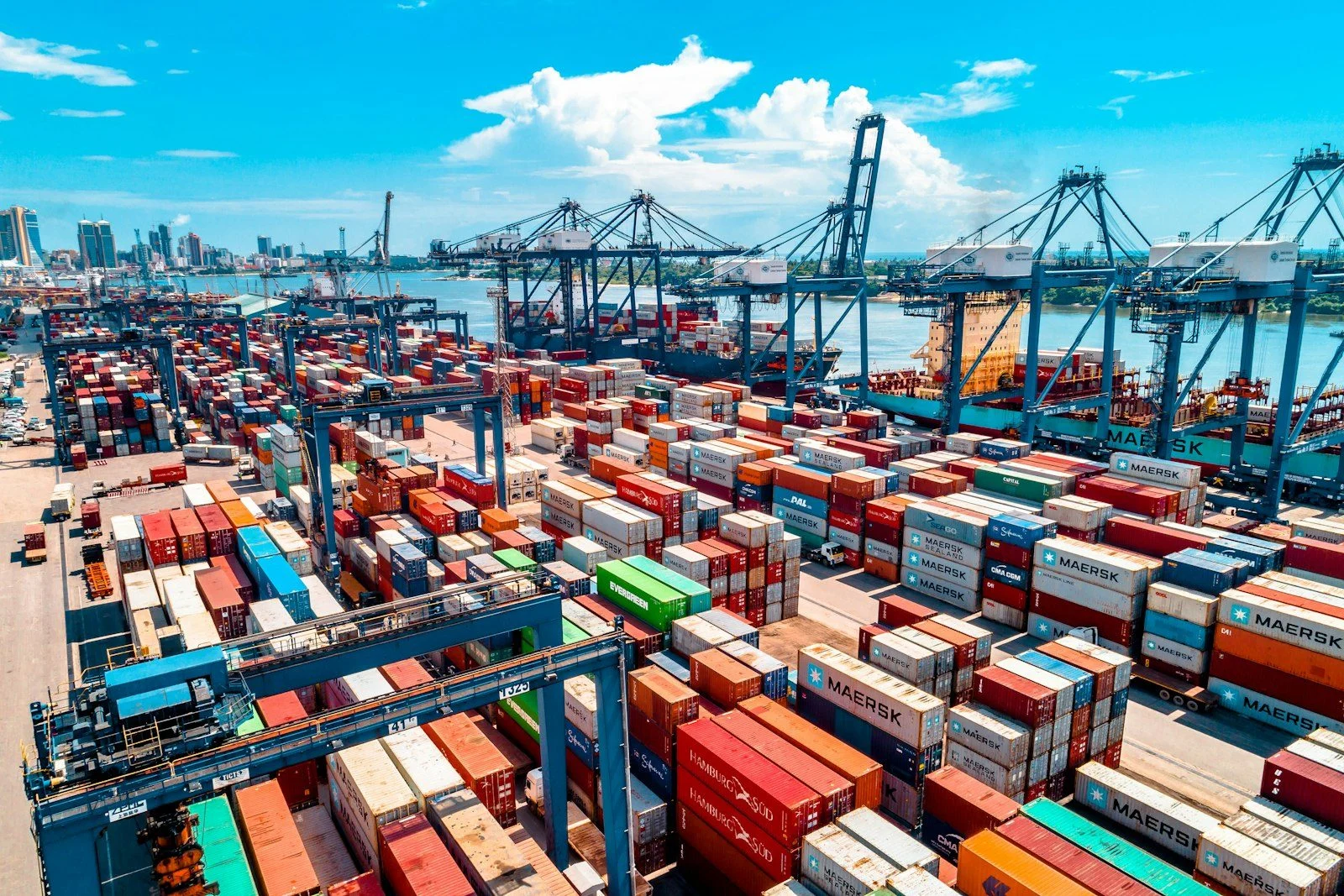
Photo: Ali Mkumbwa on Unsplash
The cost to ship a container from China to USA was about $7,514 per 40ft from Shanghai to Los Angeles and $9,631 from Shanghai to New York on October 29, 2026, according to the Drewry World Container Index. That is about three times the $2,438 Drewry reported for the same route a year earlier, on October 30, 2025 (archived Drewry page). Freight is only part of the bill, though: on a $60,000 shipment of Chinese goods, duties and federal fees can add more than $25,000.
So how much does it cost to ship a container once everything is included? This guide covers dated ocean freight rates, what a quote includes, every fee and duty you pay to land a container, and a full worked example you can adapt to your own shipment.
How Much Does It Cost to Ship a Container from China to USA in 2026?
| Route (40ft container) | Drewry WCI (Oct 29, 2026) | Freightos FBX (Oct 28, 2026) | Typical port-to-port transit (estimate) |
|---|---|---|---|
| China to US West Coast (Los Angeles/Long Beach) | $7,514 | $8,368 | About 14–18 days |
| China to US East Coast (New York/New Jersey) | $9,631 | $10,565 | About 30–40 days |
Spot ocean freight per 40ft container, container yard to container yard. Drewry's index includes fuel, peak-season and other carrier surcharges and port additionals, plus terminal handling charges where that is market practice; it excludes documentation and booking fees, customs clearance and inland transport (Drewry methodology). Separate US-side charges such as PierPASS, the Clean Truck Fund, drayage, duties and federal fees are extra. Transit times are GoFreight estimates based on mid-2026 liner schedules. Sources: Drewry WCI; Freightos weekly update.
The two indexes measure slightly different things and can move in opposite directions in the same week. In late October, Freightos showed rates still climbing while Drewry showed them easing:
"Congestion has been one factor keeping some pressure on container rates even as demand eases post peak season."
Judah Levine, Head of Research, Freightos, Freightos weekly update, October 28, 2026
Both indexes publish 40ft rates only, so treat them as a benchmark for the cost to ship a container from China to USA rather than a quote. Your forwarder's price will also depend on the carrier, your contract versus spot booking, and the week you sail.
20ft vs 40ft vs 40ft High Cube
A 20ft container holds about 33 cubic meters, a standard 40ft about 67 and a 40ft high cube about 76 (Maersk specifications). In practice you can load less than that; a common rule of thumb is 25 to 28 cubic meters in a 20ft and 55 to 60 in a 40ft, depending on packaging. Drewry and Freightos publish only 40ft rates, so ask your forwarder to quote both sizes; a 40ft is often better value per cubic meter if your volume comes close. Heavy, dense goods suit a 20ft because the 80,000-pound federal gross vehicle weight limit caps how much a loaded container can carry on US roads; light, bulky goods such as furniture or apparel suit a high cube. See our guides to the 40ft container and high cube containers.
Why Container Rates from China Tripled in 2026
Drewry's Shanghai to Los Angeles rate fell to $2,191 on February 26, 2026, then climbed to $5,750 by June 25 and $7,884 by October 15, before reaching $7,514 on October 29. That was down 6% from the previous week and 4.7% from October 15. A year earlier, on October 30, 2025, the same route cost $2,438, so the rate is up about 208% year over year.
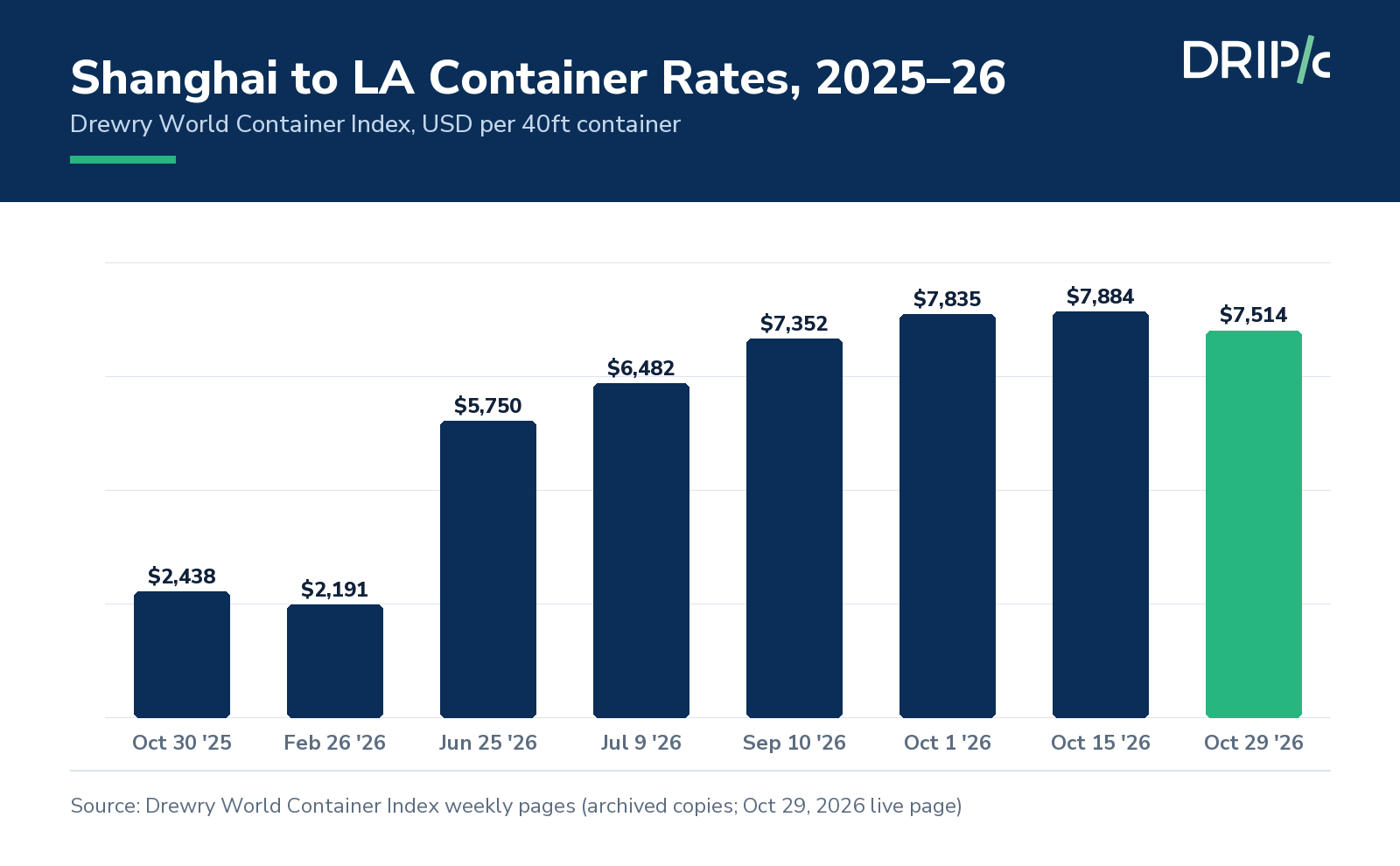
Chart sources: Drewry WCI weekly pages for Oct 30, 2025, Feb 26, Jun 25, Jul 9, Sep 10, Oct 1, Oct 15 (archived copies) and October 29, 2026.
What pushed the cost to ship a container from China to USA so high? The index itself does not identify causes. Commentary from the index publishers points to carrier capacity management, surcharges, port congestion and US trade policy (Freightos; Drewry below). Drewry summed up what will drive the next moves:
"Overall, weak demand, capacity management by carriers, potential surcharges, and ongoing US trade policy developments will continue to influence freight rates in the coming weeks."
Drewry, World Container Index commentary, October 29, 2026
For planning, that means three things. Check the index the week you book, because Drewry's Shanghai to Los Angeles rate fell 6% in the week to October 29. Ask your forwarder whether a contract rate beats spot for your volume. And build a buffer into early-2027 landed costs, since surcharges and trade policy can change the cost to ship a container from China to USA quickly.
Every Cost to Land a Container from China, Itemized
Your total container shipping cost goes well beyond the freight quote. Your Incoterm decides which of these you pay (see the cheat sheet later in this guide).
| Cost | Typical amount (late 2026) | Notes |
|---|---|---|
| Ocean freight (40ft) | $7,514 to LA; $9,631 to New York | Drewry WCI, Oct 29, 2026 |
| Cargo insurance | About 0.3%–0.5% of insured value (estimate) | Ask your insurer or forwarder; insured value is usually goods plus freight, plus 10% |
| ISF (10+2) filing | About $25–$75 (estimate) | Most importer data is due 24 hours before loading; stuffing location and consolidator can follow up to 24 hours before US arrival (19 CFR 149.2). Late or inaccurate filings can draw penalties |
| Customs broker entry | About $100–$250 (estimate) | Varies by broker |
| Customs bond | Single entry about $50–$250+; continuous about $400–$600 a year (estimates) | A single-entry bond must cover the shipment's value plus duties and fees, which raises its price; get quotes |
| Regular (MFN) duty | 0% to 30%+ | Depends on your HTS code |
| Section 301 (China lists) | 7.5% or 25%; up to 100% for some products | Listed Chinese goods; some products, such as electric vehicles, pay 50% or 100% (Federal Register) |
| Section 301 forced-labor duty | 12.5% on Chinese goods since Jul 24, 2026, unless exempt | Stacks on other duties. Exempt products include steel, aluminum, copper, vehicles and parts, wood products, semiconductors, pharmaceuticals and civil aircraft, plus donations and informational materials (CBP CSMS #69326983) |
| Merchandise Processing Fee | 0.3464%; min $34.58, max $670.86 | FY2027 rates from Oct 1, 2026 (Federal Register) |
| Harbor Maintenance Fee | 0.125% of value | Ocean only (19 CFR 24.24) |
| Port fees (LA/Long Beach) | PierPASS about $81 per 40ft; Clean Truck Fund $10 per TEU ($20 per 40ft) when a nonexempt truck moves the box | Zero-emission trucks are exempt (Port of Los Angeles); other ports differ |
| Drayage | Median $471 within 25 miles of LA/LB | Gateway Lines bid-based estimates, Jul–Oct 2026; chassis, waiting time and other extras are separate |
One common mistake: US duty is charged on the transaction value of the goods, essentially the price you paid, not on goods plus international freight and insurance (the larger "CIF" value many other countries use). Transaction value can still include more than the invoice price: packing costs, selling commissions, assists and some royalties or license fees are added when the buyer pays them (19 CFR 152.103). Related guides: ISF filing, merchandise processing fees and drayage.
US Duties on Chinese Goods After the Supreme Court Ruling
In the worked example below, duties are the largest added part of the cost of shipping a container from China; how much they add for you depends on your goods' value, HTS classification and any exemptions. The IEEPA tariffs were struck down by the Supreme Court on February 20, 2026 and the 10% Section 122 surcharge expired on July 24, 2026 (if you paid IEEPA duties, see how to claim your tariff refund). What still applies: your regular duty, Section 301 list duties, Section 232 tariffs on covered metals and goods, and, unless an exemption applies (for example steel, aluminum, copper, vehicles and parts, wood products, semiconductors or pharmaceuticals), the 12.5% forced-labor duty. Also watch the 178 Section 301 exclusions, which run through 11:59 p.m. ET on November 9, 2026; check for a subsequent extension before relying on an exclusion (Federal Register; our details). Look up your rate with our HTS code lookup.
Worked Example: Landed Cost of a $60,000 Container
One 40ft container of goods worth $60,000 (6,000 units at $10), bought FOB Shanghai and trucked to a warehouse within 25 miles of the LA/Long Beach ports. The product is illustrative: 4% regular duty, Section 301 List 3 (25%) and the 12.5% forced-labor duty, with no exclusion or exemption. Fees marked as estimates are planning figures, not quotes, and the Clean Truck Fund assumes a nonexempt truck.
| Cost line | How it is calculated | Amount |
|---|---|---|
| Goods (customs value) | 6,000 units × $10 | $60,000.00 |
| Ocean freight | Drewry WCI Shanghai–LA, Oct 29, 2026 | $7,514.00 |
| Cargo insurance | ($60,000 + $7,514) × 110% × 0.4% | $297.06 |
| ISF, broker entry, single-entry bond | Estimates ($50 + $150 + $250) | $450.00 |
| Regular duty | $60,000 × 4% | $2,400.00 |
| Section 301, List 3 | $60,000 × 25% | $15,000.00 |
| Section 301 forced-labor duty | $60,000 × 12.5% | $7,500.00 |
| MPF + HMF | $207.84 + $75.00 | $282.84 |
| PierPASS, Clean Truck Fund, drayage, chassis | $81.26 + $20 (nonexempt truck) + $471 + $100 (chassis estimate) | $672.26 |
| Total landed cost | $94,116.16 | |
| Landed cost per unit | $94,116.16 ÷ 6,000 | $15.69 |
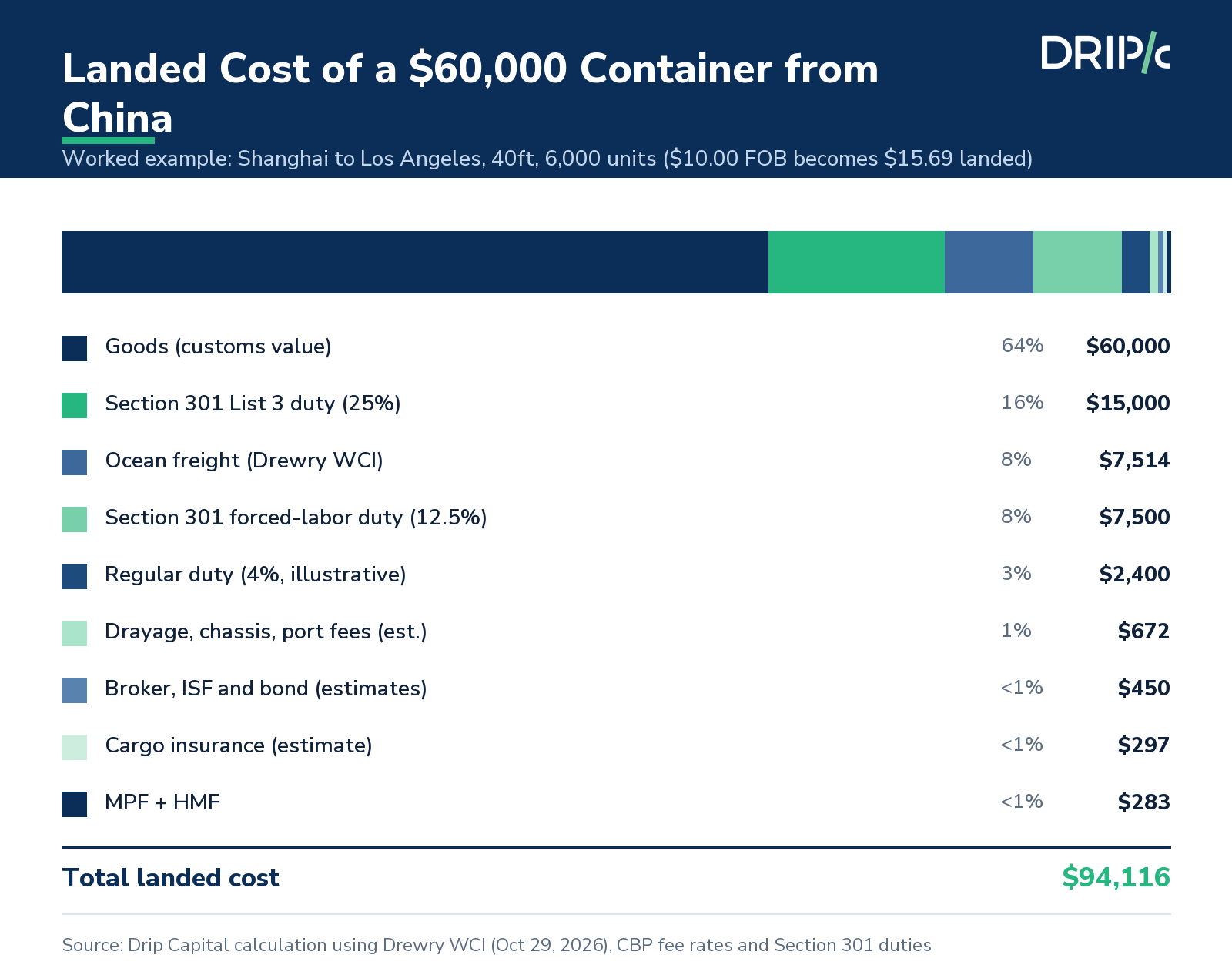
Each $10 unit really costs $15.69 delivered. Duties and federal fees total $25,183, almost three times the $8,933 of freight and logistics. On Section 301 List 4A (7.5%), the same container would cost $83,616 ($13.94 per unit). And you pay about $34,000 in freight, duties and fees on top of the vendor invoice, weeks before you sell a single unit.

Before you book, two choices shape the total more than any single fee: how full your container is and which coast you ship to.
FCL or LCL, West Coast or East Coast?
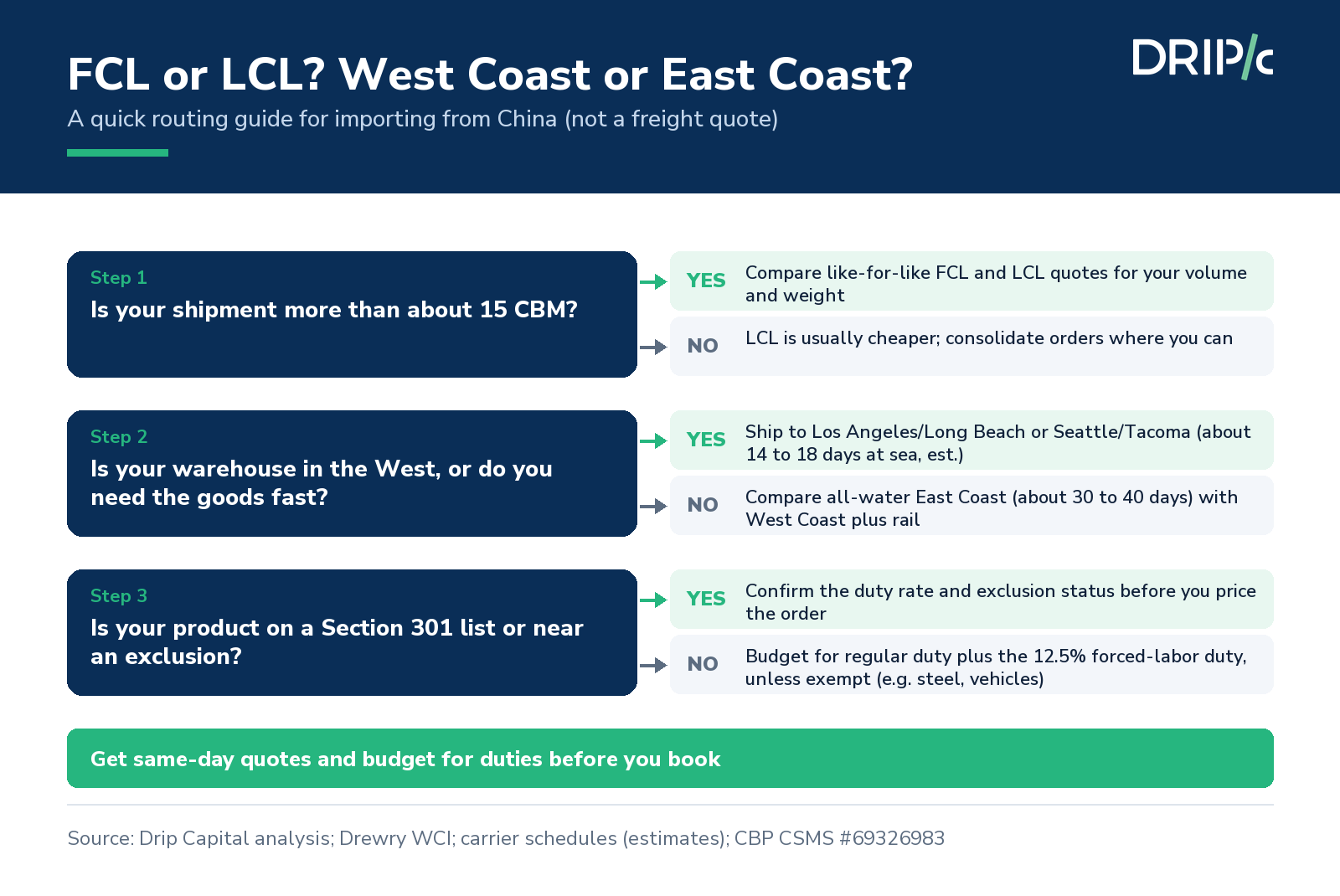
A common rule of thumb is that a full container (FCL) beats less-than-container-load (LCL) shipping above about 15 cubic meters, but the break-even moves when FCL rates spike. Take the example's FCL cost of about $8,200 to an LA-area warehouse (freight, port fees, drayage and chassis). If LCL cost a flat $100 per cubic meter, an illustrative rate, the break-even would be about 82 cubic meters, more than even a 40ft high cube holds (about 76), so under those assumptions there is no crossover within one container. At $200 per cubic meter it would be about 41. Real LCL quotes are rarely that simple: they add fixed warehouse (CFS) and documentation charges, and heavy cargo is charged by weight rather than volume. Compare like-for-like door-to-door quotes for your actual volume and weight. Transit times vary by carrier and season. GoFreight's mid-2026 estimates, based on liner schedules, put Chinese ports to LA/Long Beach at about 14 to 18 days and to East and Gulf Coast ports at about 30 to 40 days, mostly via the Panama Canal.
Who Pays What: Incoterms and Timing
Your Incoterm decides which costs are yours. Under FOB, the vendor gets goods onto the vessel and you pay everything after; under EXW you pay from the factory door; under DDP the vendor quotes a delivered price, so confirm who acts as importer of record.
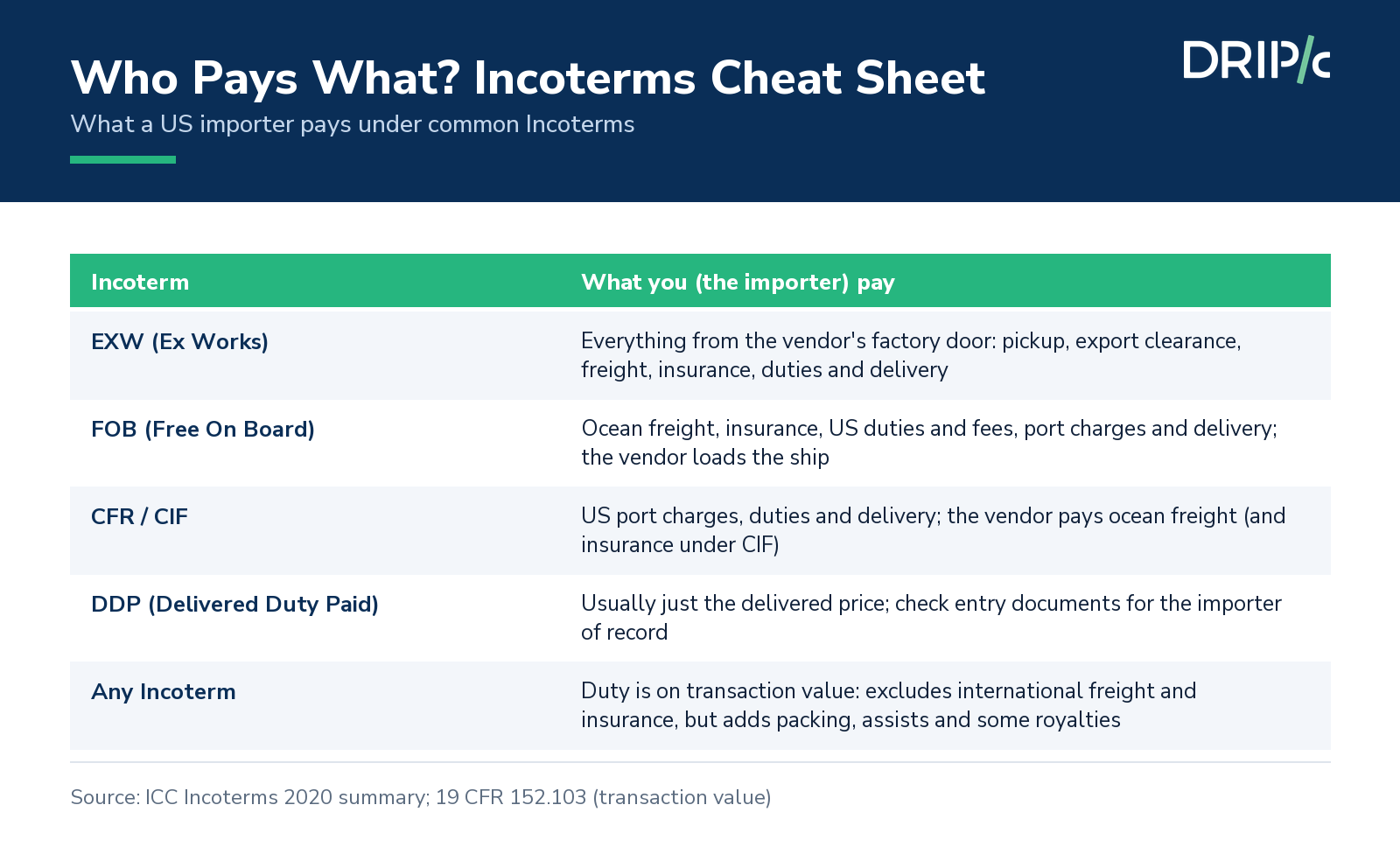
Timing matters as much as price. By early October, the National Retail Federation said the year's peak import season was largely over:
"Most holiday merchandise has arrived, and the remainder of the year is just a matter of last-minute replenishment and preparation for early 2027."
Jonathan Gold, Vice President for Supply Chain and Customs Policy, National Retail Federation, Global Port Tracker, October 8, 2026
To lower costs: book early and watch the index, compare West Coast plus rail with all-water East Coast, consolidate into full containers near the break-even point, check Section 301 classification and exclusions, file your ISF on time, and pick up containers quickly to avoid demurrage. For the end-to-end process, see our guide to shipping from China to the US.
How to Fund Freight, Duties and Vendor Payments
As the example shows, one container can tie up more than $90,000 for weeks: the vendor's invoice, then freight, then duties at the port, all before your customers pay you. Some importers bridge that gap with trade financing; others negotiate longer vendor terms or split orders. Compare the cost of each option with your margin on the goods. You can also weigh whether to pay customs duty upfront or finance it.
Drip Capital's Vendor Financing pays your vendors, in any country and currency, before or on shipment, and you repay in up to 90 days. After a one-time credit decision of about 48 hours, vendors are typically paid within 24 hours of you submitting their invoice, with no collateral required. It does not pay freight or CBP duties directly, but deferring vendor payments can leave more of your own cash for those costs. Check if you qualify.
Frequently Asked Questions
How much does it cost to ship a 40ft container from China to the USA?
On October 29, 2026, Drewry's index put Shanghai to Los Angeles at $7,514 per 40ft and Shanghai to New York at $9,631. Freightos showed $8,368 to the West Coast and $10,565 to the East Coast. These are ocean-only spot rates; duties, fees and trucking are extra.
Why are container rates from China so high in 2026?
Drewry's Shanghai to Los Angeles rate rose from $2,191 on February 26, 2026 to $7,884 on October 15, then eased to $7,514 on October 29. Drewry and Freightos commentary points to carrier capacity management, surcharges, port congestion and US trade policy.
How long does it take to ship a container from China to the US?
According to GoFreight's published estimates based on mid-2026 liner schedules, Chinese ports to Los Angeles or Long Beach take about 14 to 18 days port to port (Shanghai about 14 to 16), and New York, Savannah or Houston about 30 to 40 days, mostly via the Panama Canal. Clearance and trucking add time that varies with congestion, holds and exams, so ask your forwarder for a door-to-door estimate.
What import fees do I pay on a container from China?
The Merchandise Processing Fee (0.3464%, minimum $34.58, maximum $670.86 from October 1, 2026), the Harbor Maintenance Fee (0.125%), regular duty, Section 301 duties and usually the 12.5% forced-labor duty, plus broker, ISF, bond, port and trucking costs. MPF, HMF and all duties are paid to CBP with your customs entry, usually through your broker; the other costs are billed by your broker, carrier and trucker.
What tariffs apply to Chinese goods now that IEEPA tariffs were struck down?
Chinese goods still pay the regular HTS duty plus Section 301 list duties of 7.5% or 25% for most listed goods, up to 100% for some, and since July 24, 2026 a 12.5% Section 301 forced-labor duty unless the product is exempt. Steel, aluminum, copper, vehicles and parts, wood products, semiconductors, pharmaceuticals and civil aircraft are among the exempt products (CBP CSMS #69326983).
Is LCL or FCL cheaper from China?
LCL is cheaper for small shipments. A common rule of thumb says FCL wins above about 15 cubic meters, but when FCL rates spike the break-even moves much higher, sometimes beyond what one container holds. LCL can also take longer because cargo is consolidated and unpacked at warehouses, so compare door-to-door quotes and timings for both.
Is ocean freight included in the dutiable value of US imports?
Generally no. US Customs assesses duty on transaction value, which excludes international freight and insurance when shown separately. Some amounts are added, though, such as packing costs, selling commissions, assists and certain royalties. With no additions, a $60,000 FOB shipment pays duty on $60,000.
What happens if my ISF is filed late?
Most Importer Security Filing data must reach CBP at least 24 hours before your cargo is loaded in China; the container stuffing location and consolidator can follow up to 24 hours before US arrival. Late, inaccurate or incomplete filings can lead to liquidated damages claims of $5,000 per violation (19 CFR 113.62), and cargo holds can add storage and demurrage costs.