

On Tuesday, gas stayed above $4 a gallon on Election Day for the first time. Diesel, which fuels much of the freight moving your imports, is more expensive still. It averaged $6.29 a gallon in the week of November 2, about $2.54 more than a year earlier, using EIA’s figures.
It Costs More to Move Everything
By sea, Drewry’s World Container Index was $4,429 per 40-foot container on October 29, 2026. It was $1,687 on October 16, 2025. This is a composite of eight East-West routes, not a quote for a particular Asia-to-US shipment.
By road, assume a truck gets 5 to 6 miles per gallon. Every extra dollar per gallon adds about 17 to 20 cents per mile in fuel alone. The $2.54 annual increase would add roughly 42 to 51 cents a mile. What a carrier charges you depends on its contract and fuel surcharge.
Where You Are Matters
Diesel is not the same price everywhere. In the week of November 2, it averaged $8.08 in California, $6.40 in the Midwest, and $5.91 on the Gulf Coast. That puts more pressure on fuel costs for trucks filling up in California. It does not, by itself, tell you the difference between a Los Angeles freight quote and a Houston one.
Where the Cash Goes
An importer may need to pay freight before the goods are sold, while its buyer pays weeks or months later. Higher freight costs make that wait more expensive.
Take an illustrative trader bringing in one container from Asia and trucking it 1,000 miles inland. Suppose its ocean quote is $2,700 higher than last year and its truck bill is $450 higher. That is $3,150 extra per container. These are example invoice changes, not a route-specific forecast from the global index.
Bring in four containers a month, and about $12,600 more goes out the door each month. The buyer still pays in 60 days. The trader covers the gap.
What the Vote Changes
The vote does not reset fuel prices. Conflict with Iran and disruption around the Strait of Hormuz continue to affect energy markets. Congress can influence policy, but it does not directly set the oil price or your next freight quote.
It’s not only importers feeling this. Freight forwarders handle these costs every day too.
Last month, a New York-based freight forwarder came to Drip Capital for working capital. The company combines shipment tracking with hands-on logistics support. Its conditional approval was for up to $1 million, with an initial $500,000 cap pending a physical site visit. Here is how onboarding went:
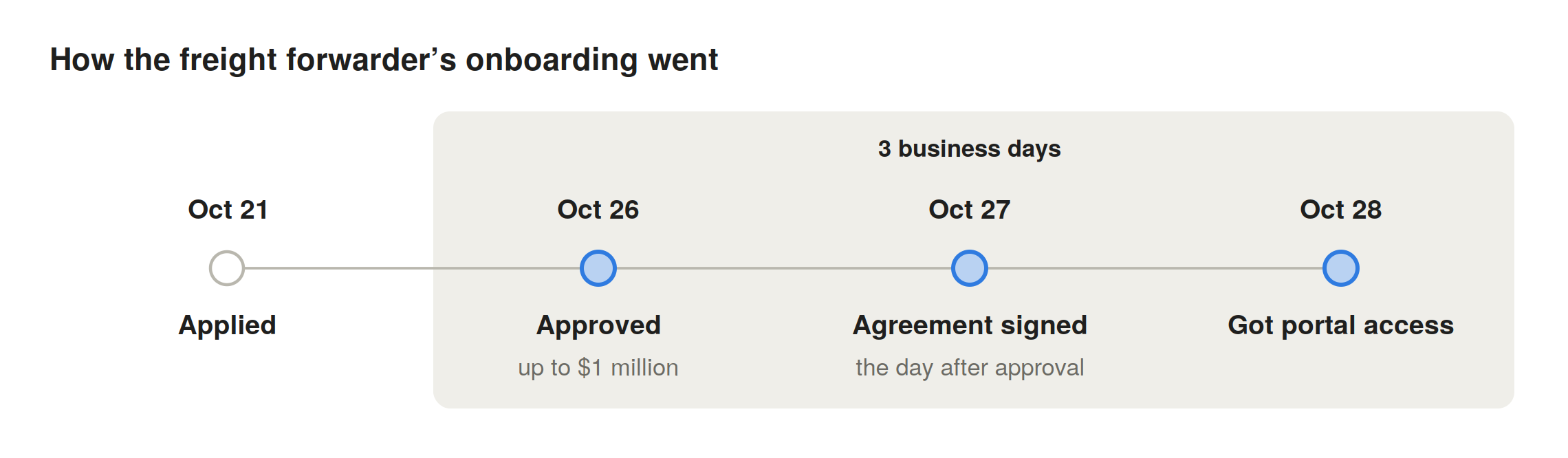
Approval on October 26, agreement signed on October 27, and digital verification cleared and portal access issued on October 28: three business dates, using US Eastern time. These milestones show account setup, not a confirmed disbursement or proof that the initial cap had been lifted. This is one customer’s experience, not a promised timeline.
If you need a hand covering that gap, Drip Capital offers working capital financing of up to $3 million, subject to approval and product terms. Happy to chat through your plans for the next few months. Get in touch with Drip Capital.