

Hero photo: CHUTTERSNAP / Unsplash. Illustrative container port in Singapore.
A foreign trade zone can change when an importer pays customs duties. Whether it improves cash flow depends on where the goods go next, how long they stay, and what the operation costs.
This guide focuses on the US program. For the broader international concept, see this free trade zones overview.
What is a foreign trade zone?
The US FTZ meaning is a designated site where businesses use special customs procedures before formal entry. The goods remain within US jurisdiction and under customs supervision. The Foreign-Trade Zones Board authorizes zone status; CBP separately activates the site.
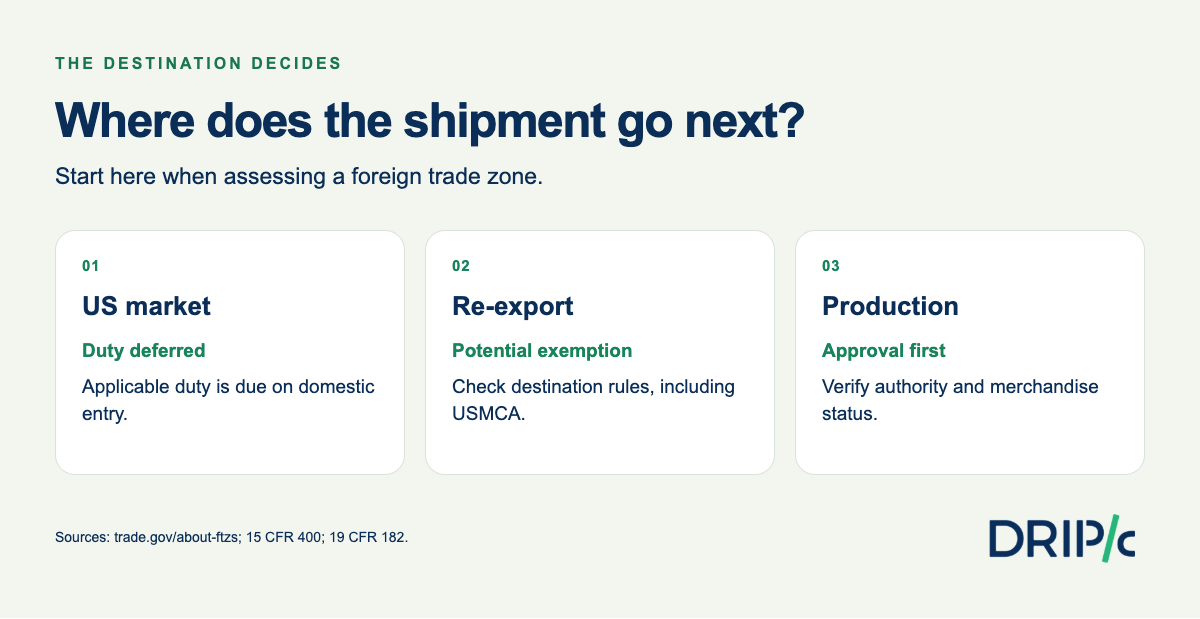
Duty deferral
One of the main foreign trade zone benefits is delaying duty payment until goods enter US commerce. Vendor invoices, freight, storage, and operating bills still need funding.
Export treatment
Re-exported goods generally leave without US import duty. Treatment depends on the goods and destination; USMCA duty-deferral rules can affect goods sent to Canada or Mexico.
By the numbers
$964BMerchandise receivedUS FTZs, 2024$134BExports from FTZs
2024
Source: FTZ Board, 2024 annual report. Merchandise received includes domestic and foreign goods.
How do FTZs work in practice?
The operator records admissions, tracks merchandise status and inventory, and documents transfers or withdrawals. CBP's inventory-control rules require an audit trail. A customs bond supports the operator's obligations.
Production needs separate authority
Manufacturing or other qualifying production using foreign-status goods needs advance FTZ Board authorization. Simply renting space in a zone does not authorize production.
Tariffs still need a product-level check
A lower finished-product duty rate may be available for authorized production, depending on merchandise status and restrictions. Privileged foreign status can preserve the component's duty treatment and limit this benefit. Trade-remedy requirements can mandate that status.
An FTZ also cannot make prohibited imports admissible. Check classification, origin, applicable measures, and import-license requirements before moving goods.
FTZ vs bonded warehouse
For an FTZ vs bonded warehouse comparison, start with the activity. Both can defer duties during storage. An FTZ can also support specifically authorized production; bonded-warehouse activities depend on the warehouse class and applicable permissions.
Bonded storage generally has a five-year limit, with longer periods possible on an approved request showing good cause. Compare the actual facilities, permitted operations, and service charges before choosing.

Ask each operator for a written quote covering admission, storage, handling, inventory reporting, and withdrawal. Include additional transport and brokerage costs in the comparison.
Test the cash-flow benefit
Consider a hypothetical shipment with a $100,000 customs value and an illustrative 10% duty rate. Its duty would be $10,000. If FTZ procedures defer the full amount for 60 days before domestic entry, the business retains that cash during the interval.
At an assumed 12% annual financing cost, the simple financing benefit is about $197: $10,000 × 12% × 60 ÷ 365. This is an illustration, excluding fees and other tariff effects. The $10,000 duty remains payable.
Use the customs duty calculator as a starting estimate, then verify the shipment's treatment with your broker. Deduct incremental zone costs from any modeled benefit; a short storage period may leave little room for extra charges.
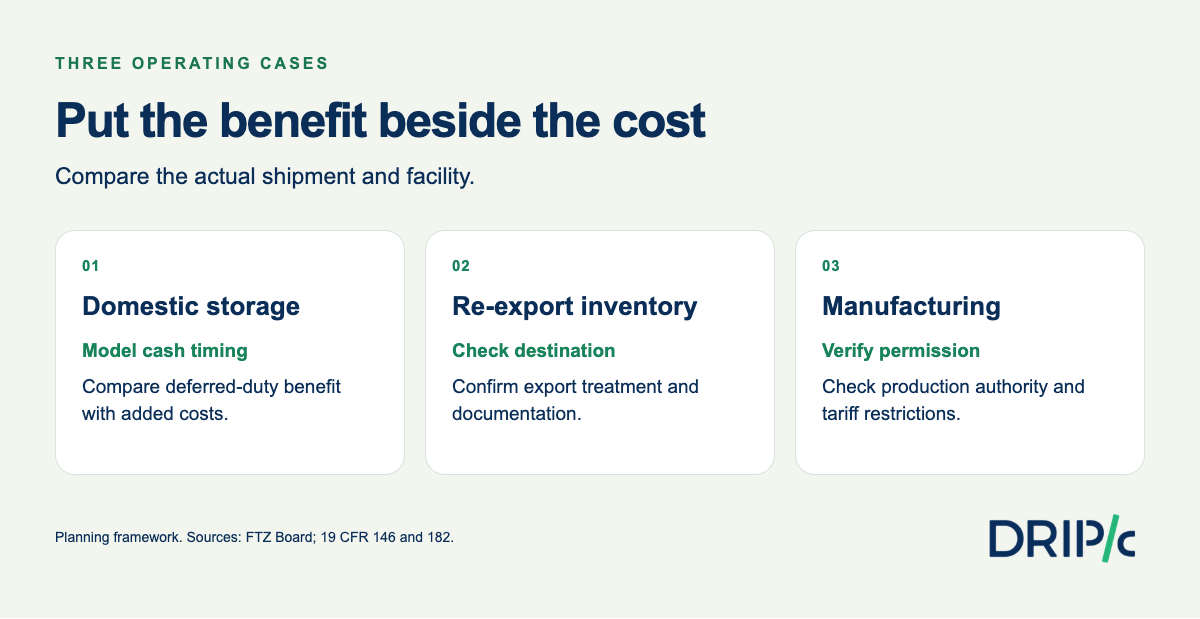
A practical assessment separates duty timing, potential export or production benefits, and ongoing administration. Build those dates into the same cash forecast used to assess working capital borrowing.
Funding vendor payments with Drip Capital
An FTZ changes customs timing while the purchase still creates a vendor-payment obligation. Drip Capital's Vendor Financing pays vendors directly, with repayment terms of up to 90 days, subject to approval and agreed terms.
Discuss the purchase timeline alongside your storage and duty budget. Financing does not change customs eligibility or remove duties owed.
Frequently asked questions
Does an FTZ eliminate every tariff?
No. Goods entering US commerce remain subject to applicable duties. Merchandise status and specific tariff measures determine the treatment.
Can a smaller importer use an FTZ?
An existing zone operator may offer services to multiple users. The commercial case depends on its charges, your goods, and your shipment pattern.
Can goods be sold at retail inside a zone?
Retail trade is generally prohibited under CBP's FTZ rules. Domestic distribution requires the appropriate customs procedures.
What should an importer ask first?
Confirm that the operator can handle the goods and intended activity. Then request the complete service costs and a broker-reviewed estimate of duty timing and treatment.