

Operating Capital Loan vs. Supply Chain Finance: Matching Funding to Each Stage of Your Cash Cycle
A business rarely has one cash flow problem. It has several, spaced across the weeks between placing an order and getting paid for it. Money leaves the account to secure raw materials, more money leaves to move goods through production, a vendor needs paying before the shipment goes out, and a customer sits on a 60- or 90-day invoice while payroll and rent still come due every month.
Because these gaps look similar from the outside, businesses often reach for one financing tool and expect it to cover all of them. That is where the confusion between an operating capital loan and supply chain finance usually starts, framed as competing options. In practice, they are built for different moments in the same cycle.
What "cash conversion cycle" actually means for a small business
The cash conversion cycle is the stretch of time between paying cash for inventory or materials and collecting cash from the customer who buys the finished goods. For a business sourcing product from overseas vendors, that stretch can run 90 to 150 days once production, shipping, and buyer payment terms are added together.
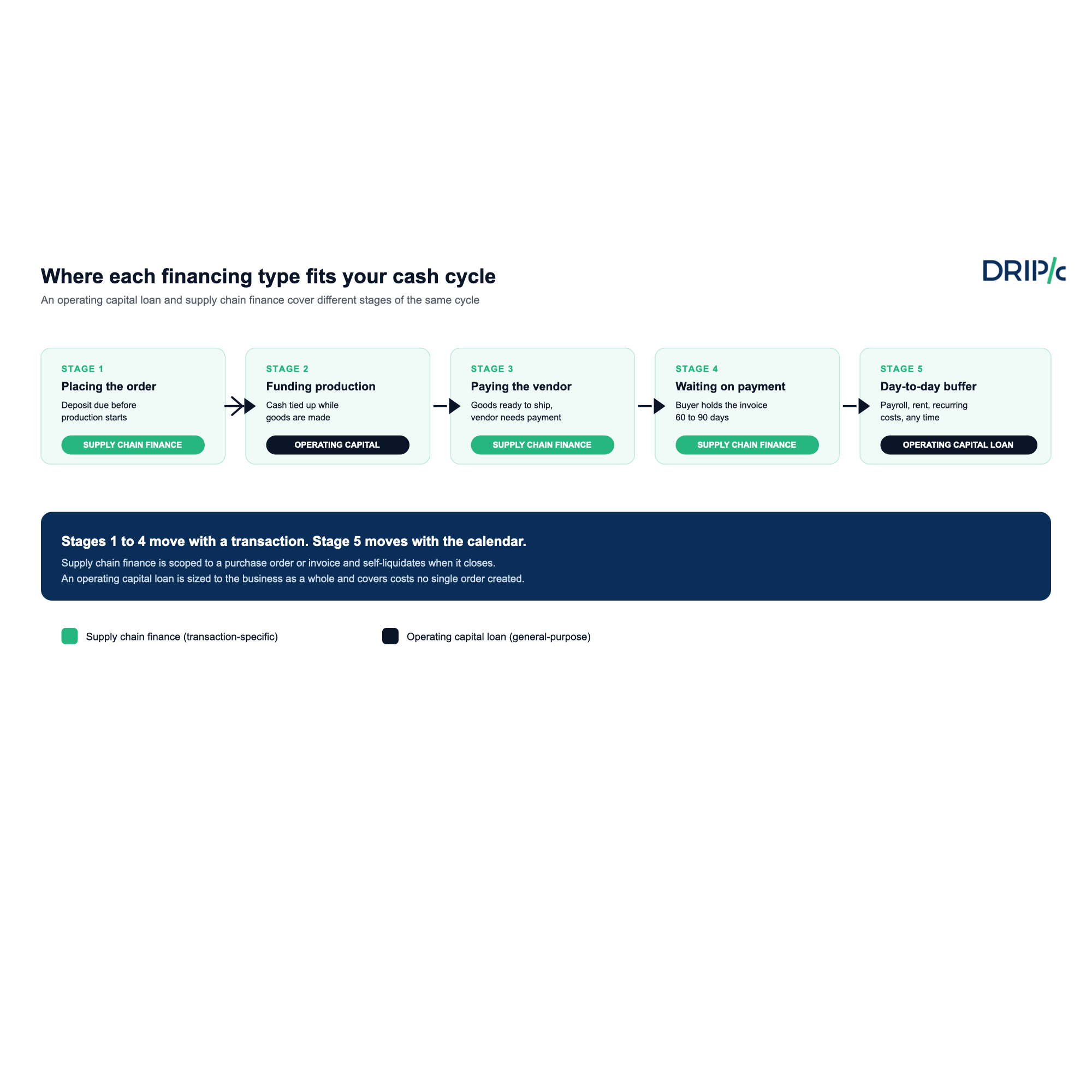
Every stage in that stretch pulls cash in a different way. A deposit before production is a lump sum paid early, with nothing coming back yet. A vendor payment before shipment is tied to one purchase order. A receivable sitting with a customer is money already earned but not yet collected. General operating capital needs, like payroll and rent, run on their own clock, separate from any single order.
Stage one: placing the order, before production starts
Many purchase orders require a deposit before a vendor will start production, often 30% of the order value or more. A general-purpose operating capital loan or line of credit can cover this if the business has room on an existing facility; the deposit simply draws against overall creditworthiness.
This is also where transaction-specific supply chain finance starts to make more sense, since the funding lines up directly with the actual purchase order.
Stage two: funding inventory or production while goods are made
Once production is underway, cash stays tied up in unfinished inventory for weeks. A business importing seasonal goods might have six or eight weeks of capital loan-funded inventory in transit or sitting in a vendor's factory at any given time, with no revenue yet to show for it.
This stage is where a general operating capital facility earns its keep. It is not tied to one transaction, so a business can draw against it as multiple orders move through production at once.
Stage three: paying the vendor when goods are ready to ship
This is the moment supply chain finance was built for. The vendor wants payment before releasing the goods, and the buyer would rather not tie up its own cash weeks ahead of collecting from its own customer. Vendor Financing solves this gap: it pays the vendor directly on the buyer's behalf, and the buyer repays up to 90 days later. It is collateral-free and scoped to a specific purchase order.
Because Vendor Financing is transaction-specific, it self-liquidates: once that order sells through, the repayment obligation tied to it is done. A general operating capital loan does not work this way; it sits on the balance sheet as an ongoing facility regardless of how any individual order performs.
Pay your vendor now. Repay when the order sells through.
Drip Capital's Vendor Financing covers the payment gap between placing an order and collecting on it, without tying up your own cash.
|
$9B+ trade financed |
11,000+ businesses funded |
100+ countries |
Businesses that lean on vendor terms often ask their vendors for more time before this stage becomes a problem. If that conversation is already happening, this guide to handling longer payment terms walks through the tradeoffs.
Stage four: waiting on your own buyer to pay
Goods are delivered, the invoice is out, and now the business is the one waiting, often 60 to 90 days depending on the buyer's terms. This receivables gap mirrors stage three from the other side of the transaction.
Financing it works the same way: the funding is tied to a real invoice from a real buyer, and it self-liquidates once that buyer pays. A general operating capital financing facility works differently, advancing against the business's overall credit standing instead.
Stage five: the day-to-day operating buffer
Payroll runs every two weeks whether or not a shipment cleared customs on time. Rent is due on the first regardless of which invoices are outstanding.
This is squarely general operating capital territory. A Line of Credit is built for exactly this kind of use: a revolving facility, sized to the business's overall creditworthiness, that can be drawn against for payroll one month and a slow sales stretch the next. It carries no annual maintenance fee, no prepayment penalty, and no blanket lien or UCC filing unless the business defaults.
Why most businesses end up using both
A business with only a general operating capital loan will often draw down its line of credit to cover vendor payments, tying up general-purpose capacity on a cost a self-liquidating facility could have handled instead. A business with only transaction-specific supply chain finance has nothing to fall back on when payroll is due and no order happens to be at the right stage of its cycle.
Stages one through four are moments a specific transaction creates and resolves; that is what supply chain finance is built around. Stage five runs on its own clock, tied to the calendar; that is what a general operating capital facility is built around. Reading the stage correctly is what determines which tool actually solves the problem in front of the business.
By the numbers: how small businesses experience this gap
By the numbers
Cash flow financing in 2025
60%
of small firms applied for financing
in the prior 12 months
56%
of applicants cited meeting operating
expenses as their reason
38%
applied for a loan, line of credit,
or cash advance
42%
of applicants received the full
amount they sought
Source: Federal Reserve Banks, 2026 Report on Employer Firms (2025 Small Business Credit Survey)
Most applicants who sought financing were covering ordinary operating expenses, and more than half came away with less than they asked for. That gap between what a cycle demands and what a single facility can stretch to cover is why matching the right tool to the right stage matters.
What an operating capital loan is built for, versus supply chain finance
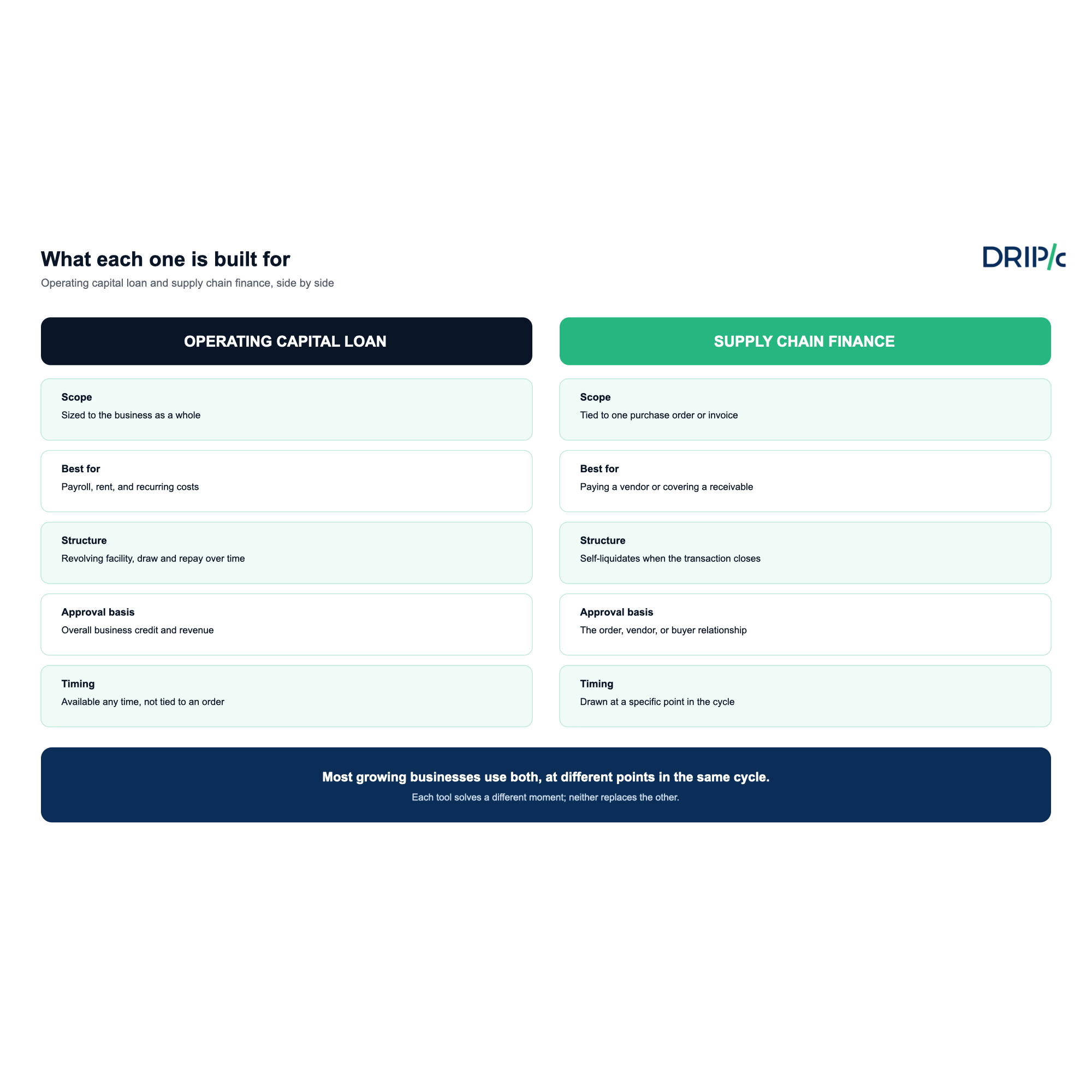
An operating capital loan, whether structured as a term loan or a revolving line, is sized to the business as a whole: its revenue, its credit history, its overall financial picture. That is exactly why it works for payroll, rent, and the general rhythm of running the business. Supply chain finance, covering both the vendor-payment and receivables side of a transaction, is sized to a specific purchase order or invoice instead. It self-liquidates when that transaction closes.
Neither tool substitutes for the other; each is scoped to a different kind of cash need. A business that treats them as interchangeable ends up either overusing a general facility on transaction-specific gaps, or leaving payroll exposed because every dollar of credit sits tied up in inventory still in transit.
For a head-to-head comparison of an operating loan against Vendor Financing and a Line of Credit on repayment structure and collateral, see Working Capital Funding: How Vendor Financing Stacks Up Against Other Options. This piece focuses on a different question: which stage of the cycle each tool actually solves for.
How Drip Capital fits across the cycle
Drip Capital offers both sides of this equation. Vendor Financing covers stages one through three, paying vendors directly on a transaction-by-transaction basis so a purchase order does not stall waiting on cash. Drip Capital's Line of Credit covers stage five, a revolving facility sized to the business as a whole, available from $50,000 to $1 million with credit decisions typically returned within about 48 hours and draws funded within 24 hours.
Businesses moving inventory through a full production and shipping cycle often need both running at once: Vendor Financing on the current purchase order, and a Line of Credit in the background for whatever the calendar brings. The working capital finance guide covers the fundamentals in more depth, and the guide on types of supply chain financing breaks down the transaction-specific options further.
Getting started
Mapping financing to the cash cycle starts with identifying where the business actually feels the pinch. A business that struggles to pay vendors on time before shipment has a stage-three problem, and a transaction-specific tool solves it directly. A business that scrambles to make payroll has a stage-five problem, and a general facility fits better. Most growing businesses eventually run into both, at different points in the same year.
FAQ
Is an operating capital loan the same thing as supply chain finance?
No. An operating capital loan is a general-purpose facility sized to the business's overall creditworthiness, while supply chain finance is tied to a specific purchase order or invoice. They cover different stages of the same cash cycle.
Can a business use both an operating capital loan and Vendor Financing at the same time?
Yes, and many do. A Line of Credit can sit in the background covering payroll and recurring costs while Vendor Financing handles individual purchase orders as they come up, since the two are not tied to the same cash need.
How long does a typical cash conversion cycle run for an importing business?
It varies by product and vendor relationship, but 90 to 150 days between the initial deposit and final customer payment is common once production, shipping, and buyer payment terms are all factored in.
Does Vendor Financing require collateral?
No. Vendor Financing is collateral-free. It is scoped to the specific purchase order it finances.
What is the minimum time in business to qualify for Vendor Financing?
Vendor Financing generally requires at least two years in business, alongside Drip Capital's stated target of $2M or more in annual revenue.