

A machine arrives for repair and will return overseas when the work is finished. Before it ships, the importing business needs to settle how it will enter, how long it can stay, and what evidence will show that it left.
A temporary importation bond can support duty-free entry for eligible goods brought into the United States for a permitted temporary use. The business takes on conditions that continue after customs releases the shipment. Managing the deadline and the export records is part of the job from day one.
This guide follows that process through entry, use, extension requests, and closure.
What a temporary importation bond covers
Temporary importation under bond is a procedure for certain goods listed in Chapter 98, Subchapter XIII of the Harmonized Tariff Schedule. They must qualify under the relevant provision and generally be exported or properly destroyed within the allowed period.
For businesses looking for the temporary import bond meaning, the central point is conditional duty-free admission backed by a bond. The importer commits to the permitted use and timely disposition of the goods. The bond secures those obligations.
The HTS provisions require that goods are not imported for sale or sale on approval. A plan to bring inventory in temporarily while looking for domestic buyers does not meet that condition.
By the numbers
Start with the use of the goods
Match the activity to an eligible provision
Examples in the tariff schedule include articles for repair, alteration, or processing under 9813.00.05; samples used solely to take orders under 9813.00.20; and articles for testing, experimental, or review purposes under 9813.00.30. Each provision has its own scope and conditions.
Explain exactly what will happen to the goods. A repair job, a destructive test, and a sales demonstration can need different treatment. Have a customs broker confirm the correct provision before booking the shipment.
Check the onward destination
The country to which the goods will move next can affect the analysis. Goods imported for processing under 9813.00.05 and then exported to Canada or Mexico can be subject to special duty rules. The tariff note and 19 CFR 10.31(h) address this situation.
Tell the broker the intended destination at the outset. Include any export controls, permits, or other agency requirements in the plan; the temporary customs procedure does not remove those obligations. The import and export license guide covers that separate review.
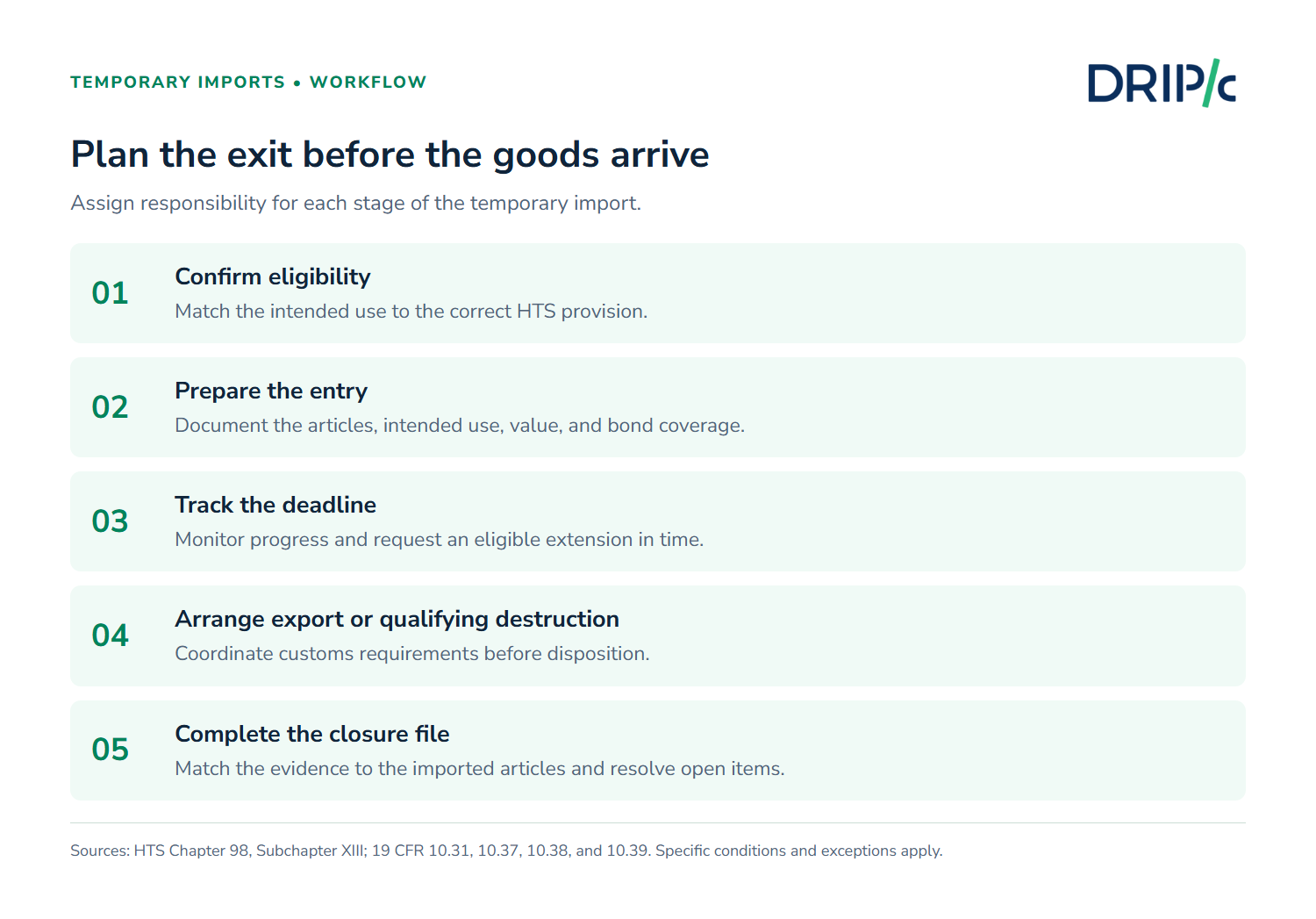
Prepare the TIB entry and arrange the bond
Make the goods identifiable
A TIB entry needs the applicable tariff provision, a detailed statement of intended use, and the required declaration about use and sale. 19 CFR 10.31 also calls for descriptions, values, and distinguishing marks or numbers.
For machinery, record serial numbers and model details. For a group of samples, identify each item and quantity. Match those records to the packing list, invoice, and shipment references so the team can account for every article later.
Separate the bond amount from the premium
The required bond amount describes the financial security supporting the entry. Ask the surety or broker separately about the premium, any collateral requirement, and administrative charges. These are different figures in the budget.
CBP permits qualifying continuous bonds to secure TIB entries, but an existing bond may be insufficient for a particular entry. Its published guidance explains when additional single-transaction security can be required. Review the customs bond basics before comparing quotes.
Manage the deadline while the goods are in use
Record the importation date, the current deadline, where the goods are held, and who owns the export task. Add an internal reminder early enough to arrange transport or request an extension. The customs deadline remains the controlling date.

For example, a repair business expecting a six-month turnaround could review progress several months before the initial deadline. If a replacement component is delayed, the team then has time to discuss its options with the broker.
Request an extension before the current period expires
Under 19 CFR 10.37, the general procedure allows up to two further one-year periods, or shorter periods as appropriate. Extensions require an application, using CBP Form 3173 or the applicable electronic process, and CBP action.
Do not assume the full three years are available automatically. Confirm that the category permits an extension, submit the request in time, and keep the resulting decision with the entry file.
Arrange export and close the entry
Coordinate with customs before departure
19 CFR 10.38 provides for an application on CBP Form 3495 sufficiently ahead of export to permit examination and identification when required. Goods may leave through the entry port or another port, with additional documentation where applicable.
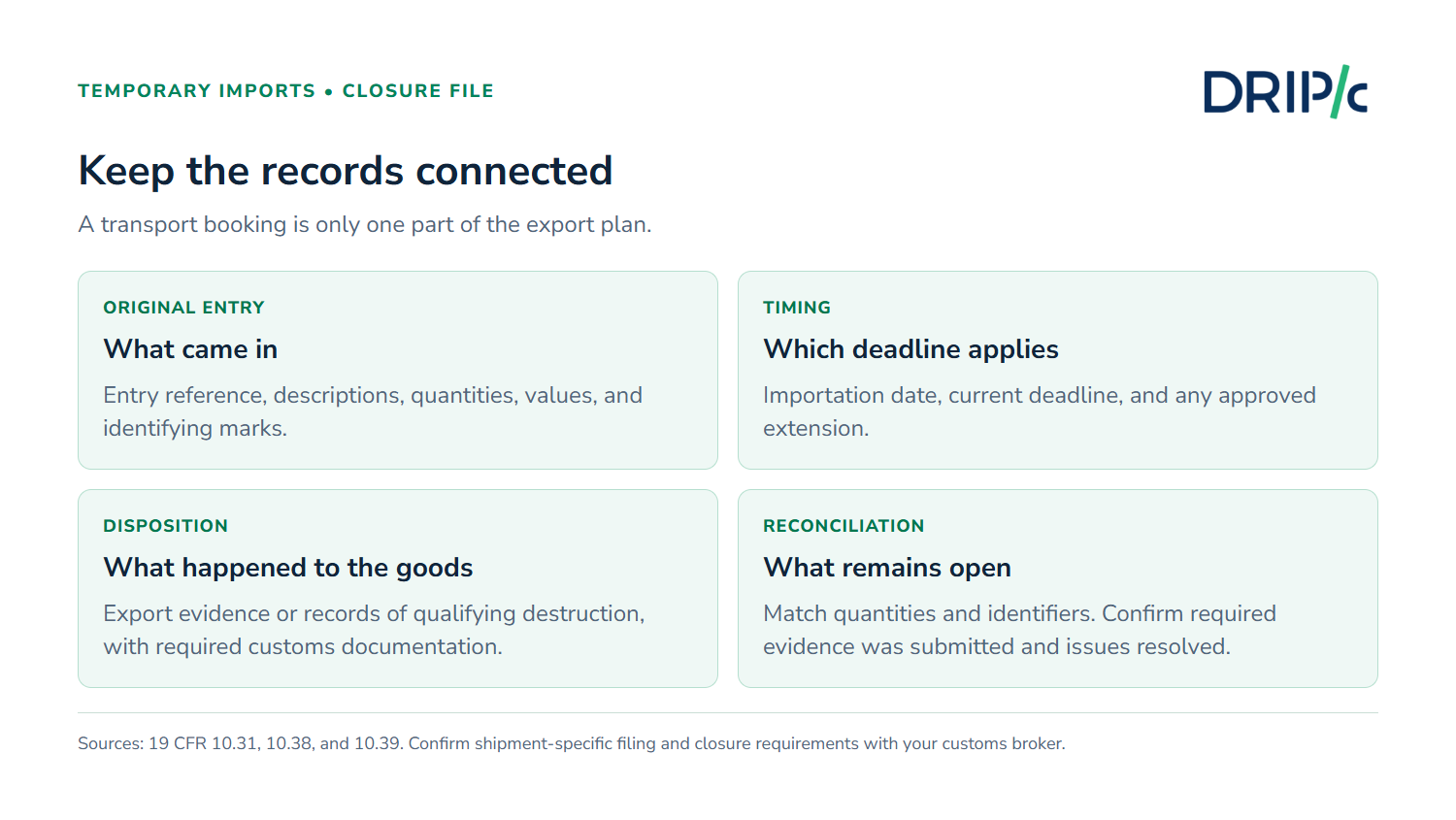
Ask the broker to coordinate the current port procedure before the carrier collects the goods. An outbound booking alone does not establish that the temporary importation bond conditions have been satisfied.
Keep proof that matches the imported articles
Build a closure file linking the original entry, item identifiers, export documents, and any customs examination or certification records. Reconcile quantities, especially when articles leave in separate shipments. A bill of lading or air waybill supports the transport record.
Request confirmation from the broker that the evidence needed for closure has been submitted and any outstanding issue resolved. Keep copies in the business's own records.
Handle destruction or a missed deadline promptly
Destruction has specific requirements. 19 CFR 10.39 distinguishes qualifying destruction during the intended testing use from other destruction, which generally requires customs supervision. Accidental loss also has its own relief procedure.
Failure to export or destroy goods as required can lead to liquidated damages under the bond. If the plan changes, contact the broker before the deadline; paying ordinary duty is not a universal shortcut to closing a TIB. Ask for advice on the actual circumstances and available procedures.
TIB vs ATA Carnet: which process fits?
The TIB vs ATA Carnet decision depends on the goods, their use, and the countries involved. A carnet can simplify repeated temporary movements of eligible goods across participating countries. A TIB is a US entry procedure that may suit an eligible repair or processing shipment.
Use the existing ATA Carnet guide for the carnet process. Have the broker confirm eligibility for your particular activity before choosing either route.
Where Drip Capital fits into the operating budget
A temporary import still creates expenses such as freight, labor, storage, and replacement parts. Drip Capital's Line of Credit can help eligible businesses manage operating expenses, subject to the facility's permitted uses and terms. Each draw is repaid over six monthly installments.
Eligibility includes at least two years in business and $2 million in annual revenue, with underwriting and approval required. Discuss the planned expense before borrowing. Financing approval does not establish TIB eligibility, issue the customs bond, or extend a customs deadline.
Frequently asked questions
Can goods entered under a TIB be sold?
Goods must meet the condition that they are not imported for sale or sale on approval. If a later commercial plan changes, seek customs advice before acting. Do not assume a domestic sale can proceed simply by paying ordinary import duty.
How long can goods stay under a temporary importation bond?
The general initial period is one year from importation, with approved extensions potentially reaching three years in total. Some tariff categories have different limits. Check the specific provision and the deadline recorded for the entry.
What are the main TIB customs documents?
TIB customs records include the entry information, intended-use declaration, item descriptions and identifiers, bond information, and evidence of export or qualifying destruction. Retain extension decisions when applicable. The broker should confirm the exact filing and closure requirements for the shipment.
Does a continuous bond automatically cover a TIB?
A continuous bond can secure eligible TIB entries, but its amount may be insufficient. CBP can require additional security for the entry. Have the broker and surety check coverage before the goods arrive.