
Share

U.S. Import Ban on Canadian Goods: List of Products and What Importers Need to Know

Understand the U.S. import ban on Canadian goods, all 68 covered classifications, applicable duties, sourcing alternatives, and illustrative cost comparisons.

U.S. Import Ban on Canadian Goods: List of Products and What Importers Need to Know

Last updated September 30, 2026

The U.S. import ban on Canadian goods took effect on September 29, 2026, covering specific products of Canada. The list includes alcoholic beverages, whey products, molasses, nonalcoholic beer, and motorcycles with engines over 800 cc.

For businesses buying these products, the change affects whether a shipment can enter the country. Covered goods imported on or after the cutoff are prohibited, while certain goods already imported remain subject to an additional 50% duty. Alcohol packaging also affects which treatment applies.

The restrictions took effect at 12:01 a.m. Eastern on September 29, following proclamations issued on September 8. This article brings together the complete product list, the tariff treatment, and the rules for goods already imported, based on the official annexes and U.S. Customs and Border Protection guidance.

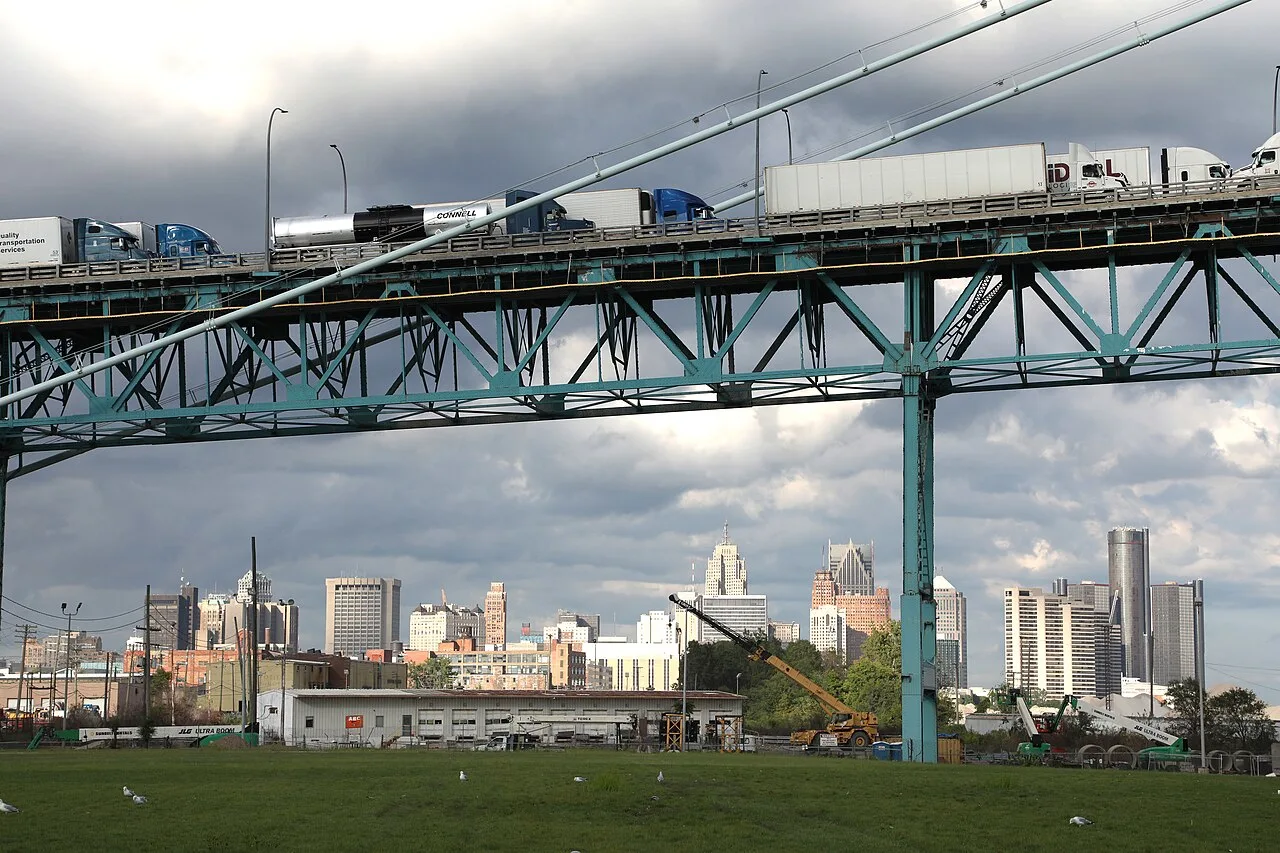
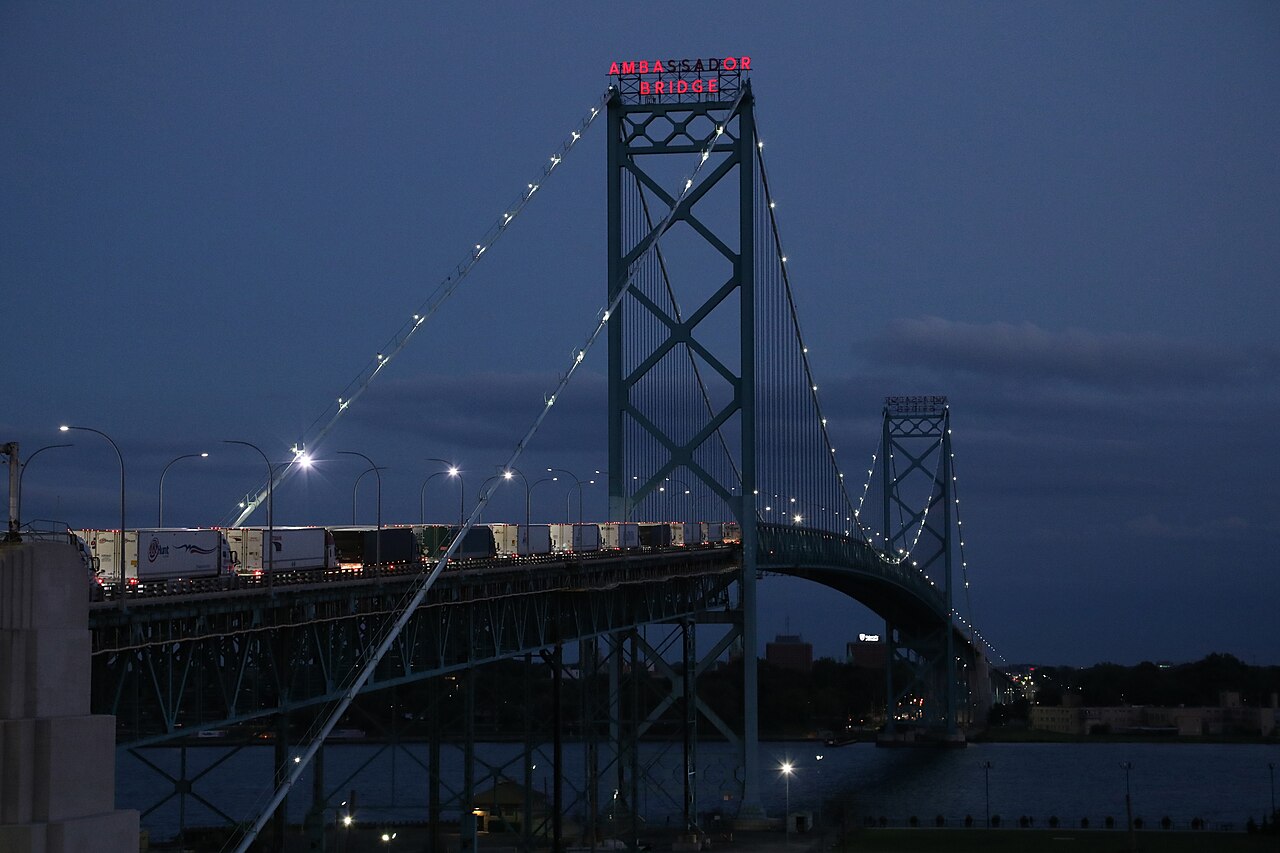
Hero photograph: ARCHIVE / Ambassador Bridge freight traffic, August 2022. Photo: Charles Csavossy / U.S. Customs and Border Protection. Source ยท Public domain in the U.S.

What the ban covers

The three official annexes list 68 tariff and statistical lines: 53 for alcoholic beverages, 14 under the dairy proclamation, and one for motor vehicles. Several lines describe different forms of the same product, so this figure represents customs classifications.

Product group Lines listed Main scope
Alcoholic beverages 53 Specified beer, wine, cider, spirits and other beverages, with packaging and classification limits
Whey products 8 Specified whey protein concentrates, modified whey, fluid whey and dried whey
Molasses 5 Invert, cane and other listed molasses
Nonalcoholic beer 1 HTSUS 2202.91.00
Motorcycles 1 HTSUS 8711.50.00, covering reciprocating internal-combustion piston engines over 800 cc

Sources: alcohol annex, dairy annex, and motor-vehicle annex.

By the numbers

The scope is narrower than the broad labels suggest. The dairy proclamation includes molasses and nonalcoholic beer, but its exclusion list does not establish a general ban on Canadian milk, cheese or butter. The motor-vehicle exclusion is limited to the single motorcycle classification above.

The Canadian import restrictions apply to products of Canada. A product's customs origin, classification and any stated scope limitation determine coverage. Goods outside the exclusion lists can still face other tariffs and import requirements.
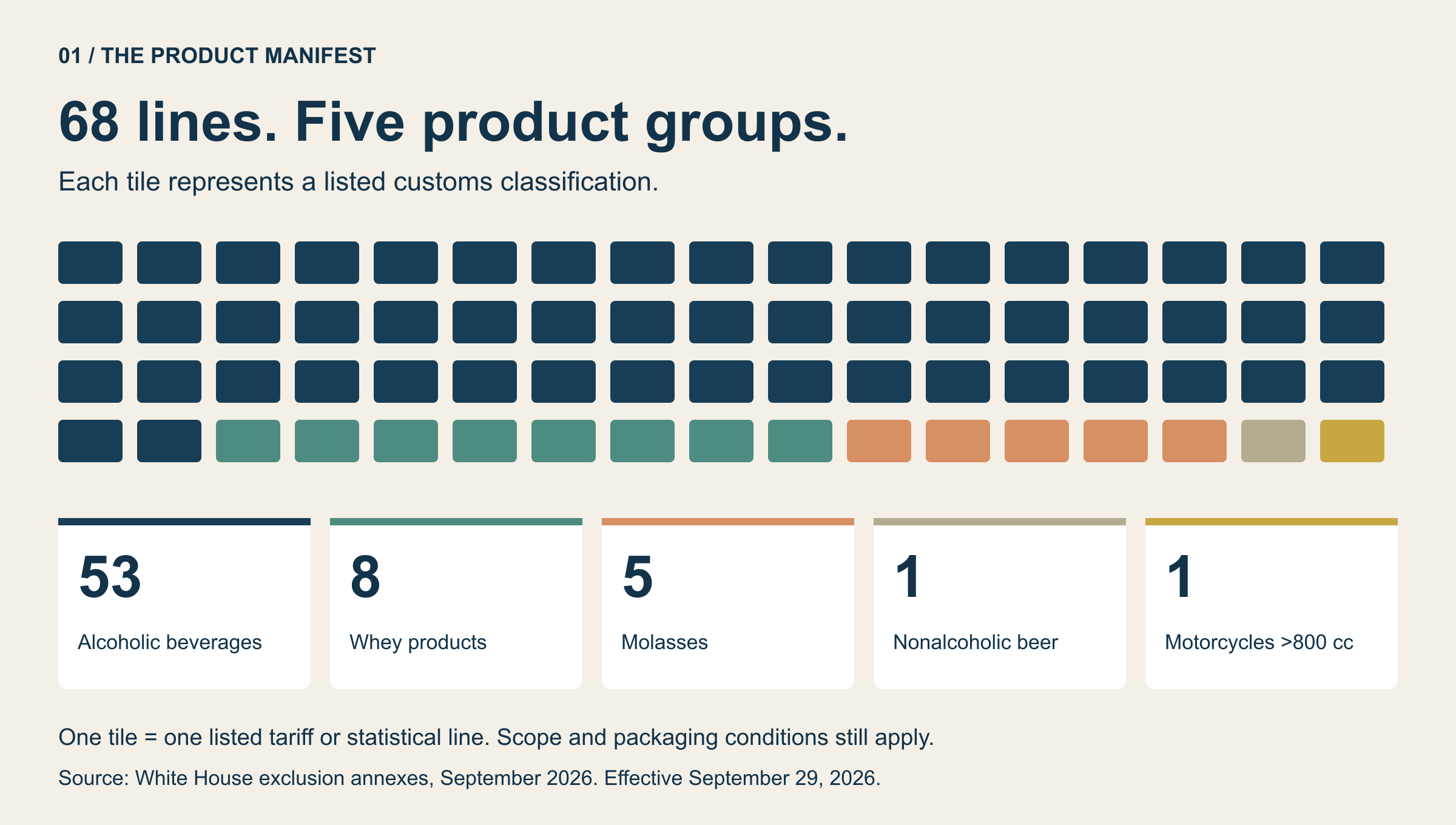
U.S. import ban on Canadian goods: 68 listed classifications: 53 alcoholic beverages, eight whey products, five molasses, one nonalcoholic beer and one motorcycle classification
01 / The product manifest. All 68 classifications appear in the reference tables below.

Why the restrictions were introduced

The administration invoked Section 338 of the Tariff Act of 1930. It says Canada continued discriminatory treatment of U.S. commerce after earlier tariff actions concerning alcohol, dairy and motor vehicles. USTR's September 8 statement sets out that position.

The additional 50% U.S. duties had taken effect on August 22, as covered in the earlier Canada tariff update. Canada introduced counter-tariffs on September 8, covering C$27.6 billion in U.S. imports. Canada's Finance Department describes those measures as a dollar-for-dollar response to the U.S. Section 338 tariffs. Canada's official counter-tariff list.

The United States issued the exclusion proclamations on September 8, alongside separate changes to its tariff lists. Those tariff changes became effective September 15; the import bans began September 29. CBP's tariff-modification notice.

What rates apply to affected imports?

The treatment depends on the goods and when they were imported. The rules create three distinct situations:

Situation Treatment under the September 29 restrictions
Listed Canadian products imported on or after the cutoff and meeting the relevant scope conditions Importation prohibited; payment of the additional 50% duty does not authorize entry
Covered goods imported before the cutoff but still awaiting entry for consumption or withdrawal from a warehouse The applicable additional 50% Section 338 duty remains in place under the transition provisions
Listed alcohol that falls outside an applicable scope limitation CBP says the import exclusion does not apply and the applicable additional 50% duty remains

Sources: CBP implementation guidance and the alcohol exclusion proclamation.
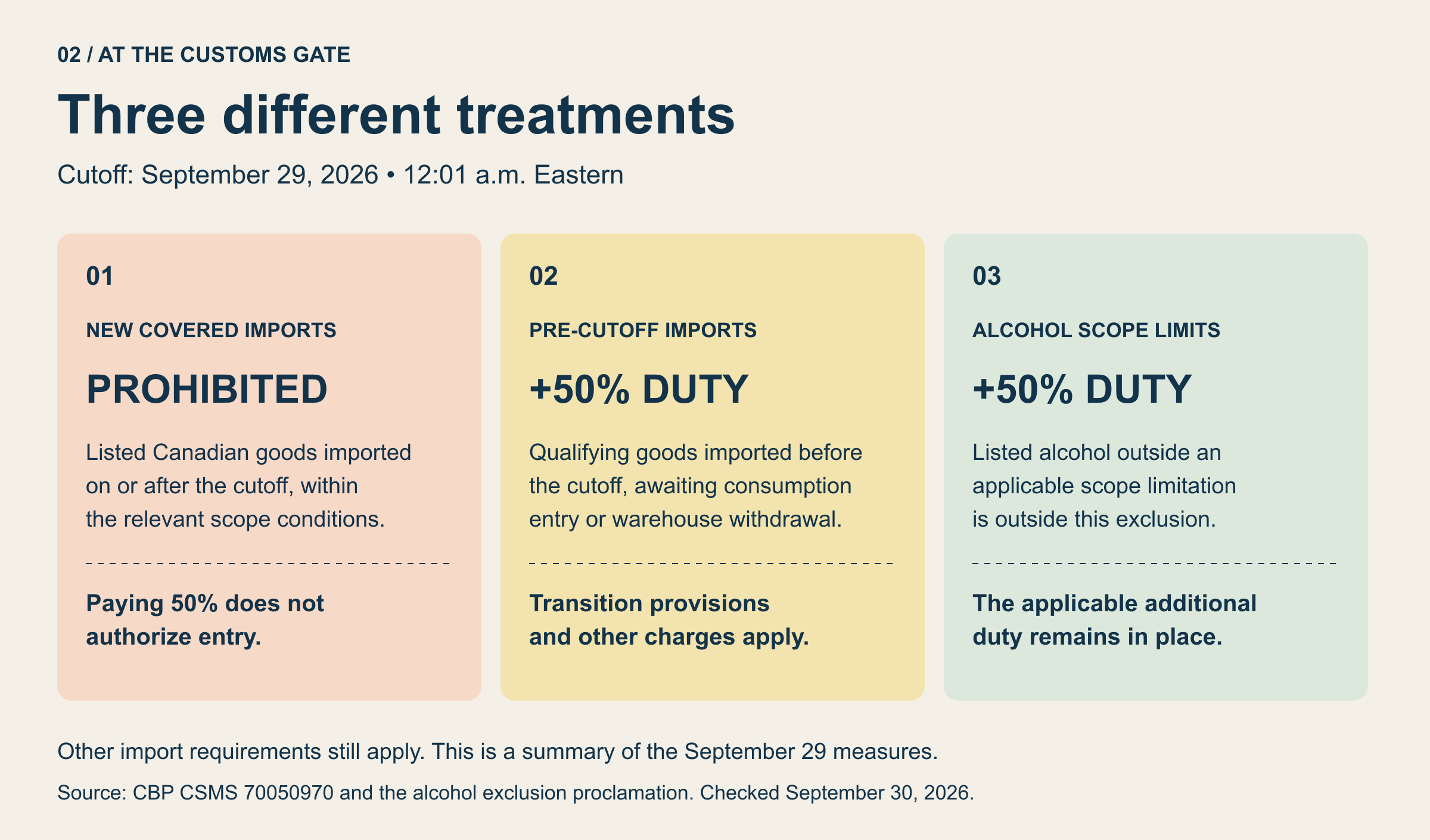
U.S. import ban on Canadian goods: Three customs treatments: prohibition for covered new imports; additional 50% duty under qualifying pre-cutoff transition provisions; applicable additional 50% duty for listed alcohol outside scope limitations
02 / Customs treatment depends on timing, classification and scope.

What a 50% additional duty means in dollars

The Section 338 duty is an ad valorem charge, calculated as a percentage of the customs value. In an illustrative case where the additional 50% duty applies to the full $10,000 customs value, that additional duty is $5,000. The goods' customs value plus this one duty would total $15,000, before other applicable duties, taxes, fees, freight or related costs.

That calculation applies only where importation remains permitted and the duty is applicable. It does not provide a price at which a prohibited shipment can enter.

The 50% figure also does not represent a universal total tariff on Canadian goods. CBP's tariff guidance preserves other applicable charges and sets out specific exceptions. The final amount depends on the product's classification and entry treatment. CBP tariff guidance.

What this means for customer prices

The proclamations establish import restrictions and customs treatment. They do not set wholesale or retail prices, and a 50% additional import duty does not establish a 50% increase in the price paid by a customer.

Where the duty still applies, it increases the import cost on the relevant customs value. How much of that cost reaches a customer depends on the seller's pricing and the other costs included in the selling price. Where importation is prohibited, the immediate effect is that covered new shipments cannot enter. The official notices do not provide a fixed percentage increase for replacement stock or consumer prices.

Does USMCA qualification change the position?

The White House states that the Section 338 duties apply to covered goods regardless of USMCA qualification. CBP's exclusion guidance provides no blanket USMCA exemption for the banned products. A preferential tariff claim therefore does not establish that a listed, covered shipment is admissible. White House fact sheet and CBP guidance.

What other sourcing options do businesses have?

Businesses can buy U.S.-produced goods, source products made in another country, or purchase inventory already lawfully available through U.S. distributors. These alternative sourcing options have different cost structures. Buying from a U.S. distributor can simplify the purchasing process, but imported stock may already include tariffs and freight in its price.

Drip Capital

Keep your next purchase
moving.

Drip Capital pays vendors directly for permitted purchases, with repayment terms of up to 90 days, subject to underwriting and applicable terms.

Talk to Drip Capital  →
$9B+ trade financed  •  11,000+ businesses served  •  100+ countries

Company figures: Drip Capital.

The examples below identify existing production sources and possible category substitutes. They do not establish available capacity, a vendor's willingness to take new orders, or an identical replacement for a Canadian product. The cost considerations explain how these purchases work. The separate food prior-notice requirements and import licensing requirements remain relevant to replacement purchases where applicable. Actual savings depend on the transaction.

Domestic and international alternatives by product group

Affected products Domestic options International options What changes the cost comparison
Beer, wine, cider and other fermented beverages U.S. breweries and wineries offer locally produced alternatives. Matching a particular style, brand or recipe is a separate question. Mexican-produced beer and French or Italian wine are established examples of non-Canadian supply. Specialty products, including sake, prune wine and vermouth, require a producer offering the particular category. Delivered case price, bottle or keg size, alcohol content, excise tax, freight and distribution terms. A different brand or appellation can change the selling proposition as well as the purchase price.
Whiskies, brandies, rum, gin, vodka, liqueurs, bitters and beverage alcohol U.S. distillers and licensed distributors offer alternatives within many of these categories. Examples include whisky produced in Scotland or Ireland and tequila produced in Mexico. Other listed specialty spirits require their own product-specific source. Age, proof, formulation, brand, package size and tax treatment affect comparability. An American whiskey cannot be sold as Canadian whisky merely because it fills the same place in a distributor's range.
Nonalcoholic beer Athletic Brewing identifies production facilities in Connecticut and Southern California. ERDINGER produces beer in Erding, Germany, and offers nonalcoholic products. Case price, packaging, shipment size, freight and remaining shelf life. An imported alternative can have a lower factory price yet a higher delivered cost.
Whey protein concentrates, modified whey and dried whey The U.S. Dairy Export Council's vendor directory includes U.S. producers of whey concentrates, sweet whey powder and demineralized whey. Arla Foods Ingredients identifies whey processing at Danmark Protein in Denmark. Suitability depends on the exact ingredient specification. Protein concentration, mineral content, functionality, testing, freight and contract volume. A price per pound for ordinary dry whey does not provide a comparable price for a higher-protein concentrate.
Fluid whey Supply from a domestic cheese or whey processor is a potential route where the required liquid product is available. Overseas dry ingredients may offer a reformulation route where technically suitable; the cited dry-whey sources do not establish a direct overseas replacement for fluid whey. Liquid transport, handling and storage have a different cost basis from powder. Reformulation can add processing and validation costs, so the two forms cannot be treated as equivalent purchases.
Invert, cane and other molasses Florida Crystals documents molasses production at its Florida mills. This establishes a domestic cane-molasses source, with suitability depending on grade and use. Belize Sugar Industries documents molasses export infrastructure in Belize. This does not establish availability of every listed molasses type. Sugar concentration, food or feed specification, tank or container handling and inland freight. Cane molasses, beet molasses and invert molasses are separate specifications; one source does not automatically replace all five tariff lines.
Motorcycles over 800 cc Harley-Davidson's York, Pennsylvania, plant produces Touring and Trike models. BMW's Berlin plant produces motorcycles including the R 1300 GS and S 1000 RR. Model and equipment, dealer terms, freight, applicable duties, warranty and servicing arrangements. A replacement brand may require a different dealership relationship and parts inventory.

Production and market sources: TTB's U.S. production reports, Constellation's Mexican brewery and U.S. beer business, French and Italian wine in the U.S. market, TTB on distinctive spirits, Athletic Brewing facilities, ERDINGER's brewery and nonalcoholic beer, U.S. whey vendor directory, Arla's facilities, Florida molasses production, Belize molasses logistics, Harley-Davidson York, and BMW Berlin.

How domestic and overseas costs differ

For a U.S.-produced finished product purchased domestically, the buyer has no import entry or customs duty on that purchase. The price can still reflect the producer's imported inputs, manufacturing costs and domestic transportation. Domestic availability alone does not establish a lower delivered price.

For a non-Canadian import, the cost can include the vendor's price, international freight and insurance, customs duties, clearance charges and delivery within the United States. The applicable tariff depends on the actual origin, classification and entry date. The Canadian exclusion does not establish a zero-duty rate for replacement goods from Mexico, Europe or elsewhere. Routing Canadian goods through another country does not by itself establish a different origin.

Alcohol also has a separate federal excise-tax layer. TTB lists general rates of $18 per barrel of beer, $1.07 per wine gallon for still wine at 16% alcohol or below with no more than 0.392 grams of carbon dioxide per 100 milliliters, and $13.50 per proof gallon of distilled spirits. These rates apply to specified volume or proof-volume units. Reduced rates or credits may apply, including through qualifying assignments from foreign producers. Domestic alcohol can also bear federal excise tax, so replacing imported stock does not remove that cost automatically. TTB tax rates.
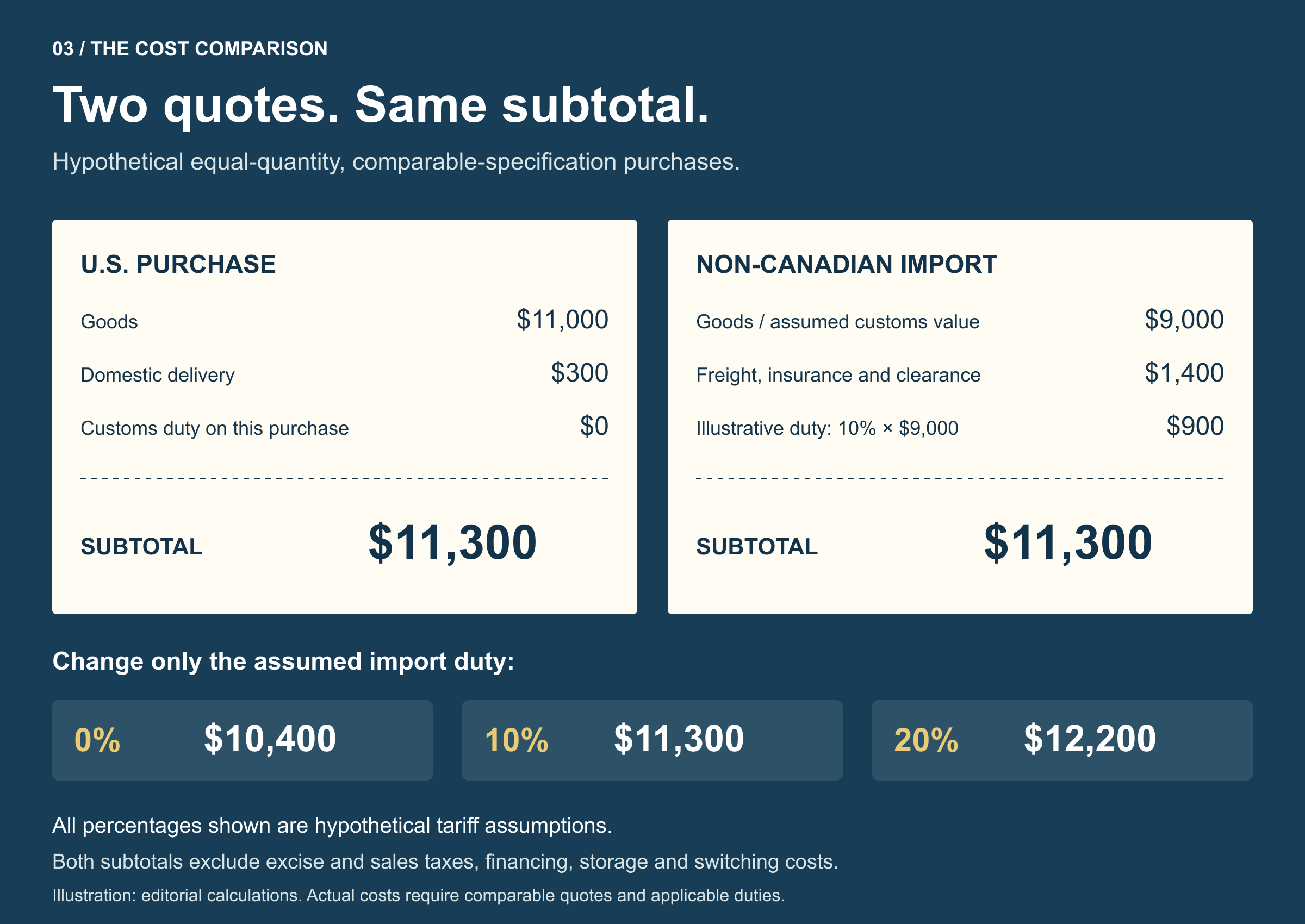
U.S. import ban on Canadian goods: Hypothetical domestic and overseas purchases both total $11,300; the overseas calculation uses a hypothetical 10% duty
03 / A lower goods quote can result in the same delivered subtotal. All amounts and tariff percentages in this comparison are hypothetical.
THE IMPORTERโ€™S REFERENCE ยท PRODUCT LOOKUP

Is your product on the list?

Search the 68 classifications in the Canadian import exclusion annexes by HTSUS code or product name.

Coverage reviewed September 30, 2026 ยท Restrictions effective September 29, 2026

Codes work with or without dots. A partial code shows matching listed classifications. Product-name matches are a starting point; the exact classification and scope determine coverage.

A listed code still has conditions. The exclusion concerns products of Canada. Origin, import timing, classification and scope determine treatment. โ€œPackaged onlyโ€ means bottles, cans, boxes, kegs or similar direct-to-consumption containers. Other alcohol lines retain their classificationโ€™s container-size and other conditions. Read CBPโ€™s implementation rules โ†—

68 listed classifications

5 product groups
Complete list of classifications in the Canadian import exclusion annexes
HTSUS codeProduct descriptionScope and source
2203.00.00Malt beerAlcoholic beveragesPackaged onlyOfficial annex โ†—
2204.10.00Sparkling grape wineAlcoholic beveragesPackaged onlyOfficial annex โ†—
2204.21.20Effervescent grape wine; containers โ‰ค2 LAlcoholic beveragesClassification conditions applyOfficial annex โ†—
2204.21.30Tokay wine, noncarbonated, alcohol โ‰ค14%; containers โ‰ค2 LAlcoholic beveragesClassification conditions applyOfficial annex โ†—
2204.21.50Wine other than Tokay, noncarbonated, alcohol โ‰ค14%; containers โ‰ค2 LAlcoholic beveragesClassification conditions applyOfficial annex โ†—
2204.21.60Marsala wine, alcohol >14%; containers โ‰ค2 LAlcoholic beveragesClassification conditions applyOfficial annex โ†—
2204.21.80Grape wine other than Marsala, not sparkling or effervescent, alcohol >14%; containers โ‰ค2 LAlcoholic beveragesClassification conditions applyOfficial annex โ†—
2204.22.20Nonsparkling grape wine, alcohol โ‰ค14%; containers >2 to 4 LAlcoholic beveragesClassification conditions applyOfficial annex โ†—
2204.22.40Nonsparkling grape wine, alcohol >14%; containers >2 to 4 LAlcoholic beveragesClassification conditions applyOfficial annex โ†—
2204.22.60Nonsparkling grape wine, alcohol โ‰ค14%; containers >4 to 10 LAlcoholic beveragesPackaged onlyOfficial annex โ†—
2204.22.80Nonsparkling grape wine, alcohol >14%; containers >4 to 10 LAlcoholic beveragesPackaged onlyOfficial annex โ†—
2204.29.61Nonsparkling grape wine, alcohol โ‰ค14%; containers >10 LAlcoholic beveragesPackaged onlyOfficial annex โ†—
2204.29.81Nonsparkling grape wine, alcohol >14%; containers >10 LAlcoholic beveragesPackaged onlyOfficial annex โ†—
2205.10.30Vermouth; containers โ‰ค2 LAlcoholic beveragesClassification conditions applyOfficial annex โ†—
2206.00.15Fermented cider, still or sparklingAlcoholic beveragesPackaged onlyOfficial annex โ†—
2206.00.30Prune wineAlcoholic beveragesPackaged onlyOfficial annex โ†—
2206.00.45Rice wine or sakeAlcoholic beveragesPackaged onlyOfficial annex โ†—
2206.00.60Other effervescent wineAlcoholic beveragesPackaged onlyOfficial annex โ†—
2206.00.90Other fermented beveragesAlcoholic beveragesPackaged onlyOfficial annex โ†—
2207.10.30Undenatured ethyl alcohol โ‰ฅ80%, for beveragesAlcoholic beveragesPackaged onlyOfficial annex โ†—
2208.20.10Pisco and singaniAlcoholic beveragesPackaged onlyOfficial annex โ†—
2208.20.20Grape brandy, excluding pisco/singani; containers โ‰ค4 L; value โ‰ค$2.38/LAlcoholic beveragesClassification conditions applyOfficial annex โ†—
2208.20.30Grape brandy, excluding pisco/singani; containers โ‰ค4 L; value >$2.38 to $3.43/LAlcoholic beveragesClassification conditions applyOfficial annex โ†—
2208.20.40Grape brandy, excluding pisco/singani; containers โ‰ค4 L; value >$3.43/LAlcoholic beveragesClassification conditions applyOfficial annex โ†—
2208.20.50Grape brandy, excluding pisco/singani; containers >4 L; value โ‰ค$2.38/LAlcoholic beveragesPackaged onlyOfficial annex โ†—
2208.20.60Grape brandy, excluding pisco/singani; containers >4 L; value >$2.38/LAlcoholic beveragesPackaged onlyOfficial annex โ†—
2208.30.30Irish and Scotch whiskiesAlcoholic beveragesPackaged onlyOfficial annex โ†—
2208.30.6020Bourbon, other than Irish/Scotch; containers โ‰ค4 LAlcoholic beveragesClassification conditions applyOfficial annex โ†—
2208.30.6040Bourbon, other than Irish/Scotch; containers >4 LAlcoholic beveragesPackaged onlyOfficial annex โ†—
2208.30.6055Rye whisky, other than Irish/Scotch; containers โ‰ค4 LAlcoholic beveragesClassification conditions applyOfficial annex โ†—
2208.30.6065Other whisky, other than Irish/Scotch; containers โ‰ค4 LAlcoholic beveragesClassification conditions applyOfficial annex โ†—
2208.30.6075Rye whisky, other than Irish/Scotch; containers >4 LAlcoholic beveragesPackaged onlyOfficial annex โ†—
2208.40.20Rum and tafia; containers โ‰ค4 L; value โ‰ค$3/LAlcoholic beveragesClassification conditions applyOfficial annex โ†—
2208.40.40Rum and tafia; containers โ‰ค4 L; value >$3/LAlcoholic beveragesClassification conditions applyOfficial annex โ†—
2208.40.60Rum and tafia; containers >4 L; value โ‰ค$0.69/LAlcoholic beveragesPackaged onlyOfficial annex โ†—
2208.40.80Rum and tafia; containers >4 L; value >$0.69/LAlcoholic beveragesPackaged onlyOfficial annex โ†—
2208.50.00Gin and GeneveAlcoholic beveragesPackaged onlyOfficial annex โ†—
2208.60.10Vodka; containers โ‰ค4 L; value โ‰ค$2.05/LAlcoholic beveragesClassification conditions applyOfficial annex โ†—
2208.60.20Vodka; containers โ‰ค4 L; value >$2.05/LAlcoholic beveragesClassification conditions applyOfficial annex โ†—
2208.60.50Vodka; containers >4 LAlcoholic beveragesPackaged onlyOfficial annex โ†—
2208.70.0030Liqueurs and cordials; containers โ‰ค4 LAlcoholic beveragesClassification conditions applyOfficial annex โ†—
2208.90.10Beverage bittersAlcoholic beveragesPackaged onlyOfficial annex โ†—
2208.90.12Slivovitz brandy; containers โ‰ค4 L; value โ‰ค$3.43/LAlcoholic beveragesClassification conditions applyOfficial annex โ†—
2208.90.14Slivovitz brandy; containers >4 L; value โ‰ค$3.43/LAlcoholic beveragesPackaged onlyOfficial annex โ†—
2208.90.15Slivovitz brandy; value >$3.43/LAlcoholic beveragesPackaged onlyOfficial annex โ†—
2208.90.20Brandy other than slivovitz; containers โ‰ค4 L; value โ‰ค$2.38/LAlcoholic beveragesClassification conditions applyOfficial annex โ†—
2208.90.25Brandy other than grape/slivovitz; containers โ‰ค4 L; value >$2.38 to $3.43/LAlcoholic beveragesClassification conditions applyOfficial annex โ†—
2208.90.30Brandy other than grape/slivovitz; containers โ‰ค4 L; value >$3.43/LAlcoholic beveragesClassification conditions applyOfficial annex โ†—
2208.90.35Brandy other than grape/slivovitz; containers >4 L; value โ‰ค$2.38/LAlcoholic beveragesPackaged onlyOfficial annex โ†—
2208.90.40Brandy other than grape/slivovitz; containers >4 L; value >$2.38/LAlcoholic beveragesPackaged onlyOfficial annex โ†—
2208.90.50Tequila; containers โ‰ค4 LAlcoholic beveragesClassification conditions applyOfficial annex โ†—
2208.90.72Mezcal; containers โ‰ค4 LAlcoholic beveragesClassification conditions applyOfficial annex โ†—
2208.90.75Other spirits for beverage useAlcoholic beveragesPackaged onlyOfficial annex โ†—
0404.10.05Whey protein concentratesWhey productsClassification conditions applyOfficial annex โ†—
0404.10.08Modified whey excluding protein concentrates; general note 15Whey productsClassification conditions applyOfficial annex โ†—
0404.10.11Modified whey excluding protein concentrates; additional U.S. note 10, chapter 4Whey productsClassification conditions applyOfficial annex โ†—
0404.10.15Modified whey excluding protein concentrates; outside general note 15Whey productsClassification conditions applyOfficial annex โ†—
0404.10.20Fluid whey, including concentrated or sweetenedWhey productsClassification conditions applyOfficial annex โ†—
0404.10.48Dried whey excluding modified whey; general note 15Whey productsClassification conditions applyOfficial annex โ†—
0404.10.50Dried whey excluding modified whey; additional U.S. note 12, chapter 4Whey productsClassification conditions applyOfficial annex โ†—
0404.10.90Dried whey excluding modified whey; outside general note 15 and additional U.S. note 12Whey productsClassification conditions applyOfficial annex โ†—
1702.90.35Invert molassesMolassesClassification conditions applyOfficial annex โ†—
1703.10.30Cane molasses for commercial sugar extraction or human consumptionMolassesClassification conditions applyOfficial annex โ†—
1703.10.50Other cane molassesMolassesClassification conditions applyOfficial annex โ†—
1703.90.30Molasses other than cane, for commercial sugar extraction or human consumptionMolassesClassification conditions applyOfficial annex โ†—
1703.90.50Other molasses, not elsewhere specified or includedMolassesClassification conditions applyOfficial annex โ†—
2202.91.00Nonalcoholic beerNonalcoholic beerClassification conditions applyOfficial annex โ†—
8711.50.00Motorcycles, including mopeds, and cycles fitted with reciprocating internal-combustion piston engines over 800 ccMotorcyclesClassification conditions applyOfficial annex โ†—

Descriptions are shortened. Alcohol percentages are by volume; container sizes are in liters. โ‰ค means at most, > means more than and โ‰ฅ means at least. Dollar values are U.S. dollar classification thresholds per liter. HTSUS general and additional U.S. notes remain applicable. The official annex text governs coverage.

The dairy annex contains eight whey lines, five molasses lines and nonalcoholic beer. Whey descriptions include the concentration and sweetening variations in that annex. Names such as Scotch whisky or tequila in a classification do not establish Canadian origin.

U.S. import ban on Canadian goods: The Ambassador Bridge illuminated at dusk
ARCHIVE / Ambassador Bridge, August 2022. Photo: Charles Csavossy / U.S. Customs and Border Protection. Source ยท Public domain in the U.S.

What happens to goods already imported?

CBP preserves entry eligibility for covered products imported before 12:01 a.m. Eastern on September 29. It specifically states that covered goods already entered into a bonded warehouse or admitted to a foreign trade zone before the cutoff may be withdrawn for consumption with the applicable additional 50% duty.

The same notice says unreleased entries containing covered goods in the Automated Commercial Environment, or ACE, will be canceled at the cutoff. An earlier filing therefore does not, on its own, establish that the goods can be released. The transition provisions refer to prior importation and the goods' customs status. CBP implementation guidance.

Goods in transit and new warehouse admissions

The published guidance does not provide a general exemption based only on an order date, payment date or dispatch before September 29. Covered goods are also excluded from new admission into a bonded warehouse or foreign trade zone, in-bond transportation, and entry for consumption after the cutoff. CBP implementation guidance.

How long will the ban last?

The exclusion proclamations do not give an automatic end date. They authorize implementation by CBP and include provisions governing what happens if part of an exclusion is invalidated. For example, the alcohol proclamation provides for the earlier additional 50% duty to apply to imports affected by an invalidation. Alcohol exclusion proclamation.

As of this article's September 30 update, the official implementation guidance reviewed places the restrictions in effect from September 29. Future changes to the scope or treatment would depend on subsequent official action.

Where Drip Capital fits

For a business arranging lawful replacement purchases, vendor payment timing can become part of the sourcing decision. Before committing funds, confirm the replacement goods' admissibility and applicable duties with your customs broker. That establishes the import costs around which a funding plan can be built.

Drip Capital's Vendor Financing pays vendors directly, with repayment terms of up to 90 days. It can help address the timing of vendor payments for approved transactions, subject to underwriting and applicable terms. Financing does not change a product's admissibility or remove a customs duty.

If a change in sourcing creates a gap between paying vendors and collecting customer payments, speak with Drip Capital about financing for your business's permitted purchases.

Frequently asked questions

Does the U.S. import ban on Canadian goods cover everything from Canada?

The U.S. import ban on Canadian goods covers the specified products of Canadian origin in three exclusion annexes. Together, the annexes contain 68 tariff and statistical lines, with classification and packaging conditions determining coverage. Other Canadian goods can still face separate duties and import requirements.

Can an importer pay 50% and bring in a banned product?

Payment of the additional duty does not authorize a covered new import. The applicable 50% duty remains relevant to qualifying pre-cutoff goods under the transition provisions and to listed alcohol outside an applicable scope limitation.

Does a U.S. purchase automatically cost less than an overseas replacement?

A U.S.-produced finished good purchased domestically has no customs duty on that purchase, but its delivered price can still be higher. International freight, applicable duties, taxes, product specifications and distribution terms all affect the comparison. The cost infographic above uses hypothetical quotes and duty rates.

Can Canadian goods avoid the exclusion by passing through another country?

A change in shipping route alone does not establish a change in origin. The exclusion applies to covered products of Canada, and origin and classification remain part of the customs determination. CBP's implementation notice defines the covered-goods treatment.

Shlok Bang

Shlok Bang

Senior Content Marketer at Drip Capital

A finance, global economics, and fintech storyteller who turns complex ideas into clear, engaging narratives. Experience across global markets, trade, banking, and supply chain finance, backed by strong research and sharp editorial instinct. Driven by curiosity about the forces shaping the modern financial world.