
A packaging line could clear the bottleneck in your warehouse. Paying for it could also absorb the cash reserved for inventory, freight, and payroll. The question behind bonus depreciation in 2026 is how to make the investment work across both your tax return and your bank account.
Qualifying purchases can receive a full first-year federal depreciation deduction. Getting there requires an eligible asset, the right acquisition timing, and equipment that is ready for use. A financing plan should also protect the working capital that keeps daily operations moving.
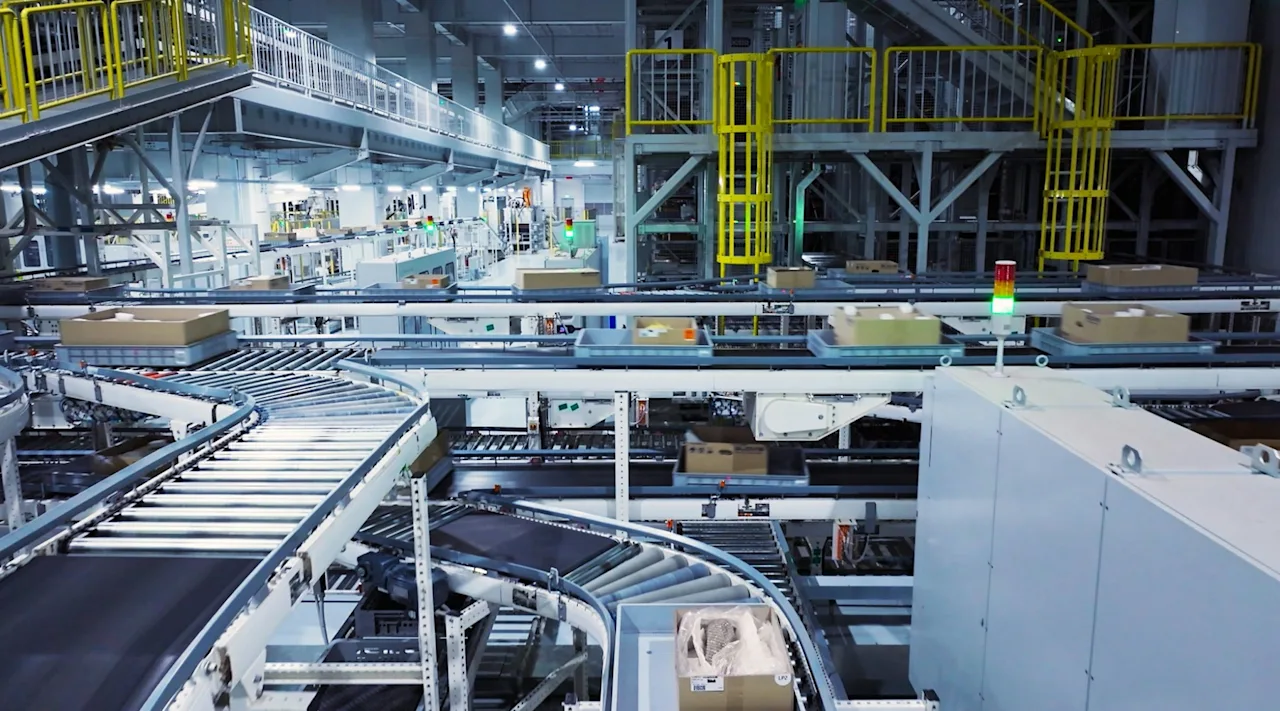
Photo: Hyundai Motor Group / Unsplash. Illustrative equipment image.
What Changed for Bonus Depreciation in 2026?
The 2025 tax law restored 100% bonus depreciation for qualifying property acquired and placed in service after January 19, 2025. The IRS describes the provision as permanent under current law, replacing the previous phasedown. There is no scheduled expiration at the end of 2026. IRS guidance
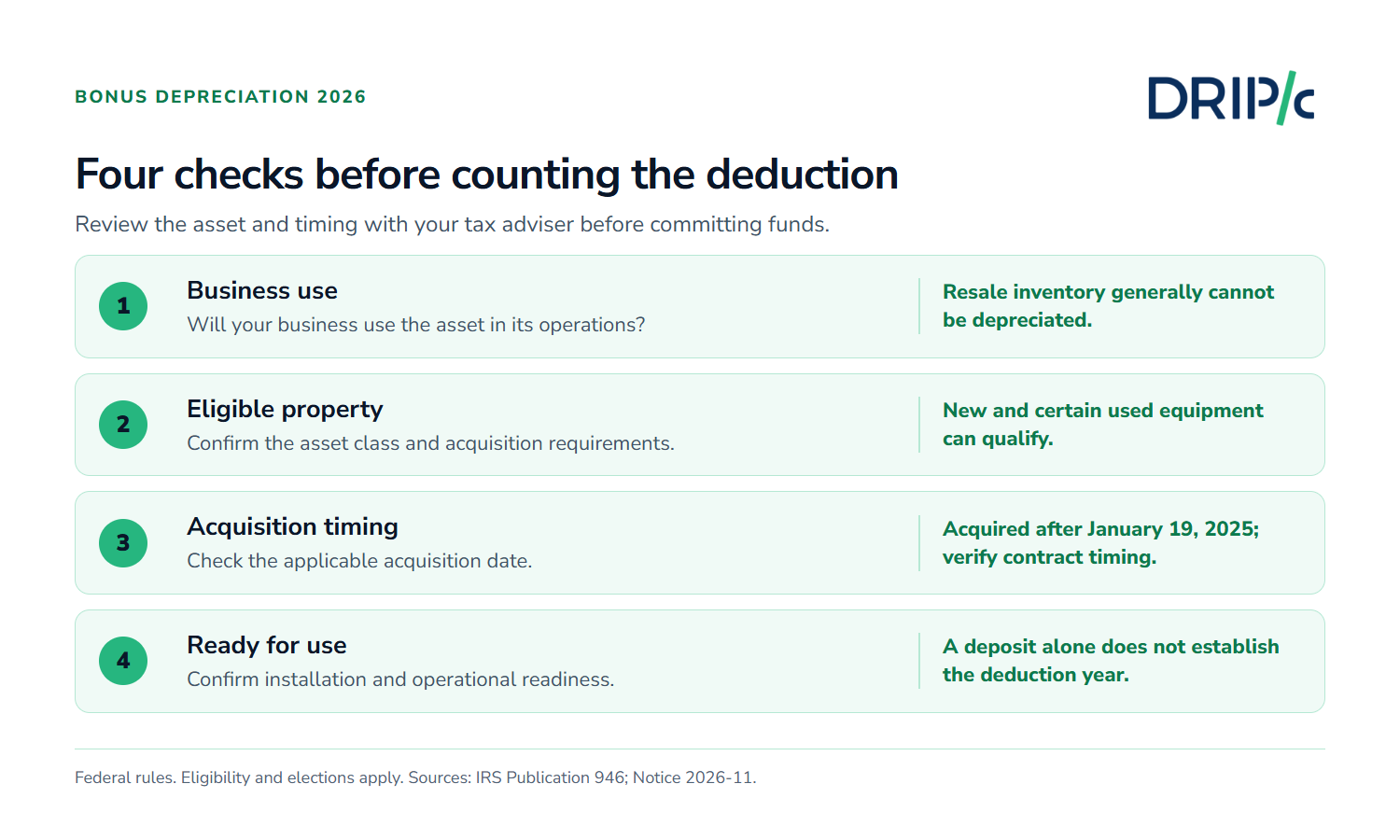
Acquisition timing still matters. Written binding contracts and special construction rules can affect the acquisition date, so an older order delivered in 2026 needs separate review. Notice 2026-11 explains those transition rules.
By the Numbers
For a calendar-year business, the year-end question is which purchases can enter service during 2026. Start with the equipment's intended use.
Which Equipment Can Qualify?
Assets Used in Your Operations
The bonus depreciation rules generally cover qualifying tangible property with a tax recovery period of 20 years or less, along with specified other property. New equipment and certain used equipment can qualify. A packaging machine or warehouse forklift may fit, subject to its classification and acquisition requirements. IRS Publication 946
Inventory Held for Resale
A machine purchased for your own packing operation and a machine imported for resale have different tax treatment. Inventory generally cannot be depreciated. For a wholesaler, classify each purchase before including it in the equipment deduction budget. IRS depreciation guidance
Purchases That Need Closer Review
Land, ordinary building purchases, vehicles with special limits, and mixed personal/business use require different analysis. Used-equipment acquisitions also have eligibility restrictions. Give your tax adviser the asset details and purchase agreement before assuming 100% bonus depreciation applies.
Why the Placed-in-Service Date Matters
Under the IRS placed-in-service standard, property enters service when it is ready and available for its intended use. A deposit or signed purchase order alone does not meet that standard.
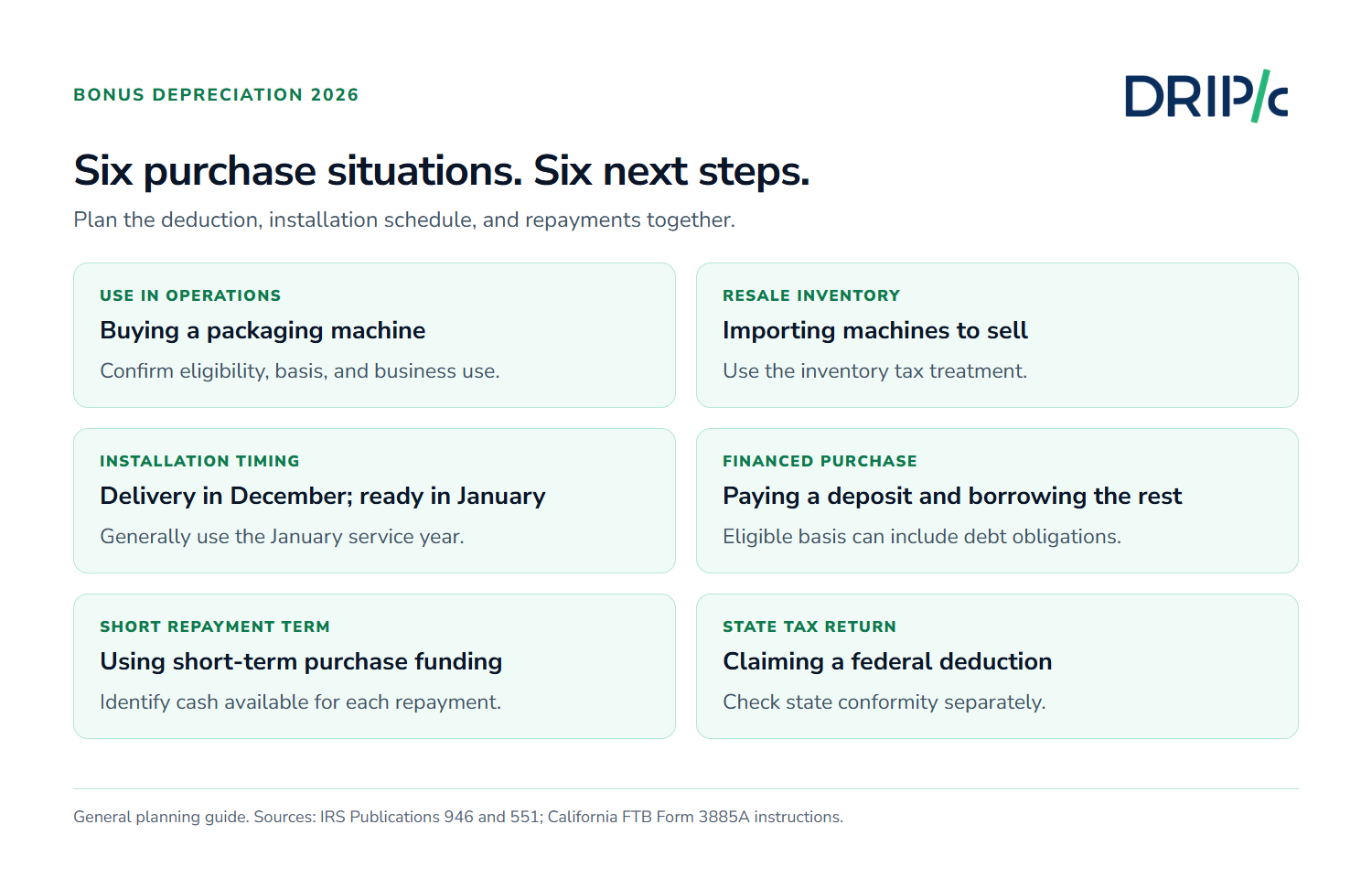
Imagine a packaging machine arriving in December 2026. If essential installation finishes in January 2027, the placed-in-service year would generally be 2027. If it is installed and ready in December, it can enter service then even if the first production run happens later.
Build the purchase schedule backward from readiness: testing, installation, delivery, customs clearance, production, and the vendor's deposit deadline. Put those milestones into your vendor contract and payment terms. Leave room for delays before committing to a tax-year target.
A $100,000 Purchase: Deduction and Cash Flow
Consider a hypothetical business buying a qualifying packaging machine with a $100,000 depreciable basis. Assume full business use, acquisition and readiness during 2026, and eligibility for 100% bonus depreciation.
The first-year deduction would be $100,000. At an assumed 25% applicable marginal tax rate, with the entire deduction usable at that rate, the illustrative tax reduction would be $25,000:
$100,000 deduction × 25% assumed tax rate = $25,000 illustrative tax reduction.
The business still owes the purchase price and any financing costs. Its actual tax result depends on its entity, income, other deductions, and applicable limits. Tax savings may also arrive on a different schedule from vendor payments.
Keep the purchase schedule and tax estimate separate in your cash-flow plan. Test whether the business can meet repayments if the expected tax benefit arrives later.
Section 179 vs Bonus Depreciation
The Section 179 vs bonus depreciation decision involves different limits and elections. For tax years beginning in 2026, Section 179 has a maximum deduction of $2,560,000, reduced dollar for dollar when qualifying purchases exceed $4,090,000.
Section 179 also has a business-income limit. Bonus depreciation has no equivalent overall dollar cap or Section 179 business-income limit, although other tax-loss limitations can affect when a deduction produces a benefit. Section 179 is generally applied first, followed by bonus depreciation on the remaining eligible basis. IRS Topic 704
Ask your adviser to compare the available elections against this year's taxable income and future depreciation deductions. State treatment can differ from federal treatment; the comparison should cover every state where you file.

Once the tax treatment is understood, the purchase still needs a funding plan that leaves enough cash for normal operations.
How to Finance Equipment Before Year-End
Financing Can Form Part of the Asset's Basis
Borrowing to buy equipment does not automatically prevent depreciation. IRS Publication 551 explains that cost basis can include debt obligations, as well as cash. Freight, installation, and testing can also form part of the asset's cost.
A qualifying financed purchase may therefore have an eligible basis greater than the cash down payment. Ownership, asset eligibility, and placed-in-service requirements still apply. Have your adviser distinguish a financed purchase from a lease before calculating the deduction.
Match Repayment to the Business's Cash Flow
When deciding how to finance equipment before year-end, estimate the full cash requirement: deposit, balance, shipping, installation, and a reserve for disruption. Compare financing offers using their total cost, payment dates, and required cash contribution.
For equipment expected to generate returns over several years, evaluate longer-term Equipment Financing. Short-term borrowing needs a repayment source within its actual term. The Line of Credit vs. Term Loan comparison explains how those structures address different funding patterns.
A forecast should show the first repayment alongside payroll, inventory replenishment, and customer collections. Our guide to how a Working Capital Loan works covers the broader application and repayment process.
Keep a Purchase File Your Adviser Can Use
Retain the purchase agreement, invoice, financing documents, freight and installation bills, and evidence of readiness. Record business use and any expected changes. These documents help your adviser establish basis, acquisition timing, and the deduction year.
Where Drip Capital Fits
Drip Capital's Vendor Financing pays vendors directly, with repayment terms of up to 90 days. Discuss an equipment vendor invoice with the team to confirm whether the purchase fits the facility and underwriting requirements.
A Line of Credit can provide revolving access to capital; each draw is repaid over six monthly installments. Assess those payments against the cash your business expects to generate during that period.
Both options require a repayment plan that works independently of the timing of any tax benefit. Your tax adviser determines the equipment's eligibility and deduction; the financing discussion should focus on the invoice, cash requirement, and repayment capacity.
Frequently Asked Questions
Is Bonus Depreciation 100% in 2026?
Yes, bonus depreciation in 2026 can be 100% for qualifying property acquired and placed in service after January 19, 2025. Earlier acquisitions require separate analysis, and taxpayers may elect out under the applicable rules. IRS guidance
Do I Have to Pay for Equipment in Full Before Claiming It?
A qualifying financed purchase can include debt in its cost basis. The deduction still depends on tax ownership, qualifying use, acquisition timing, and readiness for service. IRS basis guidance
Does Ordering Equipment Before Year-End Qualify?
The equipment must be ready and available for its intended use during the relevant tax year. A calendar-year business seeking a 2026 deduction should confirm readiness by December 31, 2026. IRS Publication 946
Should I Buy Equipment Just to Get the Deduction?
Start with the business need, expected return, and ability to fund the purchase. Then have your adviser apply the bonus depreciation rules to the investment you can support. A tax deduction alone does not establish that a purchase is affordable.
This article provides general federal tax information. Consult your tax adviser about your facts, elections, state treatment, and any later sale or change in use.