

Illustrative financial-planning photo by Kelly Sikkema on Unsplash.
The QBI deduction can reduce the federal taxable income of qualifying business owners. The 2025 tax law made it permanent, removing the scheduled expiration after 2025. For 2026, it also introduced a minimum deduction for certain active business owners and widened the income range over which additional restrictions take effect. Section 199A
The familiar 20% figure is still part of the calculation. But claiming it starts with three questions: how is your business taxed, what income qualifies, and what is your taxable income on the owner’s return?
What Is the Qualified Business Income Deduction?
The qualified business income deduction, also called the Section 199A deduction, generally allows eligible owners to deduct up to 20% of qualifying net business income, subject to limits. It can be claimed whether you take the standard deduction or itemize. IRS overview
It reduces taxable income. The actual tax saving depends on the owner’s tax situation. A $20,000 deduction does not mean a $20,000 refund or a 20% reduction in the business’s entire tax bill.
What Does “Permanent” Mean?
The law no longer contains the previous end-of-2025 sunset. Owners still need to qualify and calculate the deduction each year. Annual inflation adjustments and changes in income can produce a different result even when the business itself stays much the same.
Who Qualifies for the QBI Deduction?
Owners of sole proprietorships, partnerships, and S corporations may qualify, along with some trusts and estates. For partnerships and S corporations, the deduction is determined at the partner or shareholder level. The business supplies information that the owner uses on their return. IRS eligibility guidance
Does an LLC Qualify?
An LLC’s federal tax treatment matters. An LLC taxed as a sole proprietorship, partnership, or S corporation may generate qualifying income. An LLC taxed as a C corporation does not generate an owner-level QBI deduction from that corporation’s earnings. IRS LLC classifications
Which Income Is Excluded?
Employee wages and income earned through a C corporation are excluded. An S corporation owner’s reasonable compensation and a partner’s guaranteed payments for services are also excluded from that recipient’s QBI. Capital gains and many investment-income items have separate treatment. Section 199A income rules
What Counts as Qualified Business Income?
QBI starts with qualifying business income after related deductions and losses. Gross sales alone cannot tell you the deduction. An importer with substantial revenue may have a much smaller qualifying profit after inventory costs, wages, freight, rent, and other deductible expenses.
Deductions attributable to the business, including qualifying retirement contributions, self-employed health insurance, and the deductible portion of self-employment tax, can also affect QBI. Loss carryforwards need attention. IRS calculation guidance
For a US importer, buying goods overseas does not by itself make the resulting business profit foreign income. The relevant rule concerns income effectively connected with conducting a US trade or business. Cross-border activities can require a closer review.
By the Numbers: What Changed for 2026?
20%: the basic QBI percentage, before applicable limitations.
$400: the new minimum deduction for qualifying active business owners.
$1,000: the minimum aggregate QBI from active qualified businesses needed for that $400 floor.
These amounts come from Section 199A. An active qualified business is one in which the taxpayer materially participates under the tax rules. The $400 floor replaces a smaller calculated deduction for an eligible taxpayer; it is not an extra $400 added to every deduction. The minimum and eligibility amount become inflation-adjusted after 2026.
What Are the QBI Income Limits for 2026?
The QBI income limits use taxable income calculated before the QBI deduction, under the Section 199A rules. They are measured on the taxpayer’s return. A spouse’s income on a joint return can therefore affect the result.
Figure 1 shows the IRS thresholds for tax years beginning in 2026. The two ends of each range mark when additional restrictions begin and become fully effective.
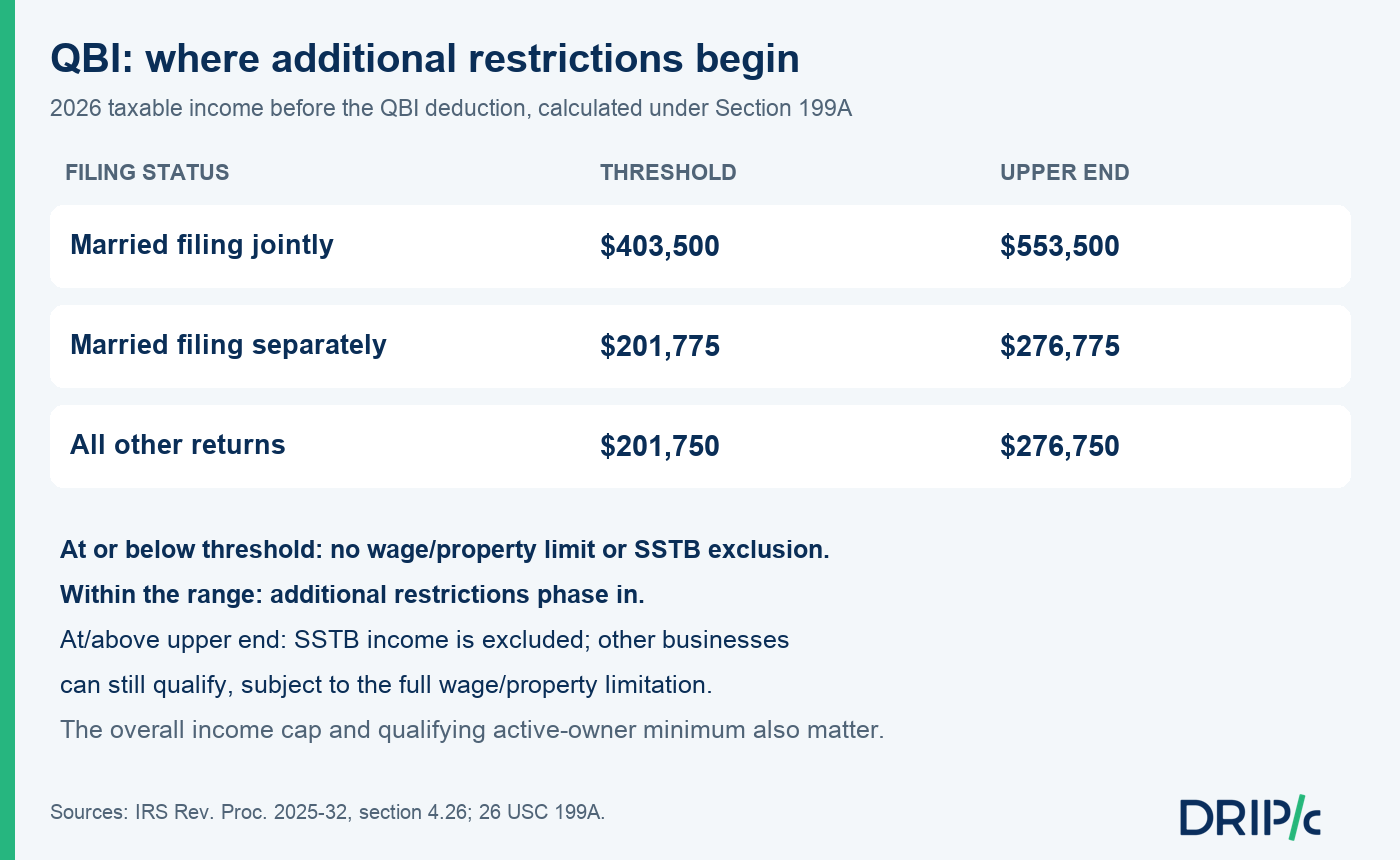
Figure 1. QBI deduction thresholds and restriction ranges for 2026. Sources: IRS Revenue Procedure 2025-32, section 4.26 and Section 199A.
Below the Threshold
At or below the applicable threshold, the W-2 wage and qualified-property limitation does not apply, and specified service businesses can qualify. The normal overall taxable-income cap still matters, subject to the new minimum deduction for qualifying active owners.
Within or Above the Range
Above the threshold, restrictions phase in. For a business that is not a specified service trade or business, the deduction may be limited by wages and qualifying depreciable property. Passing the upper figure does not automatically eliminate every business owner’s deduction. Statutory limitation rules
What Is a Specified Service Trade or Business?
This category, commonly shortened to SSTB, includes fields such as health, law, accounting, and consulting. Its qualifying income is progressively restricted through the applicable range and excluded at or above the upper endpoint. A business with mixed activities needs a classification review. IRS SSTB guidance
Payroll, property records, and the owner’s wider income picture become especially useful when a business approaches these thresholds. Keep the supporting records alongside the year-end forecast.

A separate payment calendar can show whether the business has enough cash for vendor invoices and operating expenses. Our vendor payment terms guide explains the commitments to include.
A Simple QBI Deduction Example
Assume a single owner has $100,000 of QBI and $140,000 of taxable income before the deduction, calculated under the applicable rules. Assume no net capital gain, qualified dividends, REIT or publicly traded partnership income, prior QBI losses, or cooperative adjustments.
The basic QBI amount is $20,000. The ordinary taxable-income cap is $28,000, so the smaller amount gives a $20,000 deduction. This illustrative owner is below the 2026 threshold, so wage and property restrictions do not apply. IRS calculation framework
The deduction’s tax value depends on the owner’s tax rates and other circumstances. Net capital gain, including qualified dividends for this calculation, can reduce the overall taxable-income cap.
How Year-End Purchases Can Affect QBI
An equipment deduction can lower business income and also reduce the income used for the QBI calculation. For an owner receiving an unrestricted 20% QBI deduction, an additional $10,000 deductible business expense could reduce the QBI deduction by $2,000. In that simplified case, taxable income falls by $8,000 overall. This illustration assumes all other limits and adjustments remain unchanged.
Ask your accountant to compare the combined result before accelerating a purchase. Our bonus depreciation explainer covers equipment deductions, while the Equipment Financing vs. Working Capital guide addresses the payment decision.
How Do You Claim the Deduction?
Use Form 8995 or Form 8995-A, as applicable, with your tax return. Use the form and instructions for the tax year you are filing. Partnerships and S corporations provide relevant information through Schedule K-1 and supporting statements.
Collect the records in Figure 2 before the year-end discussion. If your business has losses, multiple activities, cooperative income, or changing ownership, flag those details for your preparer.
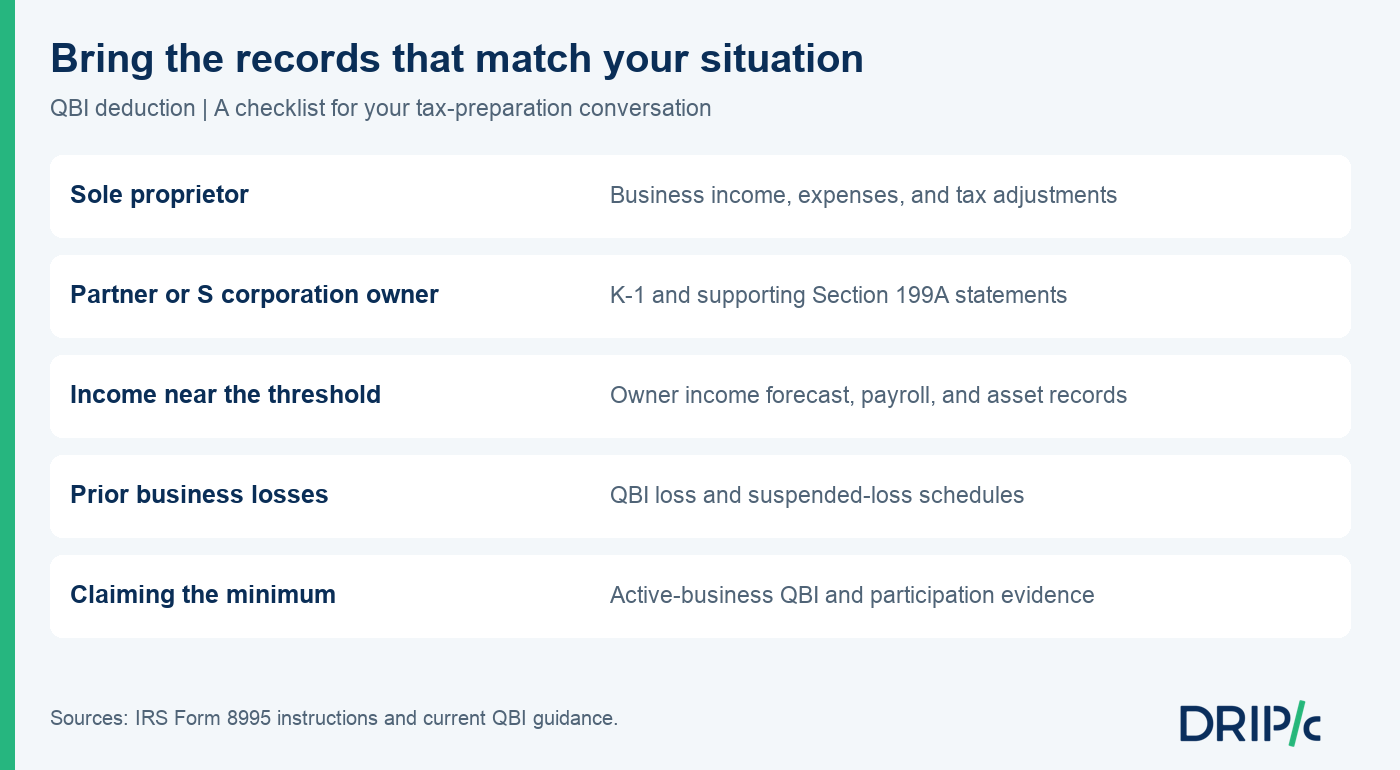
Figure 2. QBI deduction preparation checklist for common owner situations. Sources: IRS Form 8995 instructions and current QBI guidance.
Keep the Tax Forecast and Cash Forecast Connected
A potential tax saving does not establish when customer payments will arrive. Keep tax estimates, owner distributions, inventory payments, and financing repayments visible in the cash plan. Update the forecast when the accountant confirms the deduction.
The small-business funding comparison can help you evaluate repayment commitments alongside ongoing operating needs.
Where Drip Capital Fits
Drip Capital’s Vendor Financing pays vendors directly, with repayment terms of up to 90 days. Its Line of Credit provides revolving access to working capital, with each draw repaid over six monthly installments.
These options can support permitted business cash needs, subject to eligibility and approval. Discuss the repayment plan using expected business cash flow, while your tax adviser handles the QBI calculation. Talk to Drip Capital about your working capital requirements.
Frequently Asked Questions
Is the QBI Deduction Permanent?
Yes. The 2025 law removed the scheduled expiration after 2025. Eligibility and annual calculation rules still apply.
Can I Claim QBI With the Standard Deduction?
Yes, qualifying taxpayers can claim it with either the standard deduction or itemized deductions. The amount remains subject to the applicable QBI rules.
Does the Deduction Reduce Self-Employment Tax?
The QBI deduction itself does not reduce self-employment tax. It is an income-tax deduction, so include self-employment tax separately in your estimate.
Does Every Business Owner Get the New $400 Minimum?
No. For 2026, the owner needs at least $1,000 of aggregate QBI from active qualified businesses in which they materially participate. An eligible owner receives the greater of the regular deduction and $400.