

Who instructs payment, who must pay, and when is the money due? A Bill of Exchange puts those questions into a written payment order. In international trade, a vendor may draw one on a buyer and send it through banks as part of a documentary collection.
You may also hear it called a draft. This guide explains the document from a US business perspective, including the parties, acceptance, common variations, and a worked example. Start with the payment terms in your contract, then check how the draft and bank instructions carry them out.
Illustrative paperwork. Photo by Romain Dancre on Unsplash.
What a Bill of Exchange Does
A Bill of Exchange directs a named party to pay money. The International Trade Administration describes its use in documentary collections, where banks handle documents and payment instructions between the exporter and importer.
For US negotiable instruments, UCC Section 3-104 distinguishes a draft, which contains an order, from a note, which contains a promise. Negotiability requires additional conditions, including a fixed monetary amount and payment on demand or at a definite time. Calling a document a bill does not settle its legal treatment.
State law, the instrument's wording, and the transaction's governing law matter. Have the handling bank and legal adviser review the proposed form before using it in a transaction.
Identify the Parties Before Signing
Drawer
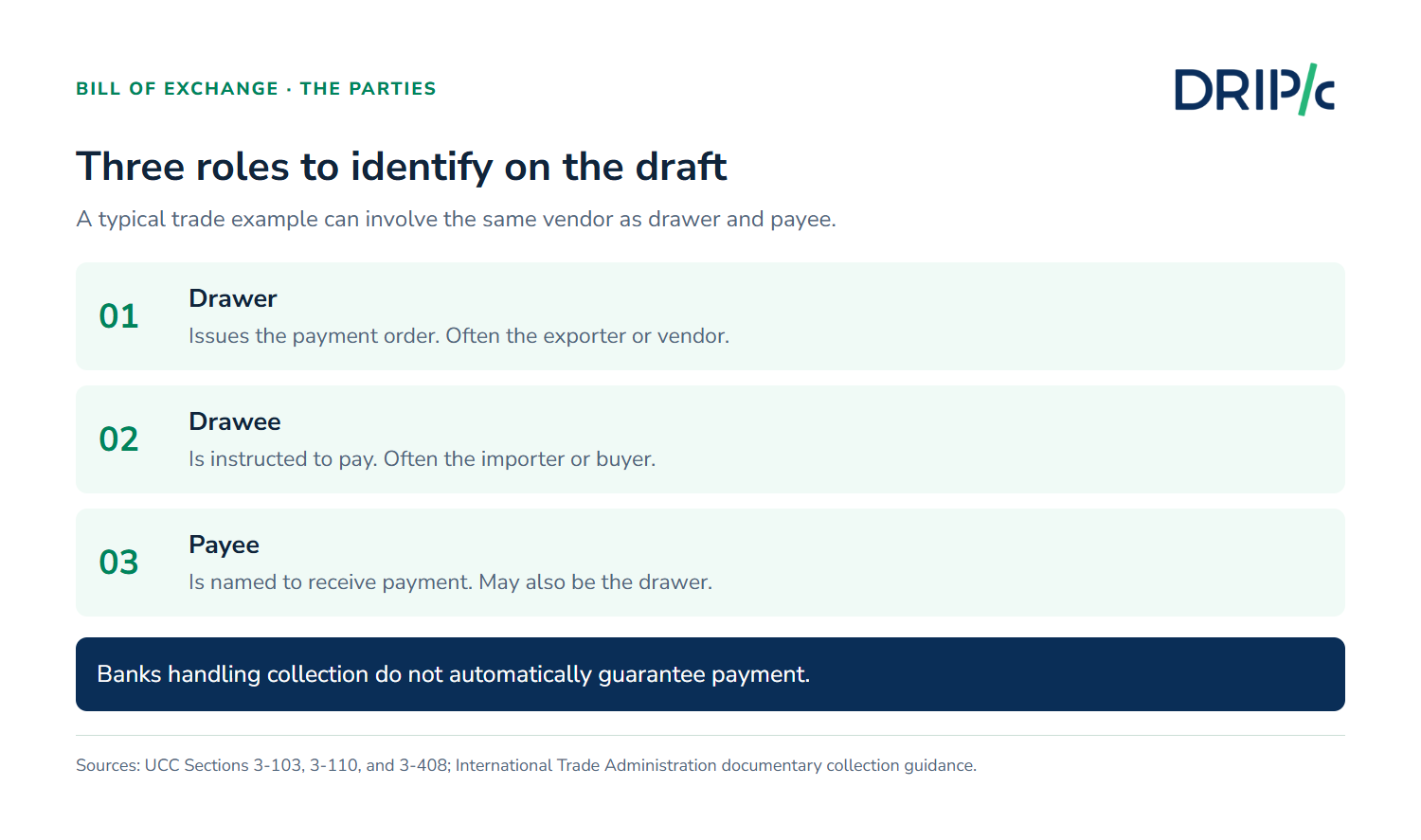
The drawer issues the payment order. In a typical export transaction, this is the vendor seeking payment for the goods. Use the correct legal entity name and confirm who has authority to sign for it.
Drawee
The drawee is the party instructed to pay, often the buyer. Being named on a draft alone does not make the drawee liable on that instrument: UCC Section 3-408 ties that liability to acceptance. Obligations under the underlying sales contract are a separate question.
Payee
The payee is the person or entity to receive payment. It may be the drawer or another named party. Check the payment destination against verified banking instructions, especially if someone requests a change shortly before maturity.
By the Numbers
Types of Bill of Exchange
Sight and Time Drafts
A sight draft calls for payment on presentation. A time draft provides a future payment point, such as a specified period after sight. Record the trigger precisely: shipment, presentation, and acceptance can occur on different days.
The Trade Finance Guide explains how sight and time drafts are used in collections. For practical purposes, the question is when your finance team must have funds available and what evidence establishes that date.
Documentary Drafts
A documentary draft travels with specified commercial or shipping documents. This description addresses the document package; sight and time address when payment is due. Confirm which documents the bank will hold and the conditions for releasing them.
When comparing Types of Bill of Exchange, keep those dimensions separate. Review the bank's collection instructions alongside the commercial invoice and transport documents. The amounts, parties, and references should tell a consistent story.
Acceptance and Document Release
Under UCC Section 3-409, acceptance means the drawee's signed agreement to pay the draft as presented. It must appear on the draft and can consist of the drawee's signature alone. Signing an acceptance therefore deserves a specific review of amount, currency, timing, and authority.

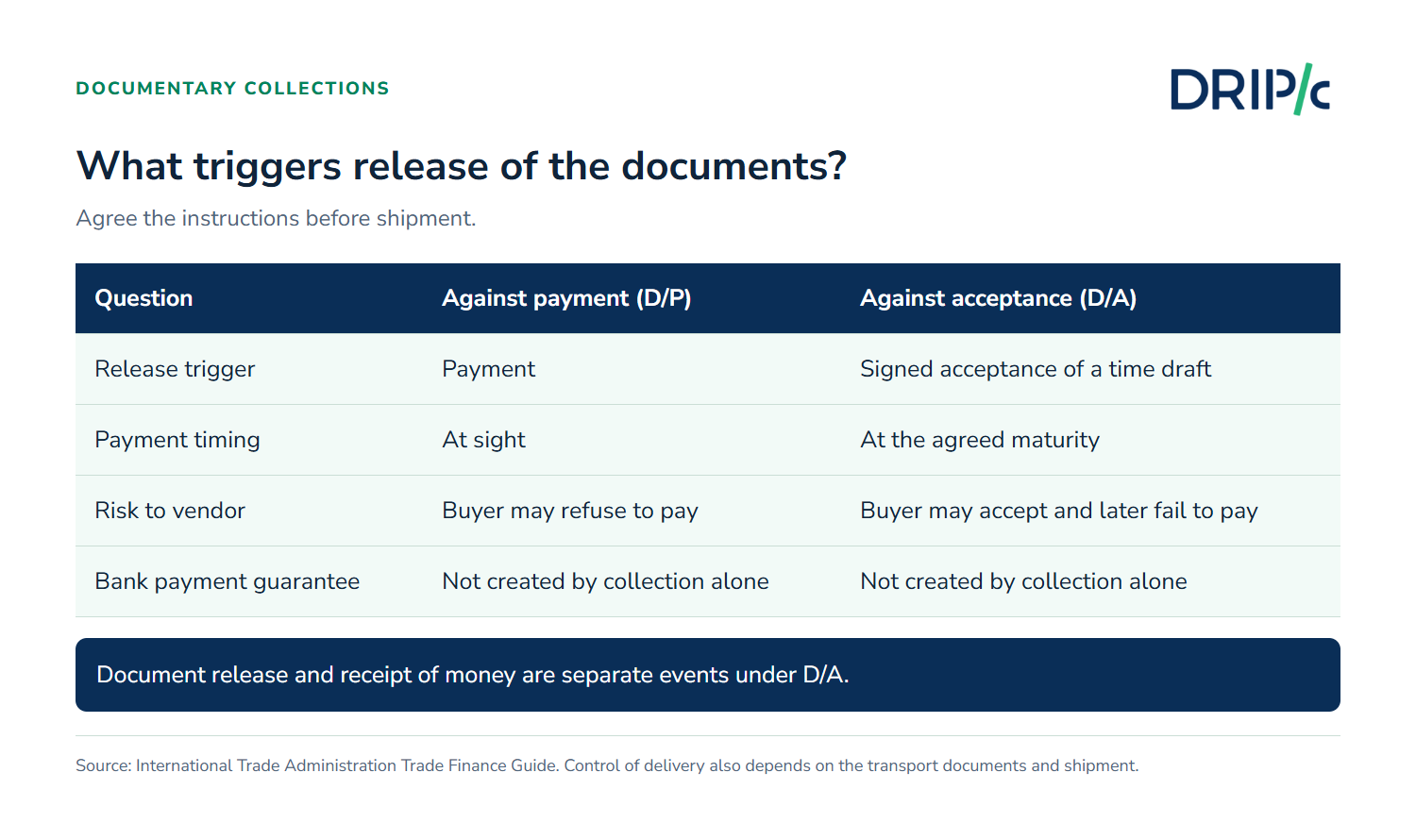
In a documents-against-payment collection, the bank releases the specified documents against payment. In a documents-against-acceptance collection, release follows acceptance of a time draft, with payment due later. Confirm the exact instructions with both banks before shipment. Our documentary collection guide covers the wider bank-to-bank process.
Acceptance does not establish that a bank has guaranteed payment. The acceptor's obligation under UCC Section 3-413 belongs to the party accepting the draft. An importer accepting its own obligation and a bank accepting a draft are different arrangements.
A Bill of Exchange Example
Agree the Commercial Terms
Consider a hypothetical exporter selling $60,000 of components to a US importer. They agree to a documentary collection with payment 60 days after sight and documents released against acceptance. Assume the importer's dated acceptance establishes the sight date for this example.
The exporter is the drawer and named payee; the importer is the drawee. The banks handle the collection under the agreed instructions. Before shipment, the parties confirm the document list, currency, charges, and procedure if acceptance is refused.
Present and Accept the Draft
The exporter submits the draft and required documents to its bank for forwarding. The importer reviews the draft and, if it agrees, signs and dates its acceptance. The collecting bank releases the specified documents according to the acceptance instructions.
This Bill of Exchange Example illustrates the payment arrangement only. Actual control over delivery depends on the transport documents and shipping arrangements. Ask the bank and freight forwarder whether the intended document controls work for that shipment.
Plan for Maturity
The importer records the $60,000 obligation and its due date, then arranges payment through the agreed channel. It should confirm how weekends, holidays, currency conversion, and bank processing affect the payment instructions.
If customer collections are expected after maturity, address the shortfall before accepting the draft. A working capital forecast helps show the cash needed alongside payroll, inventory, and other commitments.
What to Check Before You Use One
Match the Commercial Documents
Check the amount in figures and words, currency, legal names, payee, payment location, and timing. Match the transaction references to the invoice and shipping documents. Resolve inconsistencies before presentation instead of relying on the bank to infer your intention.
Ask which originals or electronic records the banks require. Agree who receives notices and who can authorize amended collection instructions. Keep a controlled record of changes so operations and finance use the same version.
Agree What Happens if Payment Fails
Discuss refusal to accept, refusal to pay, storage, insurance, and the possible return or resale of goods. Assign responsibility for charges while instructions are being resolved. Your agreement should also address the process for disputes and the applicable law.
Banks handling a collection generally act as intermediaries without undertaking the buyer's payment obligation. Where a bank payment undertaking is needed, discuss a Letter of Credit or another suitable arrangement with your bank. Each structure brings its own requirements and cost.
Separate the Instrument From Financing
A payment document can establish when money is due while leaving the business to arrange the cash. Do not assume that issuing or accepting a draft creates a credit facility. Any purchase or discounting of the instrument requires a separate agreement and eligibility review.
Our Forfaiting guide explains one related export-financing structure. Keep its financing terms separate from the original buyer-vendor payment agreement.
Where Drip Capital Fits
Drip Capital's Vendor Financing pays vendors directly, with repayment up to 90 days. Eligibility includes at least two years in business and $2M+ in annual revenue. Confirm the intended transaction and applicable terms before making a funding commitment to a vendor.
This is a separate financing discussion. It does not mean Drip Capital accepts, guarantees, or discounts a Bill of Exchange. If your transaction already uses a collection, establish how any proposed financing would coordinate with the vendor, banks, and existing payment obligations.
Frequently Asked Questions
Is a Bill of Exchange the Same as an Invoice?
An invoice records a commercial charge and its payment details. A Bill of Exchange is an order directing payment by a named party. The two documents can relate to the same sale and should be checked for consistency.
Does Acceptance Mean the Bill Has Been Paid?
Acceptance records the drawee's agreement to pay the draft. A time draft can be accepted before its payment date. Track acceptance and receipt of funds as separate events.
Does a Collecting Bank Guarantee Payment?
Handling a documentary collection does not itself create a bank payment guarantee. Identify which party has accepted the draft and what any separate bank undertaking actually covers. Ask for written confirmation if the arrangement is unclear.
Can I Use a Generic Bill of Exchange Template?
A sample can help explain the fields, but the completed instrument needs to fit the transaction and applicable law. Have your bank and legal adviser check the wording, signatures, due-date trigger, and collection instructions before use.